
Why springs give out on North End service doors
In a neighbourhood of old, tightly packed streets with hardly any private garages, the doors that depend on springs are shopfront-style roll-ups at street level and the service doorways buildings use for bins, deliveries and storage. Garage door spring repair North End MA buildings call about is usually for one of those doors, and usually because the door has gone from working one evening to refusing to lift the next morning.
Springs are a counterweight. A full curtain of steel slats, or a stack of sectional panels, is heavier than any one person could raise unaided, and the spring stores enough energy to make that weight feel light. Every trip of the door winds and unwinds it. A service door opened for every delivery and every bin collection, by every flat in the building, uses up those cycles quickly, and when the steel finally fatigues it breaks without warning.
If the door has suddenly become impossible to lift, check these from a safe distance before you touch anything:
- On a roll-up: whether the operator runs and the curtain stays put, or the hand chain will barely move the curtain.
- On a sectional door: whether a visible gap has opened in a coil on the bar above the opening.
- On either: whether a loud bang was heard from the door when nobody was using it.
Springs and the parts around them
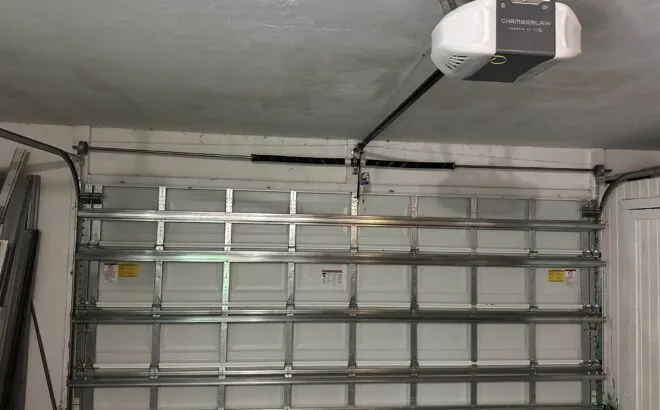
Torsion springs over a sectional door
Fixed to a bar that spans the head of the doorway, these twist as the door closes and unwind as it rises. A break leaves a clear gap between two coils.
The spring inside a roll-up barrel
A roll-up hides its torsion spring inside the barrel the curtain wraps around. You cannot see the break, but you feel it: a curtain that no longer rises, or rises only under heavy strain.
Extension springs
Some sectional doors are balanced instead by a pair of long coils pulled taut beside the overhead rails. A safety cable should run through each one to stop a broken spring flying loose.
Weak and tired springs
Before a spring snaps it often weakens. The door creeps down instead of staying put halfway, or the opener labours on the way up.
Cables, drums and bearings
Spring work on a sectional door means checking the lift cables, the drums and the end bearings at the same time, since they share the load.
Opener strain
A door with a failed spring overloads the motor. The North End opener repair page covers what happens if the opener has been run against a dead weight.
How a spring carries the weight of a door
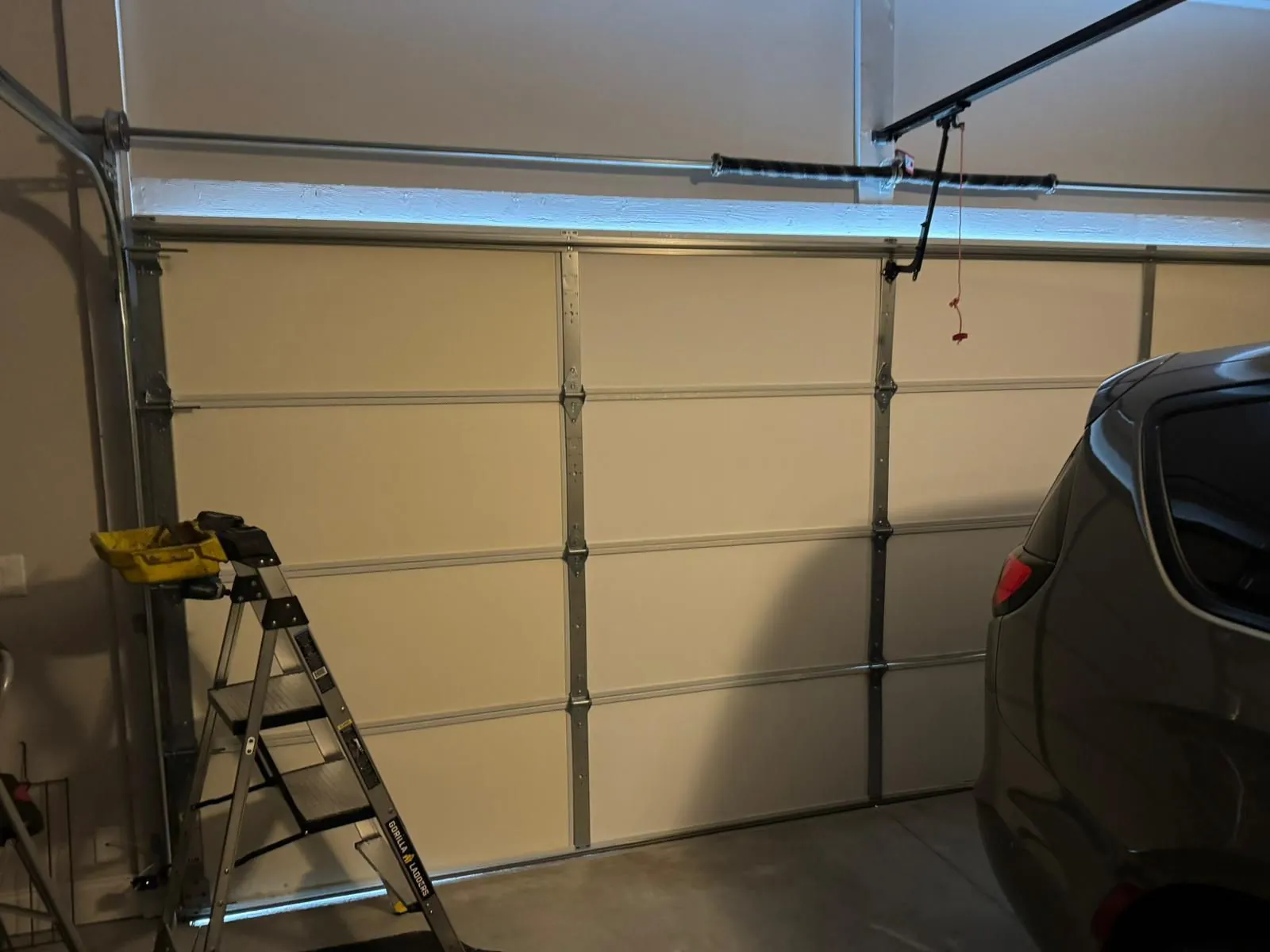
Picture the job a spring does. As a sectional door closes, its weight pulls the cables down, the cables turn the drums, and the drums wind the torsion spring tighter on its shaft. On the way up, the spring gives back the twist it took in, and that is what raises the door. With the spring set correctly, the door can be stopped halfway up and it stays there, balanced.
A roll-up works on the same idea in a different shape. The curtain wraps onto a barrel, and the spring inside the barrel is wound so that it pushes back against the weight of the curtain. As more of the curtain rolls up, less of it hangs below to be lifted, and the spring’s tension is set to match that change through the whole travel.
Extension springs do the job by stretching rather than twisting. They lie parallel to the overhead tracks and pull on cables through a set of pulleys. They are found less often on service doors, but they do turn up, especially on older or lighter sectional doors.
People often ask whether garage door spring repair North End MA buildings need is any different from spring work on a suburban garage. The parts are the same family; what changes is the door type, the amount of use and the way the doorway is reached.
Whatever the type, the spring is matched to that particular door: its weight, its height and the size of the drums or barrel. Under-sized, it leaves the door sluggish and punishing for the opener; over-sized, it throws the door upward and will not let it rest shut. Part of every garage door spring repair North End MA doors receive is choosing and setting the spring to suit the door it is going on, not just fitting the nearest one to hand.
A broken spring: what you see and hear
The commonest sign is the sound. A torsion spring breaking makes a sharp bang, loud enough that people often think something has hit the building. It can happen with the door closed and nobody near it, because the spring is under the most strain when the door is down.
After that, the signs depend on the door:
- A sectional door with a broken torsion spring shows a gap of a few inches between two coils on the shaft above the opening. The door may lift slightly and stop, or not lift at all.
- A sectional door with a broken extension spring may hang crooked, with one side lower than the other, and the broken spring may be dangling from its safety cable.
- A roll-up with a broken spring inside the barrel gives no visible clue from the outside. The operator may run and stall, trip its overload, or wind the curtain up a short way before stopping. A chain-operated roll-up suddenly takes enormous effort to move.
A weakening spring gives earlier warnings: a door that drifts down when left halfway, a door that comes down harder than it used to, or an opener that strains at the start of each lift.
Leave the spring alone: the danger in a wound coil
A torsion spring holds dangerous tension. That is true of the springs on the shaft above a sectional door and just as true of the spring inside a roll-up’s barrel. To wind or unwind one safely takes proper bars made for the job, a set order of steps and a clear understanding of where the energy will go if something slips. If the stored energy escapes in an uncontrolled way, a winding bar can be torn from a grip and swung hard enough to break bones, and a loose set screw can let a shaft or barrel turn without warning.
Extension springs carry a different hazard. Without a restraining cable threaded through the coil, a snapped one lashes out sideways into whatever or whoever is near.
So the advice is simple. Do not try to wind, unwind or adjust any spring. Do not loosen the set screws on a winding cone, the bracket at the bottom corner of a sectional door, or the tension wheel at the end of a roll-up barrel. Do not haul on the bottom of a door that is resisting in the hope of clearing the doorway. Switch off or unplug the opener, keep people back from the door, and call.
What a spring visit involves
- On the phone we ask what sort of door it is, curtain or panels, how wide and tall the opening is if you know, and what route a technician on foot would take from the nearest stopping point.
- On site the door is secured first, so it cannot drop or rise while the spring is being dealt with.
- The broken or tired spring is identified and measured, and the door’s balance and condition are checked: cables, drums, bearings, the barrel, the curtain or panels.
- Before the old spring is touched, you hear what broke and which replacement we would fit.
- Tension is released safely, the old spring is taken off, and the replacement is fitted and wound to suit the door.
- The door is balanced by hand, run through several cycles, and the opener’s force and reverse settings are checked now that the load has changed.
On a sectional door with two torsion springs, it usually makes sense to renew both together. A pair fitted together has lived through every opening together, so when one gives up its partner tends to follow before long.
Doors that open for the whole building
The heaviest users of springs in this part of the city are not private garages, because there are almost none. They are service entries that every household in a building uses, and roll-ups that go up and down with deliveries morning and evening. A spring’s life is counted in cycles, not years, so a door like that works through its spring far sooner than a garage door that opens twice a day.
That has two practical consequences. First, a spring on a busy door is worth watching. If anyone notices the door feeling heavier, hanging lower on one side, or the opener sounding strained, report it before it fails completely. Second, when a spring is replaced on a door like this, the choice of spring matters. The new spring is picked with that heavy use in mind, and we talk through what suits the door in front of us once we have seen it.
A building that relies on its service door for bins and deliveries also has an awkward time when it is out of action. Keeping a note of who to call, and where the opener’s power switch is, saves a lot of trouble on the morning a spring goes.
Getting a spring repair into a narrow, restricted street
Access along Hanover Street and Salem Street is both tight and limited to set times. That matters for spring work, because springs, winding bars, ladders and sometimes a replacement shaft or drums all have to reach the doorway. Where a van cannot stop beside the door, everything is carried the last stretch on foot.
When you book, it saves time if you can tell us:
- Which street the doorway opens onto, and any back lane or side entrance that is easier to reach.
- When vehicles can reach the street, if the building or the street has set hours.
- How much floor space there is for a ladder, out on the street and within the building.
- Whether the spring can be reached from indoors when the pavement is crowded.
Spring work needs a clear, safe space around the door while tension is being handled. On a narrow street with people passing close by, that sometimes means working from the inside with the door closed, or keeping the doorway screened while the door is moved. We plan for that before we arrive. Narrow, time-restricted access is simply part of how garage door spring repair North End MA buildings need is set up and carried out.
Cold mornings and spring breaks
Springs are steel, and steel under constant load does not like sudden cold. A spring with little life left in it tends to choose a cold morning to break, when the metal is stiffer and the door is asked to lift from a standstill. Doors that face straight onto a street, with no garage around them to take the edge off the weather, feel that more.
Nobody can change the weather, though a few habits help. Keep the moving parts lightly lubricated as recommended, so the spring is not fighting stiff bearings as well as the cold. Listen for changes: a spring that has started to squeal or a door that has begun to jerk is telling you something. And if a door struggles on a cold morning, do not keep pressing the button. Every extra try cooks the motor a little more, and a lost spring can become a lost opener too.
Choosing the right spring for an old opening
Older buildings did not come with overhead doors, and the doors fitted into them since have been made to suit openings of every size. A roll-up may have been cut down or built up to suit an odd height. A sectional service door may be heavier than its width suggests, with extra bracing or reinforcement added over the years.
That is why a replacement spring is sized to the door actually hanging there, not to a standard chart. We weigh up the door’s height and weight, the barrel or drum size and how the door is used, and set the new spring so the door balances properly through its whole travel. On a door where a previous spring was the wrong size, getting that right can change how the whole door behaves: quieter, lighter by hand and kinder to the opener.
Repair or replace
A broken spring on its own is a repair, almost always. Springs are made to be renewed, and once a new one is fitted and set, the door can carry on for a long time.
The question of replacing the door only comes up when the spring has broken on a door that is failing in other ways too: a curtain whose slats are creased or corroded along much of its height, a damaged barrel, a sectional door with rotten or creased panels, or a door so heavy from old repairs that it is hard to balance at all. When that is the case we say so, and our page on replacement doors for North End buildings walks through what a new door involves. Otherwise a fresh spring goes on, the curtain or panels hang in balance again, and the doorway returns to daily use.
Getting the spring looked at
A snapped spring tends to show itself at the worst moment, with a building’s service door shut and bins or deliveries waiting. Somebody answers our line in the small hours too, so the bang you heard at midnight can be on our list before you go back to bed. For a door that will not open at all, or one jammed partly up, see what to do in the meantime on the North End emergency repair page. For any other fault on the door, from cables to panels, North End garage door repair has the detail. The main garage door springs page explains spring work more broadly, and every service we bring to these streets is listed on the North End page.
For garage door spring repair North End MA doors need, tell us whether the door is a roll-up or sectional, what you heard and saw, and when the street can be reached. Call us or book online with those few details ready.
Questions from North End
We heard a loud bang and now the service door will not open. Is that the spring?
That points strongly to the spring. When a torsion coil fractures it lets out a crack like a gunshot, often with nobody near the door. Leave the button alone and resist the urge to heave the door up. Turn the opener’s power off and ring us.
Our door is a roll-up. Where does its spring live?
Inside the barrel above the opening, around which the curtain wraps. It cannot be seen from outside, which is why a broken roll-up spring shows up as a door that will not lift rather than as a visible gap in the coils.
Only one spring snapped. Do we really need two new ones?
Usually, yes, where a sectional door has two torsion springs side by side. The survivor has worn just as hard and seldom lasts much longer. Replacing both keeps the door balanced evenly.
Can a spring be replaced when the street outside is restricted?
Yes. Tell us about the access when you book. Parts and tools are carried in on foot where needed, and where the pavement is crowded the spring is often tackled with the door shut, working from within.
Is it safe to use the door with the hand chain if the spring is broken?
No. Without the spring the curtain is a dead weight, and forcing it with the chain can damage the drive, bend the curtain and put anyone nearby at risk. Leave it closed or as it is and call.