
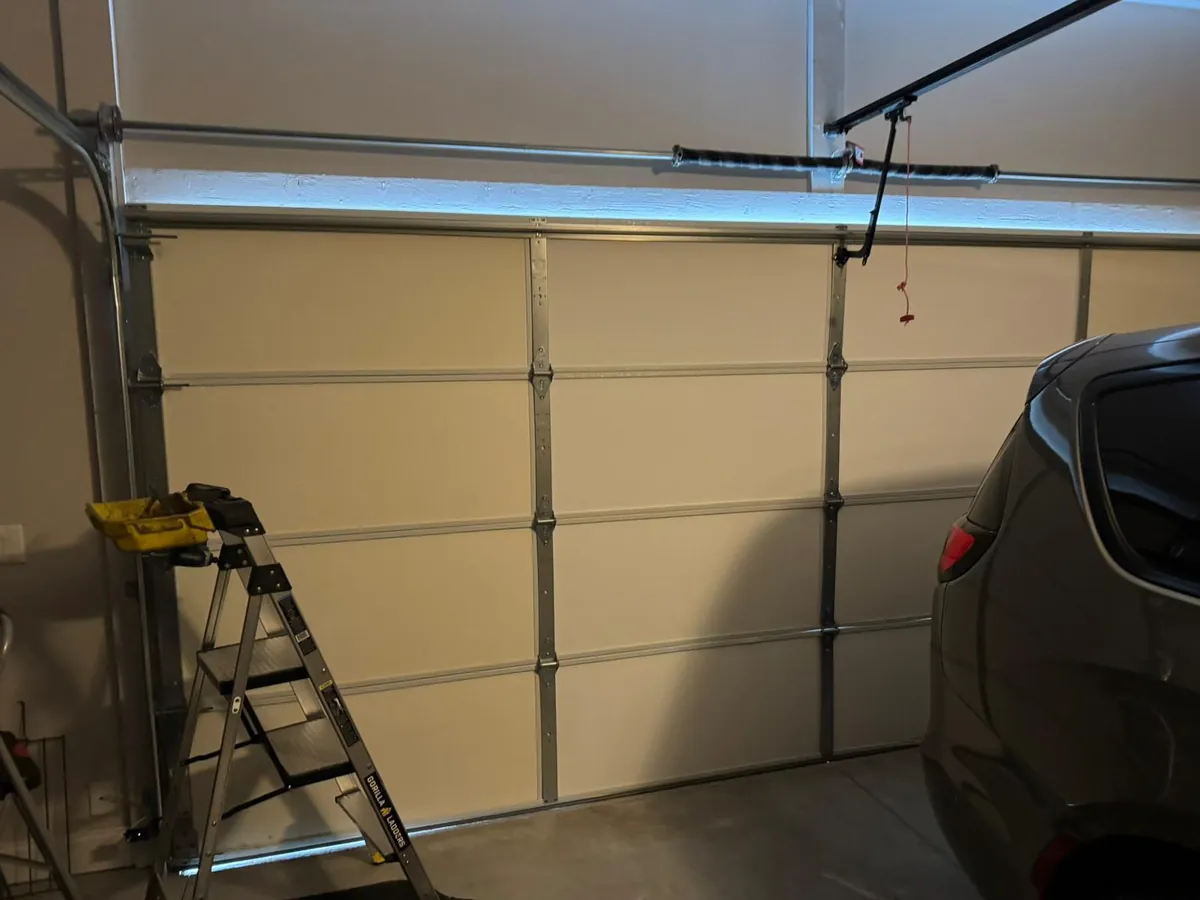
Single bays beneath Federal row houses
South of the Common lies Bay Village, a tight little grid of Federal row houses. The streets are narrow, nobody has a driveway, and a garage, where there is one at all, is a single bay tucked under the building itself. The garage doors Bay Village MA owners rely on therefore open straight off the pavement, with the house sitting on top of them and the street serving as the only approach.
That arrangement makes these some of the most hemmed-in garages we work in. There is no yard to lay a section down in, no drive to park a van on, and no side passage to bring a ladder round. Whatever the job, the parts come in off the street, carried by hand, and go back out the same way.
Three things follow from that, and they shape nearly every visit:
- The opening is set into the base of a masonry building, so headroom and side room are whatever the original builder left.
- A new door cannot arrive assembled; it comes in pieces through the street and goes together inside the bay.
- Working outside the door means working on a narrow public street, kept as short and tidy as possible.
Every service, one compact neighbourhood
Each service we offer has its own page for this neighbourhood. Doors that stick, drag, sag or clatter are covered by garage door repair in Bay Village. When a coil snaps and the door becomes a deadweight, see spring repair for Bay Village. Motor heads, remotes, keypads, push buttons and photo eyes fall under Bay Village opener repair and replacement. A bay stuck open after dark, onto a street of row houses, is what our urgent Bay Village service is there for. And when the door is finished, we supply and install new garage doors in Bay Village, brought in piece by piece.
The streets of Back Bay and Beacon Hill nearby have their own row-house garages with related quirks, and every other place we work appears on our service areas page.
A bay with a house on top of it
Most garage doors Bay Village MA streets hide are hung inside an opening cut into the ground storey of a brick house. A building like that gives a door a very solid frame: brick reveals do not rack or twist the way wood studs do. It also gives very little else. The floor of the room above forms the ceiling of the garage, so headroom is set by the joists, and the brick reveals leave just enough width for the tracks beside the opening.
That compression affects three parts more than any others. The torsion shaft, where there is one, has to squeeze into the slim gap left under the joists, above the top section. The horizontal tracks may run close enough to the ceiling that the top section only just clears. And the opener rail, if the door has an opener, competes for the same narrow strip. When any of those parts is replaced, the new one has to fit the room that is actually there, which is rarely the textbook amount.
Fixings are the other concern. Tracks and brackets are anchored into brick and mortar. Where an anchor has been driven into soft mortar instead of solid brick, every run of the door works it a little looser, until the track starts to wander and the door scrapes. Re-anchoring into sound masonry is often part of a repair here.
No driveway, no staging area
The phrase that best describes a job in this neighbourhood is “everything by hand”. With no driveway and no space beside the house, tools, ladders and parts are unloaded at the kerb and carried straight into the bay. On a repair visit that is no great obstacle: everything a repair calls for, from a coil to a roller, fits into a toolbag and a parts case.
A new door is a different matter. A garage door is normally delivered as a set of long sections, plus tracks, a shaft and springs. Here there is nowhere outside to lay any of that down, so the sections come in one at a time, straight into the garage, and the door is assembled where it will hang. The old door leaves the same way, section by section, before the first new piece comes in.
It helps a great deal if the bay can be cleared before an installation day: cars out, storage moved back from the opening, and the floor just inside the door kept open so sections can stand against a wall while the tracks go up.
Working on a narrow street
Because the door opens straight onto the street, anything done from the outside happens in public space. Fitting a bottom seal, checking the outside face of the bottom section, or sighting the door against the threshold all need a little room on the pavement. We keep that time short, keep the pavement passable, and do as much as possible from inside the bay with the door raised and secured.
For an owner, the useful thing is to tell us at booking whether there is anything unusual about the frontage: a step, a planter or a railing beside the opening, or a particularly tight corner. A two-minute description on the phone saves a lot of shuffling on the day.
Springs, and why they are not a weekend project
Of all the reasons a bay door here quits lifting overnight, a snapped spring leads by a distance. You may hear a sharp bang from the garage, or simply find the motor raising the bottom edge a hand’s breadth before giving up. Once that coil has parted, every pound of the door bears on the opener’s drive and on any arm that tries to help.
On a torsion door, the spring sits on the shaft above the opening and holds dangerous tension; that is not a DIY repair. Winding or unwinding it means working with steel bars in a loaded mechanism, and in a low bay under a row house there is barely room to stand clear if something slips. Older doors in tight spaces sometimes use extension springs along the tracks instead, and a broken one of those can lash out sideways unless a cable runs through it to hold it.
When we replace a spring, it is sized to the door that actually hangs there, not to a label. Doors in these bays have often been altered or reskinned over the years, and their real weight can differ from what the original hardware was chosen for. The how garage door springs work article explains the balance in more detail.
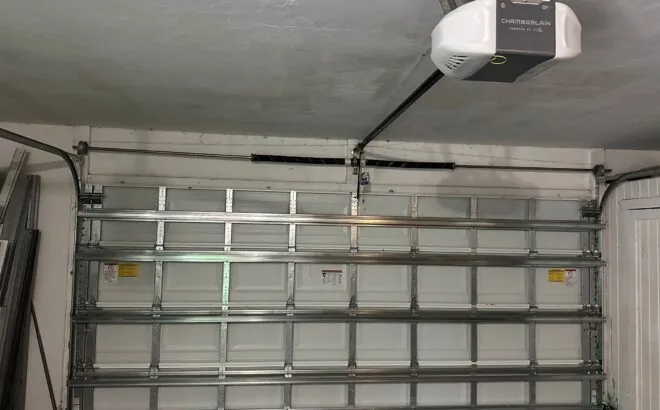
Openers squeezed under a floor
Openers hung under a row house occupy a remarkably shallow slot. The motor head hangs from the joists, often within a hand’s width of a car roof, and the rail runs along the same narrow strip as the tracks. A door that is balanced makes light work for an opener even in that space. A door that drags, or has lost spring tension, makes it strain on every trip, and the strain shows as a motor that slows, stalls or reverses.
Most opener problems here come down to a handful of causes. A sensor nudged sideways by a bike pedal or a crate. A remote with a tired battery. A wall button with a pinched wire. A drive worn out by years of pushing a heavy door. Each has a different fix, and some are quick. LiftMaster openers are included in the units we repair or replace. For more on opener faults, see the opener services page and the article on safety sensors.
Noise matters too. With bedrooms or living rooms directly above, a rattling chain or a grinding roller is heard upstairs. Lubrication, tightened hangers and new rollers often quieten an old door considerably.
A bay that refuses to shut after dark
A bay that will not shut is the call that matters most in a street of row houses: the garage, and sometimes an inner door into the house, is left open to the pavement. A real person picks up our phone at midnight as readily as at noon, so ring the minute the door misbehaves.
No arrival time is promised, since it depends on the hour and the night’s calls. On the phone, though, we can help narrow down the cause. A blocked or dirty photo eye makes the door reverse. A remote with a dead battery does nothing while the wall button still works. A door that has jumped a roller hangs crooked and should not be run at all. Knowing which of those you are dealing with tells you what to do while you wait.
What to check, and what to leave
Things that are safe to try:
- Wipe both photo eye lenses with a dry cloth and move anything that might be breaking the beam.
- Use the wall button instead of the remote, to rule out the remote’s battery.
- If the door keeps straining or reversing, unplug the motor head where its lead meets the ceiling outlet.
Things to leave strictly alone: the coiled springs, both lift cables, and the bottom brackets those cables hook into. All three are under heavy load. Do not try to raise a door with a broken spring, and do not try to push a crooked door back into its tracks. The cable replacement guide explains why cable work belongs with a technician.
Off-track doors in a tight bay
Rollers can leave their rails when a bumper or a bin catches the lowest panel, or when the motor carries on shoving against a door that is already wedged. In a narrow bay with a brick reveal on each side, a derailed door can wedge itself against the masonry and look worse than it is, or better than it is. Either way, it can fall.
The repair starts by securing the door so the rollers carry no weight. Each roller is then fed back into its track, any bent length of track is straightened or replaced, and both lift cables are checked for even tension on their drums. Because the track brackets are anchored into brick, we also check every anchor, since a jolt that throws a door off its track can loosen a fixing too. The off-track repair page covers the process in more depth.
Snow against a street-front door
A bay that opens straight onto the pavement collects whatever winter leaves at the kerb. Snow cleared from the street ends up banked against the bottom section, slush freezes the bottom seal to the threshold, and grit gets pushed into the gap under the door. When the opener is asked to lift a door that is frozen down, it strains, the seal tears, and sometimes the bottom section bends where the lift cables pull against it.
The safer routine is to clear the snow from the face of the door before running it, and to ease an iced-up seal off the stone by hand, warm water and patience, instead of letting the motor tear it. If the door will not move after that, stop and call. For garage doors Bay Village MA streets bank with snow every winter, a torn seal or a bent bottom section is the usual cost of forcing it. Our article on winter garage door problems covers the cold-weather faults in more detail.
Auto-reverse on a door that closes onto the pavement
With no driveway in front, a bay door here comes down a step away from the public pavement. That makes the safety reversing system more than a formality. Those paired photo eyes, mounted low on each brick reveal, should send the door back up the moment anything crosses the beam, and the opener’s force setting should make the door reverse if it meets an obstruction the eyes miss.
Every repair visit ends with that tested: a block laid in the opening, the door run down onto it, and the reverse confirmed. Should the eyes have drifted, or should the force has been turned up over the years to push a sticky door closed, both are corrected. For garage doors Bay Village MA owners close onto a street with people walking past, that check matters as much as any part we replace.
Panels, seals and the street face
The outside of a garage door in this neighbourhood is part of the street. A dented bottom section or a split panel shows on the front of the house. Where a matching section can be found, a damaged one can usually be replaced on its own, without replacing the whole door.
The bottom seal deserves attention on any bay that opens onto a street. Where the pavement or threshold is uneven, the seal wears unevenly and eventually lets water, leaves and cold air in underneath. Replacing it is a small job that protects both the garage and the bottom of the door. Side and top weatherstrip can be renewed at the same time.
Repair it, or replace it
Given what a new door involves here, with every piece carried in and assembled inside, repair is usually the first choice. The moving hardware is consumable by nature; renew it on a door with healthy panels and that door carries on for a long while.
Replacement becomes the better option when the sections themselves have failed: rust through the bottom of a steel door, rot or splits in a wooden one, or a door so altered that it can no longer be balanced. In those cases we supply and fit a door built for this exact opening, with the tracks, springs and opener arranged for the headroom under the floor above. The replacement guide lists the signs worth watching for.
Choosing a new door for a row-house front
A replacement for one of the garage doors Bay Village MA row houses carry is chosen with the building in mind as much as the mechanism. The door is seen from the street as part of the house front, it sits under living space, and it has to fit an opening that may not be perfectly square. That points toward a door made to measure for the opening, with a finish that suits the brick around it, and with insulation worth considering for the sake of the room above. Glass sections are an option too, and our full view glass doors page shows that style.
Book a visit
Tell us which street the bay is on, whether anything sits beside the opening, and what the door is doing. With that, the visit can be planned before anyone arrives. After that, just call us or book online.
Questions from Bay Village
With no driveway, how does the work get done?
From the street and from inside the bay. Everything comes through the bay by hand, and wherever possible the work happens indoors with the door raised and secured, so the pavement stays passable.
Can a new door really be installed in a bay this small?
Yes. The door comes in sections, one at a time, and is assembled inside the bay. The old door is taken out the same way first. Clearing the garage beforehand makes the day much easier.
The opener is noisy and we can hear it upstairs. Can that be fixed?
Often, yes. Worn rollers, dry hinges and loose hangers are common causes and can be dealt with on a repair visit. If the opener itself is worn out, replacing it is the other option.
Our door hits the ceiling on the way up. Why?
Under a floor this low, the horizontal rails may hug the joists, or one anchor in the brick has worked loose and lets that side of the door rise. Both can be corrected so the door clears the ceiling again.
The bay is wide open late in the evening. What now?
Unplug the opener, keep away from the springs and cables, and call. Somebody picks up whatever the time, and together we can work out how to secure the bay until the door is repaired.