
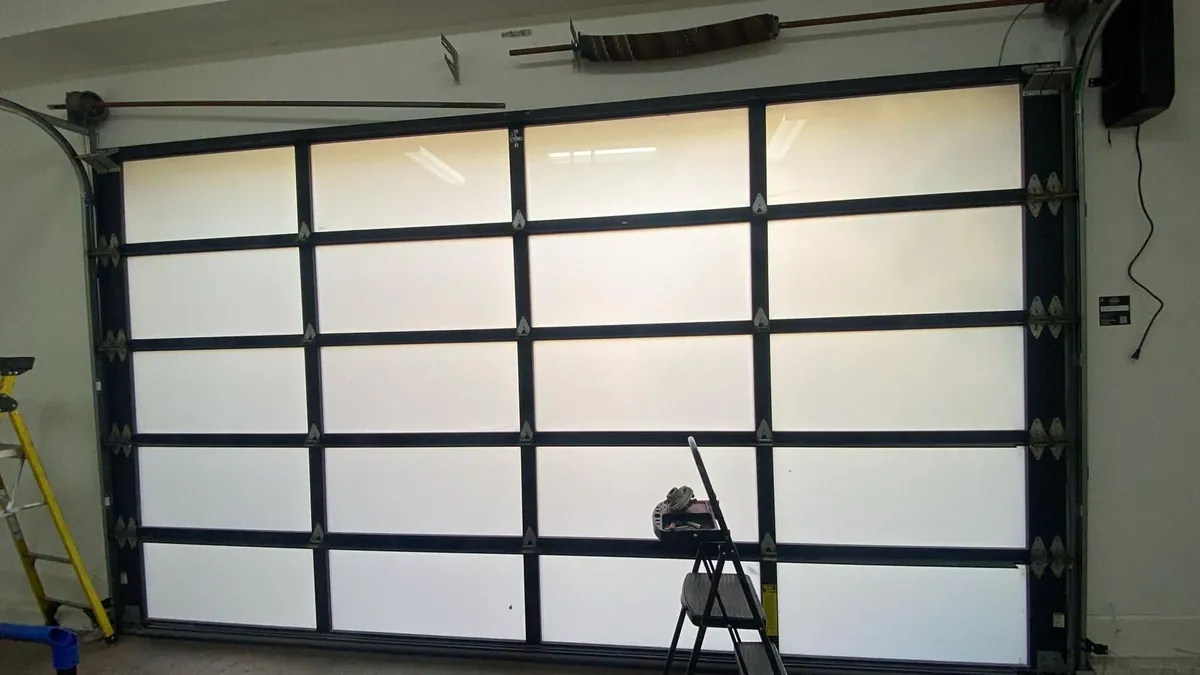
Back-lot garages behind the Victorians and colonials of Melrose Highlands
Around Melrose Highlands the houses stand close together, Victorians and colonials with only a strip of driveway between one and the next, and at the end of that strip, set well back from the porch, waits a garage of its own. Most of the calls we get about garage doors Melrose MA homeowners rely on come from those back-lot buildings: a single bay, a door facing down a long, slim drive, and a structure that has stood on its own through a great many New England winters.
A freestanding Melrose garage lives a different life from one built into a house. No heat leaks in from a kitchen, so cold reaches the springs, the rollers and the weatherstrip sooner. Power usually reaches it along one lonely circuit, which matters when an opener starts acting up. And because it sits beyond a drive squeezed between two Victorians, any fault with the door tends to leave a car boxed in with almost nowhere to turn.
Before you pick up the phone, stand back from the door and note three things:
- Whether the coil above the header, or the long springs stretched beside each track, show a clean gap somewhere along their length.
- Whether the bottom edge sits level, or one corner has sagged with a slack cable dangling beside it.
- Whether every roller still rides inside its rail all the way up, or one has popped loose.
Garage door services in Melrose
Everyday repairs
Dragging panels, split hinges, brackets working loose from old framing, rollers worn flat and weatherstrip gone stiff in the cold. Our garage door repair page lists everything a general visit can take in.
Torsion and extension springs
Of every urgent call from a Melrose back lot, a snapped spring tops the list. Torsion springs carry dangerous tension and are never a job for a homeowner. Spring work is explained on our spring repair page.
Openers, remotes and keypads
A motor in a detached bay can lose power, lose its remotes or lose sight of its photo eyes. Repairs and replacements, LiftMaster units included, are on the opener services page.
Night and weekend calls
A door jammed open after dark leaves the back of the lot exposed and out of view from the house. Someone picks up whatever the hour; the emergency repair page explains how those calls work.
Lift cables and drums
Once a lift cable unravels or parts, its side of the door slumps and the sections twist in the opening. Both cables are renewed together. See cable repair.
Doors out of their rails
A door shoved out of its tracks, often by a bumper in a tight drive, has to be lowered and realigned with care. The off-track repair page has more.
Replacement doors
When the old door is beyond saving, we supply a new one and fit it to the opening the garage really has. Choices are laid out under new garage door installation.
Why a detached garage wears its door differently
When we talk about garage doors in Melrose, we are mostly talking about doors that live in unheated, freestanding buildings, and that changes how the parts age. A garage built into a house borrows a little warmth through the shared wall and stays a few degrees above the yard on a January night. The Highlands back-lot garage gets no such help. Its springs go through the full swing of the seasons, its rollers sit in tracks that can collect frost, and the rubber strip on the door’s lowest edge can bond to the slab with ice after a wet afternoon turns into a hard night.
Cold does not break a healthy spring on its own, but it finds the weak one. A coil that has done many years of opening and closing has lost some of its strength, and the first deep freeze of the season is often when it finally gives up. The same goes for a lift cable whose strands have begun unravelling near the bottom bracket, or a roller whose bearing has already run dry. If your door was sluggish or noisy through the autumn, the first proper cold snap is when that warning tends to turn into a phone call.
A freestanding garage also tends to be built more simply than the Victorian in front of it. Plenty were framed with lighter timber, sit on a slab that has shifted over the decades, and carry a header sized for an older, lighter door. None of that stops a modern door from working well, but it means we look at the opening as well as the door before deciding what needs doing.
The long, narrow driveway
The approach shapes almost every visit. On a lot where the houses sit shoulder to shoulder, the driveway between them is often only just wide enough for a car, with a fence or a side porch hemming in one edge and the neighbour’s clapboard on the other. The garage waits at the end, sometimes after a short dog-leg at the last moment.
That has a few practical effects. A car backing out of a single bay down a long, slim drive is the classic way to clip a track or the lowest panel, and a clipped track is where most derailed doors on these lots begin. A drive with no turning space also means a stuck door can hold a car prisoner for as long as the fault lasts, so a door jammed shut before work on a weekday is a real problem rather than a nuisance.
It also means our parts and tools travel up the drive on foot. Springs, a length of track, a replacement section or a new opener all get carried from the kerb to the back of the lot. If the drive is shared, or if cars from the house usually park along it, it helps to clear a path before the visit and mention it when you book. If a gate closes off the rear of the lot, say so, and say how it opens.
Springs in a back-lot garage
Most doors are lifted by one of two spring systems. A torsion spring is a heavy coil threaded onto a steel bar above the header; it winds up as the door closes and unwinds to lift it. Extension springs stretch out along each horizontal track, lengthening as the door lowers. Older detached garages in Melrose turn up with both kinds, and some doors have clearly been switched from one system to the other at some point in their life.
Whichever kind yours has, the spring carries the load. The opener merely steers it. Once a spring snaps, the full dead weight of the sections lands on whatever tries to move them, and an opener asked to lift that weight will strain, stall after a few inches or strip its gear.
Torsion springs on these back-lot doors hold dangerous tension, broken or not, and adjusting or replacing one is never a DIY repair. The winding bars, the set screws and the cones at each end are where people get hurt. Extension springs need respect too: if one parts with no restraining cable threaded through its middle, the loose end can lash across the bay. Spot a snapped coil and the door stays exactly as it sits, nobody parks or stands beneath it, and the next move is a call to us. Leave the red release cord alone while a door on a broken spring is up, because the door can come crashing down.
Openers at the end of a single run of wire
An opener in a freestanding garage has a few troubles that an opener inside the house rarely meets. Power usually arrives on one circuit, so a tripped breaker, a worn outlet or a loose connection can make the motor dead one day and fine the next. Remotes have to reach further, often from a car idling in the drive with a house pressing in on either side, and a weak signal shows up as a remote that only answers a few steps from the panels.
The paired photo eyes mounted low on either jamb are easy to knock out of line in a slim bay crowded with bikes, bins and rakes. When they lose sight of each other, the door creeps down a little and then reverses, or refuses to budge from the remote at all. Re-aiming them is usually simple; a cracked sensor or a nicked wire takes a little longer to trace.
When an opener is beyond rescue, the replacement is sized for the door, and LiftMaster models are among the openers this shop repairs and replaces in Melrose. A detached garage with no side door also needs a reliable way in when the power drops, so we check that the manual release works and walk you through using it safely.
Cables, drums and doors that come off the track
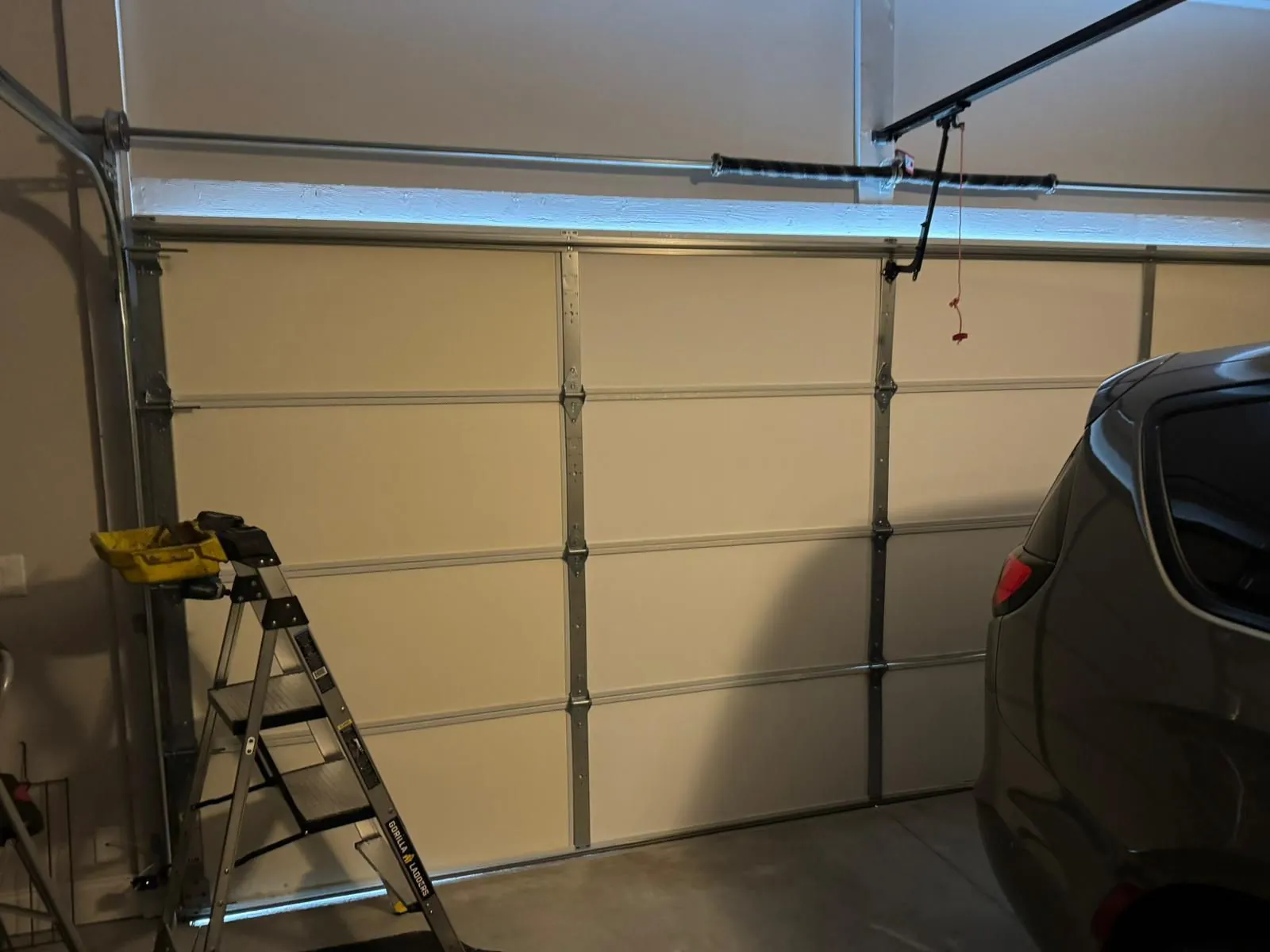
Lift cables climb from brackets at the door’s lower corners to grooved drums riding the spring bar; on an extension-spring door they loop over pulleys instead. When one unravels or parts, that side stops being held, the door tilts, and the rollers on the low side can be dragged clean out of the rail. A door hanging crooked in its frame is a signal to stop using it at once: running the opener against it bends sections and tracks that would otherwise have come through unharmed.
On a lot with a long, slim approach, derailed doors more often start with a knock than with wear. A bumper nudges the lowest panel as it closes, or a mower handle catches a track, and the rail is pushed just far enough out of line that a roller climbs out on the next cycle. Putting it right means unloading the door’s weight under control, straightening or replacing the bent track, refitting the rollers and checking the cables and springs, since a door that has jumped its rails usually strains all three on the way out.
Emergency calls from the back of the lot
A door that fails at night is harder to live with when the garage is out of sight of the house. When the door will not lower after nightfall, the bay sits gaping at the far end of a dark drive with tools, bikes and a car inside. A door stuck shut may be holding the only car you have. Whether it is midnight or Sunday dawn, someone answers, so you can describe what you are looking at the moment it happens.
What we ask on an urgent call is straightforward: what the door is doing, whether you heard a bang, whether a spring or cable is visibly broken, and where the door has come to rest. If it is partly open on a broken spring or cable, everyone stays well back and nobody tries to force it down. If it is shut with a car behind it, resist the urge to heave it up yourself; a door with no working spring is very heavy and can slam down without warning.
Repair or replace
Most problems with garage doors Melrose MA households call us about are repairs: one tired spring, a frayed cable, a worn roller set, a misaligned sensor or a balky opener. Swapping a single part is worth doing when the rest of the door is sound, the sections run straight and the timber around the opening is solid.
Replacement starts to make sense when the faults pile up. Panels that have cracked or rotted along the lowest edge, sections bent more than once, a door that no longer seals against the slab even after adjustment, or a door far heavier than the springs it now carries are all reasons to think about a new one. Older wooden doors in freestanding garages often reach that point after years of soaking up winter damp along the bottom.
A new door for a back-lot garage is measured to the opening as it stands today, not as the original plans say it should be. We check width and height, the clearance between the header and the rafters, the space beside each jamb for the vertical track, and whether the timber framing is still sound. If the frame needs attention before a new door goes in, you hear about it before the work begins, not halfway through it.
What a visit involves
- Ring us or book online, describe what the door is up to, and mention how the garage is reached and whether a gate or a parked car sits in the way.
- At the garage, we look over the springs, cables, tracks, rollers, opener and sensors before touching anything, and we test how the door balances.
- We explain what we found and what we recommend, repair or replacement, and nothing starts until you say yes.
- Before we pack up, the door goes up and down a number of times, the sensors are tested, and we show you where the manual release is and how to use it.
Looking after the door between visits
Because so many garage doors in Melrose MA live in unheated buildings, a few habits go a long way. Once a month, watch the door through a full cycle. It should travel smoothly and quietly, without jerking or pausing. Listen for scraping from the rollers and glance at the cables near the lower corners for broken strands. Keep the threshold clear of ice and leaves so the weatherstrip can close fully, and keep the photo eyes free of cobwebs and garden tools.
Should the door begin to drag, lean or make a sound it never made before, do not wait for it to quit on a frosty morning. A spring close to its last cycle, a cable beginning to fray or a roller that has seized is far easier to deal with before it lets go.
You can find the rest of the towns we serve on our service areas page. If your garage is just over the line, our Malden and Stoneham pages cover the neighbouring towns.
When you are ready
Whether it is a snapped spring at the back of the lot, an opener that has stopped answering its remote, or a tired door ready for replacement, we can help with garage doors in Melrose MA whenever the trouble starts. Call us or book online.
Questions from Melrose
Our garage is at the far end of a long, shared driveway. Is that a problem for a visit?
Not at all, but it helps to know in advance. Tell us when you book if the drive is shared, if cars usually park along it, or if a gate shuts off the back of the lot. Everything we bring is walked up from the street, so a clear route makes the visit smoother.
The garage has no power except one outlet. Can it still run an opener?
In most cases, yes. An opener needs a dependable outlet near the ceiling of the bay. If the circuit feeding the garage is unreliable, the opener may stop and start without any fault of its own, and we will tell you if that is what we find.
Should I try lifting the door myself after a spring snaps?
Please do not. With no working spring the door is very heavy and can drop at any moment. Leave it in place, keep the bay empty of people and cars, and ring us. That Highlands torsion spring still holds dangerous tension; winding or swapping it is not a DIY repair.
Our wooden door is soft along the bottom. Can that section be replaced?
Sometimes a single section can be swapped, when a matching panel still exists and the other sections are solid. If the rot has crept up the door or the sections no longer line up, a new door usually makes more sense. Once we have seen it, you will know which applies.
Do you work on older detached garages with extension springs?
Yes. Plenty of older doors around the Highlands still hang on extension springs beside the tracks. We repair and replace them, thread restraining cables through them where they are missing, and can talk through converting to a torsion system if the opening allows it.