
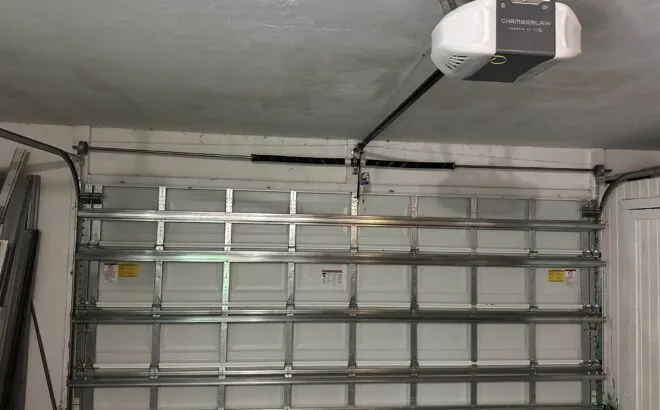
Roll-up doors on the side streets off Washington
A private garage beside a house is almost unheard of here. The buildings are dense and mixed-use, with a shop, a restaurant kitchen or a storeroom at street level and apartments stacked above, and the doors that matter are the steel roll-ups that close those ground floors off from the pavement. Most garage doors Chinatown MA buildings rely on are of this kind, set into the brick on the narrow side streets running off Washington Street.
A roll-up door lives a hard life in that setting. It may go up first thing for a delivery, come down again, rise for a second drop later, and be shut tight overnight. Trucks stand alongside it with their engines running, handcarts bump its bottom bar, and grease, steam and grit from the street all end up in its guides.
Three things to note before you call:
- Whether the curtain rises evenly or climbs higher at one end.
- Whether the motor runs but the curtain stays still.
- Whether the bottom bar is bent where it meets the pavement.
Loading access, not a driveway
Elsewhere in the city a garage door problem usually means a car stuck in a garage. Here it means a shop that cannot open, stock that cannot come in, or a ground floor that cannot be locked at night. There is no driveway to work from. The door opens straight onto a pavement that may be busy with people, onto a side street just wide enough for a van, and often onto a stretch of kerb where vehicles stop only briefly to unload.
That changes how work on garage doors Chinatown MA owners call about has to be organised. A repair is planned around when the door can be closed off and when the pavement in front of it can be used, not around when somebody happens to be home. If deliveries arrive at a set time, the job needs to finish before the next one or start after the last. If the building’s ground floor is a kitchen, the door may need to be workable before service begins.
When you call, tell us when the door is needed open, when deliveries usually arrive, and whether there is a rear or side way into the space. Those details shape the visit more than anything about the door itself.
How a commercial roll-up actually works
A roll-up door is simpler to look at than a sectional door, but the parts inside it carry a great deal of force. The curtain is made of interlocking steel slats. It winds around a barrel mounted in a hood above the opening, and inside that barrel sits a torsion spring that is wound up as the curtain comes down. That stored tension is what lets a heavy steel curtain be lifted by a motor, a chain hoist or, on lighter doors, by hand.
The slat ends ride up and down in a pair of channel guides bolted to the brick either side of the opening. Along the lowest edge, a heavier bottom bar keeps the curtain from flapping and holds the rubber astragal that seals against the pavement. A motor operator, where one is fitted, drives the barrel through a chain or gear, with a pair of limit settings marking the fully open and fully shut positions.
Nearly every fault we find on these doors traces back to one of the following: a spring inside the barrel that has broken or lost tension, a slat that has cracked or pulled out of its neighbour, a guide knocked out of line, a bottom bar bent by a cart or a bumper, or an operator that no longer reads its limits correctly.
Garage door repair for street-level roll-ups
Repair calls in this neighbourhood tend to follow the rhythm of a working street. A curtain that has started to rack, rising faster at one end than the other, usually has a slat end that has slipped or a guide that is no longer straight. Left alone, the racking gets worse until the curtain jams in the guides, and the operator either stalls or pushes hard enough to damage something else.
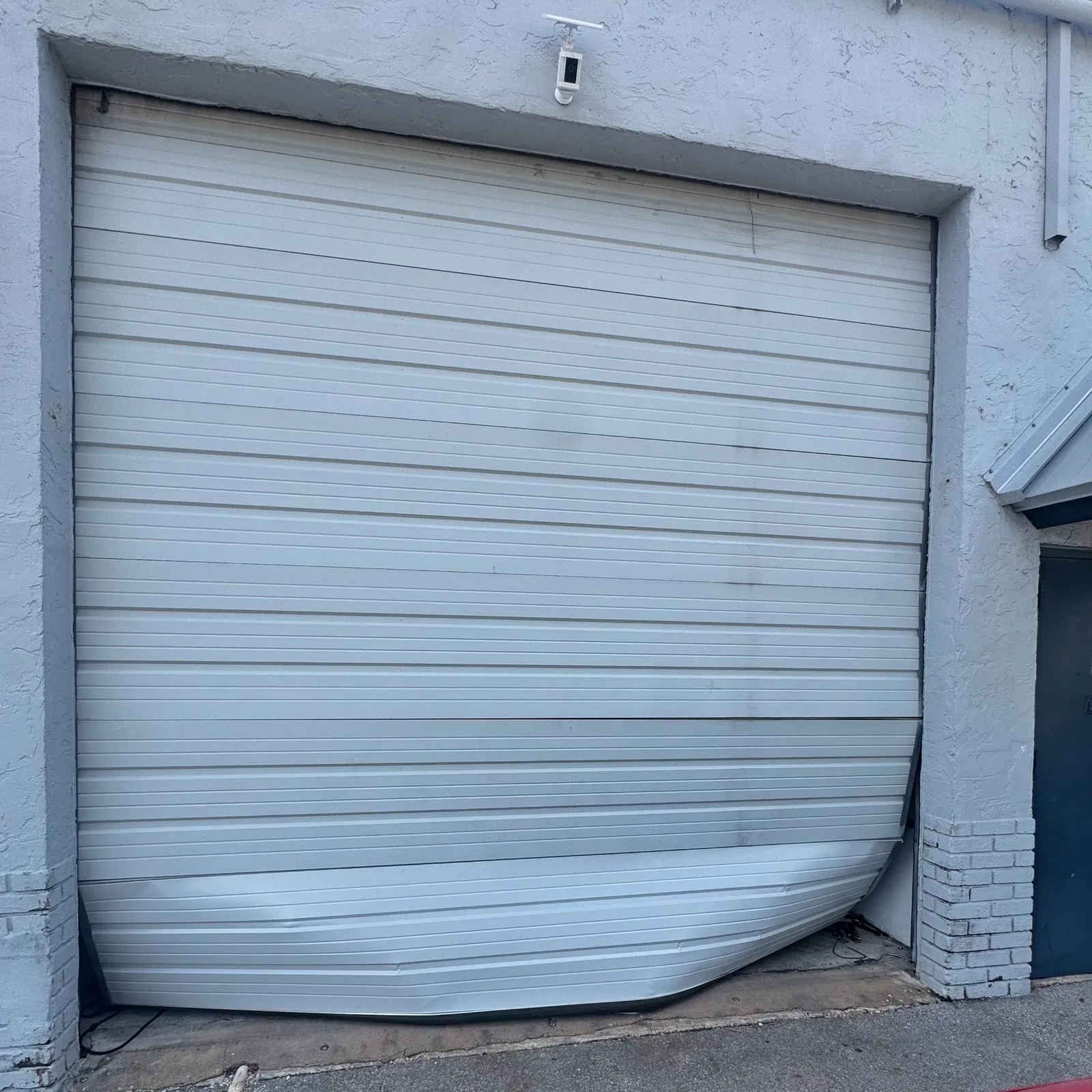
Damaged slats are common on any garage doors in Chinatown that face loading activity. A handcart or a pallet edge catches a slat low down, or a vehicle reversing to the kerb touches the bottom bar. Single slats can often be replaced without changing the whole curtain, provided the profile matches. A bent bottom bar is worth dealing with promptly, because a door that cannot close flat leaves a gap that lets in water, rubbish and cold air, and a ground floor that cannot be secured properly.
Guides take punishment too. Grease and dust from a kitchen, grit thrown up from the street and, in winter, salt and slush all build up in the channels. A dirty or dented guide makes the curtain drag, and that drag reads to the operator as extra weight. There is more on each of these faults on the Chinatown repair page. For shop owners weighing up curtains, operators and loading doors in general, the commercial garage doors page is the place to start.
Springs inside the barrel
On a roll-up door, the spring is hidden inside the barrel above the opening, which means it is easy to forget until it fails. When it breaks or loses its tension, the curtain suddenly feels much heavier. A manual door that used to rise with a steady pull now barely moves; a motorised door makes its operator labour and stop. Sometimes the curtain will still go up but will not stay up and creeps back down.
The spring in a roll-up barrel holds a large amount of stored energy whether the curtain is open or closed. Adjusting it means working with the tension wheel or the barrel end while the curtain’s weight is controlled, and getting that sequence wrong can spin the barrel or release a fitting with dangerous force. Like the torsion springs on residential sectional doors, it is not a DIY repair. If the door has suddenly become heavy, switch the operator off, let the curtain stay exactly where it stopped, and phone us. The Chinatown spring repair page explains spring work in more detail.
Openers and operators
Many roll-up doors here are motorised, with an operator mounted beside the hood or above the opening, a wall control inside the space and sometimes a key switch or remote outside. Some have a chain hoist as well, so the curtain can be raised by hand if the power is off.
Operator problems usually show up as a door that stops short of the top or bottom, reverses unexpectedly, hums without moving, or does nothing at all. Limit settings drift over time, especially after a curtain has been repaired or a spring adjusted. Safety edges and photo eyes, where fitted, can be damaged by the same carts and deliveries that dent the slats. A remote or key switch exposed to the street weathers faster than one indoors.
Where an operator is beyond repair, a replacement is chosen to suit the curtain’s weight and the way the door is used. Where a building has a smaller residential-style door instead, we also repair and replace LiftMaster openers. More is on the Chinatown opener repair page.
When the door will not open, or will not close
A street-level door that fails at the wrong moment leaves a business either locked out or unable to lock up. A curtain jammed halfway at closing time is a real problem: the space cannot be secured, and running the operator again and again may make the jam worse.
Someone answers our line at any hour, holidays and weekends included, so a jammed shutter on a side street can be phoned in the minute it sticks. We do not make promises about when someone will arrive, because that depends on the work already under way, but there is no need to wait for business hours to call. While you wait, stop using the operator, keep people clear of the curtain and the pavement directly beneath it, and do not try to shift a jammed curtain by forcing it down or prising the slats. The Chinatown emergency repair page covers what to do in the meantime.
What a visit involves
Work on a street-level door starts with the space around it. Where the pavement in front of the door is in use, the area is made safe for passers-by before anything else, and the timing is agreed with whoever runs the ground floor.
Then the door is looked at as a system. If there is an operator, it is disengaged so the curtain’s balance can be judged, either by hand or by chain hoist. The curtain is checked for damaged or slipped slats, the guides for dents, debris and alignment, the bottom bar for bends, the hood and barrel for signs of wear, and the operator for its limits, its controls and any safety devices.
Whoever runs the ground floor hears what broke, what broke it and which other parts look worn, and nothing proceeds without their go-ahead. Once the parts are in, barrel tension is brought back so the curtain weighs the same at every height, the operator relearns its open and shut stops, and the shutter goes up and down repeatedly while both ends are watched for any lean.
Night closing, grime and winter on a working street
A street-level shutter is often the only thing between a ground floor and the pavement overnight, so its last cycle of the day matters most. A curtain that sticks a hand’s width short of the ground, or an operator that refuses to close at all, leaves a premises exposed until it is fixed. That is why we suggest testing the door fully before the last person leaves, not at the moment of locking up.
Kitchens add their own wear. Warm, greasy air drifting out through an open shutter settles in the guides and on the slats, where it catches dust and street grit and turns into a sticky paste. The curtain then drags in its channels, and the operator labours a little more each week until it trips or stalls. Regular wiping of the guides makes a real difference.
Winter brings salt and slush splashed up from the gutter. On garage doors Chinatown MA side streets carry, the bottom bar and the lowest slats sit right in that spray, and corrosion usually starts there first. Ice forming along the astragal can also hold the curtain to the pavement on a cold morning; running the operator against it can tear the seal or bend the bottom bar, so it is better to let it thaw.
Mixed-use buildings and the apartments above
The roll-up door at street level is usually only one part of a building that has homes above it. That brings its own considerations. Noise from a worn curtain or a struggling operator carries up into the flats, especially if the door is used early in the morning or late at night. A door that cannot be secured affects everyone in the building, not only the business at street level.
Building owners sometimes have several doors in one property: a shopfront roll-up, a separate door to a storeroom or bin area, and occasionally an overhead door to a loading area at the rear. Looking at them together can be sensible, because they often share the same wear patterns and were often installed at the same time.
In the rare cases where a building has a residential garage door, perhaps to a small parking space within the ground floor, the work is the same as on any residential sectional door, with the added constraint of a tight entrance off a busy street.
Repair or replace
Most roll-up doors can be repaired. Springs, slats, guides, bottom bars and operators are all parts that can be renewed while the rest of the door carries on. A curtain with a few damaged slats, or a door that has lost its balance, does not need replacing.
Replacement becomes the better route when the curtain itself is badly worn, with many slats cracked, corroded or pulled apart, when the barrel or hood is damaged, or when repeated repairs are not keeping the door reliable. A door that has to open and close many times a day for deliveries needs to be dependable, and at some point a new door is a better spend than another round of parts.
A replacement shutter is measured to the brick opening and to the traffic it will see, from a storeroom opened weekly to a kitchen entrance used all day. See the Chinatown door replacement page for how that works on these streets, and new garage door installation for the process across the city.
Looking after a roll-up between visits
A few simple habits make a roll-up door last longer. Keep the guides clear of debris and grease, and wipe the bottom of the channels where grit collects. Avoid leaving carts, crates or rubbish bags against the curtain or in the opening. Raise the door fully before anything passes underneath, rather than squeezing beneath a half-open curtain. If the door starts to sound different, rise unevenly or feel heavier, report it early rather than waiting for it to stop.
For the staff who open and close the door every day, knowing where the operator’s power switch is and how to use the chain hoist, if fitted, makes a fault far easier to manage. A door that is stopped quickly when something seems wrong is far less likely to end up with a bent guide or a damaged curtain.
Booking a visit to a shopfront shutter
A useful call about garage doors Chinatown MA shopfronts and storerooms depend on covers five points: roll-up or sectional, motorised or hand-raised, what the curtain is doing, whether the ground floor can be locked tonight, and which stretch of the day the kerb outside stays quiet. Neighbouring districts we serve appear on the service areas page.
Calls reach a real person whatever the hour, so a fault spotted while shutting up for the night goes on our list that night, not the next morning. For a stuck shutter, a worn operator or a curtain that is ready to be replaced, call us or book online.
Questions from Chinatown
Can work be done around our delivery times?
Yes. Tell us when deliveries usually arrive and when the door needs to be open, and the visit is planned around those times wherever possible.
Our roll-up door rises higher at one end. What does that mean?
Usually a slat end has slipped, or a guide has been knocked out of line. Stop running the door, because racking tends to get worse and can jam the curtain in the guides.
The curtain suddenly feels much heavier. Is it the spring?
Very often, yes. The spring inside the barrel does most of the lifting, and when it breaks or loses tension the curtain feels far heavier. Stop operating the door and call; the spring is under tension and is not a DIY repair.
Our door is jammed halfway at closing time. What should we do?
Stop the operator, keep people clear of the curtain and the pavement beneath it, and call. Do not force the curtain down or prise the slats, as that can bend the guides or damage the curtain further.
Is a single damaged slat a reason to replace the whole door?
Not usually. Individual slats can often be replaced if a matching profile is available. Replacement only makes sense when many slats are damaged or the barrel, hood or guides are badly worn.