
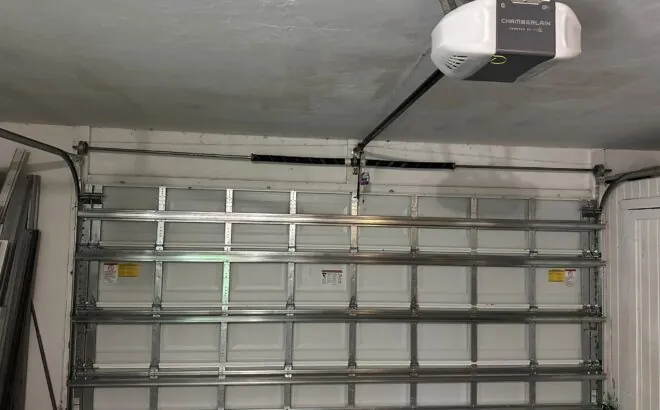
Wood doors at the end of long driveways
Off Mount Auburn Street, the single-family and two-family houses put up in the nineteen-twenties sit on lots where a long driveway runs back past the house to a detached garage. Plenty of those garages still carry their original wood doors. Caring for garage doors Watertown MA homes have on these streets therefore often means caring for timber: doors that have been painted many times over, that swell in a wet spell and shrink in a dry one, and that grow heavier as the years go by.
Wood is a forgiving material in some ways and an unforgiving one in others. A split rail can be repaired, but rot that has got into the bottom of a stile spreads quietly behind the paint. A wood door can run sweetly for decades, but only if its springs keep up with its weight.
Before you call, take a look from a safe distance at:
- The bottom rail and the lowest panel, where paint peels and wood softens first.
- Whether the bottom edge runs parallel to the slab or one corner hangs lower.
- Whether the door has springs and tracks at all, or opens on hinges or a pivoting arm.
What “original wood door” can mean
Not every old wood door works the same way, and it helps to know which kind you have.
Some are hinged doors, a pair that swing out like a gate, or a set that slide and fold along a track at the top. These have no springs at all and are repaired more like a gate or a cabinet door than an overhead door: hinges, latches, hangers and the frame.
Some are one-piece doors that swing up and back on a pair of pivoting arms, with springs at the sides. The whole door moves as one panel, tilting outward at the bottom as it rises, which needs clear space in front of the opening.
Many were later converted to, or replaced with, wood sectional doors that roll up on tracks, with a torsion spring over the opening or extension springs along the ceiling tracks. These work the same way as modern overhead doors, but carry the extra weight and the moisture behaviour of timber.
Knowing which you have before the visit helps plan what to bring. If you are not sure, describe how the door opens: on hinges, in one piece tilting out, or in sections rolling up.
Why weight matters so much on wood
A garage door is meant to be balanced: the springs carry its weight, so a person or an opener only has to guide it. Wood complicates that balance in two ways.
First, wood doors are heavier than steel ones of the same size to begin with. Second, they gain weight over time. Layers of paint add up, and every time water gets past the paint into the grain, the timber holds some of it. A door that was balanced when it was hung can drift out of balance year by year as it gets heavier.
The symptoms are a door that feels heavy to lift by hand, a door that slides down instead of staying put when lifted halfway, and an opener that labours, slows near the top or stops partway. The fix is usually to re-tension or replace the springs to suit the door as it is now, and to check that the hinges, rollers and their screws can still take the load.
Swelling, sticking and the change of seasons
Timber moves with the weather. Through a damp spell the sections take up moisture and swell; in a dry, heated winter they give it back and shrink. On a sectional wood door that movement shows up at the edges. A door that closed cleanly in autumn may rub on a jamb after a wet week, or leave a gap at the side once the air dries out.
Swelling on its own is rarely the whole story. A door that binds only in wet weather often has a track or a jamb that is already a little out of line, so the swollen edge finds the tight spot. Planing the edge of the door treats the symptom; checking the track, the jamb and the hinges finds the cause. On a detached garage that has settled since it was framed, the jamb is often the part that has moved.
Wood also cracks along the grain where paint has failed, and cracks let more water in. Small splits in a panel can sometimes be filled and painted; a rail split right through at a joint loses its strength and needs proper repair or a replacement section. Of all the garage doors in Watertown that are still wood, the ones that last best are the ones whose paint is kept up along the bottom and the edges, where water does its damage first.
Hinged and swing-up wood doors have their own seasonal habits. Hinged pairs drop at the outer corners as the hinges and the frame wear, and then drag on the ground. Swing-up doors can twist slightly out of flat, so one side rises before the other. Both can usually be put right with hardware adjustment and new fixings into sound wood.
Springs on a heavy door
On an overhead wood door, the springs do a lot of work. Whether it is a single torsion coil above the lintel or a matched pair of stretch springs up by the ceiling, the spring setup must hoist a weighty timber door cycle after cycle, year after year. When one breaks, there is often a loud bang, and the door afterwards is too heavy for the opener to lift.
A torsion spring holds dangerous tension, held by a winding cone and set screws on a steel shaft. Releasing or winding it calls for the right bars and the right sequence, and mistakes can throw a bar or a bracket hard enough to injure. That is doubly true on a heavy wood door, where the spring is wound tighter, which puts it firmly outside DIY territory. Each extension coil ought to have a restraining cable threaded through it, something older Watertown installations sometimes lack.
Replacement springs are chosen to suit the door’s actual weight, which on an old wood door may be well above what it weighed when new. The Watertown spring repair page covers spring faults in more depth.
Cables, drums and dropped corners
The spring’s pull reaches the door’s lowest corners through a pair of steel lift cables. Hanging a timber door, they work harder than they would on steel, and a frayed cable is more likely to snap. When one goes, that side of the door drops, the door racks in the opening, and the rollers can be forced out of the track.
There is a timber-specific risk here as well. The bottom brackets that hold the cables are screwed into the bottom rail of the door, and if that rail has started to rot, the screws can pull out under load. The cable is fine; the wood it is anchored to has given way. Checking the bottom rail is part of every cable repair on a wood door. Cables are replaced in pairs and the door is rebalanced.
Hinges, rollers and tracks on old timber
On a sectional wood door, the hinges between the sections are screwed into the stiles. As the wood ages, screw holes wear and the hinges loosen. Once a hinge works loose, neighbouring sections bend against one another, so the door dips across its middle or scuffs the same spot every trip. Re-fixing hinges into sound wood, sometimes moving them slightly or using longer fixings, is a common part of a repair on these doors.
Rollers wear in their bearings and in their stems, and the roller brackets on a wood door are also screwed into the stiles. The tracks themselves are fixed to the jambs of a detached garage that may have settled over the decades. A track that has drifted out of plumb makes the door bind.
If a wood door slips out of its rails, leave it hanging: the springs and cables stay wound, and a timber door that falls does real damage. How derailed doors are rehung is set out on our off-track garage door repair page.
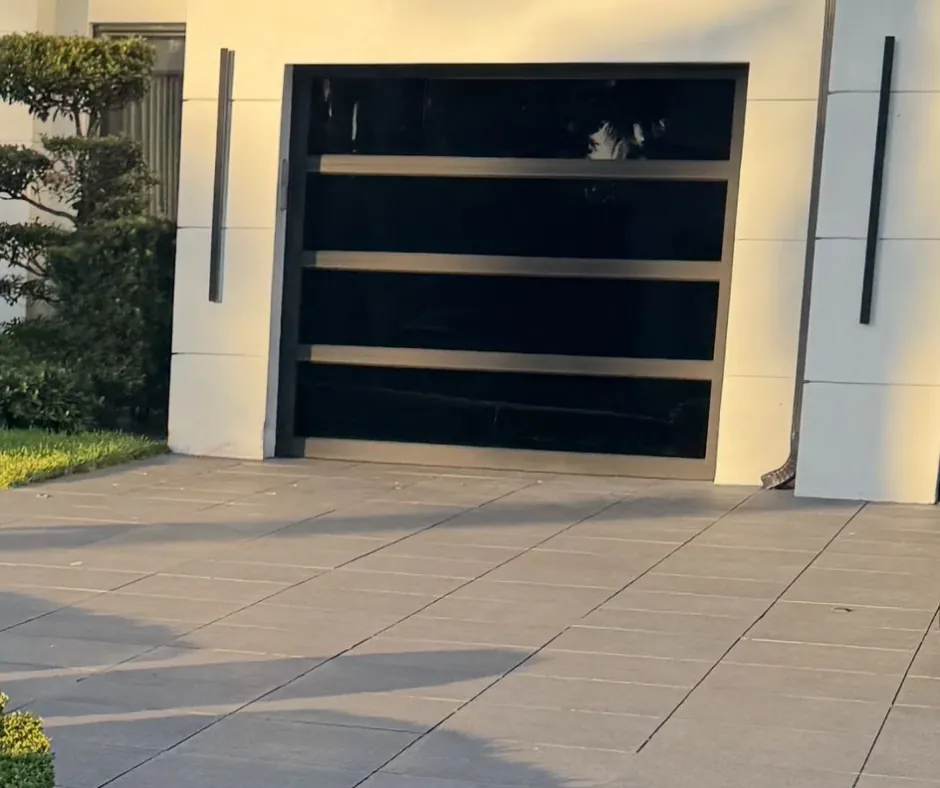
Openers on wood doors
Openers are often fitted to wood doors long after the doors themselves. Matched to a balanced door and set up for its weight, an opener copes fine. They struggle when the door is heavier than the springs can carry.
A struggling opener gives itself away: the motor labouring through the last stretch upward, travel halting midway, the door rebounding inches from the floor, a drive that grinds or slips. Some of those are opener faults; many are door faults that the opener is reporting. Remotes and wall buttons fail in their own right too, and the safety sensors at the foot of each jamb get knocked out of line or dirty. If the door will not close, check both sensor lights and wipe the lenses first.
A one-piece swing-up door can be motorised, but it needs clear space in front for the door to tilt outward. Opener repair and replacement covers motors, drives, remotes, wall buttons and sensors, LiftMaster openers included. The Watertown opener repair page has more.
Urgent faults, whatever the hour
A heavy wood door that drops a cable or breaks a spring does not wait for office hours. Somebody picks up our line after midnight as readily as at lunchtime, any day of the week, so report the fault as soon as you find it.
Until someone arrives:
- Unplug the opener so nobody tries the button again.
- Keep people and pets well clear of a heavy door that is crooked or partly open.
- Do not try to lift a door with a broken spring.
- Do not try to force a door back into its tracks.
The Watertown emergency repair page walks through the urgent faults.
The long walk from the street
A detached garage behind a nineteen-twenties house is often a good distance from the street, at the end of a driveway that runs the length of the lot. That is useful in some ways: there is usually room in front of the door to stand and look at the outside face, and room to set a ladder.
It also means every part and tool travels on foot from the street to the back of the lot. Where two households share a driveway, and cars from both units often sit in it. On the day of a visit, clearing the cars nearest the garage and the floor just inside the door means the work can start at once.
A long driveway also changes how the door is used. Many people drive in, stop near the garage and press the remote from the car, which can mean the door starts and stops more often than it needs to. That is hard on a heavy wood door’s springs and on the opener’s gears.
Inside a Watertown visit
Step one is uncoupling the opener and raising the timber door manually. On a wood door this one test says a great deal: whether the springs are carrying the door’s real weight, whether the door is racked, and where it binds. Then the hardware is checked part by part: springs, safety cables, lift cables, drums or pulleys, rollers, hinges and their screws, tracks and brackets. The wood is checked too, especially the bottom rail and wherever hardware is fixed into it.
The opener is run on its own and then coupled up again, and the handsets, wall control and photo eyes are put through their paces.
Before any repair starts, you are walked through what failed, the cause, and what else is near its end. Afterwards the springs are set for what the door actually weighs today, the opener’s limits and push are reset, and reversing is demonstrated by letting the door come down on an offcut of board.
Keeping the wood door, or replacing it
Many owners want to keep an original wood door, and many of those doors can be kept. New springs sized for the door’s weight, new cables, rollers and hinges, and hardware re-fixed into sound wood can give a sound door a good many more years.
The case for replacing it grows when the wood itself has failed: rot in the bottom rail or the stiles, panels split through, sections that have warped so far that the door no longer closes square, or a door so heavy that it cannot be balanced sensibly. A hinged or swing-up door that has become awkward for the way the garage gets used now is another candidate. When garage doors Watertown MA owners have get to that stage, a new door is measured to the opening and to the headroom and side room inside the garage. New garage doors are supplied and installed, and the old door is removed.
Looking after a wood door between visits
Timber rewards a little care, and none of it involves the springs or cables.
- Keep the paint sound, especially along the bottom rail and the lowest panel.
- Keep snow, leaves and standing water clear of the bottom of the door.
- Every so often stand back and watch a complete open and close. Both sides should rise together.
- Book a look once lifting by hand gets harder or the opener sounds strained.
Most garage doors in Watertown MA that fail suddenly gave signs beforehand, and a look at the first sign usually means a smaller job. The garage door repair service covers every part of the door, and the Watertown garage door repair page looks at repairs here in more detail.
Neighbouring towns
Our work spreads across Greater Boston. Watertown shares borders with Newton and Belmont, each of which has its own page, and our service areas page lists every other town.
Booking your visit
For garage doors in Watertown MA, the most helpful details are what the door is made of, how it opens, what it is doing now and whether a car is shut in behind it. Mention a shared driveway or one lined with parked cars. Google reviewers rate us 5.0, and calls are taken at any hour, Mount Auburn Street busy or asleep. Call us or book online.
Questions from Watertown
Should we save the original wood door on the garage?
Often it is. Springs, cables, rollers and hinges are all replaceable, and hardware can be re-fixed into sound wood. If the wood itself is rotten or badly warped, replacement is usually the better choice.
Why is my wood door so heavy to lift by hand?
Either the springs are weakening, or the door has gained weight from paint and moisture over the years. In either case the springs need to be matched to the door’s weight as it is now.
The cable came loose but did not snap. What happened?
On a wood door, the bottom bracket the cable is attached to may have pulled out of a rotting bottom rail. Leave the door alone and ring us; the rail needs checking as well as the cable.
Can an opener be fitted to a door that tilts out in one piece?
Often, yes, if the door is balanced and there is clear room in front for it to swing out as it rises. A heavy or unbalanced door should be put right first.
Should I keep painting the door?
Yes. Paint is what keeps water out of the wood. Pay most attention to the bottom rail and the lowest panel, which take the most water.