
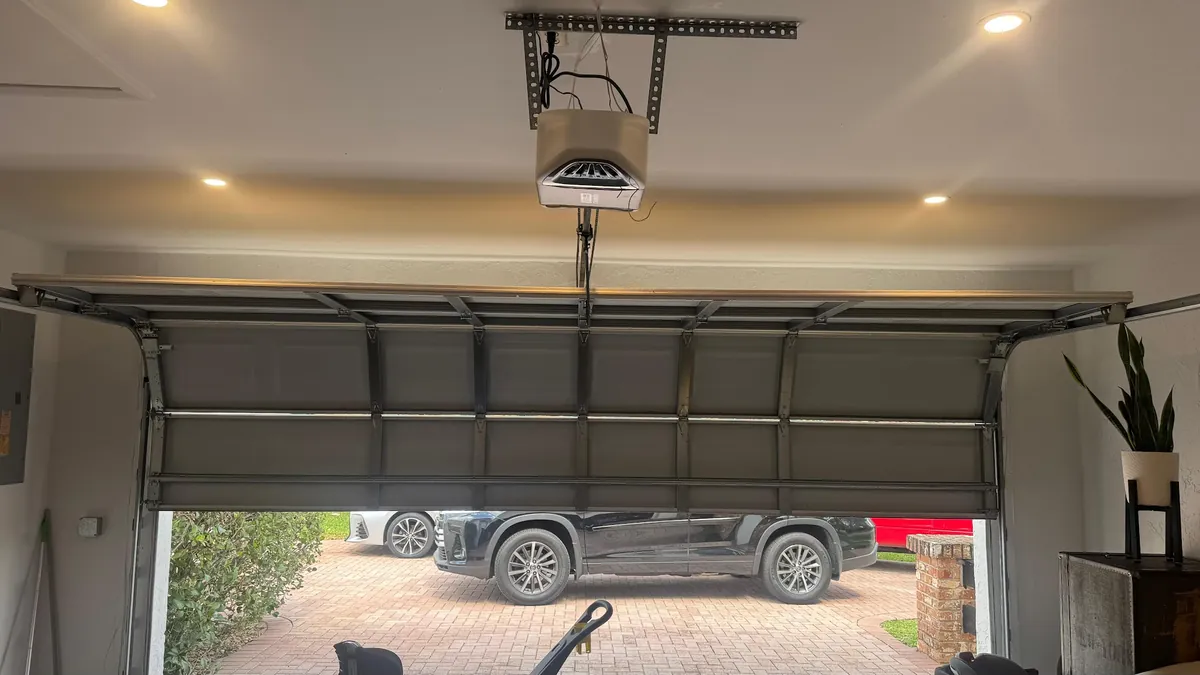
When the button stops working in an East Boston garage
Of all the parts of a garage door, the opener gets the most attention, since its button is what gets pressed every morning. Our garage door opener repair in East Boston covers the opener itself, the remotes and keypads that talk to it, the wall button by the door, and the pair of safety sensors near the floor. Openers that have quit are repaired and new ones installed, both in the single bays tucked behind Eagle Hill and Orient Heights triple-deckers and in the ground-floor garages of the newer Jeffries Point townhouses.
Three quick checks tell you a lot about where the fault is:
- Try the wall button. When it runs the door but the remote will not, the fault lies with the remote.
- Check the little lights on the floor-level sensors. One blinking or unlit means the beam between them is broken.
- Listen when you press the button. A hum with no movement points inside the opener or to the door, and silence points to power.
What opener work covers
The opener unit
Units humming without the door moving, stripped gears, worn drive sprockets and logic boards that have stopped responding.
Chain, belt and rail
Slack chains that slap the rail, worn belts, and rails rusted by damp air in an unheated garage.
Remotes and keypads
Remotes that need a new battery or reprogramming, keypads that have lost their code, and lost remotes cleared from the opener’s memory.
Wall buttons and wiring
Dead wall buttons, damaged wiring between the button and the opener, and loose connections at the terminals.
Safety sensors
Photo eyes knocked out of line, cracked brackets, dirty lenses and damaged sensor wiring along the wall.
New openers installed
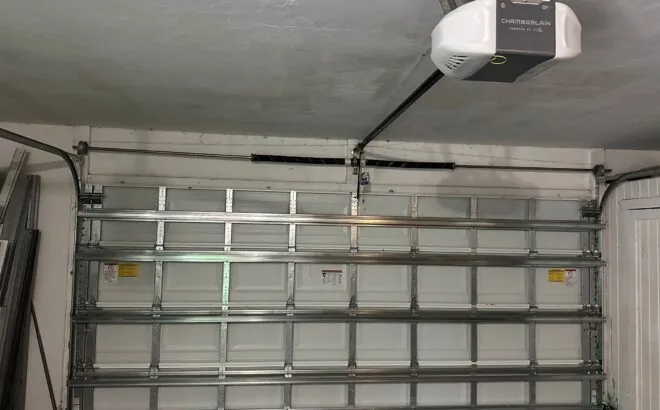
When an opener is past repair, a new one is supplied and fitted, set to the door and tested. LiftMaster openers are among those we repair and replace.
How an opener works with the door
It surprises many people to learn that the opener is not what lifts the door. The springs carry the weight. What the opener does is move an already balanced door back and forth, through a trolley that runs along a rail on the garage ceiling, driven by a chain, a belt or a screw. It also watches for trouble: if the closing door hits resistance, or the safety sensors see something in the opening, it stops and reverses.
That arrangement explains a lot of opener faults. When a spring weakens or breaks, the opener suddenly has to lift weight it was never built to carry, so it strains, trips its force limit, or grinds its gears down. A door that binds in its track because of a seized roller or a bent rail feels like an obstacle, so the opener reverses for no visible reason. Good garage door opener repair in East Boston always looks at the door as well as the opener, because a new opener on a badly balanced door will soon go the same way as the old one.
Remotes, keypads and wall buttons
A remote that stops working is the most common opener complaint and often the simplest. A flat battery is the first suspect; after that, the remote may have dropped its link to the opener, or the opener’s receiver may be failing. Programming a remote again is quick once the opener’s learn button is reached. If a remote has been lost, its code can be cleared from the opener so it no longer opens the door.
Wall buttons fail less often, but when they do the cause is usually the wiring, not the button. In older detached garages, the wire from the button to the opener is sometimes stapled along damp walls, chewed or pinched, or loose at the screw terminals. When a wall button only works on certain days, suspect the wiring before anything else.
Exterior keypads take the full force of the weather, and near the harbour that means salt spray on the contacts. A keypad that has stopped accepting its code may need cleaning, reprogramming or replacing.
Safety sensors in tight garages
Low on each side of the opening, a pair of sensors passes an invisible beam between them. If anything interrupts it, or if the sensors are out of line with each other, the opener will not close the door, or will close it partway and send it back up.
Up in the cramped Eagle Hill and Orient Heights bays, sensors get knocked easily. Bins, bicycles, shovels and storage boxes stacked along the walls sit right next to them, and a single bump can push one sensor a fraction out of line. Low evening sun striking a lens head-on is another thing that throws them off.
What you can safely do:
- Wipe both lenses with a soft cloth.
- Move anything sitting in the beam or pressing against either bracket.
- Look at the sensor lights. Most sensors show a steady light when they can see each other and blink or go dark when they cannot.
- Gently turn a sensor that has been knocked until its light goes steady.
If the lights still will not settle, the wiring or the sensor itself has probably failed. Never tape over the sensors or move them up the wall to get around the problem; they are what stops the door coming down on a person, a pet or a car.
Power, damp and detached garages
Detached garages behind triple-deckers do not always have a dependable power supply. Some openers run off an extension lead from the house, some share a circuit with lights and tools, and some sit on outlets that have seen years of damp. If the opener makes no sound at all, start with the supply: check the plug, look for a tripped breaker, and test the outlet with a lamp.
Damp also affects the opener’s circuit board. In an unheated garage close to the harbour, condensation forms on cold mornings, and the salt in the air finds its way onto exposed contacts. A board that works intermittently, especially on wet days, is a common find. Where an opener has been running off an extension lead for years, the lead deserves a look too: a cracked or damp lead can cut the power in and out and make a sound opener look faulty.
Openers in Jeffries Point townhouse garages
The townhouse garages at Jeffries Point are built into the house, often with bedrooms or living space overhead, and the household uses the opener several times a day. That brings two priorities.
The first is noise. A chain drive slapping its rail, a worn sprocket or a loose rail bracket carries straight through the ceiling. Tightening the chain, replacing worn parts or, where the opener is being replaced anyway, choosing a quieter belt drive makes a real difference to the rooms above.
The second is reliability. A built-in garage that only opens with the opener leaves the household stuck when the opener fails. Most openers carry an emergency release, the red cord dangling from the trolley, which uncouples the door for lifting by hand. Pull it only with the door closed, and only if the springs are intact; with a broken spring, nobody should try to raise it. Garage door opener repair in East Boston is often a call from a household that has found that out the hard way.
What an opener visit involves
- The door comes first. With the opener uncoupled, the door is worked by hand to prove the springs, cables and tracks are sound. An opener cannot be set up correctly on a door that is out of balance.
- Power and controls are tested. Outlet, wall button, every remote and any keypad get tried in turn to narrow down where the fault lies.
- The opener is inspected. Gears, sprocket, chain or belt, rail, trolley and logic board are checked for wear and damage.
- The sensors are tested for alignment, wiring and response.
- You hear what is wrong and the options before any work starts, including whether the opener is worth repairing.
- The repair or installation is made and set up. Travel limits get set for a full close and the right opening height, force gets set so the door turns back at any resistance, remotes are paired, and a block on the floor proves the reversing works.
Signs an opener is wearing out
Openers rarely die without some warning, and the early signs are worth acting on before the unit stops altogether:
- It runs slower than it used to, or pauses partway before carrying on.
- It makes new noises: grinding from inside the motor housing, a clicking that was not there before, or a chain that slaps the rail on every run.
- It reverses for no visible reason, even with the sensors clear and the door running freely by hand.
- The light flashes in a pattern when the door stops, which on many units is the opener reporting a fault.
- It works only some of the time, often worse on cold or damp mornings.
- It needs several presses of the remote or the wall button before it responds.
Every one of these hints at its own culprit, from a worn drive gear to a failing board or a sensor on the edge of its range. Catching them early usually means a smaller repair.
Travel and force: the two settings that matter
Two sets of adjustments govern how an opener handles the door. Travel limits mark the stopping points at the top and bottom. Too short a setting leaves the door hovering above the floor with a gap underneath; too long, the opener keeps pushing after the door has met the floor, which bows the top section and strains the drive.
The force settings tell the opener how much effort it may use before concluding something is in the way and backing off. They are a safety feature. Force turned up too high will drive the door down onto an obstacle instead of backing off; force set too low makes the door reverse at the slightest stiffness. A common fault is force that someone has turned up to cure a door that keeps reversing, when the real problem was a weak spring or a seized roller.
Both are set with the door balanced and running freely, and then a solid block on the floor is used to prove the reversing. The door should touch it, stop and go back up.
Looking after an opener near the water
An opener in a damp garage within reach of the harbour air needs a little care to keep going:
- Keep the rail and chain lightly lubricated if it is a chain drive, and wipe off any build-up of grime.
- Check that the outlet it plugs into is dry and that the cable is not hanging in a damp corner.
- Wipe the sensor lenses every so often, since salty air leaves a film on them.
- Replace remote batteries before they are completely flat, so the remote does not start failing at a distance.
- Every few months, pull the release cord with the door closed and lift the door by hand. If it drags or sinks from halfway, the springs need attention before the opener suffers.
Using the door by hand while the opener is out of action
When an opener fails, the door can usually still be used by hand for a while, provided the springs and cables are intact. Tug the red release cord on the trolley with the door closed; pulling it with the door open can let the door run down on its own if a spring is weak. Lift from the handle or the bottom section, never from the joints between sections, where fingers can be caught as the panels fold over the curve of the track.
A properly balanced door should lift with modest effort and stay where it is left halfway up. If it does, it is safe to use by hand until the opener is repaired. If it is very heavy, slams down or will not stay put, stop using it and leave it closed: the problem is the springs, not the opener.
To reconnect the door to the opener afterwards, most openers relatch when the button is pressed and the trolley runs back to meet the door. If it does not catch, leave it for the visit rather than forcing the trolley by hand.
Repairing or replacing an opener
Most garage door opener repair in East Boston is ordinary work on a unit worth keeping: a stripped gear, a worn sprocket, a slack chain, failed sensors or a remote awaiting pairing are routine fixes. Replacement makes more sense when the logic board has failed on an older unit, when the motor has burned out, when the opener lacks working safety sensors, or when it has been badly damaged by straining against a broken spring.
When a new opener goes in, the garage shapes the choice. Low headroom in the small detached garages limits the gap above the door available for a rail. A garage with living space above benefits from a quiet drive. A detached garage with an unreliable power supply may need that sorted before any new opener is fitted. You will be told what fits your garage. We repair and replace LiftMaster openers too.
Related work on the same door
An opener fault often turns out to be a door fault. A broken spring found during the check is handled as spring work in East Boston; cables, rollers, tracks and panels fall under door repairs in East Boston. For a door jammed open overnight, go to urgent repairs in East Boston, and if the door needs replacing along with the opener, new doors in East Boston explains how.
Opener work across Greater Boston is described under opener repair and replacement, and the local services are all collected on the East Boston page.
Getting an opener looked at
Openers like to quit just as you leave for work or pull in late. Calls are picked up whatever the hour and whatever the day, so report it straight away. Describe what the wall button and the remote each do, what the sensor lights show, and whether the door moves by hand. Then, for garage door opener repair in East Boston, whether it is one remote or a whole new unit, call us or book online.
Questions from East Boston
Why does the opener hum while the door stays still?
Typically a worn-out drive gear, or a door too heavy for it because a spring has snapped. Leave the button alone, pull the plug and look up at the spring. With the spring whole, the fault is probably inside the opener.
Why does the door reverse just before it closes?
Most often the safety sensors. Wipe the lenses, clear anything near them and check that both lights are steady. In a small garage, a bin or bicycle knocking one sensor is the usual cause. If the sensors are fine, the door may be binding in its track.
The remote is dead but the wall button works. Is the opener at fault?
Unlikely. Fit a fresh battery. Failing that, the remote probably needs pairing with the opener again, a quick job.
Can you replace the opener in a garage with very little headroom?
Often, yes. The detached garages behind triple-deckers can be tight above the door, and the opener and rail have to suit the space. The room above the door is measured and the options suited to it are explained.
Do you work on LiftMaster openers?
Yes. We repair and replace LiftMaster openers in garages across the neighbourhood, along with openers of other makes.