
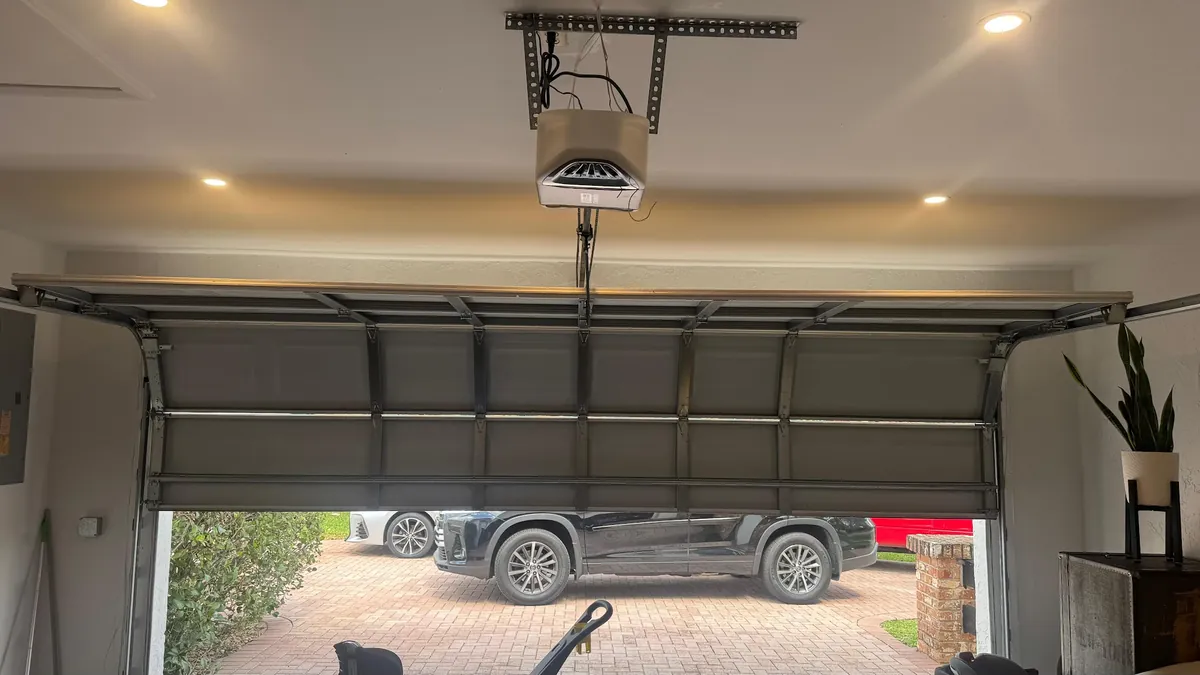
Why openers on Hyde Park’s wider doors give more trouble
On the larger lots around Cleary Square and out by Readville, plenty of garages hold two cars behind one broad door, and the opener hung from the ceiling has a real load to move. Garage door opener repair Hyde Park MA homeowners call about tends to follow from that: a motor working against a heavy door several times a day, a remote expected to reach from the bottom of a proper driveway, and photo eyes set far apart across a wide opening.
Some of these garages are joined to the house, with the opener mounted under a bedroom or a family room. Others are separate outbuildings further along the driveway, fed with power from the house, with a wall button wired across the building. Each layout gives its own set of faults, and the first job on any call is to work out whether the trouble sits in the motor head, in the handsets, button and sensors that command it, or in the door hanging on the end of its arm.
A few observations from you make that quicker:
- Pressing the button, do you hear the motor stir, and does the bulb on the unit light up?
- Does the door move partway and then stop or reverse, and at roughly the same point each time?
- Do the remotes, the wall button and any keypad all fail together, or only one of them?
Opener faults we handle in Hyde Park
Motor units that hum or go silent
Humming without travel tends to mean a seized gear, a failed start capacitor or a door too heavy to lift. Total silence points to power or the circuit board.
Stripped gears and worn drives
The plastic drive gear inside many units wears away under a heavy two-car door. Chains stretch and belts fray along the rail.
Remotes and keypads
Handsets that only respond a few steps from the door, keypads that have forgotten their code, and missing handsets still able to open the garage.
Wall buttons and wiring
A dead wall control, a loose terminal on the motor head, or low-voltage wire damaged where it runs along a joist or through a detached garage.
Safety sensors
Beam sensors nudged askew, lenses fogged or dirty, brackets bent by a bumper, or wiring cut by a shovel along the floor.
New openers installed
When an old unit is beyond saving, a replacement opener fitted to suit the door’s weight, the ceiling height and the way the garage is used.
Wide doors ask more of the motor
A two-car door can weigh well over what a single door does, yet the motor overhead only expects to steer it, with the springs carrying almost all of that load. When the springs and cables are doing their job, a modest motor moves a big door easily. When a spring has weakened, a roller has seized or a section has bowed and started to bind in the track, the opener has to make up the difference, and it is usually the opener that complains first.
That is why many opener calls in Hyde Park turn out to be door calls. The door reverses halfway down because the opener senses resistance and its safety logic sends it back up. The motor strains and the light flickers because the load is too high. The drive gear strips because it has been dragging a door with a broken spring. Before anything is replaced on the opener, the door is disconnected and checked by hand. If the door is the cause, a new opener would only fail the same way, and the real fix lies in the springs or the hardware, covered on the Hyde Park spring repair and Hyde Park garage door repair pages.
Where the door is sound, the opener itself is examined: the gear and sprocket inside the head, the chain or belt and its tension, the trolley that runs along the rail, the travel limits, the force settings and the logic board.
Remotes that have to reach the end of the driveway
Real driveways are one of the things that set Hyde Park apart from the denser parts of the city, and they change what people expect from a remote. A handset that used to open the door as the car turned in from the street, and now only works a few lengths from the door, has a reason behind it.
The usual suspects, in order, are a weakening battery in the handset, an antenna wire on the motor head that has been pushed up against metal or tucked away, and interference from other devices in the house. Where the garage stands a good distance from the street, the motor head may sit behind a metal door with little line of sight. A handset that does nothing at all may no longer be paired, something a power cut or a failing board can cause.
Each of those has a different fix: new batteries, repositioning the antenna, reprogramming the remotes, or, if the receiver on the board is failing, repairing or replacing the opener. When a handset goes astray, or leaves with a car that has been sold, the stored codes can be wiped and only the handsets still in your hands re-learned, which locks the stray one out.
Detached garages and the power supply
A detached garage is a separate building, and its opener depends on power travelling from the house. When an opener in a standalone garage goes completely dead, the first question is not what is wrong with the motor but whether electricity is reaching it.
Things worth checking from your side before calling: whether the light inside the garage works, whether the outlet the opener plugs into has power, and whether a breaker in the house has tripped. A garage outlet on a protected circuit may have tripped its reset button, sometimes on a different outlet from the one the opener uses. If the garage has no power at all, an electrician is the right first call; if the power is there and the opener is still dead, the fault is in the unit.
The wall button in a detached garage is often wired along the inside walls with thin low-voltage cable. That wire gets nicked by tools, chewed, or pulled loose from its terminal on the motor head. A wall button that has stopped while the remotes still work usually points to that wire or to the button itself.
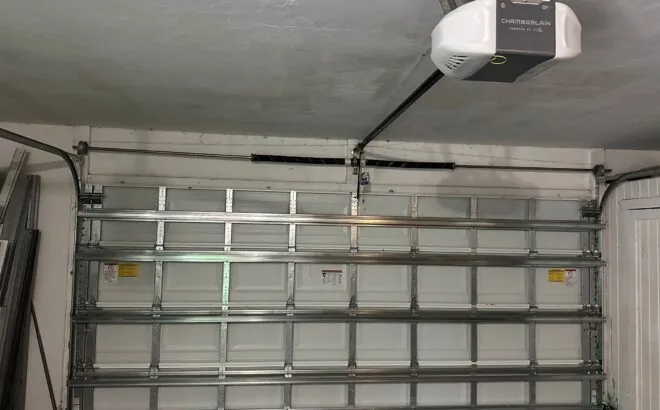
What an opener visit involves
First the technician uncouples the arm by pulling the red release cord, then walks the door up and down by hand. It should glide, and it should hang more or less still at mid-height. Any tendency to fall or float is a balance fault in the door, and that gets sorted ahead of the opener.
Next the motor gets a solo run with nothing attached. The technician listens to the motor, watches the trolley along the rail, looks at chain or belt tension, and checks the head for burnt smells, stripped teeth or a failed board. The remotes, the wall control and any keypad are tried in turn. The photo eyes are checked for alignment, signal lights and clean lenses, and their wiring is followed back to the motor head.
You are told what has failed and the options: repair the existing unit where the part is available and the rest of it is sound, or fit a new opener where that makes more sense. Before leaving, the technician sets the open and close stopping points so the bottom seal just meets the floor, turns the force down as far as it will go while still moving the door reliably, and proves the reversing feature by bringing the door down onto a length of timber lying across the threshold.
Photo eyes across a wide opening
Modern openers carry a pair of safety sensors near the floor, mounted low on either jamb of the door, shining a beam across the opening. Anything crossing the beam on the way down makes the opener stop and reverse. On a double-width door those two sensors sit a long way apart, so even a small knock to one bracket can throw the beam off its target on the other side.
Signs of a sensor problem include a door that will only close if you hold the wall button down, a door that starts down and immediately reverses, and an opener light that flashes after a failed close. Check what you safely can: look for anything sitting in the beam’s path such as a bin, a bike wheel or a pile of leaves, wipe both lenses with a soft dry cloth, and see whether the small indicator lights on each sensor are lit steadily.
If they are still not lined up, or a light stays off, the bracket may be bent, the sensor may have failed, or the low-voltage wire may be damaged where it runs along the floor or the wall. Snow shovels, mowers and car bumpers account for a fair share of those. The sensors are repaired or replaced and lined up again, then the door is tested to make sure it reverses when the beam is broken.
Noise from an opener in an attached garage
In an attached garage the opener often hangs directly under living space, and a noisy opener is heard through the ceiling. Some sound is normal, but a lot of grinding, rattling or banging usually means something is wearing.
Slapping noises along the rail usually come from a chain that has loosened. A grinding from the motor head may be a worn gear. Rattling can come from loose mounting brackets on the ceiling or the header, or from the door itself: worn rollers, dry hinges and a loose track all transmit noise through the opener’s rail into the house. Tightening, adjusting and lubricating the right parts makes a noticeable difference. Where an old chain unit is simply loud by design, some owners choose to replace it with a quieter belt-drive opener. Any garage door opener repair Hyde Park MA owners book under a bedroom gets that conversation if noise is part of the complaint.
Repair or replace the opener
Most opener breakdowns can be put right without a new unit. Gears, sprockets, capacitors, trolleys, belts, chains, sensors, wall buttons and remotes can all be renewed, and an opener that is basically sound will keep going for years once they have been.
Swapping the whole unit starts to look sensible if parts for an ageing model have dried up, if the circuit board dies on a motor that is tired everywhere else, when the opener is undersized for a heavy two-car door and has been struggling for years, or when the unit predates the safety sensors and reversing features modern openers include. LiftMaster openers are among the units we work on, both repairing them and fitting replacements. Any new unit is matched to how big and heavy the door is, the ceiling height in the garage, and how often the door is used, and it is installed with new remotes, a wall control and sensors set up from the start.
Garage door opener repair in Hyde Park occasionally reveals that the real casualty is the door, worn past the point where new hardware is worth the spend. Should that be your situation, see new garage doors in Hyde Park, which walks through supplying and hanging a replacement, with an opener fitted to it at the same time.
Keypads, wall controls and how a household uses the door
On a property with a long driveway and a garage that doubles as the main way in, the opener gets used in several ways: from handsets clipped in each car, from the wall inside, and by anyone arriving on foot without a handset. An exterior keypad beside the door suits that pattern well, and keypads have faults of their own. Buttons wear, the battery inside runs flat in the cold, the unit loses its pairing with the opener, or the code has been shared so widely that it is time to change it.
Inside, the wall control on many newer openers does more than send a signal. It may carry a lock-out switch that disables the remotes, a light button and a programming button. A lock-out switch left on by accident is a common reason for every handset failing at once, and it is worth checking before anything else. Part of garage door opener repair Hyde Park MA owners sometimes need is no more than finding that switch, explaining the wall control, and making sure each handset and the keypad answer to it again. When the controls are sorted out at the same visit as the opener, the whole system is left working as one. Older wall buttons are simple push switches, and their contacts wear out after years of daily use. Either kind can be replaced on its own when the opener itself is fine.
When the opener fails at a bad hour
A motor that gives up with the car shut in before work, or with the garage gaping open at bedtime, rarely suits waiting for office hours. We take calls through the night and on weekends. In the meantime, most doors can be lowered or raised by hand using the emergency release cord on the trolley, provided the springs are intact and the door slides easily on its rollers. Should the door feel like a slab of lead once released, let go and step back: a spring has probably snapped, so the door stays put. Our Hyde Park emergency repair page has the safe steps for a night like that.
Booking the work
Our garage door opener repair page describes this service citywide, and the Hyde Park page pulls together each kind of door work we carry out locally. For garage door opener repair Hyde Park MA homes need, a quick description goes a long way: house-joined or standalone garage, one wide door or a narrow one, the opener’s reaction to a press, and which controls have gone quiet. Call us or book online, and keep the release cord in reach.
Questions from Hyde Park
There is a humming from the motor, yet the door stays shut. Why?
Worn gear teeth, a dead start capacitor, or a door made unliftable by a snapped spring all produce that hum. Pull the plug, then look up at the spring shaft. With a broken spring visible, the opener stays off until a technician has been.
Our handset has lost its range. Is that fixable?
In most cases. A fresh battery is the simplest test. Should range stay short, the antenna wire on the motor head may be badly placed, or the receiver may be fading. A long driveway makes a weak signal more noticeable, but it is normally fixable.
Halfway down, the door changes its mind and rises again. What causes it?
The sensors are the likeliest cause. Check for anything blocking the beam, wipe the lenses, and see whether both indicator lights are on. If they are, and it still reverses, the door may be binding on the way down and the opener is reacting to the resistance.
A handset has gone missing. Should we worry?
Until it is erased from the opener, that handset can still raise your door. Wiping the stored codes and pairing only the handsets you still hold shuts it out for good.
Our opener is getting on in years. Repair it or replace it?
Repair it, often, provided the motor is healthy and its parts can still be had. If the unit is very old, lacks safety sensors, or has been struggling to lift a heavy two-car door for years, a new opener sized for the door is usually the better choice.