
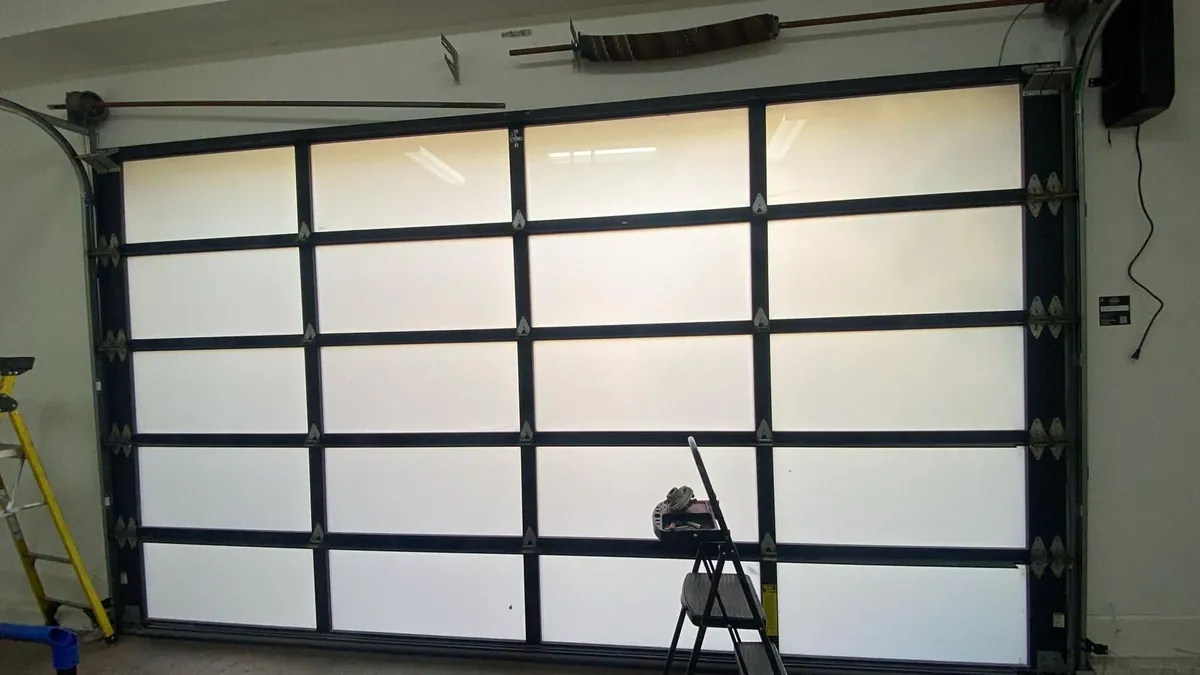
Long driveways and the garages at the end of them
Around the depot, Reading’s colonials and capes sit on lots deep enough for a long driveway, and at the end of that driveway is either a detached garage standing on its own or an attached one built onto the side of the house. The two behave differently, and when it comes to garage doors Reading MA homeowners call about, which kind you have shapes almost everything about the problem and the fix.
A detached garage is a little building in its own right. It may have its own electrical feed, no heat, and a door that was hung long after the garage was built. An attached garage is joined to the house itself, normally leads by an inside door to the living space, and serves as the household’s everyday entrance. Either way, the door waits where a lengthy strip of asphalt runs out, which matters when snow falls and when remotes are pointed from halfway down the drive.
Three details, noted from a comfortable distance, make the first phone conversation quicker:
- Whether the garage is detached or attached, and whether the door has an opener at all.
- Where the springs are: wrapped around a bar over the opening, or stretched out beside the ceiling rails.
- How the door behaves in the cold, since detached garages feel every frost.
Garage door services in Reading
The shop’s full range of work reaches both detached and attached garages on these streets. Every card links up to the service’s own page, and between them they cover most of what garage doors Reading MA properties need through the years.
Everyday repairs
Hinges, rollers, panels, bottom seals and brackets on doors of every age, from carriage-style doors on old outbuildings to steel sectionals on attached garages. See garage door repair.
Spring breakage
Torsion or extension, a broken spring stops the door cold. Stored tension makes it strictly a job for a technician. See garage door springs.
Openers and the long drive
Remote range, keypads, wall controls, motors and the photo eyes, including openers added to detached garages years after they were built. See opener services.
Stuck open after dark
A detached garage gaping open after dark, its door refusing to drop, exposes every tool and bike inside. Ring whenever it happens. See urgent repair.
Frayed and snapped cables
The cables that lift the door, and the drums or pulleys they run on. See cable repair.
Off its rails
Rollers forced out of the track by a car, a frozen bottom edge or uneven lifting. See off-track repair.
Replacement doors
Replacement doors supplied and installed to the opening each garage already has. See new garage door installation.
Detached garages: a building of their own
Set apart near the rear boundary, a freestanding garage keeps its own climate. With no heated wall beside it, the inside temperature tracks the outdoors closely, so on a January morning the springs, the rollers, the grease and the opener are all as cold as the driveway. A coil that is nearly spent seems to pick the bitterest dawn of the winter to snap, because deep cold robs tempered wire of what little give it had left.
Grease thickens in the cold, too. A door that glides in summer may move slowly and noisily in winter, and an opener that is sized just right for July may strain in February. If the opener reverses on cold mornings and behaves on mild ones, the cause is often the door itself, not the motor: stiff rollers, a bottom seal frozen to the slab, or springs that have weakened enough that the cold tips the balance.
Detached garages also tend to have a history. Many began as plain outbuildings with swing or sliding doors and gained an overhead sectional door later. Some have had several doors over the decades. That can leave tracks fastened into framing that has already held other hardware, jambs that have shifted, and openings that are not quite square. A repair on a garage like that starts with working out what the door is hung from and whether it is still sound.
Attached garages: the door the household uses
An attached garage is usually the way into the house. The car goes in, the door comes down, and someone walks a few steps into the kitchen or mudroom. That makes the opener the most-used piece of machinery in many homes, and it means a failure is felt at once: nobody gets the car out, or the house is left open on one side until the door closes again.
Attached doors cycle more than detached ones, so the faults are more often wear: rollers with flat spots, hinges cracked at the screw holes, cables beginning to fray at the bottom brackets, an opener’s drive gear wearing smooth. These faults usually announce themselves with new noises or a change in the door’s rhythm long before anything breaks outright.
Springs, and why to keep your hands off them
Detached or attached, it is the springs that raise the door, not the opener. A torsion spring is twisted tight around the bar over the opening; an extension pair is pulled long beside the overhead rails. Both are loaded with enough force to cause serious injury.
Never try to adjust, release or replace a torsion spring yourself. The bars used to wind it can be wrenched out of your grip, and a broken spring can still hold much of its tension. With extension springs, check that a containment cable runs through each spring; it stops a snapped spring from lashing across the garage.
A broken spring usually reveals itself through a loud bang, a door that will not lift, or an opener that hums and gets nowhere. Where there are two, they are swapped as a matched set to keep the door’s balance even. While nothing is under tension, the technician also inspects each cable, each drum or pulley and every bearing on the shaft.
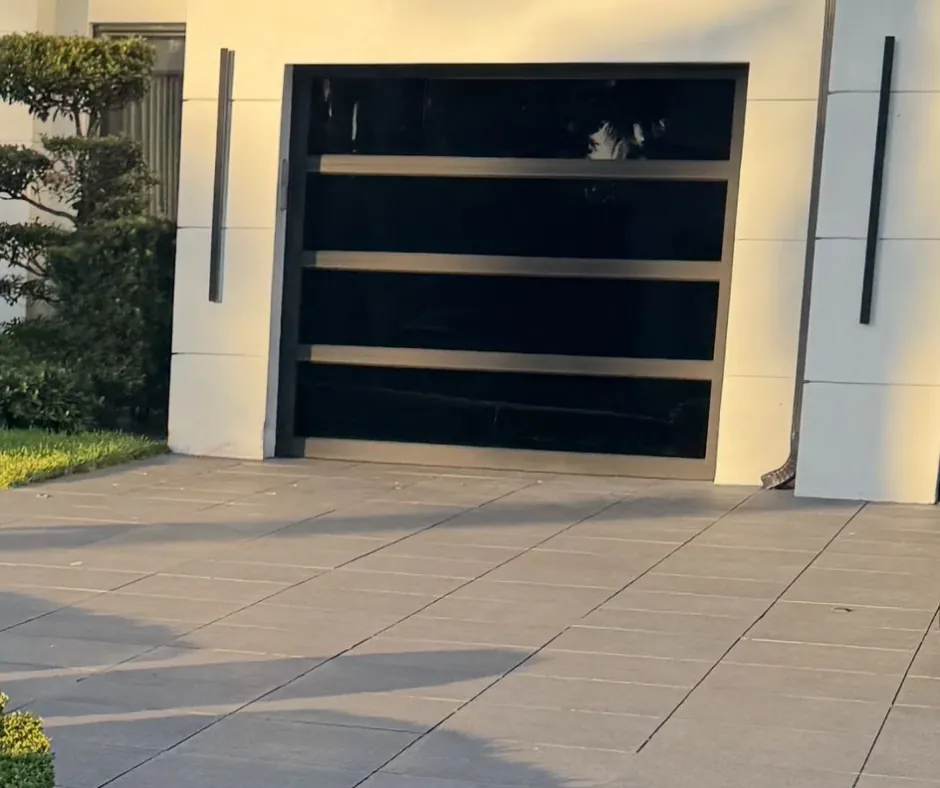
Snow, ice and the long driveway
A long driveway gives snow a lot of room to collect, and the bit that matters most to the door is the last few feet in front of it. Plough ridges, shovelled banks and meltwater that refreezes overnight all end up against the bottom section. Once the rubber along the bottom is iced to the concrete, the opener fighting it may rip the seal, crease the lowest panel or throw a cable clean off its drum.
If an icy dawn finds the door refusing to budge, press once and no more. Chip away the crust at the foot of the door with care, keeping the shovel blade off the panels, and let the rubber let go in its own time. If the door went up crooked, or a cable now hangs loose, leave it alone and call.
Snow piled against a detached garage door can also push on the bottom section from outside. Shovelling a lane across the doorway after each storm keeps that weight off the panels and keeps the threshold dry enough to reduce the freezing.
Remotes and openers at the end of a long drive
On a long driveway, people want the door opening as they turn in, not when they are nose to nose with it. That puts a remote’s range to work. When a remote that used to work from the street now only works close up, the cause can be a tired battery, a damaged aerial on the opener, or a receiver beginning to fail. Out in a detached garage, check the power feeding the opener as well, particularly where lights and a workbench draw from the same circuit.
Openers fitted to detached garages after the fact sometimes sit on improvised mounts or lack the safety sensors that newer units have. If your opener does not stop and reverse when it meets an obstruction, or if it has no sensors at all, treat it as a safety issue. Where an opener needs replacing, the new unit is picked to match how heavy the door is, how much room sits above it and what supply reaches the building. LiftMaster units are among the openers repaired and replaced, and their keypads and handheld remotes are dealt with on the same trip.
The two photo eyes near the floor have to see each other across the doorway. Snow blown into the garage, a bin left in the doorway or a bracket nudged by a bicycle can each break the beam. Wipe the lenses, clear the area, and if the door still refuses to close, the sensors need checking.
Cables under strain
On a door that has been forced off a frozen threshold, or one that has run on a weakening spring for months, the cables carry more than their share. Strands break at the bottom bracket first, and the cable can then snap or jump its drum. The door lifts on one side and stops at an angle.
Let it hang, and cut the opener’s power. On the visit a fresh pair of cables goes on, the drums or pulleys and corner brackets are inspected, and the door is set level again.
Rollers out of the rail
Once rollers escape their rail, the door may twist or wedge part way up. In a detached garage with shifted framing, a track bracket can loosen enough for a roller to slip out; in an attached garage, a bumper against the bottom section on the way in is the usual cause. Give it a wide berth and keep the motor idle. Bent rail is trued or swapped, brackets are re-anchored where the wood is sound, battered rollers are renewed, and the door is cycled until it tracks cleanly.
Repair, or a new door for the opening
Hardware wears out and is replaced; the door itself can last much longer. When the sections are sound, repair is usually the answer. Replacement starts to win when sections are rotten, cracked or caved in, when years of patching have left the door impossible to balance, or when an outbuilding door from another era fights the opening at every cycle.
The shop supplies the replacement and fits it within the opening already there, with a spring, cable and roller package sized for it. For a detached garage with an out-of-square opening, the visit records how the jambs and header sit so the new door can be hung to close evenly. For anyone thinking about new garage doors Reading MA garages could carry, that measuring visit is where the choices are laid out.
The visit itself
- The door is run and watched, with attention to how it lands, where it rubs and whether it lifts evenly.
- Everything that lifts and guides the door is examined in turn, from the springs and cables down to each hinge and bracket, followed by the opener, its remotes and the photo eyes.
- You are given a straightforward account of broken parts, worn parts and parts that are fine.
- Once you approve, the work is completed, spring tension is tuned to this door, the opener’s limits are reset, and a test object proves it backs off on contact.
Garages around the depot, then and now
The colonials and capes around the depot were built with very different ideas about where a car should live. Some lots have the garage tucked behind the house, with asphalt running along the side yard all the way back to it; others have it joined to the house, with the driveway ending right at the door. That variety is why two neighbouring houses can need quite different repairs for what sounds like the same complaint.
A door that sticks halfway on a detached garage may come down to framing that has moved, a track bolted into tired wood, or springs chilled stiff overnight. The same symptom on an attached garage is more likely to be wear: a roller with a flat side, a cracked hinge, or an opener whose gear has worn. Knowing which kind of garage it is, and roughly how the door is hung, helps the person on the phone ask the right follow-up questions before anyone sets off.
It also shapes what a new door needs to be. With garage doors Reading MA owners fit to a freestanding building, an uninsulated door may be all that is wanted; where the garage abuts a kitchen or mudroom, a foam-cored door softens the chill reaching that inside wall. Both are supplied and installed, and the choice is talked through on the visit.
Side doors, windows and the rest of the outbuilding
A detached garage often has a side door and a window or two, and on an older outbuilding those can let in as much weather as the main door. Snow drifting through a gap under a side door ends up in the bottom of the vertical tracks; a broken pane lets damp in to settle on the springs. The overhead door is the shop’s work, but a technician will point out where water or snow is reaching the door’s hardware from elsewhere in the building, since that is often why rust keeps coming back.
Keeping a long-driveway garage working
Keep a strip clear in front of the door through the winter. Listen for new sounds from rollers and the opener. On a detached garage, run the door now and then through a cold spell so the grease does not set hard. Check that extension springs have their containment cables. Leave the springs, cables and drums themselves to a technician.
Next steps
Whether the trouble lives in the freestanding garage behind the house or the attached one you pass through daily, start by describing what the door is doing. Early, late or on a holiday weekend, call us or book online. To see the full spread of towns the shop serves, visit service areas, or look at neighbouring Wakefield and Stoneham. An early call usually keeps garage doors Reading MA drivers depend on from turning a small fault into a large one.
Questions from Reading
Why does my detached garage door struggle on cold mornings?
An unheated garage gets as cold as outdoors, so the grease thickens, the rollers stiffen and a weakening spring loses what little reserve it had. The bottom seal can also freeze to the slab. If the door struggles only in the cold, the door and springs are often the cause rather than the opener.
Why must I be almost at the door before the remote responds?
On a long driveway, range matters. A weak battery, a damaged aerial on the opener or a failing receiver can all shorten it. With a detached garage, the circuit that powers the opener deserves a look too.
Is it safe to add an opener to an older detached garage?
It can be, once the door is balanced on its springs and the opener has working safety sensors and a reversal that stops and lifts the door when it meets something. The door, springs and power are checked first.
The door went up crooked after I pressed the button on a frozen morning. What now?
Stop using it and switch off the opener. Forcing a frozen door can pull a cable off its drum or bend the bottom section. Leave the door as it is and call so the cables and section can be checked.
Do you replace doors on old detached garages with uneven openings?
Yes. Measurements taken on the visit show how far the jambs and header are out, so the replacement can be hung to meet the floor evenly despite them.