
Attached garages and double doors: why repairs look different here
West Roxbury has the most suburban housing anywhere in the city. Along Centre Street and up around Bellevue Hill, the typical home is a single-family house with the garage built into it or joined onto its side, a wide driveway out front, and very often a double-width door rather than a narrow single. That shapes almost every job we see. A request for garage door repair west roxbury ma owners make is usually about a heavier door, a newer opener and a garage that shares a wall with the kitchen or the hall, rather than a lone shed at the back of a lot.
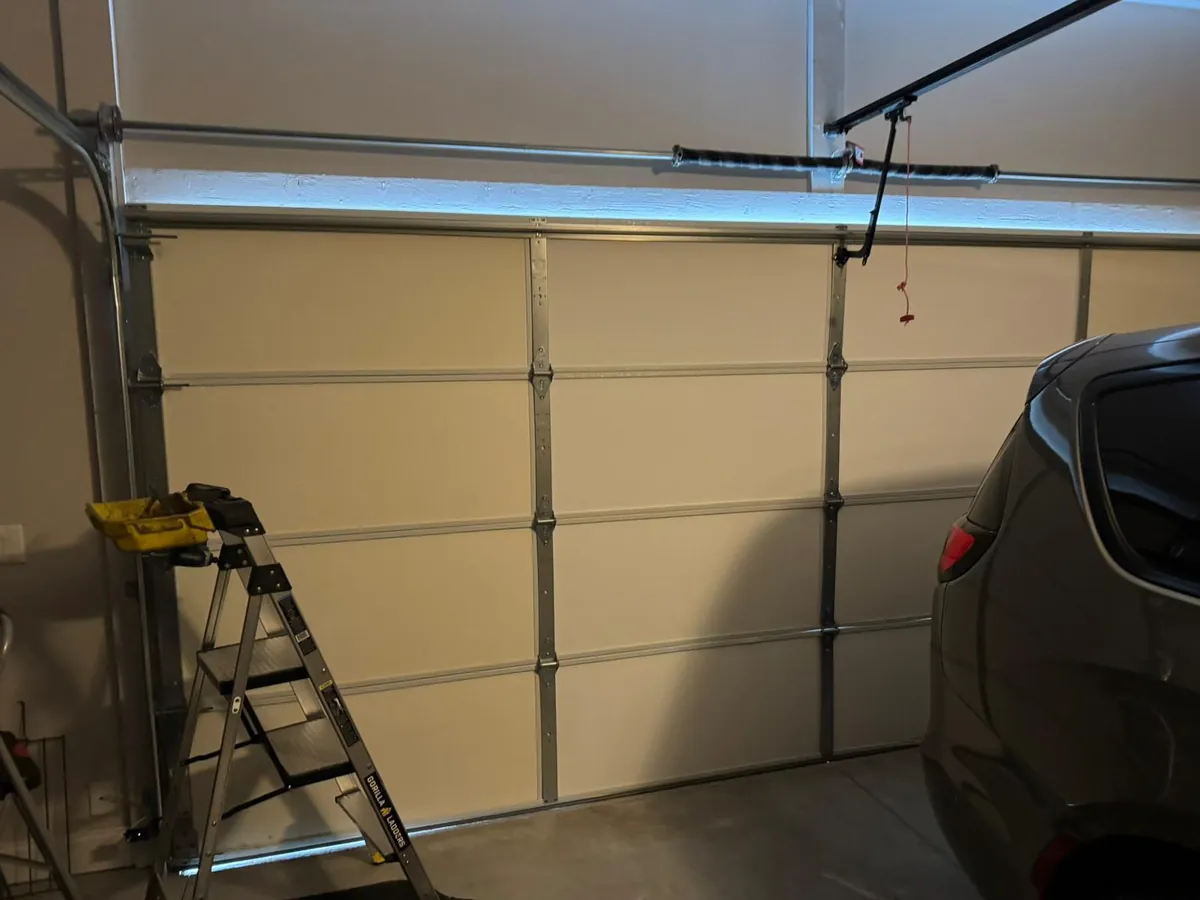
A door this size is a large moving panel held in balance by springs under serious load. When one part slips out of that balance, the rest of the system feels it at once: the opener labours, a cable slackens on one side, rollers start to grind. The good news is that most faults show themselves plainly if you know where to look.
Before you call, three things worth noting from where you stand, hands off:
- Is there a split in a coil up on the header bar, or in either long spring stretched beside the overhead tracks?
- Does the bottom of the door sit flat on the slab, or has one end dropped lower than the other?
- When you press the wall button, does the opener’s light blink or the motor hum without the door moving?
The parts a repair here takes in
Torsion and extension springs
Wide doors usually ride on torsion springs across the header; some older installations still use extension springs along the tracks. Either way, a break leaves the door too heavy to lift. The West Roxbury spring repair page goes deeper.
Lift cables and drums
A pair of steel cables runs from the drums to the lowest corners of the door. On a broad door, one cable letting go tilts the whole panel across the opening.
Sections and hinges
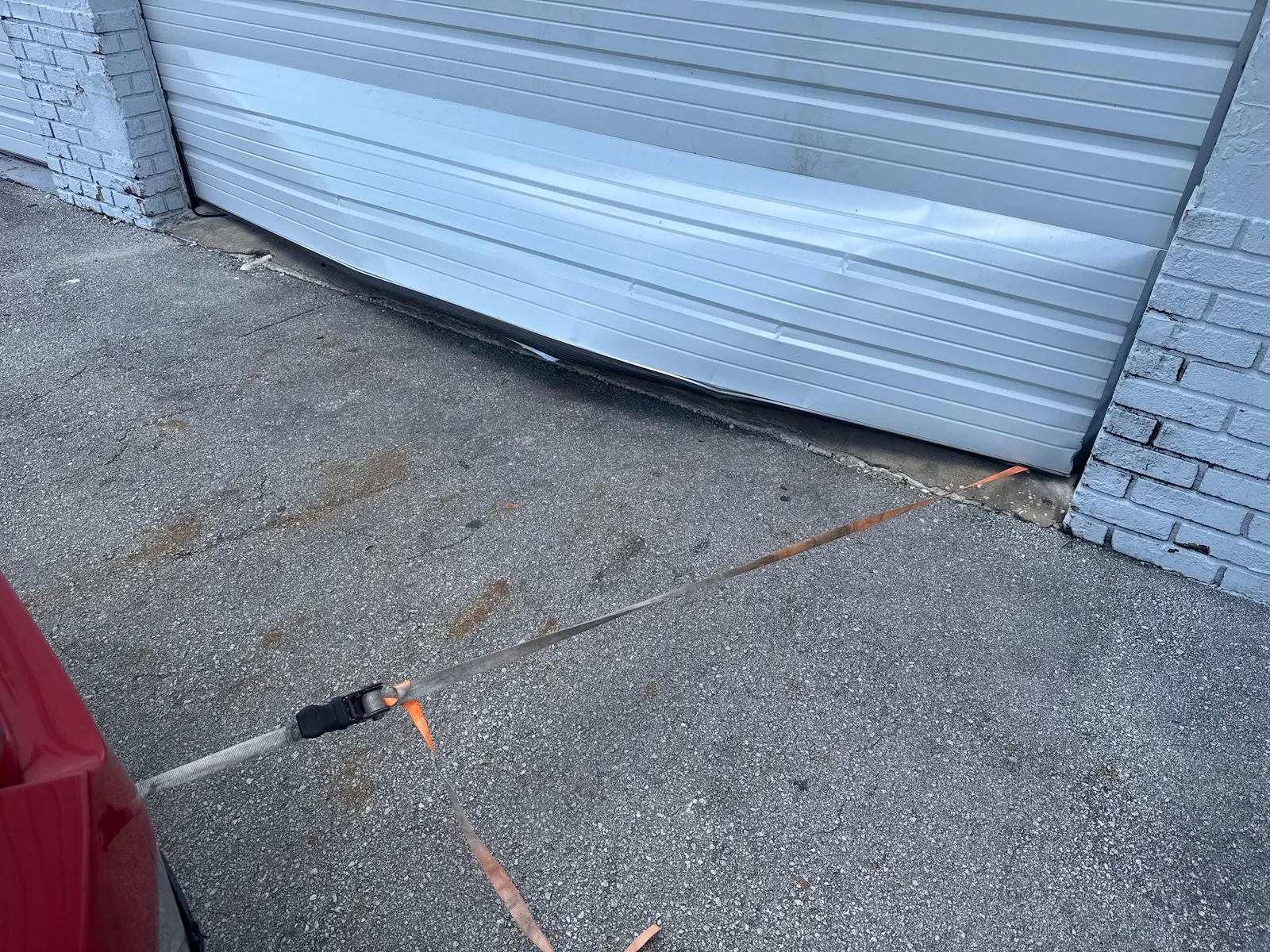
Dents from a bumper backing out, cracked sections, hinges pulling loose between panels and a bottom seal worn away along a long edge.
Openers, remotes and wall buttons
Motors that strain, gear drives that strip, handsets that stop answering and keypads that forget their code. The West Roxbury opener repair page covers these in full.
Tracks, rollers and brackets
Rollers that seize or crack, brackets working loose from the jamb, a track bumped out of true, and doors that have jumped their rails altogether.
Safety sensors
Two small photo eyes mounted near the slab, one each side, that halt a closing door when a bike, a bin or a child crosses the beam.
A garage joined to the house
Built onto the side of a single-family home, the garage is not a separate building that happens to sit nearby. It shares at least one wall with the living space, there is usually a door from the garage straight into the house, and in many single-family homes a room sits over it or beside it. That changes how a fault is felt day to day.
Noise is the first thing people notice. A worn roller or a dry hinge on a detached garage is easy to ignore; on an attached one, every squeal and bang carries through the framing into the rooms next to it. A door that shudders on the way up, or an opener whose chain slaps on its rail, can be heard from the kitchen. Often that noise is the earliest warning of a part on its way out, and it is worth acting on before the door stops altogether.
The garage door is also one of the main openings in the house’s outer shell. A door stuck partly open lets cold air and weather into a space that is joined to the rest of the home. A failing bottom seal or a cracked section lets in drafts, rain and leaves. And a door that will not shut fully matters for safety too, because the inner door turns the garage into a route straight into the home.
For all those reasons, a fault on an attached garage tends to feel more pressing than the same fault on a shed at the end of the yard. That instinct is sound: most faults cause far less disruption when they are dealt with early.
Double-width doors carry more weight
A double door spans two car widths in a single panel, and every part of it is scaled up. The sections are longer, so there is more weight for the springs to hold. Torsion setups on these doors often use two springs side by side on the shaft instead of one. The drums, cables and bottom brackets work harder, and the tracks have a longer door to guide.
Size brings a few typical faults of its own:
- Uneven lifting. If one of two springs breaks, or one cable stretches more than the other, the door rises crooked. On a long panel, a small difference at one end becomes a large twist across the width.
- Sagging sections. Long sections can bow in the middle over time, especially on doors without a reinforcing strut. A bowed section changes how the door seals along the floor and can make the opener sense resistance.
- Hinge wear in the middle. The centre hinges on a wide door see a lot of flexing and are often the first to crack or pull their screws.
- Heavier strain on the opener. An opener that was matched to the door when it was balanced can be overwhelmed once a spring weakens.
Some houses here have two single doors side by side instead of one double. That halves the size of each door but doubles the number of springs, cables, openers and sensors to keep in order. When one door of a pair starts acting up, it is worth a look at the other, since both usually went in at the same time and have done similar work.
Newer openers, and the faults they still have
Openers on West Roxbury garages tend to be newer than the ones we see on older city carriage houses. Many have belt drives instead of chains, rolling-code remotes, keypads outside the door, battery backup and connections to a phone app. Those are real improvements, but they add their own ways to go wrong.
A newer opener depends on a few small things being right. If the safety sensors are knocked out of line, the door refuses to close and the light flashes. If the travel limits drift, the panel halts above the slab or bounces back up as it lands. If the force setting no longer suits the door, the opener may reverse on its own for no visible reason. A handset that has forgotten its code, a keypad with a flat battery and a wall control with a loose wire all look like a dead opener at first.
The most common opener complaint, though, has nothing to do with the opener at all. A door with a broken spring is far too heavy for any residential opener to lift, and a good opener will sense that and stop. The motor hums, the door lifts an inch or two, and it gives up. That is the opener doing its job. We check the door’s balance before we blame the motor.
We repair and replace LiftMaster openers along with other residential openers, and fit new ones when an old unit is beyond repair or the door’s needs have changed.
Where garage door repair west roxbury ma calls usually begin
The phone calls we get from these streets tend to open with one of the symptoms below, and each tends to point somewhere specific.
The door will not open, and you heard a loud bang earlier. A spring has broken. Torsion springs often go with a sharp crack that sounds, from the kitchen, like a shelf collapsing next door. The door is now carrying its own full weight.
The door opens a little and stops. Again, usually a spring. Sometimes a lift cable has unspooled and slipped from its drum. Occasionally a frozen or seized roller, or a track bent inward.
The door closes, touches down and goes back up. Often the sensors, or the opener’s close limit and force settings. A door that has warped or settled can also hit the floor sooner than the opener expects.
The door hangs crooked in the opening. One cable has slackened or snapped, or one spring of a pair has broken. Do not run it; the door can jam hard in the tracks.
The door is loud or jerky. Worn rollers, dry or cracked hinges, a loose track bracket, or springs no longer matched to the door’s weight.
Pressing the button does nothing whatsoever. Confirm the opener is plugged in and the breaker is on, that a lock bar has not been thrown across the door, and that the wall control has not been switched to its lock setting. If all of that is fine, it is likely the opener, its wiring or its circuit board.
What a visit involves
Whatever brought us out, the visit runs in this sequence:
- The whole door is inspected first. The springs, cables, drums, tracks, rollers, hinges, sections and opener are checked together, because one failure usually leans on another.
- Balance is tested by hand. Released from the opener and lifted to waist height, a healthy door hovers there. One that sinks to the slab or climbs on its own has springs out of step with its weight.
- You hear what we found. Before any work, we explain which parts have failed, which are close behind, and what the choices are.
- The repair is made. Springs are wound or replaced, cables re-hung, rollers and hinges changed, tracks re-set and brackets fixed back into sound framing.
- The door is set up and run. Balance, travel limits, force settings and the safety reversal are checked with the opener reconnected, and the door is cycled until it runs smoothly from floor to fully open.
What you can safely do while you wait
Most of a garage door is fine to look at and not fine to touch. A few things are safe and helpful:
- Keep the car, children and anyone else out of the door’s path until it has been checked.
- If the door has halted partway, unplug the opener at the ceiling so the motor stops fighting whatever is wrong.
- Look at the two photo eyes either side of the opening. A recycling bin, a bicycle or a stack of boxes pushed against one will stop the door shutting more often than any broken part. Move whatever is there and wipe each lens with a dry cloth.
- If a single handset has gone quiet but the button by the house door still works, a fresh battery in the handset is the first thing to try.
- Check the tracks for anything that has fallen in, such as a tool or a piece of trim.
Leave the springs, cables, drums and bottom brackets completely alone. A torsion spring is wound tight with dangerous tension even when it sits motionless, so replacing or adjusting one is never a DIY repair. The bottom brackets are connected to that same tension through the cables. People get badly hurt loosening the wrong bolt.
Wide driveways make the work easier
One practical advantage of the houses along Centre Street and around Bellevue Hill is room to work. A wide driveway means a service van can pull up close to the door, ladders and parts come straight off it into the garage, and a door that needs a section or a full set of springs is not a matter of carrying everything down a narrow alley.
It helps if you can move cars back from the door before the visit, so there is clear space in front of it and room to swing a section out if one has to be changed. Inside, clearing a strip of floor along each side of the opening gives room for a ladder under the tracks and the shaft. If the garage doubles as storage, anything stacked against the side walls near the tracks is worth shifting before we arrive.
A wide driveway also makes it simple to judge how well the door seals. With the door shut and daylight outside, a look from inside the garage shows any gap along the bottom edge or at the sides, which is something we check on every visit to a double door.
Tracks, rollers and a door that leaves its rails
On a well-adjusted door, each roller sits in its track with a little side-to-side play and spins smoothly. Over time rollers wear, crack or seize, especially older steel ones without sealed bearings. A seized roller drags along the track rather than turning, wearing a flat spot on itself and a groove in the track, and making the opener work harder.
Tracks are fixed to the jambs and ceiling with brackets and lag screws. On a double door they are long, and if a bracket works loose, the track can bow away from the door enough for a roller to slip out. A bumped track does the same. Backing a car out before the door is fully up, or a door coming down onto a bin, can bend a track or knock rollers loose.
Few garage faults carry more risk than a door whose rollers have escaped the rails. It may be hanging at an angle, wedged, with the springs and cables still under load. Do not try to push it back or lift it. Unplug the opener, keep everyone clear and call. We take the tension off safely, re-set the door, straighten or replace the track sections, change damaged rollers and re-fix the brackets. The off-track garage door repair page explains more.
Panels, hinges and the bottom seal
A sectional door is a stack of panels hinged together. Each hinge carries a roller at its outer end, and each panel needs to stay true for the door to roll and seal.
Dents are the commonest damage on driveway-facing doors: a bumper, a trailer hitch, a ball. A shallow dent is mostly cosmetic. A deep crease across a section, though, weakens the panel and can stop it bending round where the vertical rail turns back under the ceiling. Cracks in steel along the bottom edge, often where water has sat against it, spread with time.
Hinges crack along their bends or pull their screws out of the section, especially the centre hinges on a wide door. A loose or broken hinge lets the panels move against each other and can twist the whole door in its tracks.
The bottom seal is the strip of rubber or vinyl along the lowest edge. Along a long double door it takes a lot of weather and wears unevenly where the slab is not perfectly level. A worn seal lets in water, leaves, snow melt and drafts. Replacing it is a straightforward part of a repair visit, and on an attached garage it is one of the easiest ways to make the space warmer and drier.
Weather, and how a door copes with it
A New England winter is hard on any garage door. Metal contracts in the cold, grease thickens, and springs that were already tired are more likely to give way on a frosty morning. Overnight frost can glue the rubber edge to the concrete, and an opener pushing against a frozen door can strip its gears or pull a section loose from the top bracket. If the door is frozen down, coax the seal off the concrete before using the opener, or wait for the day to warm.
Summer brings its own wear. A dark door facing the afternoon sun expands, and a wood door can swell in humid weather and bind in its opening. Rollers and hinges that run dry squeal more on hot days.
Seasonal changes are one reason a door that has been fine for years can suddenly start acting up. Most of the time, a seasonal symptom is a small fault made visible, not a new one.
Garage door repair or replacement
For most doors here, repair is the right answer. Springs, cables, rollers and hinges wear out in use and are meant to be replaced. A door whose sections are sound keeps going well for years with new hardware.
A new door earns a place in the conversation once the panels are the problem: rust eaten through the lowest section, several panels creased or cracked, a wood door rotted or swollen past adjusting, or a door so out of square that it can no longer be balanced. It is also worth weighing when the same door needs several large repairs at once. Part of every garage door repair west roxbury ma visit is an honest view of which way the door should go. When a new door wins, our new garage doors for West Roxbury page explains how a replacement goes in on an attached garage.
Booking a repair
Doors rarely pick a good moment to give out: a dark winter evening, a weekday morning before work, the car sealed in by a door frozen halfway. Whatever the clock says, the call gets picked up, so there is no waiting until morning just to report the problem. If the door is stuck open, jammed or off its tracks, the emergency garage door repair in West Roxbury page sets out what to do first. For the wider picture, see our garage door repair service page, and the West Roxbury page gathers everything we do locally.
To make your booking for garage door repair west roxbury ma smooth, have a few details to hand: whether it is a single or double door, how it behaves when you press the button, any part you can see broken or hanging, and whether a car is stuck inside. Note those down before reaching out: call us or book online.
Questions from West Roxbury
Ours is a two-car door. Does that make the repair harder?
It is the same kind of work with heavier parts. A double door usually has a pair of torsion springs plus longer tracks and sections, so the new springs are matched to that heavier panel and both ends are set to pull evenly.
Our opener lifts the door a hand’s width and quits. Has the motor died?
Probably not. That behaviour most often points to a snapped spring, and the opener is cutting out to protect itself from the load. Unplug it, check the coils over the opening for a break, and keep the door shut until it has been seen.
Our garage is attached and the door has become very noisy. Should we stop using it?
It is wise to use it as little as possible. A new noise usually means a roller, hinge or bracket is wearing or loose, and running the door spreads the damage. On an attached garage, fixing the noise also stops it carrying into the rooms beside it.
Can I adjust the springs myself?
Please do not. Torsion springs store dangerous tension, which puts them firmly outside DIY repair, and extension springs and their cables can whip when released. Leave them alone and call. You can safely check the sensors, the remote battery and the tracks for debris.
The door reverses just as it reaches the ground. What causes that?
Usually the sensors, the opener’s close limit or its force setting. A door that has warped or settled, or a bottom seal that has built up ice or debris, can also trigger it. Check that the photo eyes are clean and lined up; if it keeps happening, book a visit.