
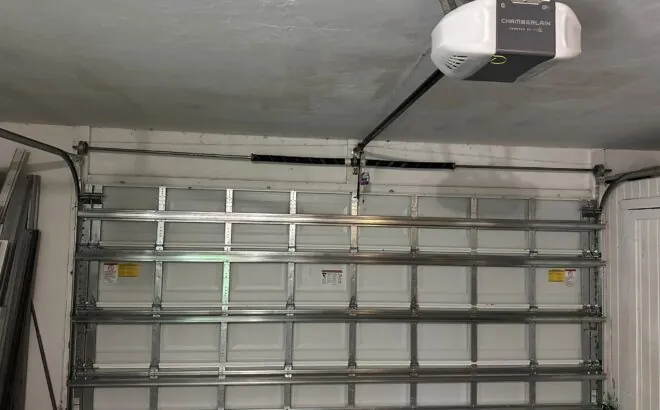
Rear garages on a hill, and houses with no garage at all
Between Nubian Square and the slopes of Fort Hill, three-deckers and Victorians make up most of the housing, and the garages are a mixed picture. Some lots have a garage at the rear, behind the house and its back porches; plenty of row houses have none whatsoever. Where one exists, reaching it tends to mean a stiff climb, a drive split between neighbours, or both. Questions about garage doors Roxbury MA owners bring us almost always involve one of those rear buildings, and the slope or the shared drive it sits at the end of.
A hill changes how a door behaves. A slab poured on a grade is seldom level from one side of the opening to the other, so a door that closes square at one end leaves daylight at the other. Water runs downhill toward the threshold, freezes there in winter and lifts or splits the bottom seal. And every time the door comes down onto an uneven floor, the opener and the bottom hinges take a little more strain than they were built for.
From a safe step back, before touching the door, notice:
- Whether the bottom edge sits tight to the slab right across, or lifts clear at the downhill corner.
- Whether a coil above the door now has a visible break in it.
- Whether ice or packed grit has built up along the threshold.
Steep grades and shared driveways
On this side of the city the drive to a rear garage is rarely flat and rarely private. A shared driveway might serve two or three households, each with its own garage or its own bay in a bigger one, and nobody can block it for long. A steep grade means a van may need to park on the street and carry gear up, and that ladders and parts are set out on a slope rather than a flat apron.
Neither of these stops a repair. They do change the planning, so when you call we will ask:
- Whether the driveway is shared, and whether the neighbours need it kept clear at any particular time.
- How steep the climb is, and whether a vehicle can reach the garage or must stay at the curb.
- Whether the garage has power, and where the opener plugs in.
A shared drive also matters to the door itself. A door that several households use, or that sits where cars turn around, gets knocked and cycled far more than a door at the end of a private drive.
Doors on an uneven slab
Most garages here sit on floors that follow the hill to some degree. A door closing onto that floor touches down at the high corner first and then has to keep travelling, or stop short, at the low one. Openers are set with a down limit, which tells the motor where to stop. If that setting is right for the high side, the low side gaps; if it is pushed further to close the gap, the door jams itself hard against the slab and the opener can read that as an obstruction and reverse.
The answer depends on the size of the gap. A thicker or taller bottom seal takes up a modest difference. A larger one may call for a threshold seal fixed to the floor. In some garages the bottom section of the door needs attention because it has been forced down onto the slab so often that its hinges have cracked. What we try not to do is fight the slope with the opener setting alone, which only moves the strain somewhere else.
Water is the other problem a slope creates. Rain and melting snow run toward the lowest point of the threshold, sit against the bottom of the door, and freeze. A door frozen to its threshold should not be forced up with the opener; the motor will tear the seal or strain the bottom section. Thawing the line along the bottom first is the safe order.
Repairs we carry out in Roxbury garages
General garage door repair here covers the whole door: worn or jumping rollers, cracked hinges, dented or split sections, loose track brackets, bottom seals that have torn or frozen, and doors that bind on one jamb. Older rear garages behind Victorians were often framed long before overhead doors were common, and the brackets that hold the tracks are screwed into timber that has seen more than one door. When those brackets work loose, the tracks move and the door begins to scrape. More on this is on the Roxbury garage door repair page.
A repair always starts with what is causing the fault. A door that will not seal may have a worn seal, or it may be closing onto a slab that has dropped. A door that scrapes may have a bent track, or a jamb that has shifted. Fixing the visible part without the cause behind it gives a door that fails again the same way.
Broken springs: what to do and what not to
A spring failure is the most frequent urgent call we get. The signs are easy to recognise: one sharp report from the rear of the lot, usually on a bitter night; a door the motor can raise only a hand’s width before it quits; and a coil with an open gap where it parted.
A torsion coil sits over the lintel, wound hard enough to maim whoever slackens the wrong bolt. Online clips make swapping one look simple; on a three-decker’s rear garage, as anywhere else, it stays off the DIY list. Extension springs, stretched out alongside the overhead rails, carry less force but are never slack while the door is shut, and an older pair lacking containment cables can whip across the bay when one parts.
With a broken spring:
- Leave the motor off; its gears were sized to guide a balanced door, not to hoist dead weight.
- Keep your hands off the handle too, since the full load now sits on whoever pulls.
- If the door is open with a car inside, ring us before moving anything under it.
Both spring types, and what fitting new ones involves, are set out on our Roxbury spring repair page.
Openers, wall buttons and photo eyes
Rear garages here often get their power from a single line run out from the house, sometimes through a basement and under a yard, and an opener at the end of that line can be affected by anything along it. Before anything else, check that the opener’s outlet is live.
After power, the usual suspects are the safety sensors. A pair of little photo eyes, bolted low on either jamb, aim a beam at each other across the doorway. On a sloping slab one sensor often sits higher than the other, and a slight knock is enough to push them out of line; the door then refuses to close or reverses near the bottom. Make sure nothing is leaning against either sensor and that both indicator lights are lit.
Other common opener faults are worn drive gears, a remote that no longer pairs, and a wall button whose wire has been pinched or chewed. If yours is a LiftMaster, that is a unit we repair or replace as a matter of routine. The Roxbury opener repair page goes further into openers, remotes and wall buttons.
A door that will not move after dark
Among garage doors in Roxbury, one that gives out on a cold night at the top of a steep, shared driveway is a particular kind of trouble: the car is stuck, the neighbours may be blocked in, and the hill is icy. A frosty two a.m. call gets answered as readily as a lunchtime one. Whoever picks up will explain which steps are harmless and which parts must not be touched, and will give an honest idea of when a visit can happen; no arrival time is promised.
While you wait, do not force a stuck door with the opener, do not prop a door that has lost a spring, and keep people and cars away from under a door that is stuck partway. If a shared driveway is blocked, let the neighbours know the door is waiting for a repair rather than trying to shift it. Night calls and stuck doors are covered more fully under Roxbury emergency garage door repair.
When a lift cable lets go on a slope
On a slope, a door that closes unevenly puts extra strain on the cable at the low corner. A frayed or broken lift cable lets that corner drop, the door twists, and if it keeps moving a roller can leave its track. Once that happens the door can jam at an angle in the opening, held only partly by springs and cables.
Leave a skewed, derailed door exactly as it hangs, and keep the motor off. A section can fold or drop. Cable replacement and off-track repairs are covered on our citywide pages for garage door cable repair and off-track garage door repair.
What a visit looks like
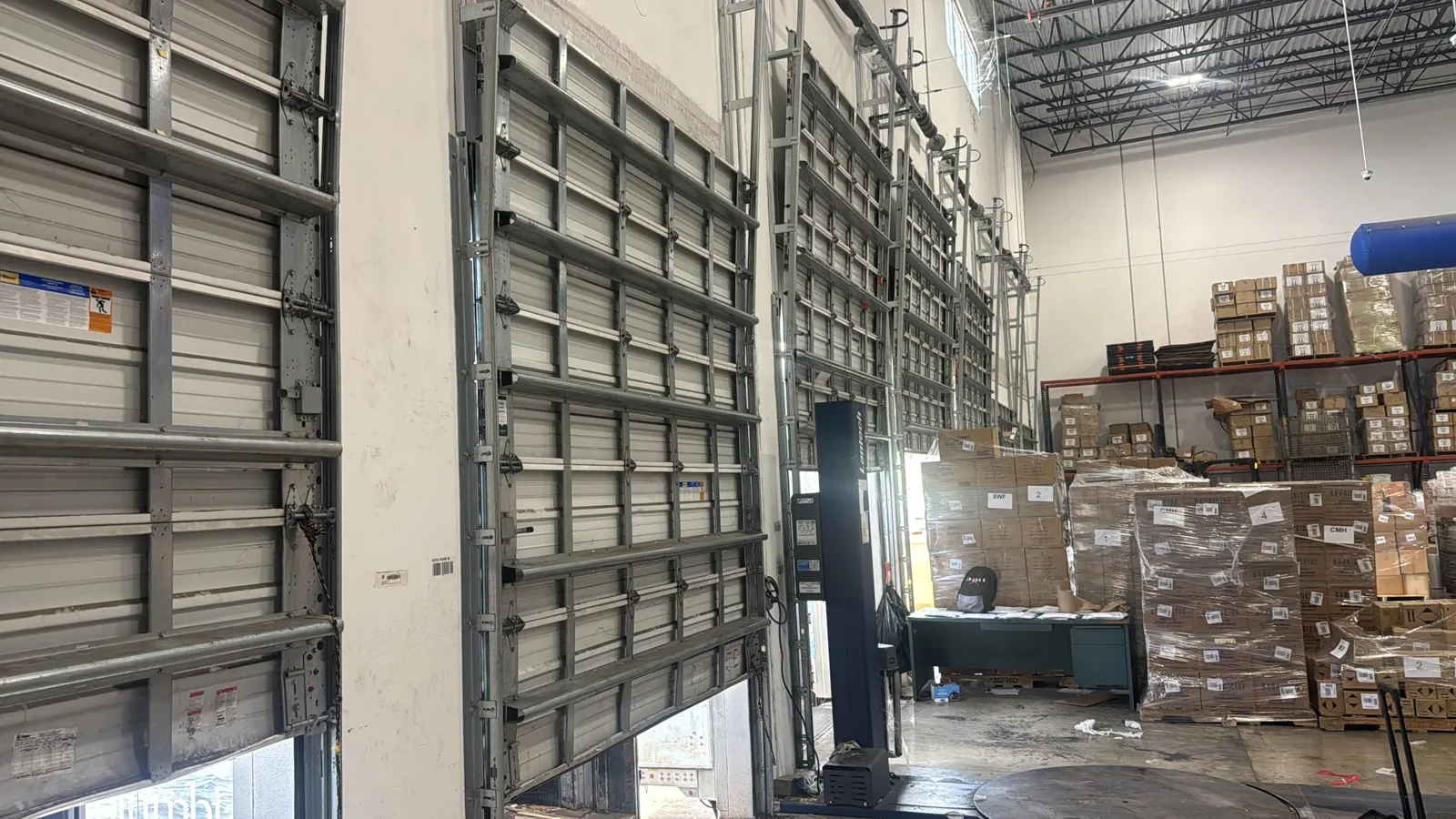
A visit to a rear garage on a hill starts with logistics: curb space for the van, who else uses the drive, and whether a ladder can stand level anywhere near the door. After that, it follows a set order:
- A careful look at the door, tracks, springs, cables, rollers, hinges and seal, and at how the door meets the slab.
- A balance check with the opener released, where it is safe to lift the door by hand.
- A run of the motor to test its down limit, the photo eyes, the button by the side door and each remote.
- An explanation of what has failed, why, and what the choices are, before any work starts.
- The repair, then several open and close cycles to check the door stops properly on the slope and reverses when the beam is broken.
On a shared driveway we try to keep the work tidy and the drive passable. If a part has to be brought back on another visit, the door is left closed and secure.
Mend the old door or hang a new one
Many doors behind three-deckers and Victorians here can be repaired, and repairs are the right answer for a spring, a cable, rollers, hinges, a single damaged section or a worn seal. Replacement enters the conversation once the lower sections have been driven against a sloping slab until they crack and bow, when damage runs across three or more sections, when an old timber door has softened along its bottom edge, or when the door has become too heavy for any spring to balance well.
We supply and install new doors, residential and commercial, and remove old ones. A new door for a garage on a hill is hung with the slope in mind: its bottom seal, the motor’s stopping point and, where needed, a raised threshold strip are all matched to how far that particular slab falls away. See new garage doors in Roxbury for details.
Things to think through:
- Does the problem come from the door, or from a slab that has dropped or a jamb that has moved?
- How many households use the door, and how often?
- Is the garage still used for a car, or now mainly for storage?
Winter on a sloping drive
Cold weather is hardest on garages that sit up a grade. Shovelled snow tends to get heaped against the jambs, and as it melts the water runs to the low corner of the threshold and refreezes overnight. Grit and road salt carried up the hill on tyres collect in the same spot, wearing the rubber seal and rusting the bottom bracket where the lift cable is anchored. Springs, which are steel under constant load, are more likely to break when the temperature drops sharply, and a door that was already working hard on an uneven slab is the one most likely to fail first.
A little attention before the season helps. Keep the threshold clear of packed snow, sweep grit away from the bottom seal, and watch for the low corner beginning to rust or the seal beginning to split. If the door already gaps at one side, that gap is where ice will form, so it is worth sorting out before the first hard freeze rather than after it. Rollers that grind in the cold, or an opener that strains on frosty mornings, are both early signs that something in the balance has changed.
Row houses with no garage, and lots that have one
Not every house here has a garage, and the ones that do vary a great deal. A row house may have nothing but a parking space on the street. A three-decker’s garage may sit far behind the back porches, with only a thin ribbon of paving leading up to it. A Victorian’s rear outbuilding may carry an overhead door fitted long after it was built. Each of these brings its own constraints on headroom, side room and track layout.
That variety is why we ask a few questions before a visit: how old the garage is, what kind of springs the door has, how the opener is mounted and how the garage is reached. It helps us arrive with the right parts for that building, rather than assuming every garage is the same.
Garage doors in Roxbury are as varied as the lots they sit on, and a good repair starts from the building in front of us. We also cover many other neighbourhoods and towns; the full list is on the service areas page.
Next steps
If your door has started to grind, scrape, gap at one corner or labour on the hill, book a look while it still runs, not after it quits with the car shut inside. Mention the symptom, any spring or cable damage visible from the floor, and how steep and how shared the drive is. For garage doors Roxbury MA homes have at the top of a slope or at the end of a shared drive, call us or book online.
Questions from Roxbury
Our garage floor slopes and the door leaves a gap at one corner. Can that be fixed?
Usually, yes. Depending on the size of the gap, a taller bottom seal, a threshold seal on the floor or a change to how the door and opener are set up will close it. What should not be done is forcing the door down harder with the opener, which strains the bottom section and hinges.
We share our driveway with the house next door. Will a repair block it?
We ask about this when you call and plan the visit around it. Tell us when the drive needs to be clear, and where a van can stop, and we will keep the drive passable as far as the job allows.
Ice has glued the bottom of our door to the slab. Can the motor just pull it loose?
It may, but at a cost. Driving the motor against an iced-in door rips the rubber seal and bends the lowest section, and it is hard on the gears. Release the opener, clear and thaw the ice along the bottom, and if the door still will not move, call us.
Something went off like a shot in the garage, and the door has been dead ever since. Why?
A snapped spring, almost certainly. Keep the motor switched off and leave the door down where it sits. A torsion spring holds dangerous tension and should only be dealt with by someone trained for it. Call us and we will tell you what to do in the meantime.
Is it worth repairing an old door on a steep driveway, or should we replace it?
Many old doors repair well. Replacement makes sense when the lower sections are cracked from years of closing on an uneven slab, when several sections are damaged, or when the door is too heavy to balance. We will tell you plainly which we would choose.