
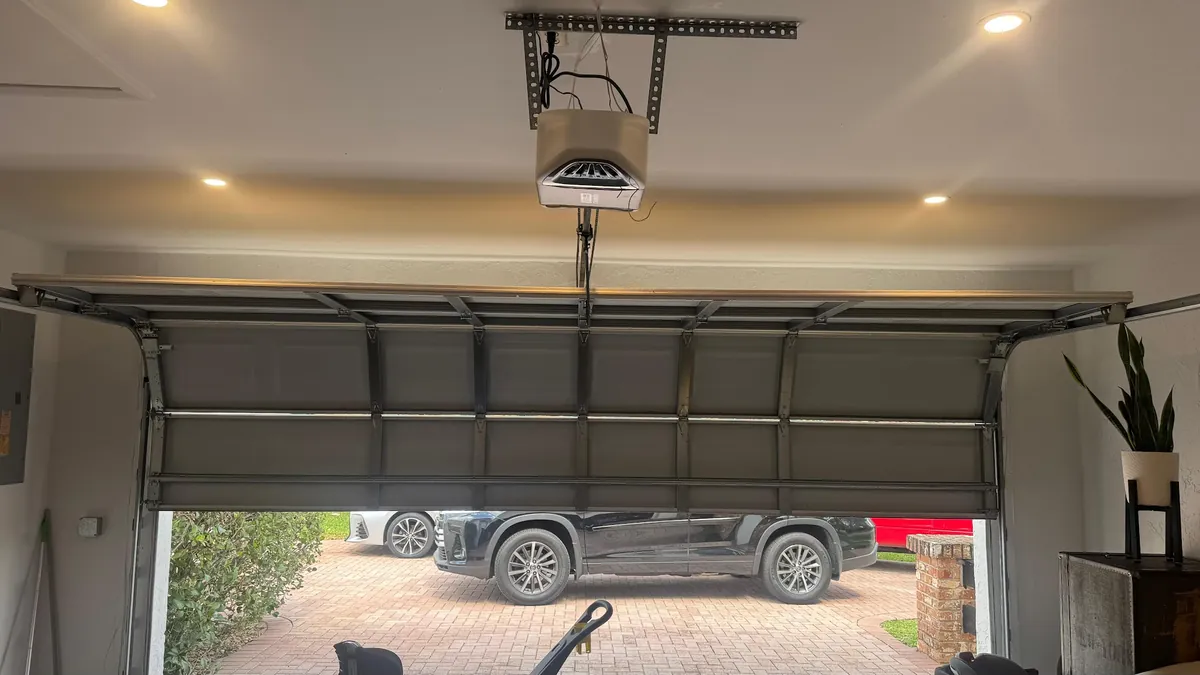
An opener bolted under someone’s living room
In the Federal row houses south of the Common, the garage, where a house has one, tends to be one narrow bay let into the ground storey, and its opener hangs from a ceiling that is the underside of the room above. Every start, stop and rattle of that motor travels through the joists. Garage door opener repair in Bay Village, MA therefore covers more than whether the door moves: it is also about how the opener sounds upstairs, how safely it closes onto a street with no driveway in front of it, and whether a replacement will fit a ceiling that was never planned for one.
Openers here also work harder than their size suggests. With nowhere else to leave a car, the bay is often the everyday way in and out, so the motor, the remote and the sensors are used several times every day.
Before you call, three quick tests narrow down the fault:
- Press the inside button. If the door runs from there, suspect the handset before the motor.
- Watch the small lights on the sensors beside the door. A dark or blinking light points to the safety eyes.
- Listen at the motor. A hum with no movement often means a stripped gear or a door too heavy to lift.
Opener faults we fix
Motor and drive
Gears worn smooth, a chain gone slack, a belt slipping on its sprocket, or a motor that hums and does nothing.
Remotes and keypads
Handsets that stop working, need pressing several times, or only work from right outside the door. Codes cleared and handsets paired again.
Wall buttons
A button by the inner door that does nothing, often a broken wire or a worn switch rather than a failed opener.
Safety sensors
Lenses knocked out of aim, dirty, or wired loose, which stop the door from closing or make it reverse for no visible reason.
Limits and force
A door that stops short, reverses on the floor or presses down too hard, because the opener’s settings no longer suit the door.
Replacement openers
Openers past repair replaced and set up to suit the bay’s ceiling height and the door’s weight.
How an opener actually works
An opener does not lift a garage door so much as steer it. The springs carry the weight, and the motor hauls a carriage back and forth along a rail stretching from the motor head to the door’s top edge. A curved arm links the trolley to the door, so as the trolley travels, the door is pushed down or pulled up its tracks. The motor turns through a set of gears, and the trolley is pulled by a chain, a belt or a threaded screw depending on the model.
Two kinds of setting govern every opener. Travel limits tell it where the door should stop at the top and at the bottom. Force settings tell it how much resistance is normal before it should give up and reverse. A logic board reads both, alongside whatever arrives from the handsets, the inside push button and the photo eyes, and decides what the motor does next.
When something goes wrong, it is usually one of four things: the door is no longer balanced and the opener is struggling against its weight, a drive part has worn, a setting has drifted, or one of the signals the board relies on has stopped arriving. Working out which it is starts with the door, not with the motor.
Garage door opener repair in Bay Village starts with the door
Many opener calls turn out to be spring calls. A weakening spring leaves the door heavier every week, and the opener absorbs the strain until a gear strips or the board decides the door is blocked and refuses to move. Replacing the gear without fixing the spring only starts the countdown again. So every visit for garage door opener repair in Bay Village begins by releasing the door from the opener and lifting it by hand. A door that feels heavy, drifts down or springs up is a balance problem first; see our spring repair page for this neighbourhood for that side of it.
Once the door proves balanced and moves easily in its rails, attention moves to the opener itself: gearing, drive, trolley, end stops, closing pressure and each signal feeding the board. Handsets, the inside push button and the photo eyes are tried one by one, so a fault in one is not mistaken for a fault in another.
A motor overhead, a room above it
Bay Village bays are built under living space, and that changes what counts as a good opener repair. A chain drive that clatters, a loose rail that rattles against its hanger, or a motor bolted straight to the joists can be heard clearly in the rooms above. Some of that noise can be fixed with ordinary repair: a tightened chain, a straightened rail, new hanger brackets and fresh rubber isolators between the motor and the ceiling.
Where the opener is simply loud by design, replacement is worth talking about. Belt-driven openers tend to run more quietly than chain drives. In bays where the ceiling is especially low or the space above the door is crowded, a wall-mounted opener that turns the spring shaft directly from the side can leave the ceiling clear altogether. Which option suits a particular bay depends on the headroom, the door and the spring system, all of which are checked before anything is suggested.
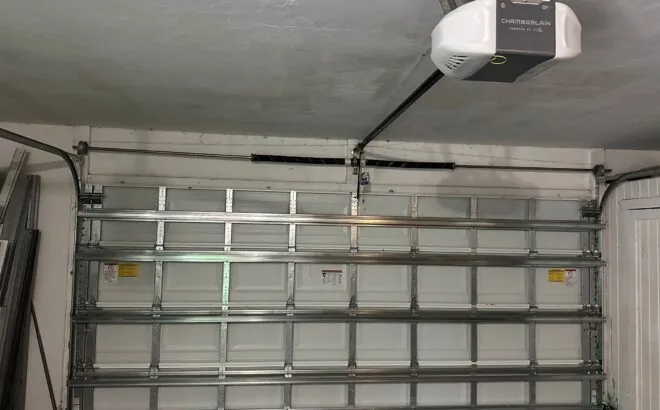
Sensors on a door that opens onto the pavement
In a suburb the safety sensors guard a driveway. In Bay Village they guard a sidewalk. A bay with no driveway opens directly onto the street, so when the door closes, the space under it is a space where people walk, push strollers and wheel bins. The paired eyes at ankle height either side of the doorway are what tell the opener to stop and reverse if anything is in the way, and on these streets they earn their keep.
They also give the most trouble. The sensors sit low beside the door, where a bin, a bicycle wheel or a broom can knock them out of aim. Street grime and road spray film over the lenses. Bright morning sun shining straight into a bay facing the street can confuse a receiving eye. The wires that feed them run along the wall at floor height, where they are easy to snag. Any of these will leave a door that refuses to close or reverses halfway down.
A visit cleans and realigns the eyes, secures or replaces their wiring, and tests the reverse with an object placed under the closing door. If you see a blinking light on a sensor, wiping the lenses and checking that nothing is leaning against them is a safe first step.
What a visit involves
- The door is released from the opener and lifted by hand to check balance, rollers and tracks before the motor is blamed.
- Inputs are tested one at a time: each remote, the wall button, any keypad and both sensors.
- The opener is run on its own, listening to the motor and gears and watching the trolley, chain or belt along the rail.
- You are told what failed and whether it is a repair or a case for replacement, before work starts.
- Parts are fitted or the opener replaced, with everything carried in from the street and assembled inside the bay.
- End stops and closing pressure are adjusted for this particular door, and the safety reverse is proved with an object under the door.
- Remotes and keypads are paired so every handset in the household works.
Repair or replace the opener
Plenty of opener faults are ordinary fixes: a drive gear with its teeth worn down, a chain hanging loose, a split carriage, a dead eye, a snapped push-button wire, a handset that has forgotten its code. Repair stops being worthwhile when the circuit board of an ageing unit has burnt out, when parts are no longer made, when the motor is wearing out as a whole, or when the opener lacks working safety sensors altogether.
Replacing an opener in a Bay Village bay suits the way everything comes in here, off the street and in pieces. A new opener arrives as a motor head, a rail in sections and a box of brackets, all of which carry easily through a single door and are assembled on the bay floor before being hung from the ceiling. We repair and replace openers of the usual drive types, including LiftMaster openers. The choice of drive, and where it mounts, is made around the bay’s headroom and the noise it will make in the rooms above.
Handsets, keypads and the inside button
Handsets going dead is the most frequent small complaint. Start with a new battery. Should the handset stay silent after that, it may have dropped its pairing, or its button contacts may be worn. A remote that only works from just outside the door often points to a weak battery, a damaged antenna wire on the motor head, or interference near the bay.
A wall button that does nothing is more often a wiring fault than a dead opener. The thin bell wire that runs from the button to the motor head is easy to pinch under a staple or cut when a shelf goes up. Testing the button at the motor head separates a wire fault from a switch fault with a simple test. Keypads mounted outside a street-facing bay take the weather full on, and their seals and buttons wear accordingly. All of these are part of garage door opener repair in Bay Village, MA, and are checked on every visit.
Getting out when the motor will not run
Where the motor has died but the springs are intact, the door can usually be raised manually once the red-handled cord on the carriage is pulled, as long as the door is fully closed when you pull it. Once released, a balanced door should lift with moderate effort and stay up. Do not pull the release on a door that is open and has a broken spring, and do not force a door that feels very heavy: that is a spring problem, not an opener one. If the door will not close, or the bay cannot be secured at night, our emergency garage door page for this neighbourhood sets out the safe steps until a technician arrives.
Early warnings from a tired motor
Most openers give some notice before they quit. A motor that has started to pause before it moves, a door that halts before it is fully raised, or a chain that slaps against the rail as it runs are all early signs. So is a door that reverses now and then for no reason you can see, or a remote that works only on the second or third press. Upstairs, a new grinding note or a longer strain each time the door opens is often the first thing anyone notices.
None of these means the opener must be replaced. A slack chain can be tensioned, a worn gear changed, a drifting setting reset and a tired remote replaced. Catching the fault early, while the door still runs, means the visit can be arranged for a convenient hour rather than at the moment the door finally refuses to move with the car inside.
Cold, damp and a bay that faces the street
Winter shows up in opener calls more than in almost any other part of the door. The grease on a chain or screw drive stiffens in the cold, so the motor meets more resistance on a frosty morning. The bottom seal can freeze to the threshold overnight, especially where slush has run in from the street and refrozen against the door. The opener feels that resistance, reads it as an obstruction, and either stops or reverses. Pressing the button again and again only strains the drive; it is better to leave the door and call.
Salt and damp work on the electrics too. Sensors at floor level sit in the splash zone from the street, and their brackets rust and their lenses cloud. An outside keypad takes driven rain on its face. Inside the bay, condensation can form on a cold ceiling and drip onto the motor head. A repair visit in winter looks at all of that: freeing a frozen seal safely, cleaning and resealing the sensor mounts, and checking that the force setting is right for a door that weighs a little more with ice on it, without turning it up so far that the safety reverse stops working.
Locking a bay that opens onto the street
An opener does more than move the door; while it is engaged, it also holds the door shut. With the trolley connected, a closed door cannot easily be pushed up from outside. Once the release cord is pulled, that protection is gone, and on a street-facing bay with no driveway between it and the pavement, that matters.
If you have had to release the door to get a car out, the trolley should be reconnected before the bay is left, or the door secured with its manual lock if it has one. A visit for an opener fault always ends with the trolley re-engaged and the door tested to confirm it holds closed. Where the old door has a slide lock that has seized or been removed, that can be looked at on the same visit, so the bay is not relying on the opener alone.
Book an opener repair
Describe the sound the motor makes, whether the inside push button and the handset behave alike, and the colour or blinking of the lights on the eyes. That is the surest way to the right parts for garage door opener repair in Bay Village, MA. For anything wider than the opener, see our repair page for doors in Bay Village; if the door itself is past saving, our page on new doors for this neighbourhood covers replacement. The Boston-wide opener repair and replacement page and the Bay Village page have more. To have the opener looked at, call us or book online.
Opener questions from Bay Village
There is a hum from the motor and the door stays put. Why?
Often a stripped drive gear, or a door so out of balance that the opener cannot shift it. Release the door and try lifting it by hand: if it is very heavy, the spring is the likely cause and should be checked first.
Can a quieter opener be fitted in a garage under the house?
Usually. Belt drives tend to run more quietly than chain drives, and isolating the motor from the joists helps further. Where headroom allows, a wall-mounted opener can take the motor off the ceiling entirely.
My door goes down, touches the ground and goes straight back up. Why?
The opener believes something is in the way. A sensor knocked out of line, a dirty lens or a close-force setting that no longer suits the door are the usual causes, and each is checked on a visit.
Is a LiftMaster opener something you handle?
It is. We repair and replace LiftMaster units, as well as the other common chain, belt and screw drives.
Can new remotes be added to my existing opener?
In most cases, yes, provided the opener’s receiver still works. Handsets and keypads are paired on the visit and tested from the street side of the door.