
Single garages tucked behind triple-deckers
Walk any block in Cambridgeport, North Cambridge or Porter and count the garages. It will not take long. Most lots carry a triple-decker or a Victorian built close to its neighbours, and a great many have no garage whatsoever; cars spend their nights at the kerb, each with its resident sticker. The lucky lots keep a little detached box out back, and the strip of drive leading to it is seldom much wider than a hatchback.
Those little garages are prized precisely because they are rare, and the garage doors Cambridge MA owners keep on them earn their keep. Whoever has one tends to rely on it: for the car, for bikes, for the things that do not fit in an apartment. When its door jams, there is rarely a second garage to fall back on and seldom a spare space on the street.
The door in a garage like this is usually a single sectional or an old one-piece door, light by suburban standards but worked hard and squeezed into a tight frame. What tends to fail:
- The spring, after a long run of daily lifts, often in the first real cold of the season.
- The opener or its sensors, nudged by bikes, bins and the tight turn into the garage.
- The tracks and frame, scuffed by mirrors and bumpers on a narrow approach.
What we do for Cambridge garages
The garage doors Cambridge MA lots still have are few, small and hard-working, and every service we offer for them has its own Cambridge page. Doors that grind, hang crooked, will not seal or have been clipped by a car come under Cambridge garage door repair. A coil that has parted above the opening is handled by spring repair in Cambridge. The motor unit, its handsets, keypad, wall push button and safety beams are looked after by Cambridge opener repair and replacement. And for a back-lot door jammed wide open at night, ring our Cambridge emergency line.
Over the town line, hubs for Somerville, Watertown, Belmont and Arlington cover garages of a similar kind, and our service areas page has the complete list.
Cambridge’s own local pages do not include replacement doors, but new doors are supplied and installed here too when repair stops making sense; there is a section on that lower down.
The narrow driveway
On these lots the driveway is often a single strip of asphalt or two concrete runners squeezed between the house and the lot line, sometimes shared with the house next door. It may be lined by a fence on one side and a porch or a bulkhead on the other. A car fits; not much else does.
That squeeze shapes the work in a few ways. Parts arrive on foot from the street, carried down the drive past the house. A long spring bar or a length of rail has to be threaded through without catching siding, railings or a neighbour’s car. A full door swap means finding somewhere on the lot to stand the old sections while the new ones go in.
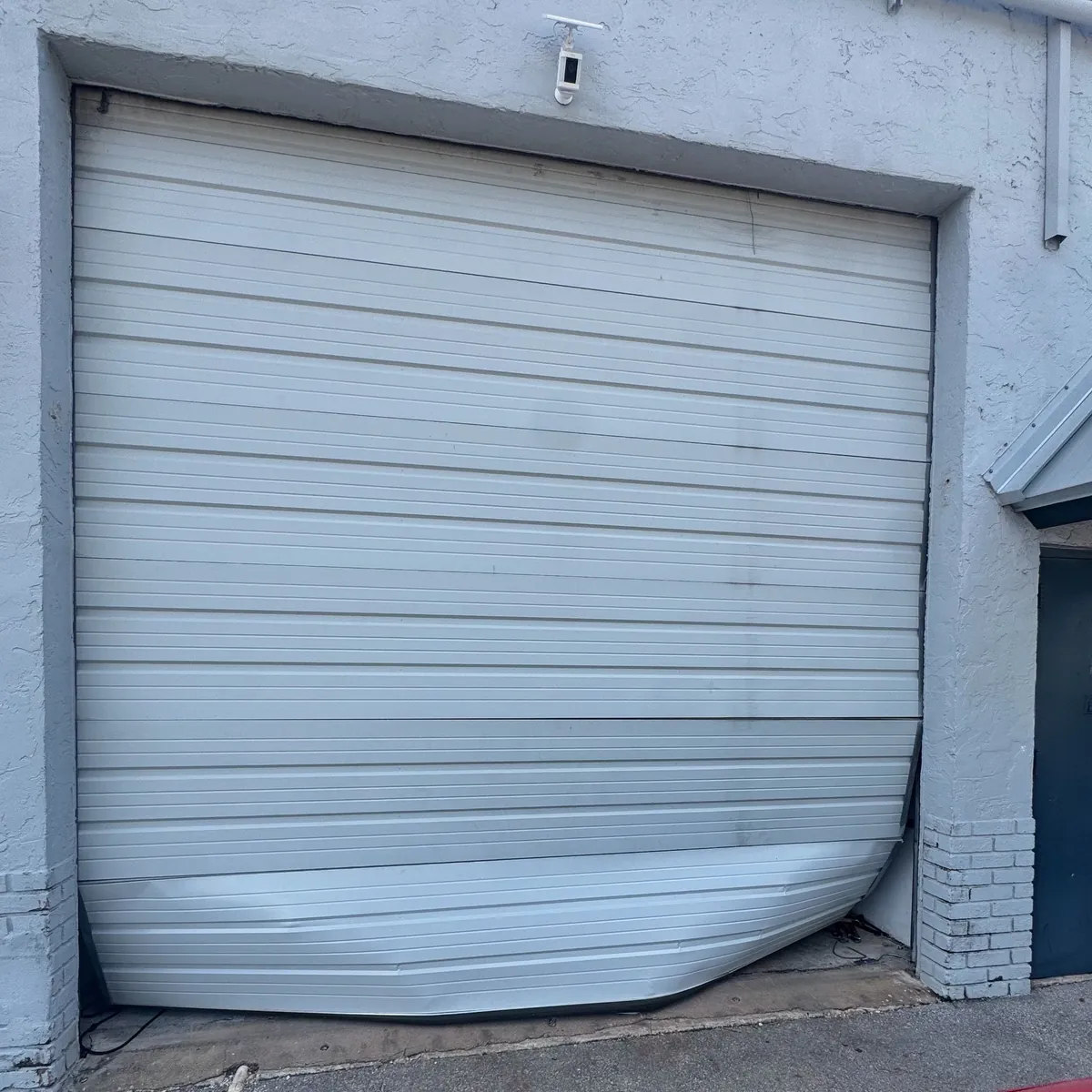
It also shapes the damage. A narrow approach with a tight turn means mirrors, bumpers and the corners of cars come close to the door frame every day. Scuffed jambs, a vertical rail knocked inward near the floor and a dented bottom panel are all common results, and a rail pushed in by even a small amount can make a roller bind or jump.
Where to park the van
Permit parking is the rule on most streets here, not a driveway, and the one driveway the house has usually leads to the garage being worked on. When booking, tell us how parking works on your block: whether there is a visitor permit, whether the driveway can hold a vehicle without blocking the garage, and whether there is a time of day when the street is easier.
Most repairs need only tools and parts carried down the drive, so parking a short way off is usually fine. Larger jobs that involve long parts or a whole door need a vehicle closer, and those visits are arranged with parking in mind.
Small garages, tight clearances
A small detached garage on a city lot was often built for a car narrower and lower than most of what is driven now. Inside, there may be just enough headroom for the door to clear the roof of a car, and just enough side room for the tracks and a person to squeeze past.
Those dimensions limit the hardware. Low headroom decides where a torsion spring can mount and sometimes means a low-clearance rail kit. Tight side room decides how the vertical tracks and their brackets sit. An opener needs space above the door for its rail and motor head, and in some garages that space is only just there.
When anything is replaced in a garage this size, it has to fit the room the building gives, not a standard template. That is especially true of springs and openers, where a part that suits a larger garage may simply not fit.
The spring over a small door
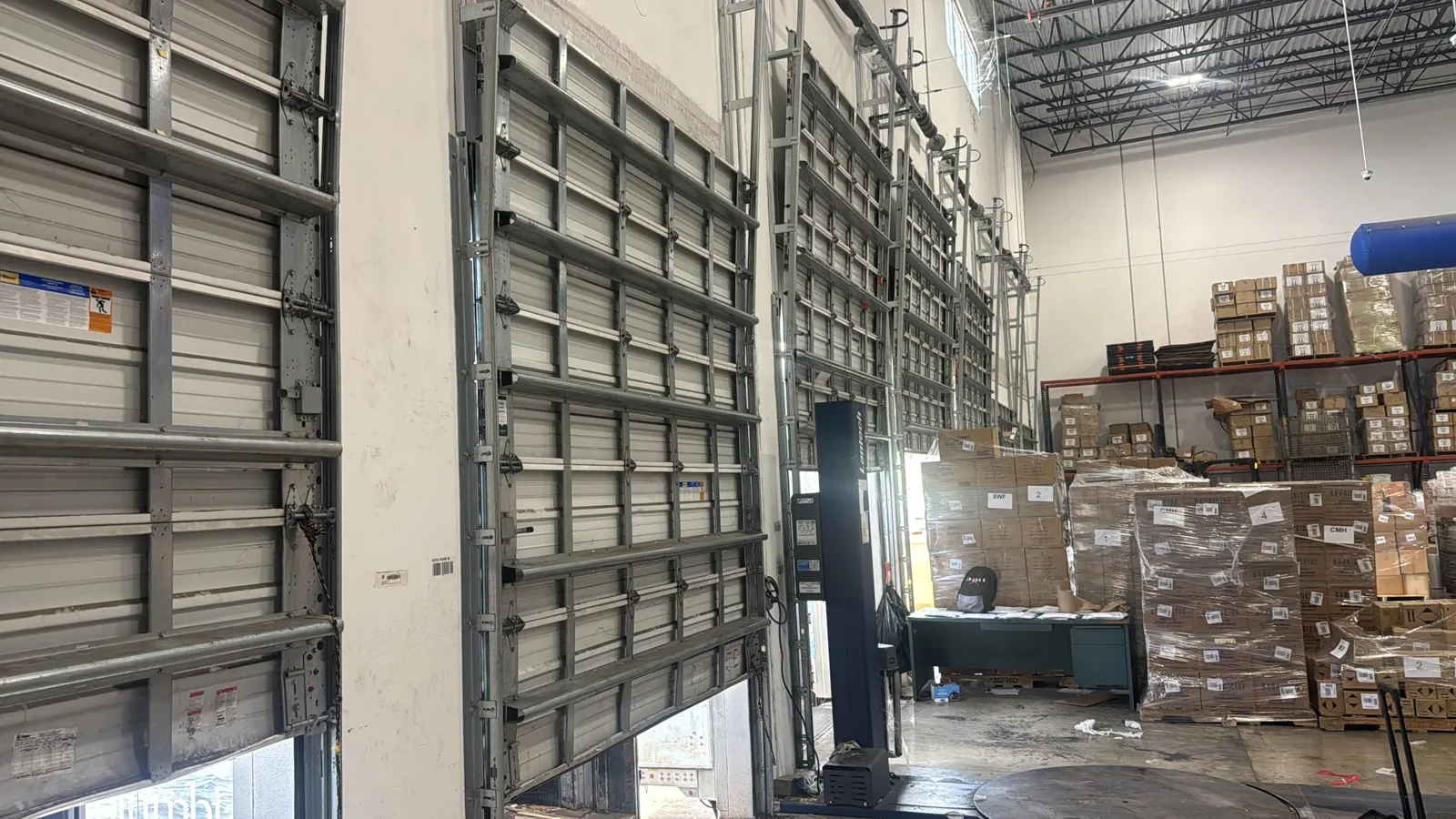
Even a single door is far too heavy to lift easily without help, and the spring provides that help. Most of these garages use a torsion coil across the lintel; a few older doors still ride on two extension springs stretched beside the ceiling rails.
Worn-out coils rarely give notice. Someone in a back bedroom hears a crack from the far end of the yard; next morning the door is a deadweight, or the motor whines, lifts it a hand’s breadth and quits. From the floor, with your hands off everything, the break is usually visible as a gap between two coils.
Small garage or not, a torsion spring holds dangerous tension, and swapping or winding one is not a DIY repair. The stored energy can injure badly if a tool slips. Shut the side door, unplug the motor unit so no housemate absent-mindedly presses the button, and then get in touch.
Doors carrying twin coils generally get both renewed at once, as the unbroken coil has lived through every one of its partner’s cycles. Replacement coils are picked for the door’s present heft, extra coats of paint, patched sections and all.
Openers on a tight lot
In a small garage, the opener lives a crowded life. Bikes lean against the wall under the safety beams. Recycling bins get parked inside on bin day. Children’s scooters, a lawnmower and garden tools all compete for the strip of floor beside the car.
The faults that follow from that are predictable:
- The door starts to close and then reverses, because one of the sensor units low on the jambs has been knocked or blocked.
- The motor whirs while the door barely shifts, a sign that the coil has parted and the motor is struggling against the full load alone.
- A remote works only within a few feet of the garage, a tired battery or a receiver that needs attention.
- The wall push button does nothing, from loose wiring or a fault in the motor unit’s board.
Our opener work covers repair and replacement, LiftMaster units included, and in a garage this size each one is set up to fit the headroom and to stop and reverse correctly for the door it drives.
A door stuck open behind the house
A back-lot garage stuck open after dark leaves the car, bikes and stored belongings reachable from the driveway, and on a narrow lot that driveway may also be a route to the back door of the house.
Nobody needs to wait for morning: the line is staffed whatever the hour. It helps to know whether you heard a snap, whether the door hangs level or slumps to one side, whether a cable is loose, and how close the nearest parking is.
Spring gone and door up? Then let it stay up. Without its counterbalance a door can crash down. Cut the motor’s power, keep bodies out of the doorway and lock up the house itself.
Cables, rollers and a door off its rails
On a small door, one frayed cable is enough to throw the door crooked: one corner sits down while the other stays up. A roller with a worn wheel, or a rail pushed in by a car, can let a roller jump free so the door tips or jams.
A door that has jumped its rails stays exactly as it stopped, with the car kept well away. Running the opener against it, or pulling it by hand, can bend the rails and crease the panels. Both cables are replaced together, worn rollers are renewed, and bent rails are straightened or replaced so the door runs true.
Safe things to check first
There is a short list of checks anyone can make:
- Check the twin sensor units bolted near the foot of each jamb: wipe the lenses and shift any bike, scooter or bin standing in the beam.
- Change the remote’s battery, then compare it with the wall push button.
- Check that the garage has power, by flicking the light, and look at the breaker if it does not come on.
- With the door closed, look along the tracks for anything caught in them, such as leaves, gravel or a dropped glove.
The spring, cables, drums and bottom brackets are under load at all times. Leave them to us.
Shared driveways and neighbours
On many lots the driveway is shared with the house next door, or runs along a lot line so close that the neighbour’s fence, porch or windows are within arm’s reach. Work on the door is done with that in mind. Tools and parts stay on your side of the drive, the drive is kept passable for the neighbour’s car where it can be, and noisy steps such as cutting or drilling are kept short.
If the drive is shared, it helps to let the neighbours know a visit is coming, especially for a longer job like a door swap. That avoids a car being blocked in at the wrong moment and gives everybody a clear idea of how long the drive will be busy.
Triple-decker garages used by several households
Behind a triple-decker, one small garage can serve more than one unit. Several people with several remotes, a keypad code shared around, and a door that goes up and down for each of them: that adds up to far more cycles than a single household’s garage. Springs, rollers and the opener all wear faster as a result.
When the garage serves more than one unit, a couple of habits help. Keep track of how many remotes are in use and who has them, so a lost one can be cleared from the opener. Agree who will call when the door fails, and who owns the decision on repair or replacement, so a broken door does not sit for days while everyone waits for someone else. For garage doors Cambridge MA triple-deckers share between units, a little organisation saves a lot of time.
Weather on a small, unheated garage
These garages are usually unheated, often single-skinned and close to the ground. In cold snaps, springs become more brittle and the grease on rollers and hinges stiffens, so a worn spring that has been on its way out for a while finally breaks. Snow piled at the end of a narrow drive by a plough can block the door entirely, and meltwater trickling down the drive can lock the rubber astragal to the concrete overnight.
Clearing snow away from the threshold before using the door, and not forcing a door that is frozen down, both save wear. If the door is stuck to the slab, a little warmth along the bottom rubber, or simply waiting for the afternoon sun to reach the end of the lot, frees it far more kindly than the motor can. Jabbing at the wall button while the door is glued down just punishes the motor, the cables and the lowest panel.
On a lot shaded by the house next door, the apron in front of a small garage can stay icy long after the street has cleared, so a door that worked at noon may stick again by evening. A cracked or flattened bottom seal can be replaced so the door closes neatly and keeps out water and draughts.
Fix it, or fit a fresh door
Most of the small doors here deserve fixing. Fresh coils, a matched pair of lift cables, new rollers and a re-tuned motor can give a sound single door plenty more seasons of service. Sometimes, though, a door has reached its limit:
- Panels are cracked, rotted or creased by car contact, with no matching sections available.
- The door is an old one-piece type that no longer runs safely or reliably.
- Most of the moving parts are worn at once.
- The frame or opening has been reworked and the existing door no longer fits it.
A replacement door is ordered to the measured opening and brought in with the slim approach in mind, and fitting one on a lot this tight is planned around access from the street. Our new door installation page covers the process, and the off-track repair page explains rails, rollers and realignment in more depth.
A word on choosing: on a lot this narrow, the door is seen mainly from the driveway and from the windows of the house itself, so a plain, light, well-sealed door that runs quietly often serves better than anything elaborate. Insulation matters if the garage doubles as a workshop or bike room in winter.
What a visit involves
A visit starts at the end of the driveway. Every working part gets a look, coil to weatherstrip, motor to sensor. We show you what has failed, what is tiring and what can be left alone, and nothing goes ahead without your agreement. Once the fix is in, the counterbalance is set, the door makes several complete trips, and the motor’s limits and safety reversal get proved.
For garage doors Cambridge MA owners open every day on a cramped lot, getting that balance right is what keeps a small door from wearing out its spring and its motor early.
Book a visit
Let us know how the garage is reached, how parking works on your street and what the door is up to. With garage doors Cambridge MA houses keep at the back of narrow lots, those details shape the whole visit. Broken coil, sulky motor or a door stuck gaping: call us or book online.
Questions from Cambridge
We have permit parking only. Is that a problem for a repair visit?
Not usually. Tell us how parking works on your block when you book. Most repairs need only tools and parts carried down the drive; for larger jobs, the visit is planned around where a vehicle can stand.
Our driveway is very narrow. Can a spring or a door still be replaced?
Yes. Parts are carried in on foot and angled past the house, and a full door is planned around the space available on the lot.
Our garage has very little headroom. Can it still have an opener?
In many cases, provided the motor unit and its rail fit the gap between door and rafters. The headroom is measured and the options for that garage explained.
Why does our door bounce back up just short of closing?
Usually a sensor unit near the floor has been knocked or blocked by a bike or bin, or the bottom rubber is landing on ice or grit along the sill. Clean and clear the sensors first; if that does not help, call us.
Can a snapped coil wait until tomorrow?
With the door down, yes; unplug the motor and let it be. With the door up and the garage open to the drive, phone us whatever the hour.