
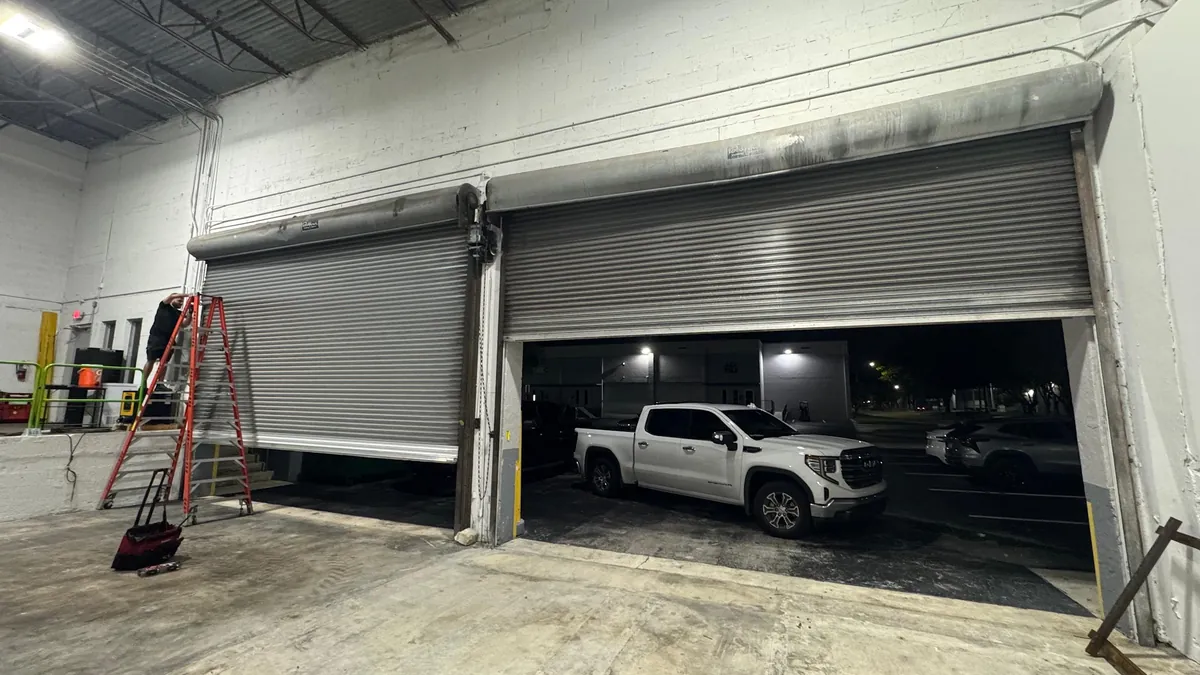
From a tiny antique opening to a modern two-car bay
The houses in the center are antique colonials, and where they have a garage at all, its opening can be very small: narrow, low, framed in old timber and sized for something far smaller than a modern car. Out on the wooded lots, larger newer houses have modern two-car garages with standard openings and heavy insulated doors. Between those two ends, nearly every size turns up. That range is what defines garage doors Concord MA houses carry, and it decides how almost every repair or replacement is approached.
A small antique opening and a wide modern bay fail in different ways. The old one tends to suffer from tight headroom, settling timber and parts that were never quite designed for it. The new one fails through weight and heavy use, with big springs, long cables and an opener that works hard.
Stand well back, keep your hands off the hardware, and check:
- Is the door level in its opening, or does one side sit lower?
- On the shaft above the door, is the spring a continuous coil, or is there a clear gap?
- Does the door run clean, or scrape a jamb as it rises?
Garage door services in Concord
Repairs, large or small
Splitting hinges, worn rollers, rails pulling out of old timber, cracked panels on wide modern sections. Our garage door repair work is matched to whichever end of the size range your garage sits at.
Spring replacement
A spring is sized to the door it lifts, so the coil for a tiny antique door and the pair on a wide insulated door are very different parts. Read about garage door springs.
Openers fitted to the space
Some low antique garages leave little ceiling for a rail; wide doors need a motor with real pulling power. Repairs and replacements, LiftMaster among them, under opener services.
Calls in the small hours
A wide door stuck partway with a storm on the way, or a small old door that will not shut. Someone is on the line overnight, so emergency garage door repair can be arranged once the door is safe.
Lift cables and drums
On a two-car door the cables carry a great deal of weight; on an old door they may be a short run in a cramped corner. Either way they go on as a pair. More on cable repair.
Off-track doors and made-to-fit new doors
Derailed doors are put right through off-track repair. When a door is finished, new garage doors are supplied and fitted, measured to the opening even when it matches no standard size.
Why the size of the opening matters so much
A garage door is a system sized as a whole. The width and height of the opening decide the size and weight of the door. The weight decides which springs will balance it. The springs and the room above the door decide how the tracks are hung. The tracks and the ceiling decide what kind of opener will fit. Change one, and the rest follow.
That is easy to manage when the garage is modern and the opening is standard. It is harder when the opening is small, irregular or low, as it often is beside an antique colonial. Parts for a standard door may not suit. A spring rated for a standard door may be badly mismatched. An opener that expects a long ceiling may not have one.
So the first thing we want to know about a Concord garage is which end of the range it sits at. A quick description over the phone is often enough to tell us whether we are dealing with a narrow, low antique door on its own timber frame or a wide insulated door with a pair of springs and a heavy-duty motor. It tells us what to expect, what to bring, and what questions to ask before we set off.
At the small end: antique openings in the center
Many of the antique colonials in the center were built long before cars, and their garages came later, fitted into whatever room the lot and the existing buildings allowed. The openings that resulted can be very small: narrower and lower than a modern opening, with old timber framing that has moved over the years.
Doors in these openings have a few recurring problems.
Headroom
Above the header there is often only a sliver of room before rafters or a ceiling begin. A torsion spring and its shaft need room over the header, and in some of these garages the room is not there. Extension springs along the overhead tracks, or a low-headroom track arrangement, may be the only workable choice.
Framing that has shifted
Old timber settles, shrinks and twists. The rails are screwed into it, and when it moves, the rails move too. A door that has started to bind on one side may be fine in itself; the jamb or the header may have shifted. Fixing the door means fixing the fixing points first.
Parts that were never quite right
Over the decades, some of these doors have been repaired with whatever was to hand. We sometimes find springs that do not match each other, rails that were cut to fit, and openers that were never sized for the door. Part of the job is setting that right so the door balances properly.
At the large end: newer houses on wooded lots
Away from the center, the larger newer houses sit on wooded lots, and their garages are what modern building expects: two-car bays, standard openings, sound framing, plenty of headroom and an opener on a long ceiling. The doors are usually insulated steel sections, heavier than they look.
Those doors bring their own issues. A wide door relies on two torsion springs, long cables and a stout opener. When a spring breaks, the remaining one cannot lift the door alone and the shaft twists. Long horizontal rails need the door’s struts and hinges in good order or the sections sag. The trees add leaves and needles that drift into the rails, shade that keeps the bottom seal and brackets damp, and the odd branch that strikes a door left partly open.
The size of these garage doors Concord MA newer houses use also means more is at stake when something goes wrong. A wide door off its tracks is heavier and less predictable than a small one.
Springs, whatever the size
From the smallest antique door to the widest insulated one, the coils carry the load. The motor merely steers.
Every torsion spring holds dangerous tension, which is exactly why winding one calls for purpose-made bars and a fixed sequence of moves. A single slip can let a bar whirl round under the coil’s full force. On no door in this town, tiny or huge, is it a DIY repair, and the quarter-turn owners try when a door creeps down is just as risky. Extension springs, the usual choice in small, low garages, each need a restraint cable through their core so that a snapping spring stays put.
How a coil failure shows itself barely changes with size: a crack like a dropped beam, a door that refuses to climb, a motor that labours then quits. Leave the door shut, stay out from under the shaft, and ring.
When one of two coils on a wide door lets go, its partner has done identical work for identical years and rarely lasts much longer. Swapping both is what we normally suggest, with the reasons spelled out; the decision is yours.
Cables at either end of the range
The cables climb from the door’s lowest corners to drums on the spring bar, or thread over pulleys on an extension-spring setup. On a small antique door they may run through a cramped corner, chafing against old timber. On a wide modern one they hold up a great deal of weight over a long run.
Once a cable frays, parts or unspools, its side of the door sinks. The door hangs askew and what remains of the lifting system is pulling crooked. Leave the wall button alone and give the door a wide berth. Fresh cables always go on two at a time, and the whole door is then rebalanced.
Openers sized to the door and the ceiling
An opener has to match two things at once: the door it pulls and the room it hangs in. On a small, low antique garage, the ceiling may be too short or too low for a standard rail, and the choice of opener is driven by what will physically fit. On a wide modern door, the opener has to have the strength for the weight and the durability for frequent use.
Motors are repaired or swapped, LiftMaster ones among them, and so are handsets, keypads, wall buttons and the photo eyes. Before blaming an opener, we look at the door. A door that is out of balance, binding in shifted rails or carrying a broken spring will wear out any opener fitted to it.
The safety sensors, the pair of small eyes set low on each side of the opening, are a frequent cause of trouble at both ends of the range: knocked out of line by bins and bikes in a busy modern garage, or mounted on old framing that has moved.
Doors that leave their rails
On a newer two-car door, the usual causes are a car catching the door before it is fully raised, a cable failing on one side, or a roller cracking. On a small antique door, rails screwed into shifting timber can creep sideways until a roller drops clear.
In every case, the door is still connected to its springs and may move unexpectedly. Stay clear, keep the opener off, and do not force it. We take the spring tension off safely, straighten or replace the rail, refit rollers, secure the rail to sound framing, and rehang the door. See off-track garage door repair.
Late-night failures
A wide door hung up open on a January night, or a little old door that will not latch as the house is locked, is worth a call straight away. Someone picks up at three in the morning just as at three in the afternoon. Nobody will name an arrival time; you get a fair picture of the options and some simple steps for the hours in between.
In those hours, the door is best left exactly where it stopped. One stuck high on a failed coil should not be dragged down; one sitting shut should not be prised up. The red cord that disconnects the motor is only for a door whose bottom edge is already on the ground.
Measuring for a new door
Once replacement is on the table, the tape measure matters more here than in most towns, because so many openings are not standard. Before anything is ordered, we record:
- The width and height of the opening as it actually is, taken at several points, since old openings are rarely square.
- The clearance between the top of the opening and whatever is above it, which settles the spring and rail layout.
- How far back the garage runs, for the horizontal rails and the motor.
- The room either side of the jambs for the upright rails and their brackets.
- The state of the timber the new door will hang from.
A small antique opening may need a door made to its own size rather than the nearest stock one. A modern opening usually takes a stock size, but the door’s weight, insulation and motor still need thought. We supply and install new doors at both ends of the range. More on our new garage doors page.
A door that sits well with an antique house
On the colonials in the center, the garage door is often visible from the street alongside clapboards, old windows and a front door that may be older than anything else on the road. A modern raised-panel steel door can look out of place there. On a center colonial that needs a new door, its appearance matters as much as how it works, and the door is chosen with the house in mind: plain or simply panelled faces, a finish that suits the trim, and proportions that suit a small opening rather than a wide modern one.
Out on the wooded lots, the priorities shift toward insulation, weight and quiet running, because the garage is usually attached and the door is used several times a day. Garage doors Concord MA houses carry at the two ends of the range rarely end up looking alike, and they should not.
What a visit involves
The visit opens with the door and the timber around it, looked at together. Where it is safe, the door is run while we watch. Coils, cables, drums, rollers, hinges, rails, framing, motor and eyes are then gone through one by one.
You hear what turned up, in everyday language, with urgent faults kept apart from things that can wait. Nothing is touched before you agree. With the job done, the door should hang still at mid-height with the motor unhooked; the motor is then reconnected and set for this door’s travel and weight, the auto-reverse is checked with a block in its path, and you see the result.
Repair or replace
If the door itself is sound, repair nearly always wins, since the moving hardware is built to be renewed piece by piece.
Replacement earns its place when the sections themselves are past it: wood rotted or steel rusted through, sections cracked or creased, a long record of patching. On a small antique opening it can also make sense when the existing door has never truly fitted. For garage doors Concord MA houses rely on at either end of the range, we show you the condition of the door and let you decide.
Neighbouring towns
Our work carries on into the towns next door. See Lincoln and Bedford, or the complete list of towns and neighbourhoods under service areas.
Getting it looked at
Whether your garage is a tight antique opening in the center or a two-car bay among the trees, describe what the door is doing and give us a rough idea of the opening’s size. For garage doors Concord MA homes of any age depend on, whether the opening is a narrow antique one or a wide modern one beside the trees, call us or book online.
Questions from Concord
Our garage opening is much smaller than a standard one. Can it still take a new door?
Yes. Small and irregular openings can take a door made to fit them. We measure the opening at several points, along with the headroom and the space behind it, before anything is ordered.
Why do the parts for our old garage look different from a modern one?
Because low headroom and tight framing often call for extension springs or a low-headroom track arrangement instead of a standard torsion setup. Over the years some old doors have also been patched with mismatched parts, which we put right.
Our wide door broke a spring. Can we still open it by hand?
Please do not. With one spring gone, a wide door is very heavy and can drop if the other spring or a cable fails. Leave it closed and call us.
The door has started to scrape against one side. Is the door bent?
Not necessarily. On an old garage, the framing often moves, taking the rail with it. We check the framing and the rails before deciding what needs doing.
Can an opener fit our low antique garage?
Often, yes, though the type depends on how much ceiling there is above and behind the door. We look at the space first and suggest what will fit.