
Small garages, short driveways and salt on the wind
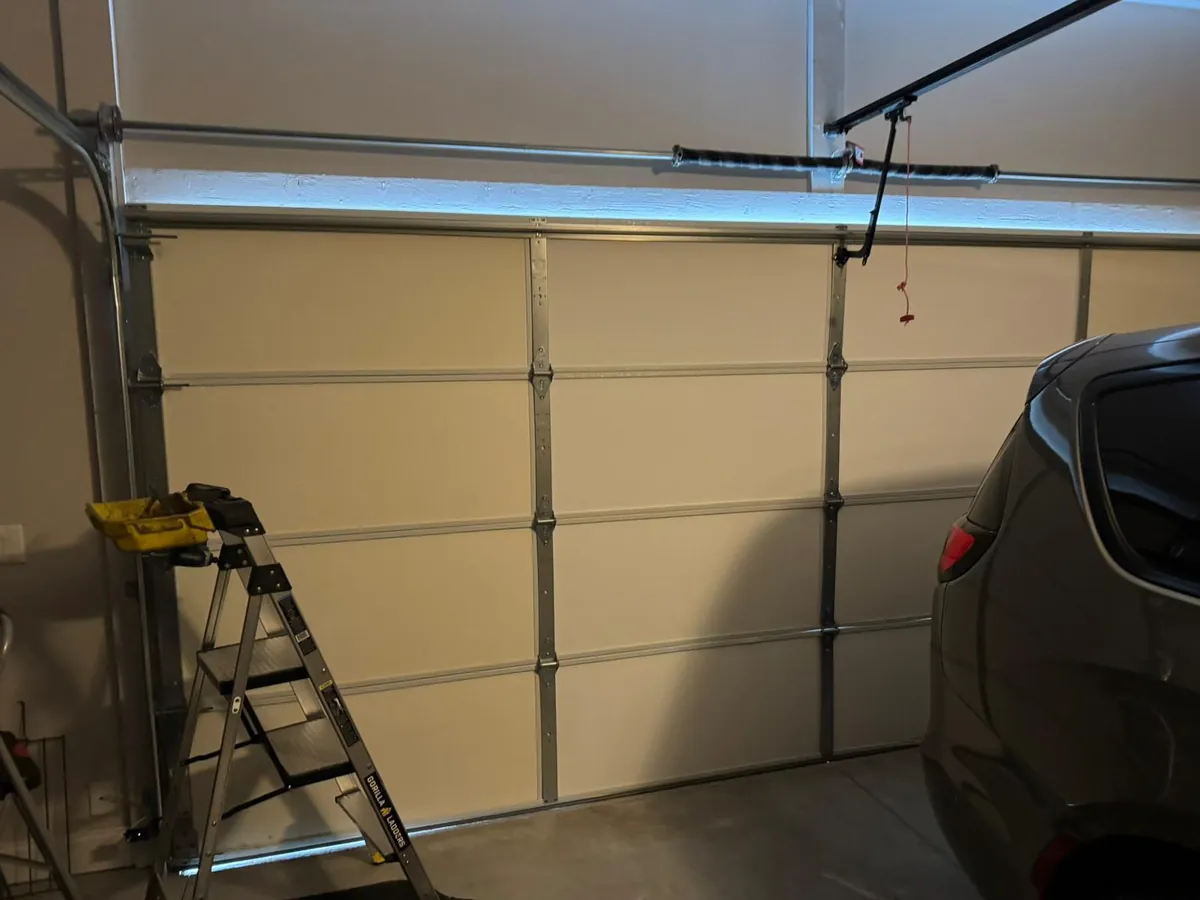
Off Broadway, and along the side streets that climb back from the beach, the typical garage is a compact single bay tucked next to, or out behind, a two-family or single-family house, reached by a driveway barely longer than the car that uses it. That one door gets opened and shut more than any other door on the lot, and the wet, briny air rolling in from the ocean settles on its springs, cables, hinges and track bolts in every season. Our garage door repair in Revere, MA takes in the full list of parts: torsion and extension springs, lift cables, dented or rusting sections, the opener along with its handsets, rails and rollers, doors that have jumped the track, and the two little safety eyes by the floor.
Standing well back on the garage floor, with your hands off the hardware, you can usually narrow things down:
- Spring bar over the opening: a clean break leaves a visible gap between two coils.
- Bottom corners of the door: a slack cable, or one unspooled from its drum, has given out.
- Sensor lights at floor level: a dark or blinking lamp tells you the beam between them is broken.
Parts we put right on Revere doors
Snapped springs
A torsion coil wound on the bar across the header, or the stretched extension springs that ride over each horizontal rail. Salt pitting weakens the coil well before it snaps. Read more on the Revere spring page.
Corroded lift cables
Rust starts deep inside the twisted strands, fraying shows first by the bottom bracket, and one side of the door sags when a cable finally parts.
Bumped and rusting sections
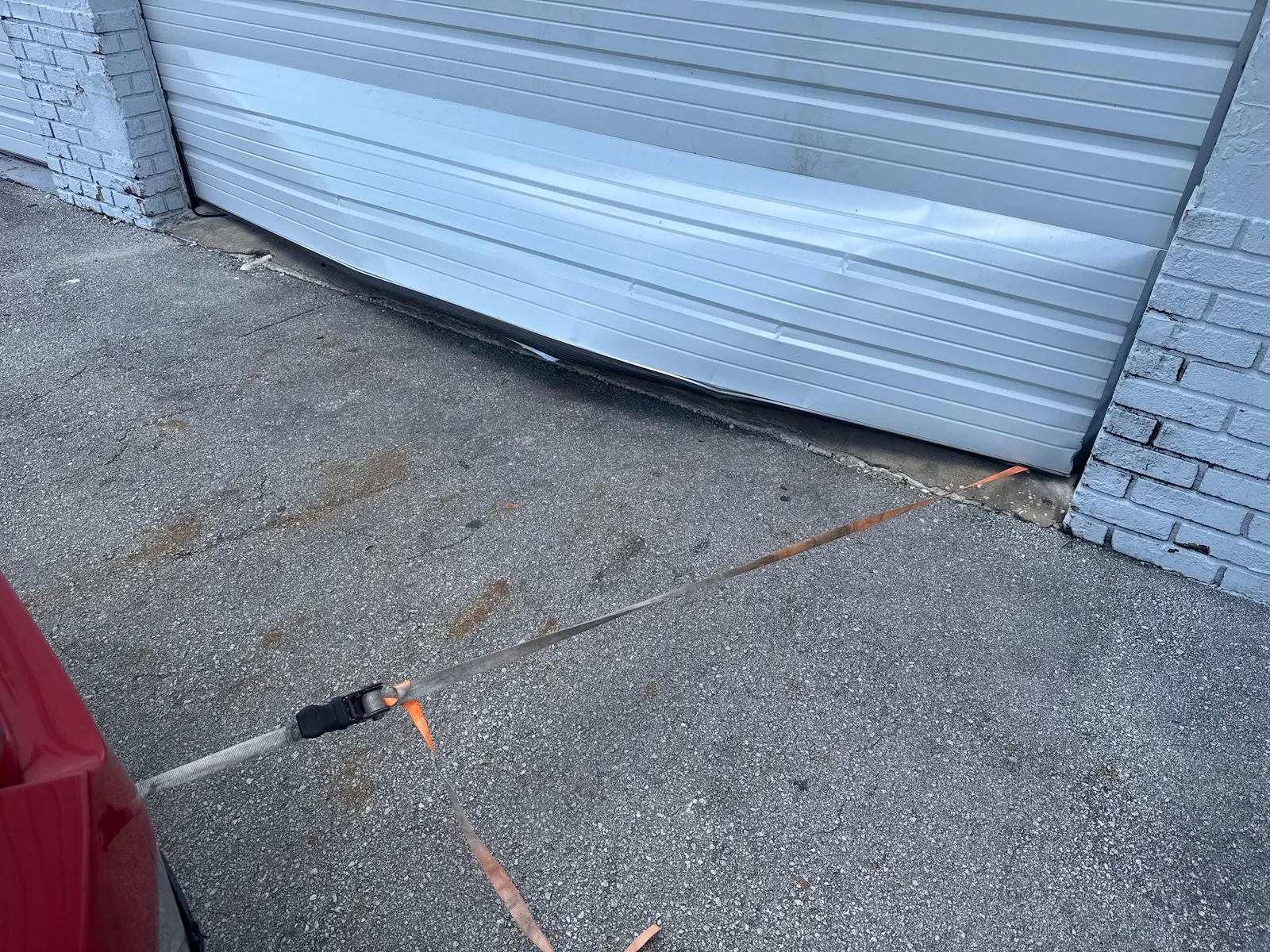
Lower panels pushed in by a bumper on a cramped apron, split hinges between sections, and steel bubbling along the seal line.
Motors and remotes
An opener that groans then quits, a remote with no reply, a wall button that clicks to no effect. Our Revere opener page goes into detail.
Rails and rollers
Roller bearings locked up with corrosion, bracket bolts rusted out of the jamb, and doors that have hopped the rail on one side.
Photo-eye sensors
Two small units at ankle height whose brackets get kicked, bent or rusted out of line, so the door will not come down.
Where sea air does its damage
A sectional door is a set of steel parts that rely on each other, and each of them reacts to salty, humid air in its own way. Corrosion creeps along slowly and unevenly, so it pays to know which parts give way first.
Springs. A spring is a coil of tempered wire that winds and unwinds every time the door moves. Salt etches tiny pits into the wire’s surface, and those pits are where fatigue cracks begin. A coil that might have carried on for years in a dry inland garage can break early once it has been pitted along its length.
Cables. Each lift cable is a bundle of fine wires twisted into a rope. Damp gets in between them, the core strands rust before the outer ones, and the cable can look sound right up to the day it unravels at the bottom corner, where rainwater sits.
Rollers and hinges. Corroded bearings stop turning, so a roller skids along its rail rather than rolling. The skidding wears a groove in the track and makes the motor labour. Hinge pins rust in place and the hinge leaves start to crack around the bolts.
Brackets and fasteners. The lag screws that pin the track brackets to the wooden jamb rust where steel meets wood, and the screw holes open up. A bracket that wobbles lets its section of rail drift, and a drifting rail is how plenty of doors come off the track.
The bottom panel. Rain, slush and road salt all gather at floor level, so the lowest section and its rubber seal are normally the first places you see rust stains or soft, rotten wood.
That is why our garage door repair in Revere so often finds corrosion somewhere on the door, even when the call came in about one broken piece. It also means a repair visit is a good moment to deal with the next part that is about to go, rather than waiting for it to fail on its own.
What the door is telling you
Most doors give some warning before they stop. These are the patterns worth recognising.
It rises a hand’s width and drops back. Nearly always a snapped spring. The motor feels a load it was never designed to lift and its safety logic reverses. Leave the button alone and look up at the shaft over the opening.
One corner sits higher than the other. A cable has broken, jumped its drum or stretched, or on an extension-spring door one side’s spring has gone while the other keeps pulling.
Scraping or grinding on every run. Dry or rusted rollers, a kinked rail or a cracked hinge snagging as the sections fold. The noise grows, and sooner or later a roller climbs out of the track.
It heads down, then springs back up. Usually the photo eyes. Something sits in the beam, salt film or grime is clouding a lens, or one of the units has been nudged askew.
The motor runs and the door sits still. Perhaps someone tugged the red release handle, leaving the carriage disconnected from the door, or a plastic drive gear inside the opener has worn its teeth away.
Total silence. Confirm the motor has power at its socket, then try the button by the inside door. When that button moves the door and the remote does not, the remote is your culprit.
Daylight round the edges, puddles inside. The rubber along the floor line or the stops at the sides are split or flattened, or the lowest section has warped out of shape.
Repairs in a tight single bay
A small garage shapes how the work gets done. Plenty of single-car bays here leave barely a shoulder’s width between the side walls and the vertical rails, and bikes, bins and garden tools tend to end up leaning on the track. With a driveway that short, the door sits close to the sidewalk, which is often how the damage happened in the first place: a car pulled in too far, or one parked tight against the bottom panel.
Overhead space can be scarce as well. Where the ceiling sits only a little above the top of the opening, there may not be room for a torsion shaft in the usual spot, and the choice of opener narrows. Extension springs and low-headroom track layouts turn up more often in garages like these than in roomier modern bays, and replacement parts have to suit the space that is really there rather than the space a catalogue assumes.
You can make the visit go more smoothly by clearing a strip along each side wall and under the spring shaft. That is the working area needed to reach springs, cables and rollers with room to stand clear of them.
Doors that serve a two-family
Where a garage sits beside a two-family house, it may be opened by more than one remote and more than one wall button, and it may be used as much for storage as for parking. A door that runs many times a day puts more cycles on its springs and rollers than one used twice a day, so those parts wear sooner. If more than one remote works the door, mention it when you call: a remote that has been lost or replaced can be cleared from the opener’s memory during the visit, and a second wall button can be checked along with the first.
Storage garages bring their own snags. Shelving pushed up against a track, boxes stacked under the spring shaft or a freezer plugged into the opener’s outlet are all common, and each of them affects how the door runs or how safely it can be worked on.
How a repair visit unfolds
Whatever part you mentioned on the phone, the technician starts by looking over the entire door. Our garage door repair in Revere follows the same pattern on every job. First the opener is unhooked so the door can be lifted and judged by hand. From there the work follows a fixed order:
- Balance. Lifted to roughly halfway and let go, a sound door hovers in place. One that sinks or rises has a spring that is broken, tired or set wrong.
- Springs, cables and drums are examined for gaps, broken strands, rust and wear on the grooves.
- Every roller and hinge is checked for locked bearings, cracked leaves and slack.
- Each rail is sighted from end to end for kinks, and each bracket and fastener is tested for rust and play.
- The opener is tried by itself, its travel limits and force settings are noted, and the photo eyes are tested.
No part is swapped until you have been shown what broke, which part looks likely to follow, and the reason behind both. With the work complete, the balance is reset, the motor is reattached and adjusted to the new weight and travel of the door, and something solid is set under the door so you can watch it touch, halt and rise again.
On a door that lives in salt air, it is worth asking for the springs, hinges and roller bearings to be given a light coat of lubricant once the work is complete. It slows the next round of corrosion noticeably.
Safe checks, and hands off the rest
A few things are fine to do yourself while you wait:
- Unplug the opener if the door is hung up halfway, so nobody in the house can set it moving by accident.
- Give each photo-eye lens a wipe and shift whatever is sitting between them.
- Fit a new cell in a handset that no longer does anything.
- Walk along both rails and remove anything leaning on them.
Leave everything else to us. On a Revere door, as anywhere, a torsion spring holds dangerous tension, stored even with the door shut tight, and that load runs through the cables into the brackets at each bottom corner. Loosening a set screw, prising at a corner bracket or putting a bar into a winding cone can let the stored force loose in an instant, with serious injuries the result. Spring work of any kind is not a DIY repair. Remember too that a door whose spring has snapped weighs far more than you expect, and hauling it up by hand, or with the motor, risks injury and usually finishes off the opener.
Fix the door, or fit a new one
Most of the time the answer is a repair: one spring or a matched pair, new cables, a set of rollers, a fresh section, a straightened rail or an opener brought back to life. Replacement becomes the wiser path once a door is failing on several fronts at the same time, its lowest sections are rusted through along the floor, more than a single panel is past saving, or an elderly timber door has soaked up so much damp that no spring will balance it. Living close to the water brings some doors to that point earlier than the same door would reach it further inland.
Either way, you get a straight opinion and the reasons behind it. If a new door is the sensible route, new garage doors are supplied and installed.
Looking after a repaired door
Once the garage door repair in Revere is done, a little regular care holds back the salt:
- Twice a year, treat the springs, hinges and roller bearings with a lubricant made for garage doors, not a thick grease that collects grit.
- After winter, hose off the lowest section and its seal to clear road salt and slush residue.
- Glance at the cables at both bottom corners for broken strands or a rusty tinge.
- Now and then, pull the release and lift the door by hand to feel whether it still balances.
- Every so often, dust off both photo eyes and nip up their brackets.
None of this stands in for a repair once something has broken, but it lengthens the gaps between breakdowns.
Seasons on the coast
Cold snaps and wet spells each leave their mark. In deep winter, spring steel turns more brittle, so the first truly cold mornings bring a run of snapped springs, and a door frozen to its seal can tear the rubber or strain the opener if the motor tries to tear it loose. Slush thrown up from the street packs against the bottom panel and the lower brackets. Through the damp months, wooden doors swell and bind in their openings, and steel doors sweat on the inside when humid air meets cold metal, which feeds the rust on hinges and fasteners.
A door that has been checked over and lubricated before the cold arrives handles all of that better. If you notice the door slowing, straining or making new noises as the weather turns, that is a good time to have it looked at, before a part gives up on a freezing morning.
Related pages for Revere
Our main garage door repair service page explains this work for the wider Greater Boston area. For a coil that has broken, the Revere spring repair page covers torsion and extension springs in depth. Motors, remotes and wall buttons have their own opener page for Revere, and a door that quits late in the evening is the subject of the Revere emergency page. Everything we offer locally is collected on the Revere town page.
Arranging a visit
A garage door has a knack for failing at the worst time, frequently with the car trapped behind it. Our line is staffed whatever the hour or day, so a fault can be phoned through the moment you notice it. Tell us how the door is behaving, what you have spotted from a safe distance, whether the garage is attached or separate, and whether a vehicle is stuck. For garage door repair in Revere whenever is convenient, call us or book online.
Questions from Revere
Our garage is a tiny single bay with a short driveway. Will that get in the way?
No. Compact bays beside two-families and single-families are what most garages here look like, and the job is planned around the space. Clearing a strip along both side walls and under the spring shaft beforehand helps.
Does living near the beach really shorten the life of door parts?
It does. Salty, humid air pits spring wire, rusts cable strands from the core outward, seizes roller bearings and loosens bracket screws. Doors near the water usually need those parts replaced earlier than doors inland, and regular lubrication helps slow it.
The door creeps up a little, then reverses. Should I keep trying?
Please stop. That pattern almost always means a snapped spring, and each extra attempt strains the opener and the door. Unplug the motor, stay out from under the door and glance up at the bar over the header before you ring.
A bumper pushed in our bottom panel. Is a whole new door needed?
Usually not. A single bent section is often replaceable by itself, if the same style of section is still made. If the damage runs across several panels, or the lower sections are rusted through, replacement may make more sense.
Do you handle garages built into the house as well as separate ones?
Yes. The same parts fail on both. With an attached garage, a rattling door or a torn seal affects the rooms next to it, so worn rollers, loose hardware and split weatherstripping are worth sorting out early.