
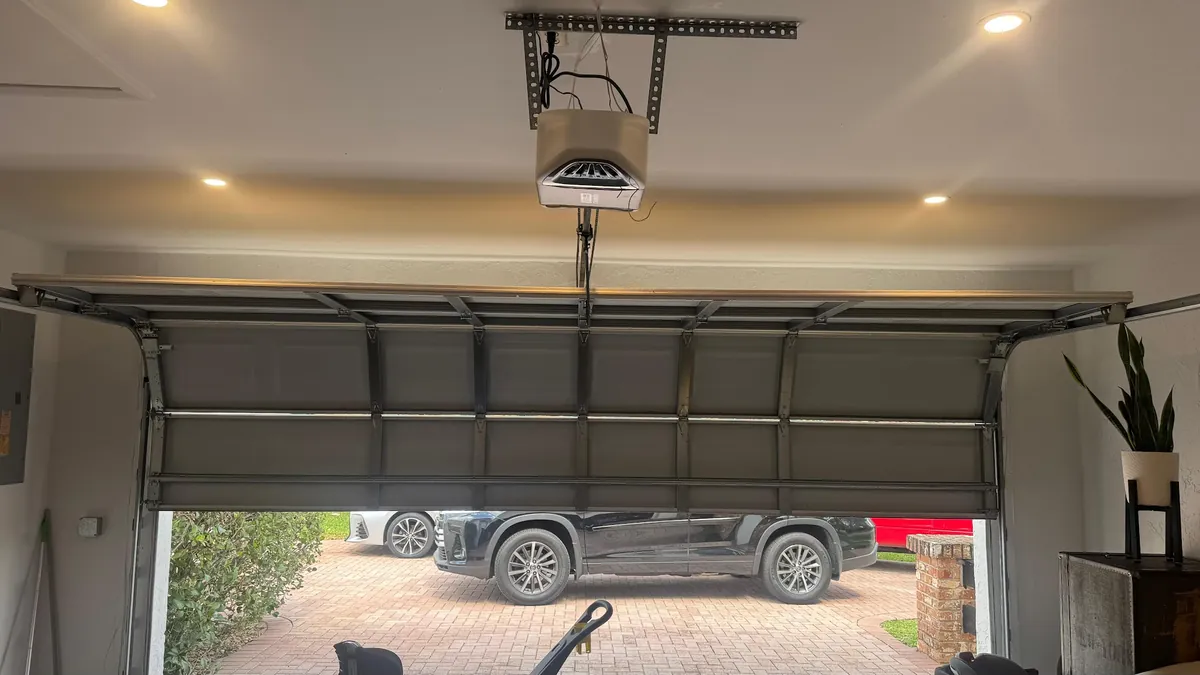
Motors under low ceilings and buttons by brick doorways
A motor whirring away while the door sits still. A clicker that behaves on Monday and sulks by Wednesday. A door that sets off downward, thinks better of it and climbs home again. Those three complaints make up most garage door opener repair in South End MA carriage houses, and they reach us from our own streets: the alleys behind the brick terraces of Columbus, Tremont and Shawmut, and the few bays tucked beneath brick buildings at ground level.
Inside one plastic housing sit several separate systems. There is a motor with its gearbox; a drive, by chain, belt or screw, that tows a trolley along a rail; a logic board listening for the remotes and the wall button; and two photo eyes down by the floor with the power to overrule all of it. Openers are repaired and installed, and the remotes, wall buttons and safety sensors that hang off them are sorted out at the same visit.
Three small experiments, all safe, point toward the culprit:
- Try the button on the wall. Should the door respond to it while ignoring the remote, the motor is probably fine and the fault sits in the handset or the receiver.
- Glance at the photo eyes. Two steady lights generally mean they can see one another; a blinking or unlit one suggests the beam is blocked, misaligned or unpowered.
- Stand under the motor head while someone presses the button. A hum without movement, a grinding noise and total silence each point somewhere different.
What goes wrong with an opener
Motor and gearbox
A motor that spins without shifting anything has frequently chewed its drive gear. One that stays silent may have lost power, a fuse or its logic board.
Chain, belt and trolley
The drive tows a trolley along the rail. Chains go slack and slap, belts glaze and slip, and a split trolley leaves the motor turning to no purpose.
Remotes and keypads
Spent batteries, handsets that no longer recognise the motor, or receivers gone deaf to anything beyond a car’s length away.
Wall button and its wire
The doorside button, plus the thin low-voltage lead running up to the head. Clipped along old mortar joints, that lead gets snagged and severed.
Photo eyes
A transmitter and receiver aimed at each other across the threshold. Knock one askew, smear its lens or nick its lead, and the door will not shut.
The opener does not lift the door
Here is the fact that saves people the most frustration: an opener is not built to carry the door. The springs carry it. A correctly balanced door can be raised with a couple of fingers, and the opener’s whole job is to tow that near-weightless load along its rails, steady it and halt it at each end. Its motor and gears are sized for exactly that and no more.
So once a spring tires or snaps, the opener inherits a burden it was never meant for. It strains against the full mass of a steel or timber door; nylon gear teeth shear, chains stretch, belts glaze and the curved arm linking trolley to door bends. A good share of the openers people assume have died are really casualties of a spring. That is why, before any opener is written off, the door gets lifted by hand first. Where the springs turn out to be the root of it, the South End spring repair page picks up that side of the story.
Carriage houses and where the opener goes
Behind the terraces, most garages began life as carriage houses. Ceilings tend to be modest and the brick above the opening shallow, and those two dimensions settle which opener can go in and where.
A conventional opener hangs from the ceiling: a rail runs straight back from the top of the door, and the motor head is fixed to the joists at its far end. In a short carriage house that layout gets cramped. The head can end up hovering close to a car roof, or jammed against a storage shelf at the back. Where headroom is especially scarce, a wall-mounted opener is often the better fit. Mounted on the side wall next to the opening, it drives the spring shaft from its end and keeps the ceiling completely clear. The right choice for any particular garage rests on the springs already fitted, how much clearance there is, and how the opening has been framed out.
Old masonry makes the wiring fiddly as well. Thin bell-wire runs from the head to the wall button and to each photo eye, and on brick it is usually tacked along a mortar line, right where a ladder or a handlebar can snag it. When a button goes dead or a sensor blinks for no obvious reason, the answer is very often a nick somewhere in that run.
Alley access and the handset
Carriage houses that open onto a rear alley bring one more opener quirk. Cars usually approach slowly and at an angle, turning in from a lane that may be barely wider than the vehicle, so the handset is pressed from further away and from odd positions, often with brick walls on both sides. A receiver that copes perfectly well in an open driveway can struggle here. Repositioning the aerial so it hangs free below the motor head, rather than tucked against a joist, often restores the range. Where several cars share one garage, each handset is paired and tested from the alley itself, not just from inside the door.
Bays under buildings, and noise
A small number of garages around here are single bays built into the ground floor, with rooms or flats sitting right on top. In one of those, the opener hangs from joists that also carry the floorboards of the flat overhead. Each slap of a chain and each thud of the trolley hitting its stop goes straight up into the living space.
Plenty can be done about it. A sagging chain can be re-tensioned or swapped, mounting bolts snugged up, and the rail’s hangers checked so the assembly is not drumming against the joists. Where an opener is due for replacement anyway, a belt drive runs a good deal quieter than a chain. The door deserves attention too, because worn rollers and squeaky hinges produce much of the racket people blame on the motor, and they are looked at during the same visit.
Such bays often double as the building’s main way in for a car. An opener that quits with the door shut can strand several households; one that quits with it open leaves the ground floor on show to the street. For that reason, garage door opener repair in South End bays beneath buildings often turns out more pressing than it first sounds.
What garage door opener repair in South End involves
Our routine for garage door opener repair in South End carriage houses and bays never changes.
- The trolley is uncoupled using the emergency cord, and the door is hand-lifted so its springs and balance can be judged.
- With the door detached, the opener is cycled alone, so the motor, gears and drive can be seen and heard working, or failing to.
- The wall button, each handset and any keypad are tried in turn, and the receiver’s reach is tested from the alley side of the door.
- Both photo eyes are inspected for aim, for clean lenses and for an intact lead back to the head.
- Before a single part is swapped, you hear what has gone wrong and whether a repair is sensible.
Once the fault is put right, the trolley is coupled back on and the travel limits are adjusted: the door should seat firmly on the floor without squashing its rubber seal, and open fully without the motor labouring at the top. Closing force is set next. Last of all comes the reversal test: a short length of timber goes flat on the concrete under the door, the door is sent down, and it has to turn around the instant it makes contact.
Chain, belt or screw
Openers differ most in how they turn the motor’s spin into a straight pull. A chain drive uses a bicycle-style chain running the length of the rail. It is rugged and copes with heavy doors, but it is the noisiest of the three and needs its tension checked from time to time; a slack chain slaps the rail and can jump a sprocket. Belt drives replace the chain with a toothed, fibre-reinforced belt; they hush the whole operation and suit a bay with living space above it, though a belt that has glazed or stretched will slip under load. Screw drives spin a long threaded shaft and the trolley travels along it like a nut on a bolt, with fewer moving parts but a sensitivity to grit and to the cold, when its grease stiffens.
Wall-mounted openers sidestep the rail altogether and turn the spring shaft from the side, which is why they suit low carriage houses so well. Whatever the type, the same rule holds: no drive outlives a badly behaved door for long, and a door with tired rollers or poor balance shortens the life of every one of them.
Small habits that spare the motor
Keeping an opener happy takes very little. Every season or so, release the trolley and raise the door yourself: if it feels heavy or will not hover, have the springs checked before the opener pays the price. Keep the photo-eye lenses clean and the threshold clear, so the door is not constantly reversing. Change handset batteries before they die completely, especially before winter, when cold drains them faster. And listen. A new grinding note, a pause before the motor starts, or a door that shudders at the top of its travel are all early hints that something is wearing, and a small adjustment at that stage avoids a stranded car later.
Remotes, keypads and range
Most opener complaints turn out to be handset trouble, and the causes are usually humble. A dead battery heads the list. Close behind is a handset that has forgotten its pairing, which some units do after a power cut or a battery swap, and which is cured by re-learning it from the button on the motor head.
Poor range is a separate puzzle. A handset that responds only when you are almost against the door might have a tired battery, but it might equally be fighting the building: thick brick walls, a head mounted deep in the back corner of a carriage house, and an aerial wire folded up against the ceiling all choke the signal. Sometimes untangling the aerial is enough; sometimes the receiver itself is failing. Keypads screwed to the brick beside an alley door live through rain, frost and the odd bump, so they are opened up and checked for moisture.
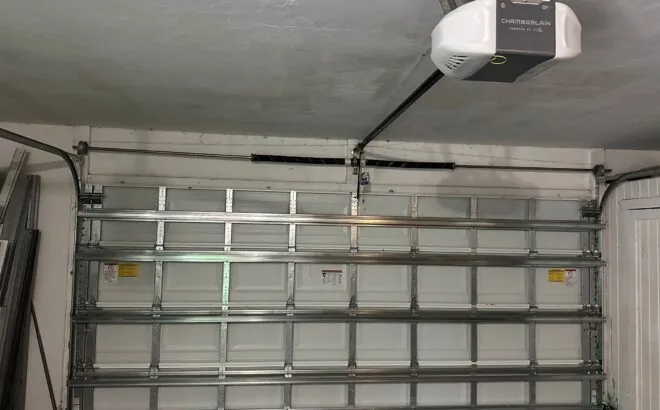
Photo eyes in a narrow garage
Down near the floor, a small sensor is screwed to each jamb. One shines an invisible beam across; its twin watches for it. Interrupt that beam while the door is travelling down and the opener reverses. A door refusing to close because of them is, in a sense, a door behaving responsibly.
In a slim carriage house the sensors have a tough time. Wheelie bins rolled in and out, bikes propped against the jamb, snow scraped from the threshold: all of it knocks them off aim. Often the cure is simply bending a bracket back and wiping the lenses, though a cracked bracket or a chafed lead means replacement. Disabling the sensors is never acceptable, since that reversing behaviour is what keeps a descending door off a child, a dog or the front of a car.
Power cuts and the emergency release
Each opener has a release: look for the red pull-handle on a short cord below the trolley. A firm tug separates the door from the drive, so the door can be pushed along its rails manually during a power cut or the opener has given up. Before you pull it, be sure the door is shut or the springs are whole, because a door with a snapped spring will fall as soon as the drive lets go of it.
In a carriage house with no side door, a power cut while the door is down can leave you shut out. On garages like that, a release worked from outside, through a small lock in the top panel, is worth asking about when an opener is being serviced or fitted. Once power comes back, the trolley normally clicks back onto the drive on the next run; if not, it can be re-engaged by hand.
Repair or replace the opener
A great many faults deserve a repair: a chewed gear, a split trolley carriage, a dead sensor, a dead wall button, a handset that wants re-pairing. A new unit starts to make more sense when the logic board on an elderly opener gives out, when the motor has burned itself out, when there is no working safety reverse, or when the thing is simply too loud for a bay with a home on top of it. You will hear honestly which applies before anything is ordered, and with garage door opener repair in South End garages, mending is always weighed up first.
When replacement wins, the new opener is fitted, matched to the door and tested, and that includes LiftMaster units. Should the door itself be at the end of its days, read how a fresh door and opener can go in together on the South End new doors page.
Getting an opener looked at
When you ring, describe what happens at the wall button and at the handset, whether the head hums, grinds or stays silent, whether any sensor light is flashing, and whether the door finished up shut, open or hanging midway. Problems elsewhere on the door, such as cables, rollers, panels or rails, belong with garage door repair in the South End, and a door refusing to shut in the small hours belongs with our South End emergency service. Our opener repair and replacement service reaches right across Greater Boston, while the South End page is where all our local work is listed side by side. Call us or book online.
Questions from South End
The motor hums, yet the door never moves. What is broken?
Frequently a stripped drive gear inside the head, which lets the motor spin without driving the chain or belt. A snapped spring can produce the same symptom, because the opener cannot raise the door alone. Leave the button alone and pull the plug until someone has looked.
Why does my handset only work when I am practically touching the door?
Rule out the battery first. Beyond that, thick brickwork and a crumpled aerial on the motor head both smother the signal, and receivers do fail with age.
Can anything be done about opener noise in a bay with a flat above it?
Usually a lot. Firmer mounting, a re-tensioned or new chain and fresh rollers on the door all cut the sound reaching upstairs. If the opener is being replaced, a belt drive is the quieter choice.
My door starts closing, then reverses all by itself. Has the opener failed?
Seldom. More often the photo eyes think something is in the way, or have been knocked out of line. Wipe the lenses, clear the threshold and watch the little indicator lights.
Is a LiftMaster opener something you can fix?
Yes. We repair LiftMaster units and replace them when they are beyond saving, handsets, wall buttons and sensors included.