
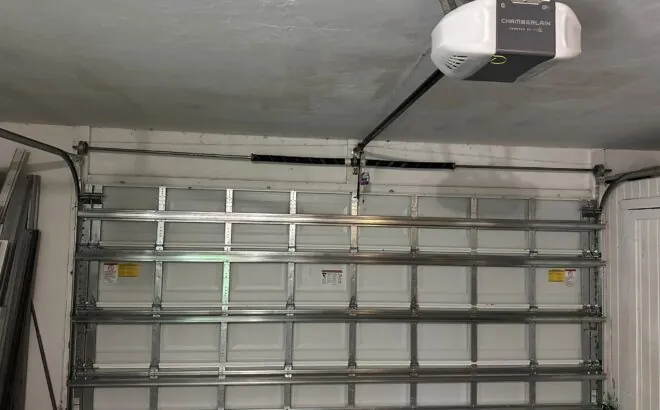
Few garages, steep approaches: what goes wrong on Charlestown doors
Facing the Training Field, and down both sides of Main Street, brick Federal row houses stand shoulder to shoulder with their front steps on the pavement, and most of them have no garage at all. The garages that do exist here tend to be newer: the townhouses built near the Navy Yard, where a single overhead door sits at the bottom of the building and the car parks inside the footprint of the house. Work on garage doors Charlestown MA owners ask us about nearly always means one of those townhouse doors, or one of the scattered older garages squeezed in where a lot happened to allow it.
What these doors have in common is the ground in front of them. The streets climb and fall sharply, and many driveways are barely a car deep, so a door often closes onto a slab that tilts toward the street. A door that lands on a slope never seals evenly, one side touches down first, and over time that uneven landing loosens the bottom hardware and wears the seal at the low corner.
Three signs worth noting before you call, all visible from the driveway:
- The door touches the floor on one side and leaves a gap on the other.
- The opener reverses just before the door closes, even with nothing in the way.
- The door has grown louder or slower over the past few weeks.
A neighbourhood where the garage is part of the house
On the newer townhouses near the Navy Yard, the garage is not a shed at the end of a yard. It sits under the living space, often with a bedroom or a kitchen directly overhead and a door from the garage into the house. That arrangement shapes every repair. Noise carries upward, so a worn roller or a dry hinge that would go unnoticed in a detached building becomes something the whole household hears each morning. Vibration from a tired opener travels through the framing in the same way.
It also means the garage door is one of the main entrances to the house. For many owners on these streets the garage is the way in from the car, with the front door used far less. When that door fails, it is not only the car that is affected; the daily route into the home is cut off too.
For anyone looking at garage doors Charlestown MA townhouses carry, that tucked-under layout explains much of what follows on this page: tight headroom under the floor above, an opener mounted close to a ceiling that is also someone’s floor, and a door that has to seal well because the garage shares walls with heated rooms.
Garage door repair on townhouse and row-house garages
Most calls start with a door that has stopped doing something it used to do. It will not close all the way, it opens crookedly, it shudders partway up, or it simply refuses to move. On a garage door, the cause is usually one of a small number of parts: springs, cables, rollers, tracks, hinges, panels, the opener or the safety sensors.
The townhouse doors here see a particular kind of wear. Because the garage sits under the house, the door is often the most-used entrance, opening and closing several times a day. Rollers and hinges take that use first. A roller with a worn bearing starts to grind; a hinge that has cracked lets the sections flex, and the door begins to bow slightly as it travels. Left alone, that flexing works its way into the track brackets.
The scarce older garages around the Training Field side of the neighbourhood have their own patterns. Where an overhead door has been fitted into an opening in an old masonry wall, the jambs and the header may not be perfectly square, and the door has been adjusted to suit them. Replacing a part on a door like that means respecting the adjustments already made, not resetting everything to a factory position that the opening cannot accept.
Each of these faults has its own section on the Charlestown repair page, and our city-wide garage door repair page lists every part we deal with.
Springs under a low ceiling
A broken spring is the most common urgent call on any garage door, and Charlestown is no exception. The spring is what makes a heavy door feel light; when it breaks, the door weighs its full weight again, the opener strains and stops after a few inches, and the door may refuse to move at all.
Tucked-under garages make spring work more involved. The torsion type winds around a steel shaft bolted over the header, and where a plastered ceiling hangs just above the header there is very little room left for it. Some doors in low garages carry a different track and spring arrangement for that reason. Matching a replacement to the headroom the garage really has, and to the weight of the door, is the core of the job.
Please hear this plainly: torsion springs store dangerous tension at every point of the door’s travel, open or shut. A winding bar that slips, or a set screw on the cone backed off by someone curious, releases that stored energy all at once, and people are badly hurt that way. This is not a DIY repair. Walk away from the door, switch the opener off at its socket, and keep children and pets well away from the shaft over the opening. There is more about the work itself on the Charlestown spring repair page.
Openers that live under a bedroom
Because the opener on a tucked-under garage is often bolted to the ceiling under a room, how it sounds and how smoothly it runs matter more here than in most places. A chain drive that clatters, a motor that hums before it moves, or a door that jerks at the top of its travel will all be heard upstairs.
Opener calls take in the motor and its rail, handheld remotes, the push button by the house door, and the two photo eyes mounted near the slab beside each jamb. On a sloping slab those sensors deserve a close look. Where the floor falls away toward the street, the two photo eyes often sit at slightly different heights already, so even a light bump from a recycling bin can leave them squinting past each other. A door that closes most of the way and then reverses with nothing in its path is very often a sensor problem rather than a motor problem.
Where an opener has reached the end, its successor is picked with the bedroom overhead in mind as much as the door below. We work on LiftMaster openers, repairing them and putting in new ones. More detail is on the Charlestown opener repair page.
A dead door after dark on a townhouse street
For a townhouse where the garage is the everyday way into the house, a door that will not open after dark is more than a nuisance. A car can be trapped inside before a morning commitment, or a door can be stuck open overnight with the house behind it unsecured.
Someone picks up our line whatever the clock says, weekday or weekend, so a failure in Charlestown can be phoned through the moment it happens. We do not promise how quickly someone will be at the door, because that depends on what is already under way, but the call itself is never left to the morning. While you wait, unplug the opener so nobody keeps pressing the button, and leave any broken spring or slack cable untouched. The Charlestown emergency repair page sets out more of what to do and what to leave. Other parts of the city we cover are listed under service areas.
What a visit involves
Every visit begins the same way: the red release cord is pulled so the opener lets go, and the door gets raised by hand. Raised to waist level and let go, a healthy door hangs there, perhaps creeping a little. A door that sinks hard, or that two hands cannot budge, sends attention straight to the springs or cables.
Next, the moving parts are checked one at a time: both springs, both cables and their drums, every roller, the hinges between sections, the vertical and horizontal tracks and the brackets that tie them to the building. In a tucked-under garage, special attention goes to how the horizontal tracks hang from the ceiling, because a hanger fixed into a joist that also carries a floor needs to be solid.
You are shown what has broken, why it went, and which neighbouring parts look tired, and no part goes on the door before you say yes. Afterwards the springs are tuned so the door floats, the opener is taught its new top and bottom stops and a gentler push, and a short length of timber laid on the slab proves that the door bounces back up on contact.
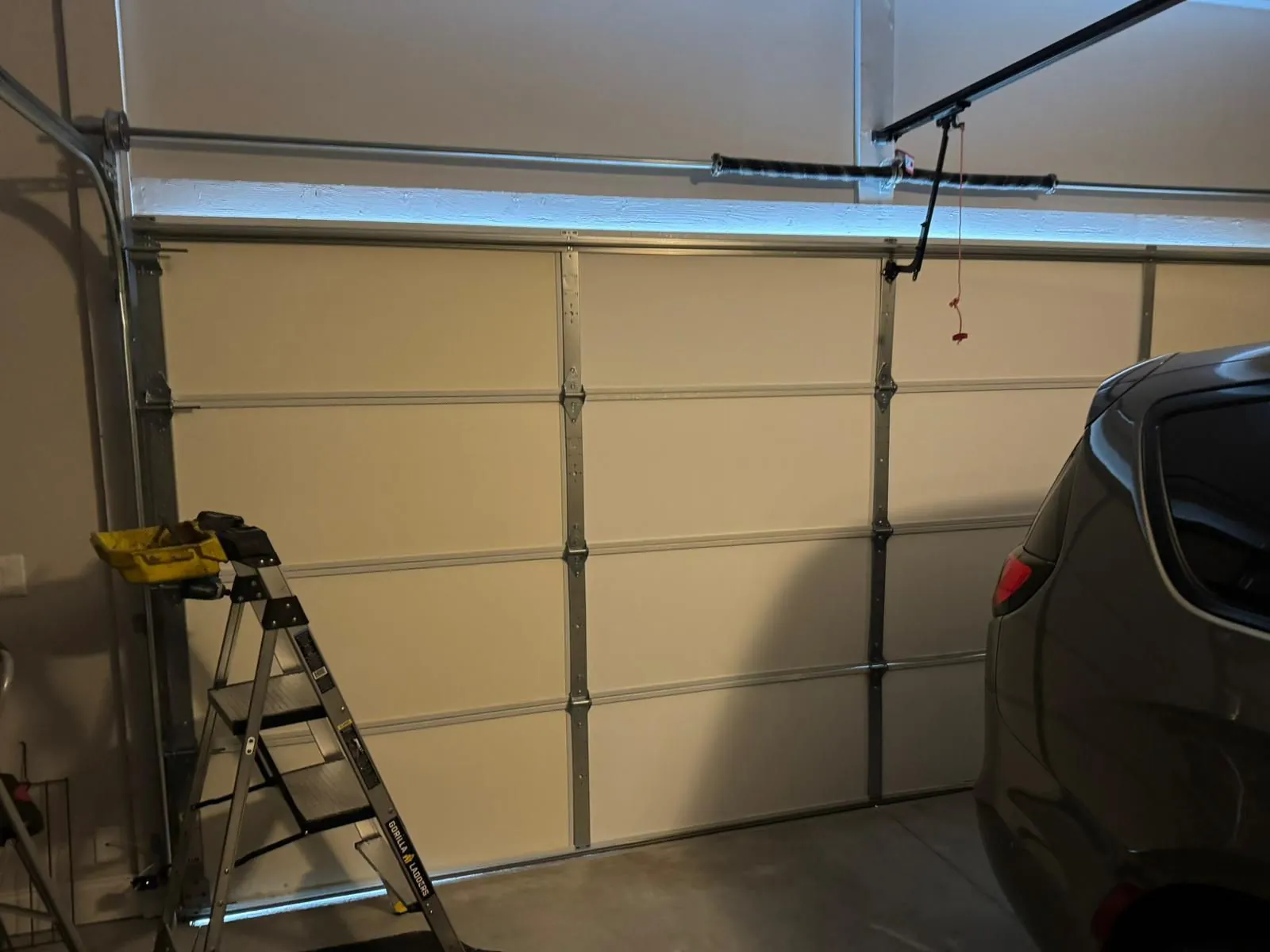
Steep streets and driveways one car deep
The slope is the detail that sets this neighbourhood apart from flatter parts of the city. When a driveway runs downhill toward the street, the garage floor rarely sits perfectly level across the opening. A door can only close flat if the bottom section meets the floor evenly, so a tilt means a gap at one corner.
That gap is where trouble starts. Rain and meltwater run under the low side; leaves and grit collect against the seal; in winter, water that has crept under the door can freeze the bottom section to the slab. Press the button on a door glued down by ice and the motor heaves against it; the bottom section can buckle long before the ice lets go. A thicker seal cut for an uneven floor, with the close limit set to press home on the high corner without crushing the low one, helps a great deal.
The shallow driveways cause their own problems. With barely a car’s length between the door and the pavement, a vehicle often parks right up against the door, and a small misjudgement nudges the bottom panel. Repeated nudges bend the bottom section inward and pull the lowest rollers out of line. Snow pushed up against a door that has nowhere else to go has a similar effect.
The older garages around the Training Field
On the streets around the Training Field and Main Street, a garage is rare enough that each one tends to be a one-off: a structure fitted in at the back of a lot, a former outbuilding converted, or an opening cut into an older wall. Where garage doors Charlestown MA row houses do have are of this kind, the doors are often older too, and some are still timber.
A wooden door in a weathered opening needs a different eye. The wood swells in wet weather and shrinks in dry, so a door that closes neatly in July may bind in March. Rot tends to start at the bottom of the panels, where water sits, and spreads upward through the joints. Hardware screwed into soft timber loosens. Each of these can be dealt with if the door is otherwise sound, but each is also a reason to ask whether the door is worth keeping.
Where the opening itself is out of square, the door needs fitting to it rather than the other way round. That calls for patient adjustment: hanging the rails plumb even where the old jambs lean, and fitting a bottom seal soft enough to fill the dips in a worn sill.
Repair or replace
On these streets, repair usually wins. Springs, cables, rollers, hinges and seals are consumable parts, expected to be swapped several times while the panels themselves carry on, so a door whose sections are still straight and solid has plenty of life in it.
The sums change once the panels are what has failed. Steel rotted through at the bottom rail, timber soft or split across several panels, or an old wooden door so soaked through over the years that the springs can no longer carry it evenly, are all signs. On a townhouse garage under living space, a door that lets in cold air or noise from the street can also be a reason to think about a newer, better-sealed door, though that is entirely your choice.
New doors are supplied and installed to suit the opening, the headroom and the look of the building. The Charlestown door replacement page covers what is involved, and the wider picture is on our new garage door installation page.
Doors that come off their tracks
A shallow driveway and a door that gets nudged by bumpers is a common route to an off-track door. Once a bottom roller leaves its rail, the door skews sideways across the opening, and if the opener keeps driving it, the track bends and the door can jam hard or drop.
Stopping is the safest move. Cut power to the opener, leave the car parked, and resist shoving the door back by hand: the springs and cables still carry their load, and a door half out of its rails can come down. We begin by pinning the door with vise grips on each rail, easing each roller back into its channel, swapping any kinked length of rail, and evening up both cables so the two sides pull alike. Every stage of that job has its own write-up, filed under off-track garage door repair.
Getting the door looked at
When you call about garage doors Charlestown MA homes depend on, it helps to tell us a few things straight away: whether the garage is tucked under a townhouse or stands on its own, how steep the driveway is, what the door is doing or failing to do, whether you can see a broken spring or a slack cable, and whether a car is shut in. That lets the visit be planned around the building rather than discovered at the door.
The phone is taken at any hour, so nothing has to wait for office time to be reported. To arrange a repair, a replacement or a look at a door that is starting to struggle, call us or book online.
Questions from Charlestown
The garage is right under our kitchen. Can the door be made quieter?
Often, yes. Most noise comes from worn rollers, dry or cracked hinges, loose track hangers and an opener drive that needs attention. Replacing the worn parts and setting the door to run balanced usually makes a noticeable difference to the rooms above.
Our driveway slopes and daylight shows under one corner of the closed door. Is that a fault?
It is common on sloping slabs rather than a fault in the door itself. The bottom seal and the opener’s close limit can usually be adjusted, or the seal changed, so the door closes evenly enough to keep water and leaves out.
Our row house has no garage. Is there anything here for us?
Without a garage door on the lot there is nothing for us to fix, which is true of most houses facing the Training Field. Where a rear outbuilding or a converted carriage space does carry an overhead door, though, it gets the same repair or replacement as any other.
The door is frozen to the slab. Should I keep pressing the button?
No. Running the opener against a frozen door can bend the bottom section or strain the opener. Unplug it, let the door thaw, and call if it still will not lift once the ice has gone.
A spring has snapped on our tucked-under garage. Is it safe to haul the door up myself?
No. Once the spring has gone, every pound of that door is dead weight with nothing above to catch it. Keep it shut, kill the opener’s power, keep everyone away from the shaft, and ring us.