
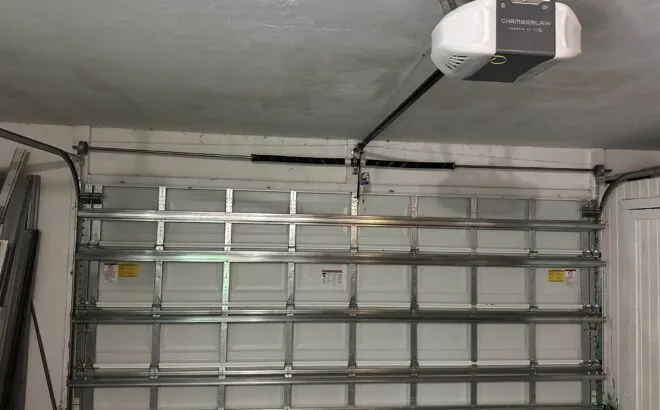
The loud bang from the garage
A broken spring is the single most common reason a garage door suddenly will not open, and it usually announces itself with a bang like a dropped steel plate. Our garage door spring repair in Boston covers both kinds of spring, torsion and extension, in the South End’s brick carriage houses and under-building bays near the shop, and in garages throughout Greater Boston.
If the door has stopped working, look for these three signs from the floor, without touching anything:
- A gap of a few inches in the coils of the spring above the door.
- A door that rises a few inches under the opener, then stops or reverses.
- Cables hanging slack at the bottom corners of the door.
Spring problems this work covers
A snapped torsion spring
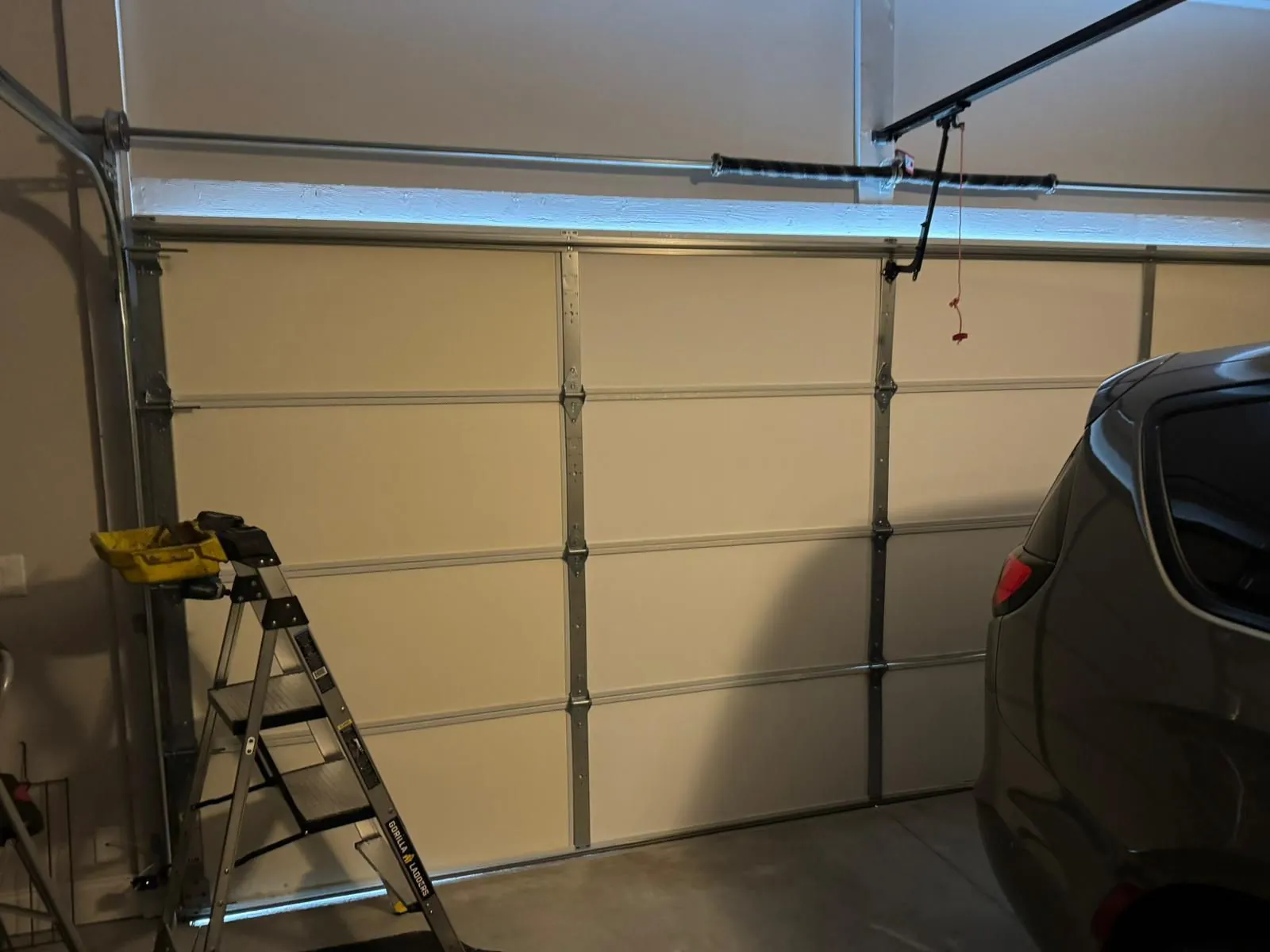
The spring on the bar above the door breaks in two, usually with a gap in the coils you can see from the floor. The door becomes a dead weight.
A broken extension spring
On doors with springs running along the horizontal tracks, one spring breaks and the door lifts crooked or not at all.
A tired, weakened spring
The spring has not broken yet, but the door feels heavy, drifts down when left halfway, or the opener labours to lift it.
A door out of balance
One spring of a pair has failed, or the old springs no longer suit the door, so it slams shut or creeps up on its own.
Missing safety cables
Extension springs with no cable threaded through them can whip across the garage when they break.
What a spring actually does
A garage door is lifted by its springs, not by its opener. A steel sectional door, with its tracks and hardware, is a heavy thing, and an old wooden door is heavier still. The spring system is set so that, when it is working, the door weighs almost nothing at any point in its travel: you can lift it with one hand and it stays where you leave it.
A torsion spring does this by twisting. It is threaded onto a steel shaft over the door, anchored to a centre bracket at one end and to a winding cone at the other. When the door closes, the cables pull on the drums at the ends of the bar, turning it and winding the spring tighter. That stored twist is what lifts the door again. An extension spring does the same job by stretching. It runs above each horizontal track, attached to the back of the track at one end and to a pulley and cable at the other, and it stretches as the door closes.
Either way, every spring has a working life measured in cycles, one cycle being an opening and a closing. A door used several times a day, every day, wears through its springs much sooner than a door used once a week. Rust shortens that life, because a pitted coil cracks more easily, and so does cold.
Why springs break in Boston winters
Breaks tend to cluster on the first cold mornings of the season. Steel loses some of its give as the temperature drops, and a spring that has been close to the end of its life for months finally lets go when the door is opened on a frozen morning. In the South End, many garages are unheated brick carriage houses on narrow alleys, and bays under buildings can be damp as well as cold, which adds rust to the strain on the coils.
Older carriage houses bring another issue. Little headroom above the door sometimes means the spring is mounted at the back of the tracks or on a low-headroom bracket arrangement rather than in the usual place. Garage door spring repair in Boston often means working within those tight spaces, and choosing a spring that fits the room available as well as the weight of the door.
Why a torsion spring is not a DIY repair
A torsion spring holds dangerous tension, enough to lift the full weight of the door. It holds that tension when the door is closed and when the door is sitting still. Winding or unwinding one means turning the cone with steel winding bars, a quarter turn at a time, against all that stored force. If a bar slips or the wrong set screw is loosened, the spring can spin the bar out of a hand, or into it, faster than anyone can react. This is not a DIY repair, and it is not a job for an ordinary socket set and a video.
The cables and bottom brackets are part of the same system. The bracket at each bottom corner of the door is under tension from the cable, and loosening it while the spring is wound can release the cable violently. Extension springs carry their own risk: when one breaks without a safety cable through its centre, the broken ends and the pulley can fly across the garage.
What you can safely do:
- Leave the door closed if it is closed, and stop pressing the opener button.
- Unplug the opener, so nobody tries to run it.
- Keep children and pets away from the door and from under any spring.
- With the door stuck in the open position, leave the emergency release cord alone; without a working spring the door may drop.
What a spring replacement involves
The first step is measuring. A torsion spring is matched to the door by its wire thickness, its inside diameter, its length and the direction it is wound, and those numbers are read off the old spring or worked out from the weight and height of the door. A spring that is too weak leaves the door heavy; one that is too strong makes it fly up.
The door is then secured so it cannot move, the old spring is unwound under control, and the new spring is fitted and wound to the right number of turns for the door’s height. The cables are checked for fraying and seated properly on the drums, the bearings at the ends of the bar are checked, and the door is tested by hand: lifted halfway, it should stay put. Only then is the opener reconnected and its travel and force settings checked against the newly balanced door. Garage door spring repair in Boston is finished when the door feels light, runs evenly and stops where it is left.
Extension spring work follows the same order: secure the door, replace the spring and its pulley if worn, thread a safety cable through each spring, and balance the two sides so the door rises level.
One spring or both?
Many doors have two torsion springs side by side on the bar, and when one breaks, the other has been through exactly the same number of cycles. It is usually close to the end of its life too. Replacing both at once keeps the door balanced evenly and saves a second visit when the remaining spring gives out a few weeks later. Garage door spring repair in Boston on a two-spring door therefore usually means a matched pair. On a door with a single spring, a heavier door sometimes benefits from being converted to a pair. These are choices you hear about before work begins.
Repair the spring or replace the door
A broken spring on its own is almost never a reason to replace the door. The spring is a wearing part, and a new one returns a sound door to daily use. Replacement only enters the picture when the spring has failed on a door that is also rotted, rusted through at the bottom or broken across several panels, or when an old wooden door has grown so heavy that it strains any spring that will fit the space. In those cases the new garage doors page explains the alternative.
Springs, cables and the opener
A broken spring rarely stays a single-part problem for long. When a spring goes, the cables often go slack and can jump off their drums, which is covered on the cable repair page. If the opener was run against a door with a broken spring, it may have stripped a gear or bent its rail, which the opener repair page deals with. And a door that came down unevenly can end up crooked in its tracks, a job for off-track repair. Panels, rollers and sensors are on the broader garage door repair page, and every service is listed on the services page.
When a spring breaks at night
Springs break whenever they reach the end of their life, and that is often early in the morning or late in the evening, when the door is used. Calls come through to a person at any hour, on any day of the year, so a broken spring can be reported when it happens rather than left until morning. To arrange garage door spring repair in Boston, call us or book online. It helps to mention whether the car is inside, whether the door is open or closed, and how the spring looks from the floor. The emergency repair page covers what to do while you wait.
Questions about garage door springs
How do I know whether my spring is broken?
Check the torsion spring over the door for a split in its coils, or along the tracks for an extension spring hanging loose. Other signs are a loud bang from the garage, a door that rises a few inches and stops, and cables hanging slack at the bottom corners.
Can I open the door with a broken spring?
It is best not to. Without the spring the door is a dead weight, too heavy to lift safely by hand, and running the opener against it can damage the opener. If the car is shut in, call us and leave the door where it is.
Why did my spring break when nothing else was wrong?
Springs wear out with use. Each opening and closing is one cycle, and every spring is made for a limited number of them. Cold weather and rust bring the end sooner, which is why breaks are common on the first freezing mornings.
Is a door with a broken spring dangerous?
It can be. A closed door is usually stable, but a door stuck open with a broken spring can come down suddenly if the opener is disconnected. Keep clear of the opening and do not walk or park under it.
Should both springs be replaced at once?
On a door with two springs, usually yes. They have done the same work, so when one breaks the other is often close behind. Replacing both keeps the door evenly balanced.
Do extension springs need anything extra?
Every extension spring needs a safety cable threaded through the middle of it, so that a broken spring is held in place instead of flying across the garage. If yours have none, they are fitted as part of the repair.