
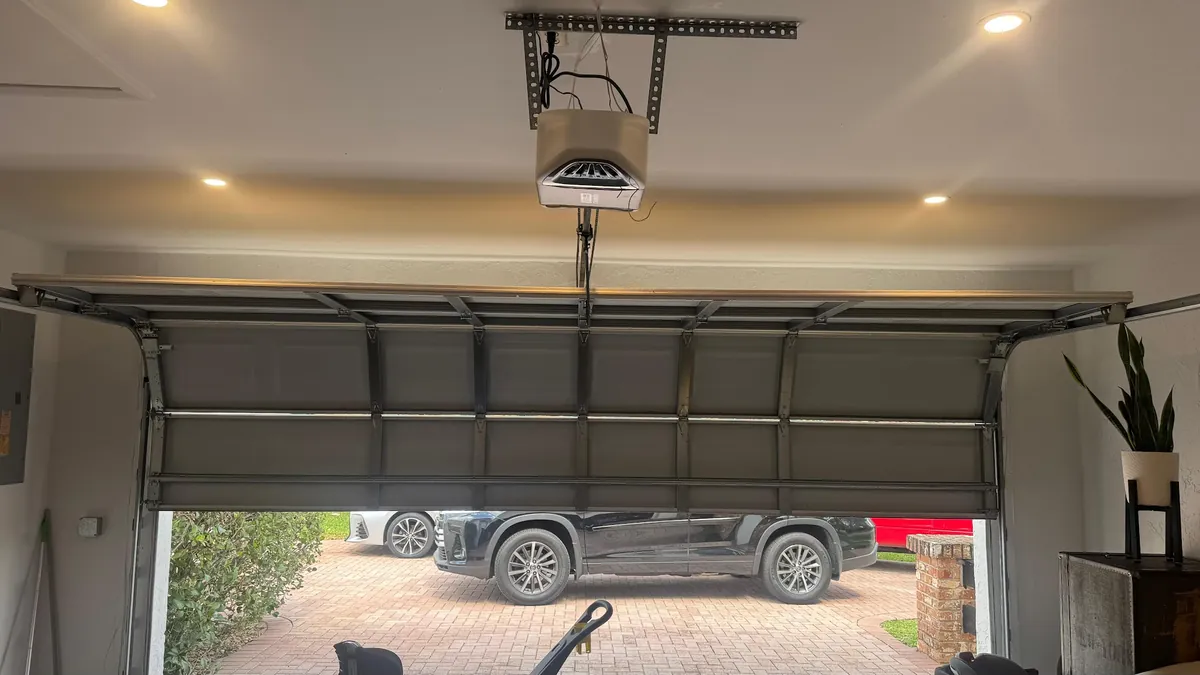
Openers on Arlington’s built-in and back-lot garages
Pressing a handset at the bottom of a steep driveway and watching nothing happen is the moment most requests for garage door opener repair Arlington MA residents send us begin. Arlington’s single- and two-family houses, from the Avenue up the slopes to the Heights, have both kinds of garage, the kind tucked into the house and the kind standing separately at the back, and the motors that work their doors live different lives in each.
An opener is the brain and the muscle of the door, but only the lighter muscle. It guides a door its coils have rendered nearly weightless, it listens for handsets and the wall control, and it watches the photo-eye beam so it can back off before it reaches a bumper or a child. When any one of those jobs fails, the door stops cooperating.
Three things worth checking from the floor, without climbing anything:
- The bulb on the motor head: a steady blink pattern after a failed close usually points to the sensors.
- The wall control: many have a lock or vacation switch that silences every handset.
- The lenses near the slab: a dark or flickering indicator on either one means they cannot see each other.
Opener faults we put right
Motors that hum and stall
A unit that buzzes without moving the trolley, often a stripped drive gear or a capacitor that has given out, sometimes a door too heavy for it.
Handsets that stopped working
Dead batteries, lost pairing, a cluttered memory holding codes nobody recognizes, or a receiver failing inside the motor head.
Wall controls and keypads
A doorway button that has gone silent, a keypad by the garage door that no longer accepts its code, or wiring chewed or pinched along the ceiling.
Photo-eye sensors
Lenses knocked out of line, dirty, sun-dazzled or wired loosely, so the door refuses to shut or reverses for no visible reason.
Worn chains, belts and screws
Slack chains slapping on the rail, frayed belts, worn drive screws, and trolleys that no longer engage.
New openers fitted
When repair stops making sense, a replacement opener supplied and installed, LiftMaster models included, with handsets programmed and safety settings tested.
How an opener actually moves the door
It is tempting to think the motor on the ceiling does the lifting. It does not. The springs above the opening carry the weight; the opener only pushes and pulls through a rail, a trolley and a curved arm bolted to the top section. A chain, belt or threaded screw runs along the rail, driven by a gear in the motor head, and the trolley rides that drive back and forth.
Two sets of settings decide how the door behaves. Travel limits teach the motor where its trip begins and finishes: fully raised and fully lowered. Force limits cap the effort the motor will spend before deciding something has gone wrong and backing off. On top of that, the photo-eye beam across the bottom of the opening gives the opener permission to close; interrupt it mid-close and the door rises again.
This setup has a practical consequence: an opener that seems to be failing is often an opener reacting correctly to a door that has gone wrong. A broken spring, a cable off its drum, a seized roller or a door frozen to the slab all make the door too heavy or too stiff, and the opener responds by stalling, reversing or blinking. Part of every visit is checking the door before blaming the motor, and when the door turns out to be the problem, our Arlington garage door repair page covers that side.
Steep driveways, sloped slabs and the closing setting
The steep approaches to many Arlington garages create a particular puzzle for openers. A slab poured to shed water often tilts toward the doorway or across it. One corner of the bottom rail then lands before the other. The opener, set to stop when it meets resistance, may decide the door is shut while the far corner still hangs above the concrete, or it may treat the early contact as an obstruction and reverse.
Neither is a fault in the motor. Both are matters of limit and force adjustment, sometimes combined with a new bottom seal that can flex to meet an uneven floor. The temptation is to turn the closing force up until the door stays down, and that is exactly what not to do: an opener with excessive force will not reverse properly on something soft, which defeats the point of the safety system. A correct setup balances the door, sets the limits for the actual floor and keeps the force as low as the door allows.
Steep driveways also affect the photo eyes. Mounted near the floor on each side, they can sit at slightly different heights on a sloped slab, and a door frame that has settled can nudge one out of line. Snow pushed against the door, leaves blown in by the wind down the driveway or a bin parked close to the jamb can block the beam just enough to stop the door closing.
Built-in garages: the door that is also the front door
Where the garage is tucked into the house, the opener runs many times a day and its noise travels into the rooms around it. That puts two things at the top of the list during garage door opener repair Arlington MA homes with attached garages call us about: durability and quiet.
A chain-drive unit slapping along its rail, or a motor head vibrating against a ceiling joist, is heard upstairs. A belt drive is noticeably quieter, and isolation pads between the opener and the framing take more of the edge off. Worn steel rollers in the door tracks add their own grinding, and replacing them with nylon rollers is a sensible partner job when the opener is being sorted.
Attached garages also make the wall control and its wiring more important. The button by the house door is used constantly, and a failing switch or a wire pinched where it runs along the ceiling makes the door unreliable in a way handsets alone will not fix. Keypads mounted outside are handy for family members without a handset, and resetting their codes is part of the work.
Separate garages at the back of the lot
A freestanding garage behind the house brings different opener troubles. Power usually reaches it from the main house, sometimes along a line that has seen better days, and a tripped circuit or a failing outlet can masquerade as a dead opener. The motor itself sits in an unheated space, where cold stiffens lubricant in the drive and drains handset batteries faster.
Range can be an issue too. A handset that works from the end of the driveway on a short lot may struggle from the street at the bottom of a long, steep one, especially if the house sits between the car and the garage. Sometimes a fresh battery, a repositioned antenna or a newer receiver solves it. Older openers in back-lot garages may also lack the safety features that are standard today; if a unit has no photo eyes at all, replacing it is the safer choice.
Two-family houses and a crowd of handsets
A garage serving both units of a two-family house tends to accumulate handsets: some current, some lost, some belonging to former occupants. Each one programmed into the opener’s memory can still open the door. Clearing the memory and pairing only the handsets in use is a simple security step, and a keypad with a code each household knows avoids passing handsets back and forth. Two households on one door also means more cycles, which wears drive gears and chains faster than a single family’s use would.
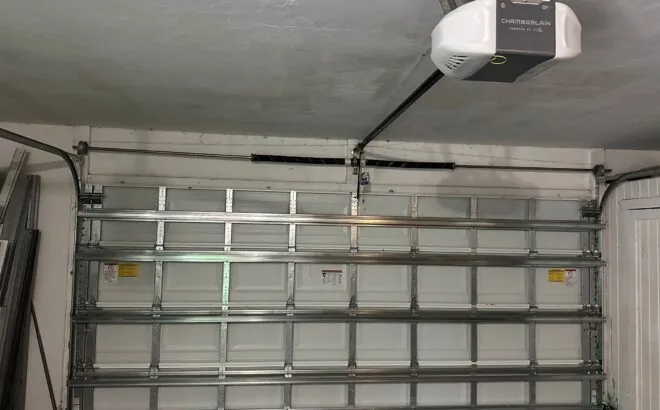
What an opener visit involves
- Hear what the door is doing. Humming, clicking, reversing, refusing a handset but answering the wall control: each points to a different fault.
- Check the door first. The trolley is released and the door raised by hand. If it is heavy or uneven, springs or cables are the real problem and are dealt with before the opener is judged.
- Test power and controls. Outlet, circuit, wall control, wiring and keypad are checked before the motor head is opened.
- Inspect the drive. Gear, chain or belt, sprocket, trolley and rail are checked for wear, slack and alignment.
- Agree the fix. Before a single part is swapped, you get the diagnosis and our view on mending versus renewing.
- Set up and prove it. Travel limits and force are set for the actual floor, the photo eyes aligned, handsets and keypads programmed, and the reversal tested with an object in the doorway.
That final test is the one that matters most. An opener that will not reverse when the door meets resistance should not be left in service.
Repair the opener or replace it
A good share of openers deserve mending. Chewed gears, tired sprockets, a tired capacitor, a slack chain, a failed sensor or a bad wall control can each be put right, and the unit carries on working. Openers repaired and replaced here include LiftMaster models, and the same approach applies: fix it when the fix is sound.
A new unit becomes the better call once an ageing motor’s circuit board dies and no spare can be found, when the opener lacks photo eyes or reliable reversal, when repeated repairs have stacked up, or when the household wants a quieter belt drive for an attached garage. A new opener is installed with its rail aligned to the door, its limits and force set for the floor it closes on, and every handset and keypad paired. Where the door itself needs replacing, it is better to choose the opener alongside it.
For any garage door opener repair Arlington MA owners are weighing up, the decision is made after the door has been checked, not before.
Handsets, keypads and smart controls
Handsets fail more often than motors. Batteries run down, buttons wear, and a handset dropped one too many times stops transmitting. Reprogramming a handset to the opener is usually quick, and clearing old codes at the same time is good practice. Keypads mounted outside lose their codes after battery changes or need resetting when the code has been shared too widely. Where a household wants phone control, an opener that supports it can be fitted or, on suitable units, an add-on paired. Whatever the control, the safety reversal and the photo eyes remain the backbone of the system.
Power cuts and the emergency release
When the power goes out, an opener cannot move the door, and a car parked in a built-in garage is stuck until the lights come back or the door is freed by hand. Every opener has a release cord, usually red, dangling beside the trolley. A tug on it uncouples door and drive so it can be raised manually.
Use it with care. Pull the cord only with the door fully shut, never with it raised or partly open, because a door whose coil is tired or parted can drop the moment it is released. Lift the door slowly by the handle or the bottom section, and if it feels very heavy, lower it again and leave it: its coils have given up, and propping it open is unsafe. When power returns, running the opener through a full cycle usually re-engages the trolley; if it does not, the release may need resetting by hand.
In a freestanding garage out back, a door released by hand in a power cut also loses its lock, since the opener’s drive was what held it shut. Re-engage it or secure the door another way before leaving it overnight. Problems reconnecting the trolley afterwards are a routine part of garage door opener repair Arlington MA households ask about after a storm.
Cold mornings and the motor
Cold affects openers in ways that are easy to mistake for a fault. Grease in the drive thickens, the door’s weather seal stiffens, and handset batteries lose voltage, so the first cycle on a frozen morning can be slow or can trigger a reversal. A door frozen to the slab is the extreme case, and the opener’s force limit is right to refuse it. Keeping the drive lightly lubricated with a product meant for openers, replacing handset batteries before winter and clearing snow from the bottom seal all help. An opener that fails every cold morning, though, may be telling you the door is out of balance and needs attention.
What you can safely check yourself
Some opener problems are simple. Replace the handset battery. Confirm the motor’s plug is seated and its breaker has not tripped. Slide the lockout switch on the doorway control back to normal. Wipe the photo-eye lenses with a soft cloth and look at their indicator lights; if one is dark or blinking, gently move it until both are steady. Clear anything from the doorway and the beam.
What not to do: avoid jabbing the handset again and again at a door that stays put, do not turn the force setting up to make a stubborn door close, and do not touch the springs or cables. If the opener hums and the door does not move, unplug the unit and call; continuing to run it against a heavy door can finish off the gear.
Getting the opener sorted
Whether the door is stuck, the motor’s bulb is flashing or the handset has gone dead, a real person takes the call, nights and weekends alike. A door stuck open overnight on an attached garage is a security concern, and the Arlington emergency repair page explains the safe steps while you wait. If the opener stalled after a loud bang, a spring is the likely cause, and the Arlington spring repair page explains why. The wider service is on our garage door opener repair page, and the Arlington page sets out everything we do locally.
For garage door opener repair Arlington MA households can depend on, jot down how the motor reacts to a press, plus where the door ended up. After that, call us or book online.
Questions from Arlington
Opener light blinking and the door goes back up before it closes. What is wrong?
The photo eyes are the usual suspect. Clear the doorway, give each lens a gentle wipe and study their indicator lights. If one is dark or flickering, it is out of line or its wiring is loose. If adjusting does not cure it, we can realign or replace the sensors.
Our door stops short of the floor on one side. Is the opener faulty?
Probably not. On a sloped slab the door often meets the floor unevenly, and the opener stops when it feels the first contact. Adjusting the travel limits and force, sometimes with a new bottom seal, usually fixes it without turning the force up to an unsafe level.
Can you replace our LiftMaster opener?
Yes. We repair LiftMaster units and fit replacements for them as well. Whether to repair or replace depends on what has failed and the age of the unit, and that is decided after the door and opener have been checked.
The handset works from the driveway but not from the street. Can that be fixed?
Often. A fresh battery, a repositioned antenna on the motor head or a newer receiver can extend range, which matters for garages at the back of a long or steep lot.
Our attached garage opener is loud enough to hear upstairs. What can be done?
Swapping a chain unit for a belt-driven one cuts the racket considerably, isolation pads between the motor and the joists reduce vibration, and nylon rollers cut track noise. A combination of those usually makes a real difference.