
Old houses by the center, post-war streets beyond
Natick is two kinds of town as far as garages go. Close to the center the houses are older, and their garages were built, rebuilt or added on at many different times. Further out, the post-war subdivisions brought ranches, splits and capes with garages designed in from the start. Turn a corner and the garages change character, so each job on garage doors Natick MA owners book starts with a simple question: what kind of garage is this, and what has been done to it before?
That question matters because the same symptom can mean different things. On a post-war ranch, a bay that sinks back after being lifted almost always means a worn-out spring. On an older garage near the center, the same complaint might come from a spring, from a door heavier than the springs were ever matched to, or from framing that has shifted and is pinching the rails.
Three things help us picture your garage before arriving:
- Does the garage share a wall with the house, or sit apart in the yard?
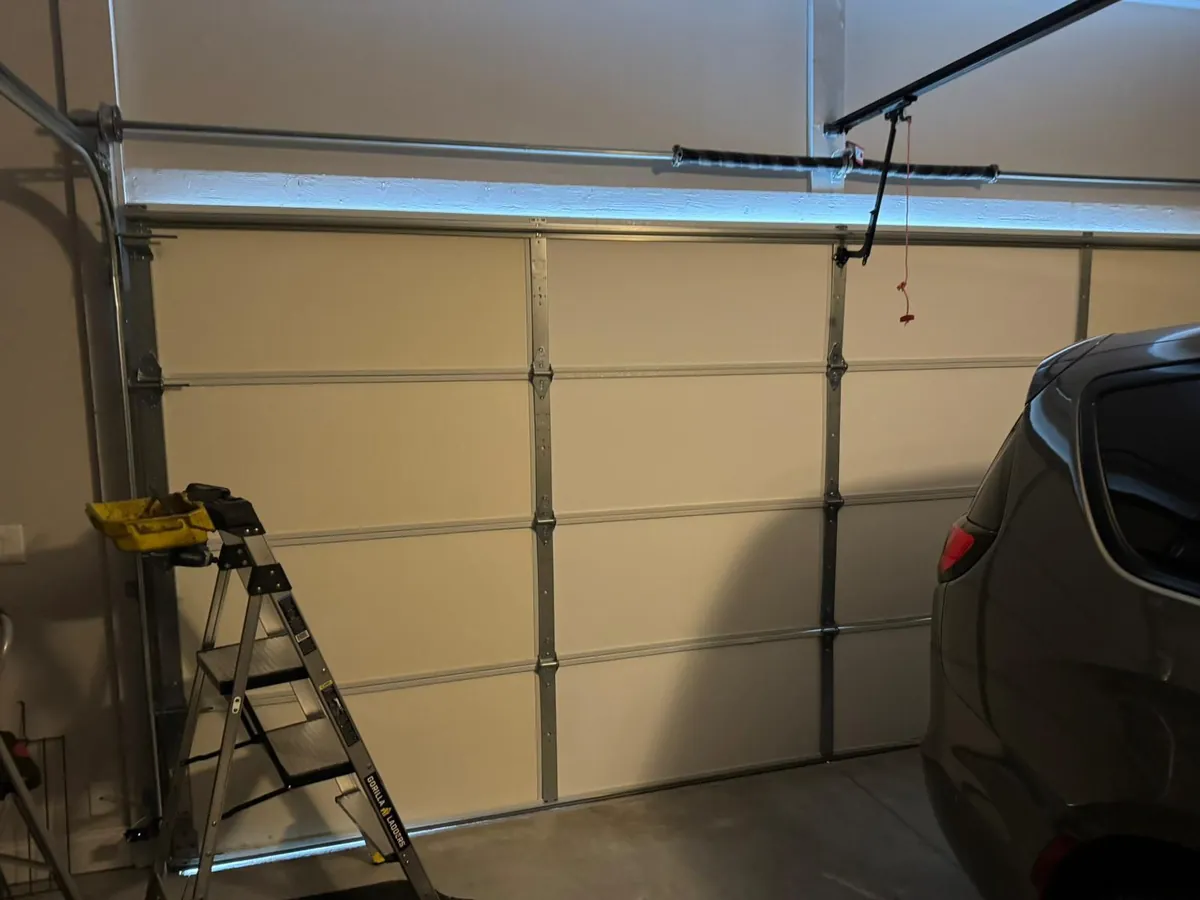
- Whether the springs sit across the top of the opening or stretch along the overhead rails.
- Roughly how old the door looks next to the house: original, replaced once, or recent.
Garage door services in Natick
Repairs
Splintered or dented sections, cracked hinges, worn rollers, a stretched-out bottom rubber, brackets working loose in old timber. The cause is found first. See garage door repair.
Springs
Extension springs on many original subdivision doors, torsion springs on newer ones, and every combination in between near the center. Spring work is covered on garage door springs.
Openers
Tired motors, gears worn smooth, remotes that refuse to pair, photo eyes knocked askew. LiftMaster units get fixed or replaced here as well. Read opener services.
Emergency calls
A bay frozen wide open at bedtime, or sealed with the only car trapped behind it. Ring whenever it happens; the emergency garage door repair page explains the first steps.
Cables
Lift cables gone ragged, snapped, unspooled from a drum or jumped from a pulley. We fit new ones on both sides; details on cable repair.
Off-track doors
A bump, a parted cable or framing that has crept can each spill the rollers from their channels. See off-track repair.
New doors
Replacement doors sized to the opening, whether that opening is a modern standard or an older one framed to its own size. See new garage door installation.
Garages near the center
The older houses closest to the center were built before the overhead sectional door became the default. Their garages, where they have them, have been added or changed over the years: some stand apart from the house, some were attached later, and some began with hinged or sliding doors and were fitted with an overhead door afterwards. Each round of change leaves traces. Jambs have been packed out, headers swapped, and rail brackets moved to fresh timber beside the holes of their predecessors.
None of that stops a door working well, but it shapes a repair. Openings framed by hand are rarely an exact standard size, so a replacement door or section has to be measured, not assumed. Older timber may have dried and split around bracket screws, so a loose rail is often fixed by moving the bracket to solid wood or adding a backing block. Scuffing along one edge can mean the jamb has wandered while the door itself is fine.
Headroom is the other variable. An older garage may have a low ceiling or a beam crossing just above the opening, which decides where the spring can mount and how the rails turn the door back. Parts are chosen for the space the building actually has.
Post-war subdivisions further out
Further from the center, the post-war streets are more consistent. Ranches, splits and capes came with garages planned into the house, usually attached, often at the end of the house or tucked partly under a living space. Many of the original doors on these houses ran on extension springs, stretched along the overhead rails, and some still do. Others have been converted to torsion springs, or replaced entirely with a newer door.
That consistency does not mean every door is the same. Houses on the same street have had different owners, and different owners have replaced different things at different times. One house may have its original door with a newer opener; the next, a new door on old rails. So even in a subdivision, the first part of a visit is a look at exactly what is there. That is the reality of garage doors in Natick: the street name tells you less than the door does.
Garages tucked under a living space have one more consideration. The opener is mounted beneath a room, so a noisy or straining unit is heard through the floor. A belt drive, a balanced door and fresh rollers all help.
Springs: extension, torsion and conversions
The type of spring decides a good deal about a repair. Extension springs run along each side of the door, above the horizontal rails, and stretch as the door closes. They are common on older and lighter doors. Torsion springs ride a tube mounted over the header and wind tighter during each descent. They are standard on most newer doors.
Either kind can break, usually with a sharp bang. From then on the motor manages a short lift and quits, or cannot shift the bay at all. Bear this in mind: of all the parts, a torsion spring holds dangerous tension most of all. Winding, unwinding or adjusting one without proper bars and training is how hands and faces get hurt. That makes it no DIY repair. The stretch-type springs carry big loads as well, and where no restraining cable runs through their middle, a snapping one can lash across the bay. If you have extension springs and no safety cables, it is worth having cables fitted. Natick has its share of both setups, and a quick look tells us which one a door uses, so phone descriptions help us arrive with the right spring stock.
On some older doors, converting from extension to torsion springs makes sense, particularly when the door is heavy or the springs fail often. On others, renewing the extension springs and their safety cables is perfectly adequate. We look at the door and explain the options. Our spring repair page has more detail.
Openers of every age
Across a town with this much variety, openers range from units that are decades old to recent ones. An older opener may lack the floor-level photo eyes that make a closing door reverse when something crosses its path; if yours has none, replacement is the safer choice. A middle-aged unit tends to fail in mendable ways instead: the drive gear shears its teeth, the carriage wears, the circuit board dies after a surge, or the handsets forget their codes.
An opener is only as good as the door it is moving. If the springs have weakened, the opener does the lifting, wears out early and may stop partway. Before an opener is condemned, the door’s balance is checked by disconnecting it and lifting it by hand. We take on LiftMaster openers too, mending or swapping them. For keypads, handsets, wall buttons and photo eyes, visit opener services.
Cables, rails and doors out of line
On extension-spring doors, the lift cables run over pulleys; on torsion doors they wind onto drums at the ends of the shaft. In both cases, they deliver the spring’s pull down to the lowest hinge line. When one frays or snaps, that corner drops and the door twists, often pulling rollers out of their rails.
On an older garage, rails also come out of line when the framing they are fixed to moves or when brackets lose their grip on dried timber. A door that has started to scrape, stick or run unevenly is often telling you a rail has shifted before it fails outright.
Seeing a bay tilted or loose of its channels? Stand back, leave the opener idle, and avoid any attempt to shove it home. The door is secured before any work starts, then rollers are returned or bent rail sections replaced, brackets refixed to solid wood, and both cables renewed together. See our cable repair and off-track repair pages.
Wood doors and what weather does to them
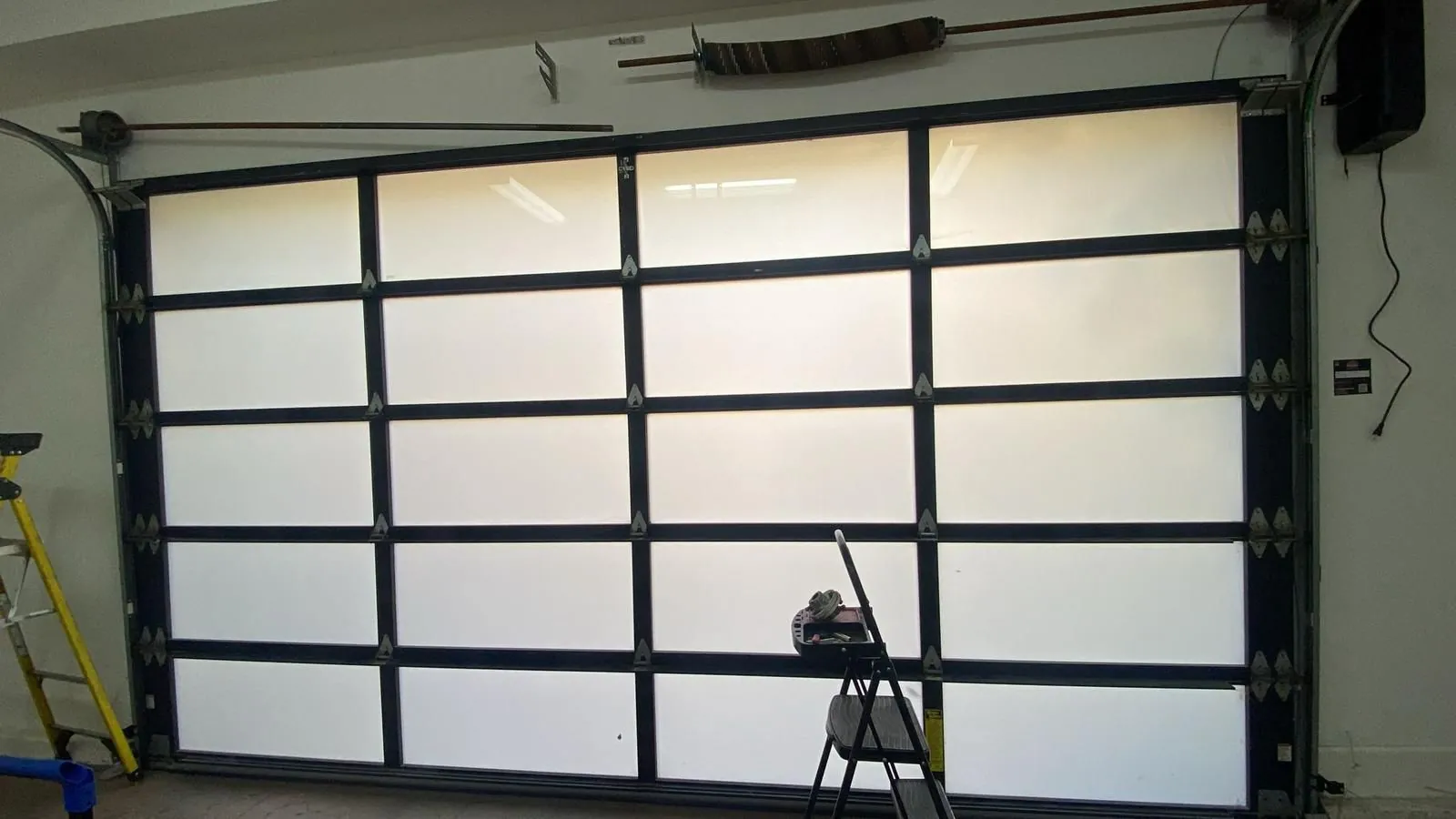
Older houses are more likely to still carry a wooden door, either the original or a wooden replacement chosen to suit the house. Wood looks right on an older facade, but it asks more of its owner. Paint protects it, and where paint fails, water finds its way into the grain, first at the bottom rail and then wherever a hinge has been screwed through. The lowest section softens first, because it sits closest to rain splash and snow. Joints in frame-and-panel sections open as the wood swells and shrinks with the seasons.
A wood door is also heavier than a comparable steel one, and it gets heavier as it soaks up moisture. That puts more strain on the springs and the opener, and a door that balanced well in a dry spell can feel heavy after a wet week.
Many wood door problems are repairable: a softened bottom section replaced, loose joints secured, hinges refixed into sound timber, the seals renewed. When rot has spread through several sections, though, a new door is the better course. Some owners replace like for like to keep the look; others choose a steel or composite door styled to suit an older house, which is lighter and asks less of its upkeep.
Detached garages and the walk across the yard
Where a garage stands apart from the house, a few practical things change. The opener’s power usually comes from a circuit run out from the house, sometimes long ago, and an opener that dies may simply have lost its supply at a tripped breaker or a tired outdoor connection. The wall button sits inside the garage rather than by a door into the kitchen, so on a detached garage the remote or keypad does most of the work.
A detached garage also has no other way in for many owners. If the door fails shut, there may be no side door, and the car, the bikes and the tools are all on the wrong side of it. If it fails open, the garage is open to the weather and to anyone passing. That is when calls come in late at night, and the phone is answered at any hour.
Older detached garages are also more exposed to the weather on all four sides, and their doors often see more damp along the bottom than an attached door. A bottom seal that has perished, or a lowest section that has softened, is common, and both are repairable.
Doors that have been patched for decades
Some doors near the center have been repaired many times by many hands. A section replaced with one from a different door, springs from one supplier and cables from another, a window section added, hinges that do not match. A door like that can still run well, but it is harder to balance, because its weight is no longer what its original springs were designed for.
When we work on such a door, the starting point is to establish what it weighs now and how it behaves with the opener disconnected. If it is too heavy for its springs, new springs are matched to its present weight. If a mismatched section is binding, it may be replaced with one that suits the rest. And sometimes the honest answer is that the door has been patched past the point where more patching makes sense.
Matching parts to an unusual opening
Because Natick’s garages vary so widely, standard parts do not always fit straight from the box. An older opening may be slightly narrower or shorter than a modern standard, a rail may need to follow an unusual curve to clear a beam, or a spring may need to match a door that has been made heavier by an added window section or a thicker panel.
That is why measurements matter before any part is ordered for a door that is not standard. A snapped spring is replaced by one wound for that particular door’s heft and height. For a new door, the exact opening, the headroom and the side room decide the door and its hardware. Taking the time to get those right means the door runs smoothly and the opener does not strain.
What a visit involves
- Anything unstable, such as a door hanging crooked or out of its rails, is secured first.
- The garage is looked at as a whole: the door, springs, cables, drums or pulleys, rollers, hinges, rails, brackets, seals, the opener and its sensors.
- We explain what has failed, why, and what we would recommend, and nothing begins without your agreement.
- Repairs are completed, the springs are tensioned for balance, and the opener’s force and limits are tuned.
- The door is run with you several times, and the safety reverse is checked.
It helps to clear the space just inside the door and, on a detached garage, to make sure it is unlocked or accessible.
Keep the old door or start fresh
Hardware failures rarely justify a whole new door, since each moving part can be renewed on its own. Starting fresh is worth it when the panels themselves are finished: a wood door gone punky or split, a door carrying so many patches that it never balances properly, or an elderly door whose weight has outgrown its opening and fittings.
On an older house near the center, a replacement door is often made to the existing opening and chosen to suit the house’s age. On a post-war house, a modern insulated door can transform how the garage and the rooms around it feel. Either way, new garage doors in Natick are supplied and installed to the opening, with springs matched to the door, and the old door removed. See our new garage door installation page.
Calling about garage doors Natick MA
Whichever kind of garage you have, describe the symptoms and, if you can see them, the springs. Calls are picked up at every hour, every day, and Google reviewers give us 5.0. Nearby, we also look after Wellesley and Wayland, and the complete town list sits under service areas. Whether your garage doors Natick MA streets know well are old timber or recent steel, the next step is the same: call us or book online.
Questions from Natick
How do I tell which type of springs my door has?
Glance up at the header. A coil wrapped around a tube over the opening means torsion. Long springs running along each side above the overhead rails are extension springs. Do not touch either.
My door has extension springs with no cable through them. Is that unsafe?
It is a risk worth fixing. With nothing running through its centre, a spring that breaks can fling pieces round the bay. Safety cables can be fitted when the springs are serviced.
Can a torsion spring be adjusted at home?
Please leave it alone. Those coils store enough energy to injure badly, and setting them belongs with a technician.
My garage is old and the door is not a standard size. Can you still replace it?
Yes. We take exact measurements first, then supply a door and fittings made for that opening.
Is it worth converting extension springs to torsion?
On some heavier or older doors, yes. On others, new extension springs with safety cables are fine. We look at the door and explain the options.