
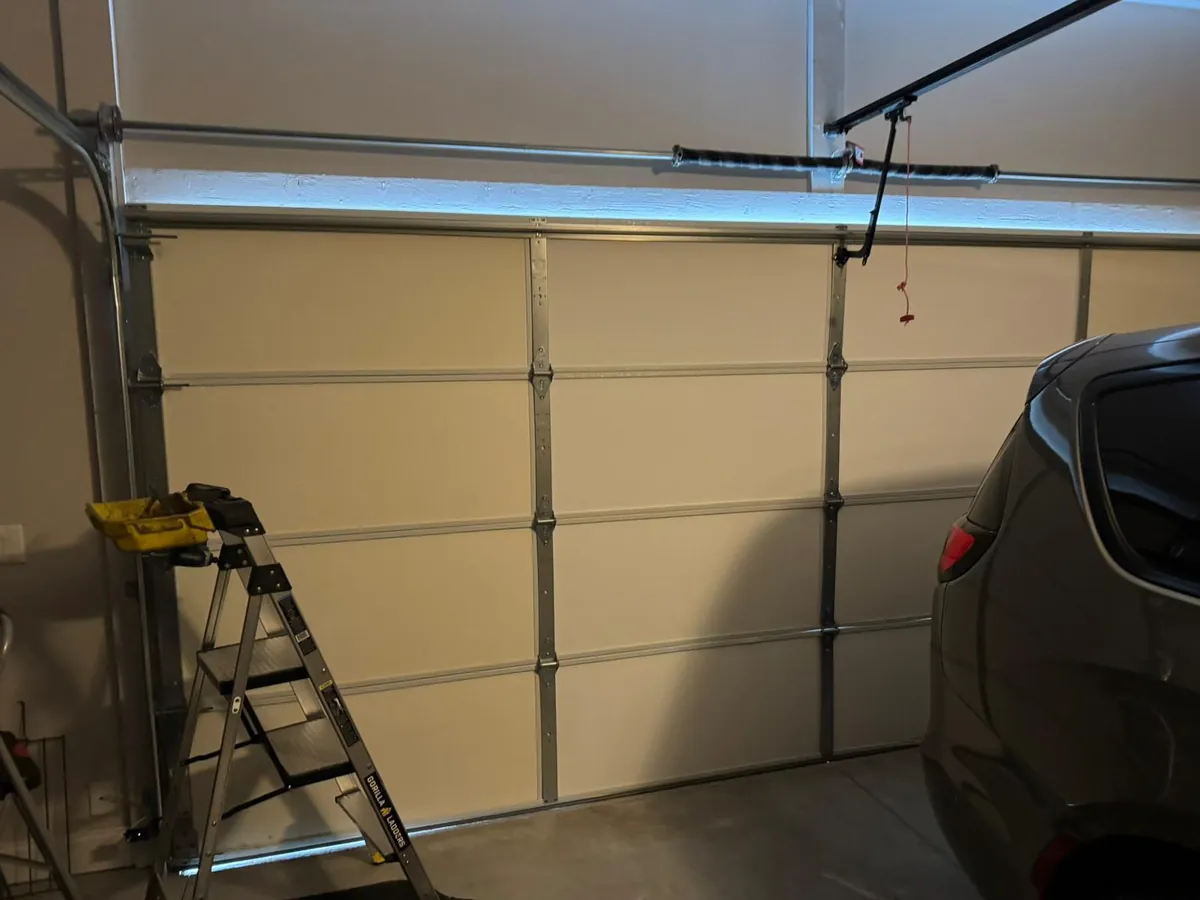
Why the garages behind Allston’s triple-deckers need repair work
Most garages in Allston are not attached to the house at all. They stand behind the house, where a long narrow driveway finally ends after squeezing past a triple-decker or a rental building off Commonwealth Avenue or Brighton Avenue, and many of them were put up in the 1920s for cars a good deal smaller than anything parked there now. Garage door repair Allston MA owners call about usually starts in one of those back-lot buildings, where an overhead door has been added to a structure that was framed for something simpler, and where the door often opens and closes many times a day for several households.
That history shows up in the hardware. A wood-framed opening that has settled over the decades pulls a track out of line. A short header leaves little room for a spring. A door that serves every unit in the building wears its rollers and opener far faster than a door that moves twice a day.
Before you pick up the phone, look, without touching anything, for three things:
- A clean break in the coils of the torsion spring over the opening, or of either extension spring beside the tracks.
- Whether both lift cables are taut at the bottom corners, or one hangs loose.
- Whether the door sits level in the opening or leans to one side.
What a repair in Allston can take in
Torsion and extension springs
All the lifting is done by the springs. Once one snaps, the door feels like a slab and the opener gives up after a few inches. Spring work has its own page for Allston spring repair.
Cables and drums
A frayed or snapped lift cable lets one corner drop, and the door twists in the opening. Cables are replaced in pairs so both sides lift evenly.
Panels and hinges
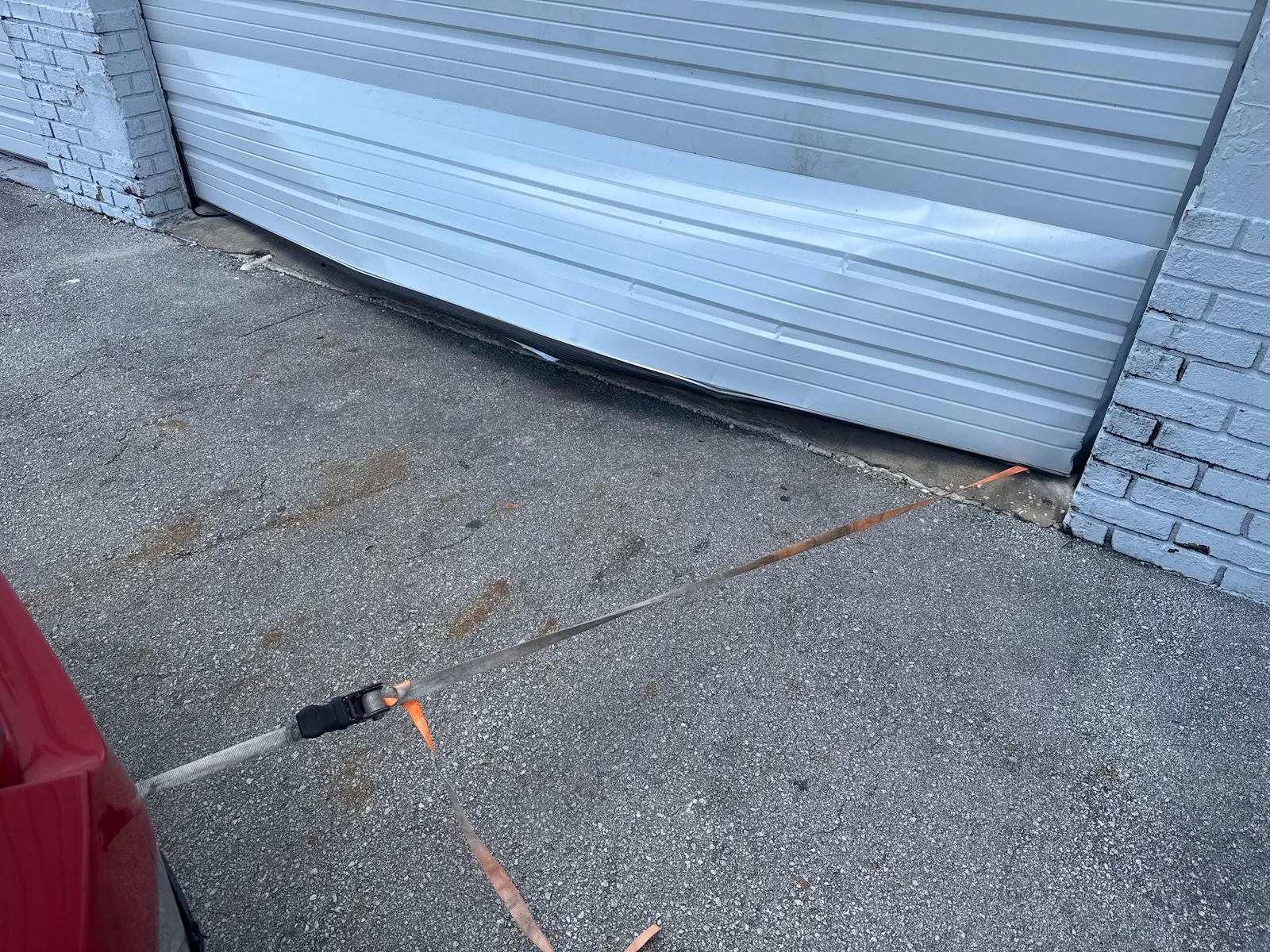
A bumper backing down a tight driveway, or a bin blown against the bottom section, cracks or dents a panel. Hinges between sections loosen and split with heavy daily use.
Openers, remotes and wall buttons
A motor that hums and goes nowhere, a remote that has stopped working, a wall button that does nothing. The details are on the Allston opener repair page.
Tracks, rollers and off-track doors
Worn rollers, loose brackets on old framing and tracks knocked out of line, up to a door that has jumped clean out of both rails.
Safety sensors
Two small photo eyes, one on each side of the opening at ankle height, which send a closing door back up. In a narrow garage they are easy to knock with a bike or a bin.
A garage built long before the door it now carries
Many of the single-car garages behind Allston’s houses date from the 1920s, when an overhead sectional door was not the standard it is now. Some were built with swing-out or sliding doors and were converted later; others have had more than one overhead door in their lifetime. Each change leaves its mark on the opening. Jambs get shimmed and re-shimmed, headers get packed out, and the track brackets end up screwed into wood that has already held a set of brackets before.
None of this stops a door from working well, but it changes how a repair is approached. A loose track bracket on a newer garage is usually a matter of tightening a lag screw. On an old wood-framed garage, the screw may be turning in a hole that has been stripped out, and the fix is to move the bracket to sound wood or add a backing plate. A door that rubs on one jamb may not need anything on the door itself; the jamb may simply have moved.
Headroom is the other limit. A low garage leaves only a narrow band of space above the opening before the joists start. That decides where a torsion spring can sit, whether a low-headroom track arrangement is needed, and what kind of opener will fit above the door. When a part is replaced in a garage like this, it has to suit the space the building actually has, which is not always the space the original door was designed for.
The long driveway and the alley behind it
The approach to the garage matters as much as the garage. A detached garage at the end of a long narrow driveway is a walk from the street, and every spring, ladder, track section and tool goes down that driveway on foot. A driveway shared with a neighbour, or lined with parked cars from the units in front, makes that walk longer still.
The alleys behind Pratt and Gardner are tighter again. A garage that opens onto one of those alleys can be so tight that there is barely room to stand behind the door, and on some the outside face has no working room at all. That shapes the repair. Work that would normally be done standing outside the door, such as replacing the bottom seal or sighting the bottom section against the floor, has to be planned from inside the garage instead, with the door partly raised and blocked. Swapping a damaged section in a garage like that takes more care than in a bay with open space on both sides.
Practical things help before a visit: moving cars from the driveway if the units can manage it, clearing the floor just inside the door, and making sure the garage can be reached from the alley side if that is the only way in.
The parts behind a working door
Every overhead door depends on the same set of parts working together. Garage door repair in Allston MA comes down to finding which of them has failed and what it has damaged on the way.
The springs do the lifting. A torsion spring is mounted on a steel bar over the opening and winds tighter as the door comes down. An extension spring stretches along each horizontal track on older and lighter doors. Either way, a broken spring leaves the door at its full weight, and the opener, which was never meant to lift that weight, strains and stops.
The cables carry the spring’s force to the bottom of the door. They wind onto drums at each end of the torsion shaft, or run through pulleys on an extension-spring door. A cable that frays on a sharp bracket edge, or comes off its drum when the door hits something, leaves one side unsupported.
The rollers and tracks guide the door. Rollers turn in the vertical tracks beside the opening and in the horizontal tracks under the ceiling. A seized roller drags; a cracked one jams. On an old garage with framing that moves, the tracks need checking at every visit.
The opener pushes and pulls a balanced door, and the safety sensors tell it to stop and reverse when the beam is broken. An unbalanced door asks more of the opener on every trip, until one of them gives up.
What a visit involves
Nothing is replaced on a guess. The first job is to unhook the opener’s trolley and work the door by hand, which shows straight away whether it is balanced: a sound door lifted to waist height more or less stays there, and one with a failing spring sinks or will not come up.
Next comes a walk round the hardware. Both springs and both cables, every roller and hinge, each length of vertical and horizontal track, and the brackets holding it all to the building. On a garage from the 1920s that last point gets real attention, because a bracket screwed into tired or split wood will pull loose again however good the new part is. Where the opener is part of the complaint, it is run disconnected from the door, the remotes and wall button are tried in turn, and the photo eyes are tested.
Then you are told what has gone, what caused it and what else is close to going, and nothing proceeds until you agree. With the worn or broken parts renewed, the door gets rebalanced, the opener’s up and down limits and its force are reset for the repaired door, and the auto-reverse is proved by lowering the door onto a block of wood laid in the opening.
While you wait: what you can touch and what you cannot
Some checks carry no risk and often save time:
- A door stuck halfway should be stopped from trying again, so pull the opener’s plug out of the ceiling socket.
- In a narrow single-car garage, a bike, a bin or a garden tool leaning against one of the photo eyes often explains a door that keeps bouncing back up. Move it, and wipe both lenses with a dry cloth.
- If only one remote has stopped working, its battery is the likely culprit. Press the wall button: if the door responds, the opener is fine.
- Run your eye along each track for anything wedged against it.
Everything carrying the door’s weight is off limits. The torsion spring with its winding cones and set screws, both lift cables, and the two corner brackets they hook onto all sit under heavy load, whether the door is open or shut. Releasing that load in the wrong order can send a bar, a bracket or a cable end flying, which is why spring and cable work is not a DIY repair. Resist heaving a spring-broken door up by hand, and resist pressing the button again too; with the spring gone, nothing is holding the door up.
Doors knocked off their tracks in tight spaces
Tight driveways and narrow alleys make off-track doors more common than they should be. A car reversing at an angle clips the bottom section; a door left partway open catches a gust; an opener carries on driving a door that has already jammed on a bent rail. Once the rollers are out of the rail, the door hangs crooked and can fall.
Running it on the opener, or shoving it back by hand, tends to make things worse. Putting it right means securing the door so its weight is off the rollers, guiding each roller back into its rail, straightening or renewing any bent length of track, and making sure the two cables sit at equal tension before the door moves again. Where an alley presses up against the outside of the garage, nearly all of that happens from inside, one more reason to leave it to someone with the right clamps. The off-track garage door repair page goes further into how these doors are put back.
Knocks, dents and a worn bottom seal
A detached garage at the end of a driveway takes knocks that an attached garage is spared. Cars turn in a confined space before backing out, bins are wheeled past the door on collection day, and snow is shovelled up against the bottom section all winter. Most panel damage on these doors is from that kind of contact rather than from age.
A single dented or cracked section can often be swapped out by itself, so long as a section of the same profile and finish can be found. Hinges between the sections deserve a look at the same time: once a hinge splits, the door bends as it moves, and you see it as a sag across the middle or hear it as a scrape at the same spot on every trip. As for the bottom seal, sitting on an old concrete or asphalt floor that is rarely level, wears fastest of all. Once it is torn or flattened, water and leaves blow in underneath and the bottom section starts to rust or rot. For garage door repair in Allston MA where the driveway slopes toward the garage, a worn seal is often the first thing worth replacing.
When one garage serves a whole building
Behind a triple-decker or a rental building, a single garage is often shared between the units, or used as storage by one and parking by another. That pattern of use is hard on a door. More cycles mean more wear on the rollers and hinges, more strain on the springs, and more remotes that may each be programmed to the opener. A door that several people open is also more likely to be run when something is already wrong with it, which is how a small fault becomes a bent track or a burnt-out opener.
For an owner looking after a rental property, a few habits help: knowing where the opener’s plug is so the door can be stopped, keeping a note of which remotes are in use, and calling as soon as a noise or a jerk in the travel is reported rather than after the door stops. A spring that is close to breaking often shows as a door that has started to feel heavier or to close faster than it used to.
Repair or replace
For most Allston garages the answer is repair. Springs, cables, rollers and hinges are all parts that wear out and are meant to be renewed, and a door with a sound skin keeps going for years once they are. In an old opening that has moved out of square, the door already hanging there has been adjusted to it over time, which is another reason to keep it if it is sound.
The balance tips toward a new door once the sections, not just the moving parts, are past saving. Look for steel sections rusted through along the bottom, wooden panels gone soft or split in several places, or a timber door so waterlogged that it has become too heavy to balance. Any garage door repair Allston MA properties need comes with an honest view of which of those cases applies. Where a replacement is the better spend, new garage doors in Allston describes how a new door is made to suit an older opening.
Getting the door looked at
Doors rarely pick a convenient moment to stop, and a car shut inside or a door stuck open after dark is the usual result. A real person answers our line at every hour, weekends included, so a fault found late at night can be reported straight away. If the door is stuck open, will not lift or has jumped its track overnight, the Allston emergency repair page sets out what to do while you wait. The wider picture of this service across the city is on the garage door repair page, and everything we do in this part of the city is gathered on the Allston page.
Before you ring about garage door repair Allston MA homes need, it helps to say how the garage is reached, whether from a driveway or an alley, what the door is doing, what looks broken, and whether your car is shut in behind it. With that to hand, call us or book online.
Questions from Allston
The door goes up a few inches, then stops. What has failed?
In most cases a spring has broken. With nothing balancing the door, the opener senses far more load than it expects and shuts off after a short lift. Stop using the button, unplug the opener at the ceiling, and look up at the coils over the door for a break.
Our garage is down a long driveway. Does that cause problems for a repair?
Not for the repair itself. It only means parts and ladders are carried down the driveway, so it helps to move cars out of the way if you can and to leave the area just inside the door clear.
The garage opens onto a narrow alley. Can it still be repaired?
Yes. Where there is very little clearance behind the door, the work is planned from inside the garage, with the door raised and secured as needed. Let us know about the alley when you call so the visit is planned around it.
Is it all right to keep using a door that has started to jerk or bang?
It is better not to. A jerk or a bang usually means a roller, a hinge, a cable or a spring is wearing out, and running the door puts more strain on the rest. On a shared garage, ask everyone to stop using it until it has been looked at.
Can I shove a derailed door back into its rails myself?
No. An off-track door can fall, and the cables and springs are still under tension. Leave it where it is, keep cars and people clear, unplug the opener and call.