
Why openers struggle in Allston’s detached garages
An opener at the back of an Allston lot has a harder life than one in an attached garage. The typical Allston garage is a one-car outbuilding reached down a long, slim driveway, standing behind a triple-decker or a rental house on one of the side streets off Commonwealth Avenue or Brighton Avenue, and plenty of them have stood there since the 1920s. They are unheated, often low under the rafters, and fed by a single circuit run out from the house. Garage door opener repair Allston MA owners ask for usually traces back to one of those conditions, or to a door that has been opened by several households for years without anyone looking at it.
An opener that hums, clicks, stops halfway or does nothing at all is giving a clue. The fault might lie in the motor head, along the rail, in a handset, at the button by the side door, in a photo eye, or in the door it is trying to move.
Three quick observations help before you call:
- Does the bulb or light ring on the motor head come on at a press?
- Does the door shift at all, or does the motor whirr while the door sits there?
- Are the tiny lamps on the two floor-level photo eyes both glowing, without flicker?
Opener problems that come up most
A motor that hums but will not move the door
Usually the plastic drive gear inside has worn its teeth off, the trolley has seized on the rail, or a snapped spring has left the motor facing a load it was never built to raise.
Remotes that have stopped working
Flat batteries, lost programming, or a remote that only works halfway down a long driveway.
Wall buttons that do nothing
A broken button, a damaged wire run along old framing, or a control panel that has been locked.
A door that reverses before the floor
Photo eyes knocked askew or filmed with dirt, a force adjustment set for the door as it was years ago, or a door catching in its track.
Openers past repair
A worn-out motor or a burnt logic board on an older unit, where replacement makes more sense than repair.
How an opener actually moves a door
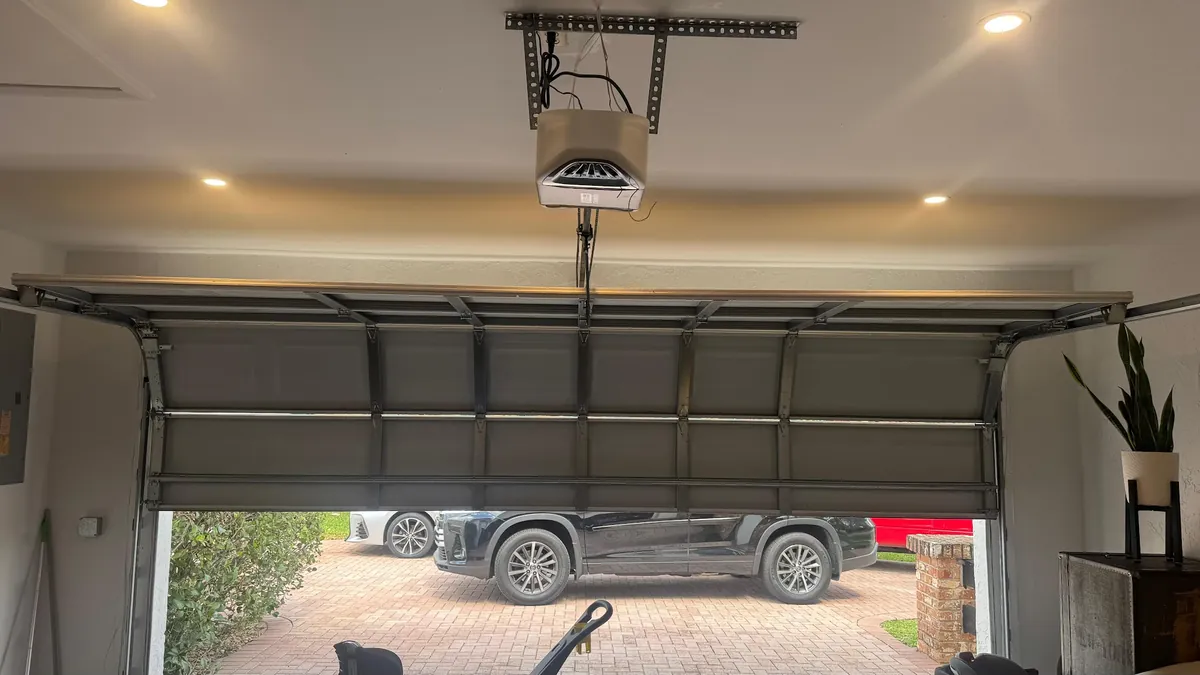
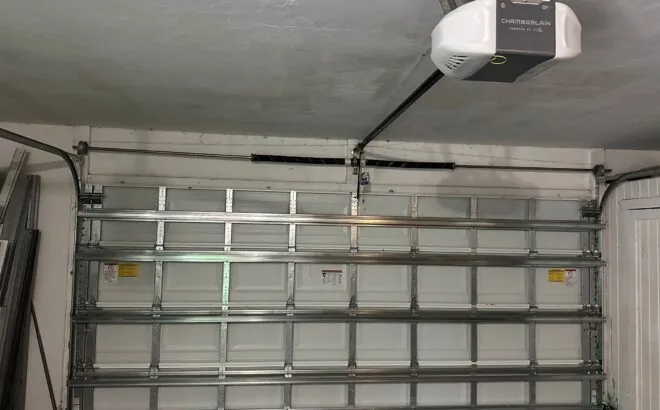
It helps to know what the opener does and does not do. The motor unit hangs from the ceiling behind the door and drives a trolley along a rail toward the opening and away from it. The trolley is connected to the top section of the door by a bent arm. On a chain or belt opener, the motor turns a sprocket that pulls the chain or belt along the rail; on a screw-drive opener, a long threaded rod turns and carries the trolley with it. Some openers mount on the wall beside the door instead and turn the torsion bar directly, which leaves the ceiling clear.
What the opener does not do is lift the full weight of the door. The springs carry that. The opener only moves a door that is already balanced, then stops it at the set points at the top and bottom of its travel, and reverses it if the sensors see something in the way or if the door meets more resistance than it should. That is why an opener that has started to strain is often the messenger rather than the culprit: a weak spring, a dry roller or a bent track asks the motor to do work it was never sized for.
Garage door opener repair in Allston MA garages with low ceilings
Low headroom is common in the old garages behind Allston’s houses. A roof that slopes toward the door, low collar ties or a beam across the opening leaves little room for an opener rail and the clearance it needs above the door’s travel. Over the years, many of these garages have ended up with an opener squeezed into whatever space was left, sometimes hung from a makeshift bracket screwed into a rafter.
That shapes garage door opener repair in Allston MA garages like these. A rail mounted too close to the door makes the arm work at a steep angle and puts extra strain on the trolley and the top bracket. A motor unit hung from a flexing rafter shakes on every run and loosens its own mounting. When a replacement is needed, a wall-mounted unit that drives the torsion bar from the side can suit a low garage better than a ceiling unit, because it needs nothing overhead at all. Which option fits is judged from the garage itself.
Remotes, distance and a long driveway
Being at the back of the lot asks a lot of a handset. Pressing the button from the street or from halfway along the drive means the signal has to travel the length of the drive, past the house and sometimes through a fence or a parked car. A weak battery, a remote tucked behind a sun visor or an aerial wire on the motor unit that has been pushed up against a rafter all cut the range. The result is a remote that works only when you are almost at the door.
The fixes are usually simple: a new battery, the aerial straightened and hanging down clear of metal, a remote reprogrammed to the opener. Where the motor unit’s receiver has failed, the board may need attention. In a garage that has picked up remotes from different occupants over the years, it can also be worth clearing the opener’s memory and programming only the remotes still in use, so that no stray handset can still open the door. That is a simple job at the same visit as any other opener work.
Wall buttons and the wire that feeds them
The wall button looks like the least complicated part of the system, and usually it is. But in a detached garage from the 1920s the low-voltage wire from the button to the motor unit often runs along old framing, gets stapled over, nicked by a tool or chewed through, and a button that does nothing may have nothing wrong with it at all. A wire damaged partway along can also make the door start on its own, or refuse to respond at one moment and work the next.
Many newer wall controls also have a lock feature that disables the remotes, and a light button that is easy to confuse with the door button. A remote that has suddenly stopped working while the wall button still runs the door is often just that lock switched on. Testing the button directly at the motor unit, and checking the wire run, separates these faults quickly.
The safety sensors by the floor
Openers made in recent decades carry two photo eyes fixed a few inches above the slab, one each side of the opening. One throws an invisible beam across; its partner looks for it. Interrupt that beam as the door descends and the motor halts and runs the door back up. When the two eyes lose sight of each other entirely, the handset usually stops closing the door, and on many models only a constant press on the wall control will bring it down.
Inside a slim one-car garage, those eyes take a beating. A bike, a bin, a snow shovel or a stack of boxes stored against the wall can nudge one out of line. Sunlight falling straight into one of the lenses through the open door, cobwebs, condensation in a damp unheated garage and a wire stapled too tightly can all cause the same symptom: a door that goes down a little way and comes straight back up. Realigning the sensors, cleaning the lenses and checking the wiring cures most of these faults. Where a sensor is cracked or its wire is damaged beyond a simple repair, the pair is replaced.
What an opener visit involves
A visit for an opener does not start at the opener. The door is disconnected from the trolley with the emergency release, then lifted and lowered by hand to check its balance and how smoothly it runs. If the door is heavy, binds in its tracks or drops when let go halfway, that is dealt with first, because any opener will struggle on a door in that state.
With the door sorted, the opener is checked on its own: the motor unit, the drive gear or sprocket, the chain, belt or screw, the trolley and its connection to the door, the rail and its mounting brackets, and the logic board where it is accessible. The remotes and the wall button are tried, the wiring is checked, and the sensors are tested. Before a screw is turned, you hear what the fault is and whether the unit deserves fixing.
Once mended, the trolley is clipped back to the door, the travel is set so the bottom seal meets the floor and the top section clears the header, and the force is tuned to this particular door. The safety reverse is then tested, both by breaking the sensor beam and by closing the door onto a solid object on the floor.
A detached garage, cold and power
Two things about detached garages catch openers out. The first is cold. An unheated garage sits at outdoor temperature through the winter, grease on the drive gear and rail stiffens, and a motor that was already working hard has a harder time on a frozen morning. Some openers slow down or stop and reverse in the cold because the door feels heavier than the force setting allows.
The second is power. Many detached garages run on a single circuit brought out from the house, sometimes through an old buried cable or an overhead line. An opener on a circuit that also feeds lights, a freezer or power tools can be starved of current or tripped off. A power surge from a storm can damage the logic board. When an opener is dead with no lights at all, the outlet and the circuit are checked before the opener is blamed. Electrical work on the circuit itself is outside an opener repair, and if the supply is the problem you will be told so.
Opener trouble that starts at the door
Many opener repairs are really door repairs. An opener that hums without moving is often pushing against a door whose spring has broken. One that stops and reverses halfway may be meeting a seized roller or a bent length of track. One that runs but leaves a gap under one side of the door may be trying to close a door that is crooked because of a slack cable.
If the door is the cause, fixing the opener alone will not last. The Allston garage door repair page covers cables, tracks, rollers and panels, and a broken spring is covered in detail on the Allston spring repair page. Whatever the opener’s state, keep hands off the spring itself: the tension wound into a torsion spring is dangerous, and changing one is not a DIY repair.
Chain, belt and screw drives at the back of the lot
The drive type matters more in an outbuilding than in a heated garage. A chain drive is rugged and copes with damp, but its chain stretches, slaps against the rail when slack, and wants a little lubrication now and then; left alone it clatters and eventually skips teeth on the sprocket. A belt drive runs quieter and needs less attention, though a belt that has been cracked by years of cold can split. A screw drive has few moving parts, yet its long threaded rod depends on grease that thickens badly in a freezing garage, so screw units are the ones most likely to slow to a crawl on a January morning. At a visit, the chain is tensioned or the belt inspected, the rod cleaned and regreased with a cold-tolerant lubricant, and the trolley checked for wear where it rides the rail.
Narrow alleys and the outside of the door
The alleys behind Pratt and Gardner leave little room behind many garage doors. For opener work that matters less than it does for panel or track work, because the opener, sensors and button are all inside. What it does affect is the testing. A door that opens onto an alley has to be run with the alley clear, and the sensors’ beam has to be checked from inside with care, because there is no room to stand outside and watch the door close. On garages like these, a working safety reverse is especially important: anything left in the opening on the alley side is out of sight from the button.
When the opener should be replaced
Repair is usually the first choice. Gears, sprockets, trolleys, sensors, remotes, wall buttons and logic boards can all be replaced on most openers. A new unit becomes the better buy once the motor windings are going, when an old unit has no safety sensors or no reliable way of setting its limits and force, when parts for it are no longer easy to obtain, or when the opener simply does not suit the door and the garage, such as a ceiling unit crowding a low garage that would be better served by a wall-mounted model.
We work on LiftMaster openers too, repairing them and fitting replacements, as set out under LiftMaster opener repair. Whether to repair or replace is explained plainly at the visit, with the reasons. Garage door opener repair Allston MA properties need is sometimes the start of a larger change, and when the door is as worn out as its motor, read new garage doors in Allston before hanging a fresh opener on a tired door.
Booking the visit
Motors pick their moments, often the morning commute with the car shut in, or late evening with the door frozen open. We take calls at any hour of any day, so you can report it as it happens. A door that is wide open and must be made secure is covered on the Allston emergency repair page. For the wider service, read about opener repair and replacement, and see the Allston page for our other work in the neighbourhood.
For garage door opener repair Allston MA garages need, it helps to describe what the opener does when the button is pressed, whether its light comes on, whether the sensor lights are steady, and whether the garage opens onto a driveway or an alley. Note those few things down, and call us or book online.
Questions from Allston
There is a humming sound from the motor, yet the door stays put. Why?
Two causes lead the list: a snapped spring leaving the door too heavy, or a drive gear in the motor head with its teeth worn away. Take your finger off the control, pull the plug at the ceiling, and glance at the coil over the door. A whole, unbroken spring points to the gear.
The handset only works once I am nearly at the garage. Is that fixable?
Generally. A fresh battery is the first try. Failing that, the aerial wire on the motor head may be folded up against the rafters, or the receiver may be losing sensitivity. Both can be dealt with at a visit.
The door goes down a little way and comes straight back up. Why?
The photo eyes are behind it nearly every time. Clear anything sitting across the opening at ankle height, wipe both lenses and look at their little lamps. If one is blinking or off, the sensors are out of line or a wire is damaged.
Will a replacement opener fit under our very low roof?
In many cases. A side-mount unit, fixed to the wall beside the door and driving the spring bar directly, takes up no space overhead, and suits many low detached garages. Whether it fits depends on the door and the spring arrangement.
The opener is completely dead. How do I get the door up?
Tug the red release cord that dangles from the trolley, then raise the door by hand, gently. Should it feel like a dead weight, or slide back down when you let go, stop there: the spring has likely failed, and the door is safest shut.