
Why so many Allston garages are ready for a new door
Plenty of the outbuildings behind Allston’s houses are on their second, third or fourth door. These are mostly one-car garages from the 1920s, set at the far end of long slim driveways behind triple-deckers and rental houses on the side streets off Commonwealth Avenue and Brighton Avenue. Whatever door they have now was fitted to an opening that was built for something else, and often it has been patched for years. New garage doors Allston MA owners ask about are usually replacing one of those worn-out doors: rotten at the bottom, rusted through, missing sections, or so heavy with soaked-in water that no spring can hold it.
A new door is supplied and installed to suit the opening as it really is, not as it was drawn. On an old garage that matters, because few of these openings are still square, level or as tall as the door they once carried.
Three signs that replacement is worth a conversation:
- The bottom section is soft, split or rusted through, and a seal will not sit flat against it.
- More than one panel is cracked or dented, and the door has been repaired more than once in recent years.
- The door feels heavy even after new springs, or still sags in the middle when raised.
What a new door involves
Measuring the real opening
Width, height, headroom over the opening, room at each side and depth back into the garage, all taken on site.
Choosing the door
Sectional doors in steel or wood, with or without windows, in a style that suits the garage and the house in front of it.
Taking out the old door
The old springs are unwound safely, the old door and its tracks are removed, and the opening is prepared.
Fitting the new door
Tracks, springs, cables and the sections themselves, installed and balanced to the door.
Opener and controls
A new opener, or the existing one checked and reset to the new door. See Allston opener repair.
Old openings and why measuring matters
A door from a catalogue assumes a tidy opening: square corners, a level floor, plumb jambs and enough height above the opening for springs and tracks. Very few of Allston’s older garages offer all of that. A century of frost under a slab tilts the floor. Wood jambs settle and lean. Headers have been cut, packed out or replaced as earlier doors came and went. Some openings were built for doors that slid or swung, so the framing never expected the load of an overhead door at all.
That is why the first step is a proper measure on site. Width and height are each read at three or more points across the opening rather than once. The clear space above the opening, up to wherever the rafters or a tie beam come lowest, is checked, because it decides which spring and track arrangement will fit. The space at each side of the opening is measured for the vertical tracks, and the depth back into the garage is checked for the horizontal tracks and an opener. Where the floor is out of level, that is noted too, because the bottom seal has to close the gap across the whole width.
New garage doors in Allston MA garages with low ceilings
Of all the limits these outbuildings impose, a cramped ceiling crops up most. A standard track arrangement needs a certain clearance above the opening for the door to curve back into the garage and for a torsion spring to sit on its shaft. Where the roof slopes down or a tie beam crosses low, that clearance may not exist.
New garage doors in Allston MA garages with low ceilings can still be fitted, with a low-headroom track arrangement that changes how the door turns from vertical to horizontal, and with the spring positioned to suit. In some garages, extension springs along the horizontal tracks remain the most practical choice. The choice is made from the measurements, and you are told what it means for the door and for any opener before anything is ordered.
Choosing a door for an old garage
Most new doors are sectional: several horizontal panels hinged together, running on rollers in a pair of tracks. Within that, the choices are about material, insulation, windows and look.
Steel doors are the usual choice for a detached garage. They are light for their size, which suits a modest spring, and a painted steel skin resists rot. Insulated steel doors have a core between two skins, which makes them stiffer and quieter and helps if the garage is used as a workshop. Wood doors suit some older buildings and can match the timber of the garage, though they need regular painting or staining and become heavier if water gets in.
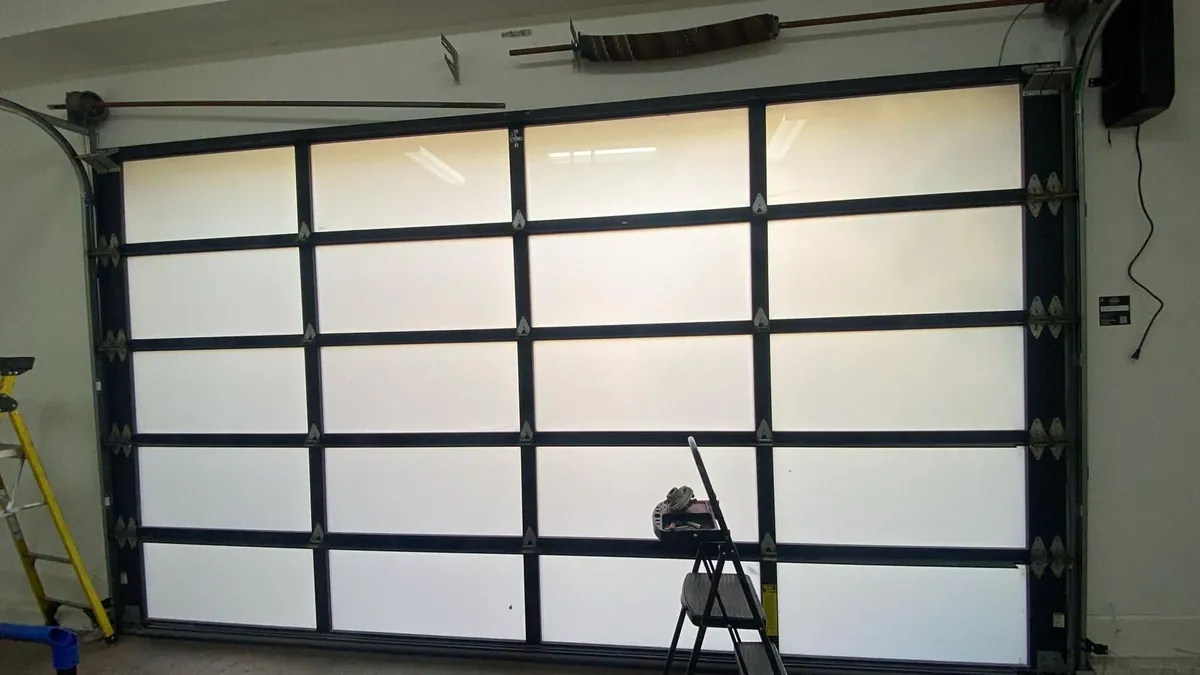
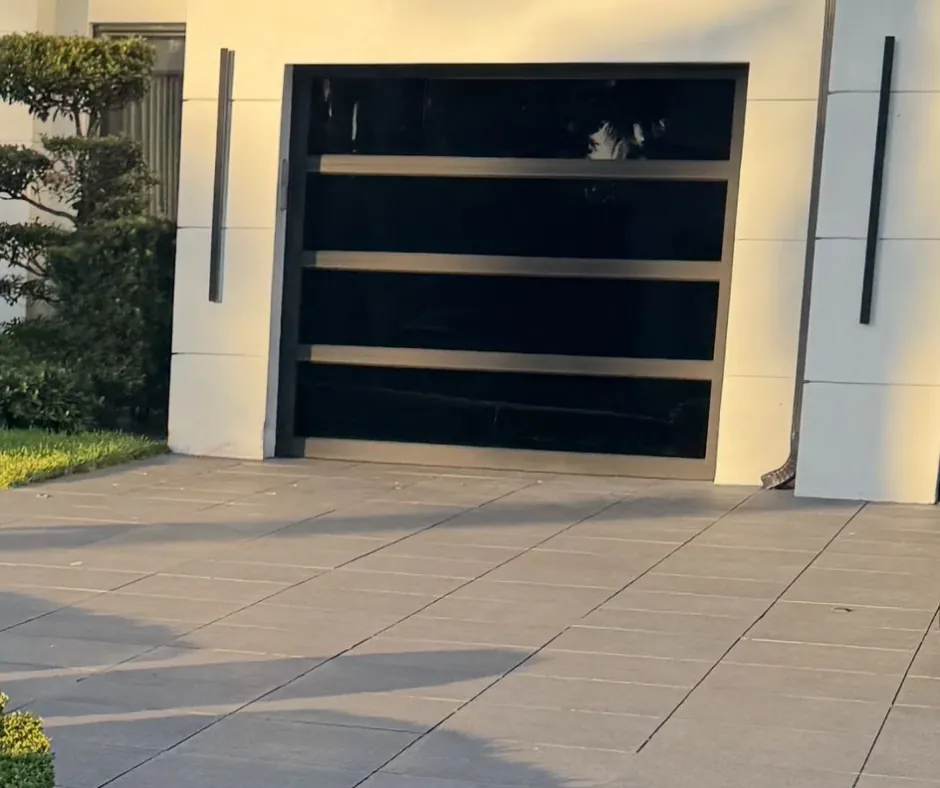
A row of glazed lites along the top section brightens an outbuilding that often has no window of its own. Panel styles range from plain flush panels to raised panels and carriage-house designs that echo the swing doors many of these garages first had. Owners after something sleeker sometimes pick an aluminium frame filled with glass, described under full view glass garage doors.
The aim is a door that is light enough to balance easily, tough enough for daily use, and in keeping with the garage and the house it sits behind.
Getting a door down a long driveway
Delivery means a stack of panels plus rails, springs, a shaft and boxes of fittings, and on an Allston lot all of it has to travel the length of a long narrow driveway to the garage. The sections are long and awkward rather than heavy, and carrying them past a house, a fence and sometimes a row of parked cars takes care.
It helps a great deal if the driveway can be cleared before installation day. Cars belonging to the units in front, bins, bikes and anything stored along the side of the drive all slow the job down. A clear path from the street to the garage, and a clear floor just inside the garage door, means the old door can come out and the new one go in without things being shuffled back and forth.
Installing where the alley leaves no room
The alleys behind Pratt and Gardner leave very little clearance to work behind a door. Many garages there open almost straight onto the alley, so there is little or no room to stand outside while the door goes in. On those garages, the installation is planned from inside. The old door is taken down section by section from within the garage, the new tracks are hung, and the new sections are stacked in from the inside, top section last. The exterior trim and the bottom seal are fitted from whatever room the alley allows.
If the alley is shared, it may need to be kept clear for part of the day. Letting neighbours know in advance makes that easier.
What happens on installation day
The first job is removing the old door safely. Its springs are unwound in a controlled way before anything is unbolted, because an old torsion spring holds dangerous tension even when it looks tired or rusty, and releasing it is not a DIY repair. Any extension springs are let down and taken down with their cables. Then the old sections come out, followed by the tracks, brackets and any old opener that is being replaced.
The opening is then prepared. Soft or split jamb timber is cut out and renewed, giving the rails solid wood to bite into, the header is checked, and the floor at the opening is looked at for where the bottom seal will sit. The new tracks go up and are set plumb and parallel, the sections are stacked and hinged, the shaft, drums and springs are fitted, and the cables are attached at the bottom brackets.
With the door hung, the springs are wound to suit its weight and the door is balanced so that it lifts smoothly by hand and stays put when left halfway. The opener, new or existing, is connected and set to the new door’s travel and force, and the safety sensors and auto-reverse are tested. Finally the weather seals are checked along the bottom and sides, and you get a walk-through of the red release cord and when to use it.
Matching the door to the building
These garages sit behind houses with plenty of character, and a new door is the most visible part of the outbuilding from the drive. A plain flush steel door can look stark on an old timber garage with clapboard sides, while a carriage-house panel pattern, or a simple raised panel painted to match the trim, sits more comfortably. Where the garage is brick or block, a cleaner modern panel can suit it well. The colour of the door is worth choosing alongside the garage’s trim and the house in front rather than on its own.
Windows deserve a thought too. Glazed top sections bring daylight into a building that usually has none, but on a garage facing an alley they also let passers-by see inside. Obscured or textured glass keeps the light without the view. If the garage stores bikes or tools, that trade-off is worth weighing before the door is ordered.
Planning the switch from the old door
Replacing a garage door is a job with a start and a finish, and a little planning keeps it simple. Once the measurements are taken and the door is chosen, the order is placed and an installation day is agreed. Until then, the old door carries on in service; if it is fragile, it is worth using it as little as possible and keeping the opener off when it is not needed.
On the day, the garage needs to be clear enough near the opening for the old door to come down and the new sections to be stacked. Anything stored against the side walls where the vertical rails run, or overhead where the horizontal rails will hang, should be moved. In a shared garage, everyone using it should know that it will be out of action for the length of the installation and that cars need to be parked elsewhere until the work is finished.
Springs sized for how the door is used
A garage behind a triple-decker or a rental building is often shared between units, and its door may open many times a day. A new door is the right moment to size the springs for that. The springs on a new door are matched to its weight and height, and where the door will see heavy use, spring options built for more cycles can be discussed, so the door does not need a spring repair sooner than it should. The same goes for rollers and hinges: a door that works hard benefits from parts chosen for that work.
Whoever looks after the property may also want to think about remotes. A new opener, or a reset of the existing one, is an easy moment to clear old remotes and program only those in current use.
Weather and a detached garage
A detached garage takes the weather on every side, and its door takes the most. Snow piles against the bottom section, slush runs under the seal, and on an old uneven floor the gap at one end of the door can let in water, leaves and cold. When a new door goes in, the bottom seal is chosen and fitted to close that gap as well as the floor allows, and the side and top seals are fitted against the jambs and header.
Insulation matters less in an unheated garage than in an attached one, but an insulated door is stiffer, quieter and less prone to denting, which can be worth having on a garage at the end of a busy shared driveway.
Rails, rollers and fixings on an old frame
A new door is only as steady as what it hangs from. On these garages the rails are fixed to jambs and a header that have often carried several doors before, each leaving its own screw holes, shims and patches. Before the new rails go up, the timber is checked for splits and soft spots, and the fixings are placed in sound wood rather than in old holes. Where the framing is too thin or too damaged to hold a bracket securely, a backing board is added so the load is spread.
Overhead, the horizontal rails are hung from the ceiling joists or rafters with angle brackets. In an outbuilding where the roof structure is light or uneven, those hangers are positioned and braced so the rails stay level as the door travels, since a rail that sags or twists makes rollers bind and wears the door from the first week. Rollers and hinges are fitted to every section, and the whole run is checked by hand before the springs are wound.
Repair or replace the existing door
A new door is not always the answer. A door with sound panels and a broken spring, a snapped cable or worn rollers is usually better repaired, and the Allston garage door repair and Allston spring repair pages cover those jobs. Swapping the whole door earns its keep once the panels, rather than the hardware, are giving up: sections rotten or rusted through, several panels damaged, timber so sodden the springs cannot cope, or an old door whose design leaves no good way of fitting safe modern springs and an opener.
If a door has become a run of repairs, each one fixing a symptom of its age, new garage doors Allston MA owners choose often turn out to be the less troublesome path. Either way, the advice is given plainly, with the reasons.
Starting with a new door
Our phones are staffed through the night and at weekends, though fitting a new door is usually something booked ahead rather than rushed. Should the existing door collapse without warning, leaving the garage gaping or a car stuck inside, the Allston emergency repair page explains what to do first, and a replacement can follow once the garage is secure. Read about the service more broadly under new garage door installation, or visit the Allston page for every job we take on in the neighbourhood.
When you enquire about new garage doors Allston MA outbuildings like yours could take, tell us a little about the building: drive or alley access, a rough idea of the ceiling height, the old door’s material, and the reason it is due for retirement. Jot those down, and afterwards call us or book online.
Questions from Allston
The opening on our garage leans. Will a new door still close properly?
It will. Readings are taken across the whole opening, and the rails are set plumb and parallel to suit the door rather than the leaning jambs. Rotten jamb wood is dealt with so the tracks are fixed to something sound, and the bottom seal is fitted to close the gap on an uneven floor.
The ceiling in our garage is very low. Is a new sectional door possible?
In most cases. A low-headroom track arrangement lets the door turn into the garage in less space, and the spring is positioned to suit. In some very low garages, extension springs are the better choice.
What happens to the door we have now?
Taking down the existing door, its rails and its springs is part of the replacement. Its springs are let down under control before anything else, since even a rusty old spring stores dangerous tension.
Must the opener be replaced along with the door?
No, not necessarily. A healthy opener that is a sensible match for the replacement door is simply reattached and recalibrated. An elderly unit, one without photo eyes, or one too feeble for the new door can be swapped during the same visit.
Our garage faces straight onto a slim alley. Is installation still possible?
Certainly. The work is organised from inside, panels are stacked in from within the building, and the alley is only needed for the trim and seals that have to go on outside.