
Replacing a door in a garage the street was never built for
Private garages are rare in Back Bay. Most of the brownstones on Commonwealth Avenue, Marlborough Street and Newbury Street have none, and where one exists it is a single bay cut into the ground floor or a carriage house off the service alley at the back of the lot. That makes choosing and fitting new garage doors in Back Bay a careful job: the opening is often irregular, the space around it is tight, and the alley width and resident permit rules decide when a door can even be delivered.
A replacement door has to fit the building as well as the opening. Before anything is ordered, three questions shape the choice:
- How the existing opening measures, side to side, top to bottom and corner to corner.
- How much headroom there is above the opening and how much room to either side.
- How the door will reach the garage: from the street, or down a narrow service alley.
What a new door involves
Supplied and installed
A new sectional door chosen for the opening, delivered, fitted and set up to run smoothly and safely.
Old doors replaced
The old door, its springs and its tracks taken down and removed before the new one goes in.
Springs and tracks to suit
Springs matched to the new door’s weight and tracks arranged to fit the headroom available.
Opener matched to the door
The existing opener reset for the new door, or a new opener installed where the old one is not up to it.
When new garage doors in Back Bay make sense
Most doors can be repaired, and repair is usually the first thing to consider. A replacement starts to make sense when several things are failing at once, or when the door itself is the problem. In this neighbourhood a few situations come up again and again.
Carriage house doors facing the service alleys stand in the path of slush, runoff and salt every winter. Water pools against the bottom of the door, and over the years the bottom sections rust through or, on wooden doors, rot from the bottom edge up. Once a door is weak at the bottom, new seals and brackets have nothing sound to fix to.
Wooden doors in old openings can soak up so much moisture that they become far heavier than when they were installed. A door like that needs springs so strong that the whole system strains, and the opener works far too hard. Doors that have been knocked by cars turning in from narrow alleys can end up with creased sections that no longer flex properly at the hinges. And a door that was cut down or adapted to fit an unusual opening long ago may never have run well. In each case new garage doors in Back Bay garages solve problems that a repair would only postpone.
Measuring an old opening
Openings in brownstone ground floors and carriage houses were made by hand, often long before overhead doors existed, and many have been altered since. They are seldom perfectly square. One side may lean slightly, the header may not be level, and the floor at the threshold may dip or rise from one side to the other.
So the opening is measured in several places, not once. The width is taken at the top, middle and bottom. The height is taken at both sides and in the middle. The diagonals are compared to see how far out of square the opening is. The floor is checked for level across the threshold, because a door that closes onto an uneven floor leaves a gap at one corner for water and draughts to get in. The headroom above the opening, the side room on each wall and the depth of the garage back to the rear wall are all recorded, because they decide which track and spring arrangement will fit.
Where an opening is badly out of square, the frame around the door can sometimes be trimmed or packed so the new door sits true. That work is decided before the door is ordered, so the door and the opening are brought together correctly on the day.
Headroom, side room and the tracks
A sectional door rises on vertical tracks and then curves back into horizontal tracks under the ceiling. The springs sit above the door or alongside the horizontal tracks. All of that needs space. In a bay cut into a brownstone’s ground floor, with rooms above, the gap between the top of the opening and the ceiling may be very small, and joists or pipes may cut across it.
Low-headroom track arrangements exist for exactly that situation. They change the curve of the track and the position of the spring so the door can open fully in a much smaller space. Side room matters too: the vertical tracks and their brackets need a strip of wall on each side of the opening, and in a narrow bay or a carriage house with thick walls that strip is sometimes only just enough. A new door that suits the space is one where these details are settled at the measuring stage, not discovered at installation.
Settling the details before ordering
A few decisions are easier to make early than to change later. Think about how the garage is used: a bay that is opened many times a day needs a door and springs set up for heavy use, while one that is opened mostly at weekends has different priorities. Decide whether light matters, since a dim ground-floor bay benefits from windows in the top section, while a carriage house used for storage may be better without them. Consider the noise that reaches the rooms around the garage, which points towards an insulated door and a quiet opener. And think about the bottom seal and threshold: on an alley where water runs towards the door, a well-fitted seal on a level threshold does more to protect the new door than almost anything else.
It is also worth deciding what happens to the opener at this stage rather than on the day. Changing door weight, track type and spring arrangement all affect it, and choosing together avoids a second visit.
Getting a door down the alley
This is the part of a Back Bay replacement that is most unlike anywhere else. A new sectional door arrives as a stack of long panels, plus its tracks, springs and hardware. Carriage houses face the service alleys behind the main streets, and those alleys can be narrow, shared and busy with bins, deliveries and parked cars. Alley width and resident permit rules decide when a door can be delivered and where a vehicle can stop while the old door is taken out and the new one goes in.
That is why a door replacement here is planned around access as well as around the door itself. Before an installation day is set, we look at how the panels will reach the garage, where a vehicle can stand, and how long the work will keep the alley partly blocked. For a ground-floor bay that opens onto the street side of the house, the same thinking applies to the street. When you book, tell us which side the garage faces and anything you know about stopping nearby; it makes the planning much easier.
Choosing the door itself
With the opening measured and the access planned, the door can be chosen. The choices are about material, insulation and appearance, and each one has practical consequences in an old building.
Steel. Durable, relatively light, and available in many panel styles, including designs that echo traditional carriage house doors. Steel doors can be insulated, which helps a garage built into the ground floor of a house stay warmer and quieter.
Wood and wood-look finishes. A traditional look that suits brick and brownstone, but solid wood needs regular care, especially on a door that faces an alley full of slush each winter. Composite and wood-look finishes give a similar appearance with less upkeep.
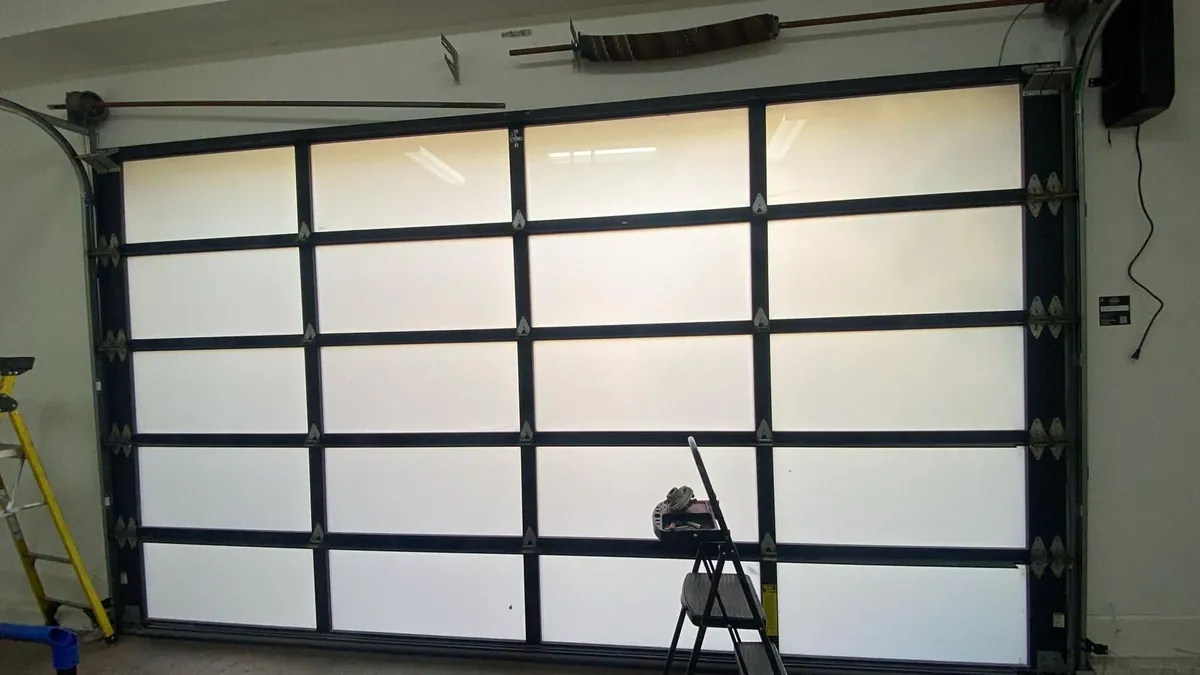
Aluminium and glass. Full view doors with glass panels in an aluminium frame let light into a dim bay and give a lighter, modern look. The full view glass garage doors page covers these in more detail.
Insulation. For a bay below or beside living space, an insulated door reduces cold, draughts and noise passing into the house. It also adds weight, which the springs are chosen to match.
Windows and trim. Small windows in the top section bring light into a garage that often has none, without exposing what is inside.
A door that suits a brownstone or a carriage house
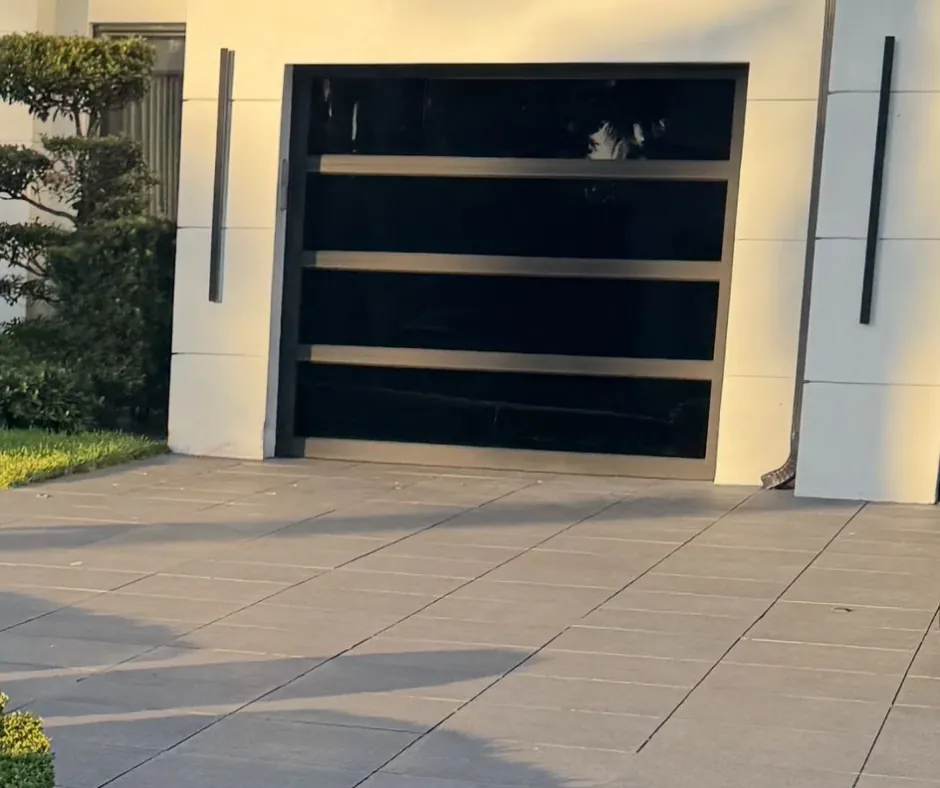
A garage door on a brownstone is part of the front or rear face of the house, set among brick, stone, tall windows and ironwork. On a carriage house it is often the largest single feature of the building. The door that suits it is usually one that looks as though it belongs: panel proportions that echo the windows around it, a colour that sits comfortably against brick or brownstone, and hardware that is plain rather than showy. Carriage house style panels, with their vertical boards and a row of small windows at the top, are a common choice for that reason, but a simple flush or ribbed panel in a dark colour can be just as fitting on a plainer rear elevation.
It helps to stand back in the alley or across the street and look at the whole elevation before settling on a style. New garage doors in Back Bay are seen alongside a great deal of older detail, and a door that matches the rhythm of the building tends to look right for a long time. Samples of colour and finish are best judged against the actual brick in daylight, not on a screen.
Living with the old door until the new one goes in
Because delivery depends on the alley and the permits, there can be a gap between deciding to replace a door and the day it is installed. During that time the old door still has to work, or at least stay safe. If a spring or cable has failed, a repair may be worth doing to keep the door usable in the meantime; if the door is beyond that, it is left closed and secure. You will be told which applies. Keep using the old door gently: no forcing it past a sticking point, no running the opener against a door that binds, and no propping it open with timber if a spring is weak.
Looking after the new door
A new door on an alley-facing garage lives in hard conditions, and a little care keeps it running well. Clear slush and grit away from the bottom seal in winter so water does not sit against the bottom section or freeze the seal to the ground. Rinse road salt off the lower panels now and then. Keep bins and deliveries away from the safety sensors at the bottom corners. Watch and listen to the door from time to time; if it starts to drift when stopped halfway, or the opener begins to labour, have the balance checked before anything wears out. Leave the springs and cables to a technician, as with any door: a torsion spring on a brand-new door holds dangerous tension from the moment it is wound.
What installation day involves
- The old door is lowered under control, its springs safely unloaded, and the door, tracks and hardware taken down and removed.
- The opening is prepared: any packing or trim decided at measuring is fitted, and the bottom of the opening is cleaned so the new seal can close evenly.
- The new tracks are fixed to the masonry, the sections are stacked and hinged one by one, the springs are fitted and set to the door’s weight, and the cables are tensioned evenly on both sides.
- The door is balanced by hand, the opener is connected and its limits and force are set to suit the new door, and the safety reverse and sensors are tested.
The old door is part of the access plan too. Its sections, springs, tracks and hardware have to leave the same way the new door arrives, through a narrow alley with nowhere to stack long steel panels, or past street parking governed by resident permit rules.
At the end of the day the door is closed fully and checked for an even seal along the floor, so the bay is secure and dry.
The opener and the new door
A new door often changes the opener’s job. An insulated door may be heavier than the one it replaces, and a door on a low-headroom track moves differently. The existing opener can usually be kept and reset if it is in good health and suited to the new door. If it is old, noisy or underpowered, replacing it at the same time is worth considering, especially in a bay with rooms above, where a quieter belt-drive or a wall-mounted opener makes a real difference. LiftMaster openers are among those we install. The opener repair page for Back Bay explains the options in more detail.
Repair first, if it will do
A replacement is a bigger undertaking here than in most places, so it is worth being sure. If the door is sound and only a spring, a cable or a roller has failed, a repair is usually the better choice. The general repair page for Back Bay and the spring repair page for Back Bay explain what can be fixed. If the door has failed suddenly and is stuck open on the alley, the emergency repair page for Back Bay explains what to do first; a replacement can be planned once the bay is safe.
Planning your replacement
Start by describing the garage: whether it is a bay in the ground floor of the house or a carriage house on the alley, roughly how the door is failing, and how the garage is reached. From there, measuring, choosing and installation can be arranged around the alley and the permit rules. For new garage doors in Back Bay, call us or book online. The main new garage doors page has more on how doors are supplied and installed, and the Back Bay page lists everything else we do in the neighbourhood.
Questions from Back Bay
My garage opening is not square. Can a new door still fit properly?
Yes. The opening is measured in several places, and where it is out of square the frame can often be trimmed or packed so the new door sits true and seals evenly along the floor.
How do you get a new door into a carriage house on a narrow alley?
The delivery is planned around the alley. Its width and the resident permit rules decide when a door can be delivered and where a vehicle can stop, so access is worked out before an installation day is set.
The ceiling in my ground-floor bay is very low. Is a sectional door still possible?
In most cases. Low-headroom track arrangements change the curve of the track and the position of the spring so the door opens fully in a small space.
Should a door in a garage under living space be insulated?
It is usually worth it. An insulated door reduces cold, draughts and noise passing into the rooms around the garage. The springs are matched to its weight.
Will my existing opener work with a new door?
Often, if it is healthy and suits the new door’s weight and track. If it is old, loud or underpowered, replacing it at the same time is worth considering.