
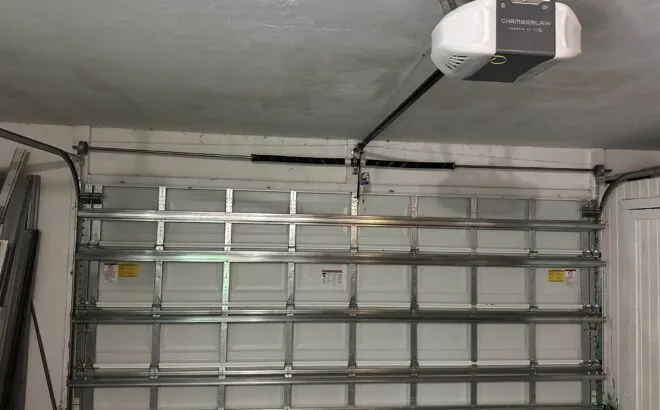
When the spring under a row house lets go
In a Federal row house, the garage, where there is one, sits in the ground floor with rooms stacked above it, and the spring that lifts its door is mounted only a short way below those rooms. When that spring breaks, the sound does not stay in the garage. Owners often describe it as a gunshot or a dropped weight somewhere in the house, and only find the cause the next time the door will not rise. Garage door spring repair in Bay Village, MA is mostly about that moment: a door that was fine yesterday and today will not leave the ground.
Bay Village adds its own twist. With narrow streets and no driveways, a car shut inside a bay cannot simply be left on the apron while the door waits, because there is no apron. The spring is the part that decides whether the car comes out.
A broken spring announces itself in a few ways you can see without going near it:
- A gap of a hand’s width or more between coils on the shaft above the door.
- The door feels as heavy as a wall when the opener tries it, and the motor gives up after a short struggle.
- On an older door with springs beside the ceiling rails, one spring hangs limp or has dropped to the floor.
Which springs fail, and how
Torsion coils that crack
The wound coil on the shaft over the opening fatigues and parts at a single point. From then on the door weighs its full weight, and the opener cannot cope.
Side springs that sag
On older or lighter doors, a long spring stretches beside each overhead rail. With age these lose their pull or snap, and the door begins to drop lopsidedly.
Doors that drift or slam
A door that will not stay put when stopped halfway, or thumps down the last stretch, has springs that no longer match its weight.
Rusted and noisy springs
Damp bays near the street wear springs early. Rust between the coils adds friction, noise and stress that shortens their life.
Why springs carry the door, not the opener
A sectional door weighs far more than most people expect, and it is the spring, not the motor, that does the lifting. On a torsion system the spring wraps a hollow tube that spans the head of the doorway. Closing the door winds the spring tighter; opening it lets the spring unwind, turning a cable drum at each end of the tube so that the door rises evenly. Set correctly, the springs leave the door feeling almost weightless by hand, and the opener only has to nudge it along.
An extension system does the same job a different way. A long spring stretches out alongside each horizontal track as the door closes, then contracts as the door opens, pulling on a cable that runs over pulleys down to the bottom corner of the door. These are common on older doors and on lighter single doors.
Either way, when a spring fails the balance vanishes in an instant. The opener, designed only to guide a balanced door, suddenly faces the full dead weight. Some openers stall and reverse; others grind a gear or strip a drive before their safety limits stop them. Running the motor again on a snapped spring only adds to the damage, which is also why the springs are the first thing examined whenever a door refuses to rise.
Garage door spring repair in Bay Village, with no driveway to work from
Spring work is usually tidy, compact work, and that suits Bay Village. There is nowhere to stage a whole door here, and everything comes in off the street in pieces, but a pair of springs, winding bars, cones and cables can be carried through a single doorway by hand. The van stops on the street, the parts come in together, and the job happens inside the bay with the door down.
That last point matters. A sectional door with a broken spring is safest closed, and on these streets the bay opens straight onto the pavement. Working with the door down keeps the garage shut to the street throughout, keeps the sidewalk clear, and means the tension work happens well away from anyone walking by.
The single bays under these houses can also be short on headroom. A torsion spring needs room on its tube above the door, and that tube has to sit square to the opening even where the brick around it is not perfectly true. Part of every spring replacement here is checking the tube, its centre bearing and the end plates that hold it, because a spring can only be balanced on a tube that runs true.
How long springs last, and why they break
Each spring is rated for a set number of cycles, where a cycle means the door going up and coming back down once. Each cycle twists or stretches the steel, and eventually it fatigues and cracks, almost always at one point along the coil. A garage that serves as the everyday entrance to the house racks up cycles much faster than one opened at weekends, so its coils use up their allowance well ahead of a quieter garage.
Cold makes it worse. Steel springs are more brittle on the first hard mornings of winter, which is when many of them finally go. Damp is the other enemy. A bay that opens straight onto the street takes in rain, slush and road salt every time the door goes up, and once rust forms in the gaps between the turns of a coil, the turns grate against each other and the spring wears out faster. A light coat of lubricant on the coils during a visit helps, but cannot bring back a spring that is already worn through.
Mismatched springs fail early too. When an earlier fix fitted a spring meant for a lighter door, or hung one spring where the weight called for two, the steel has been overworked on every lift since.
Why torsion springs are not a DIY repair
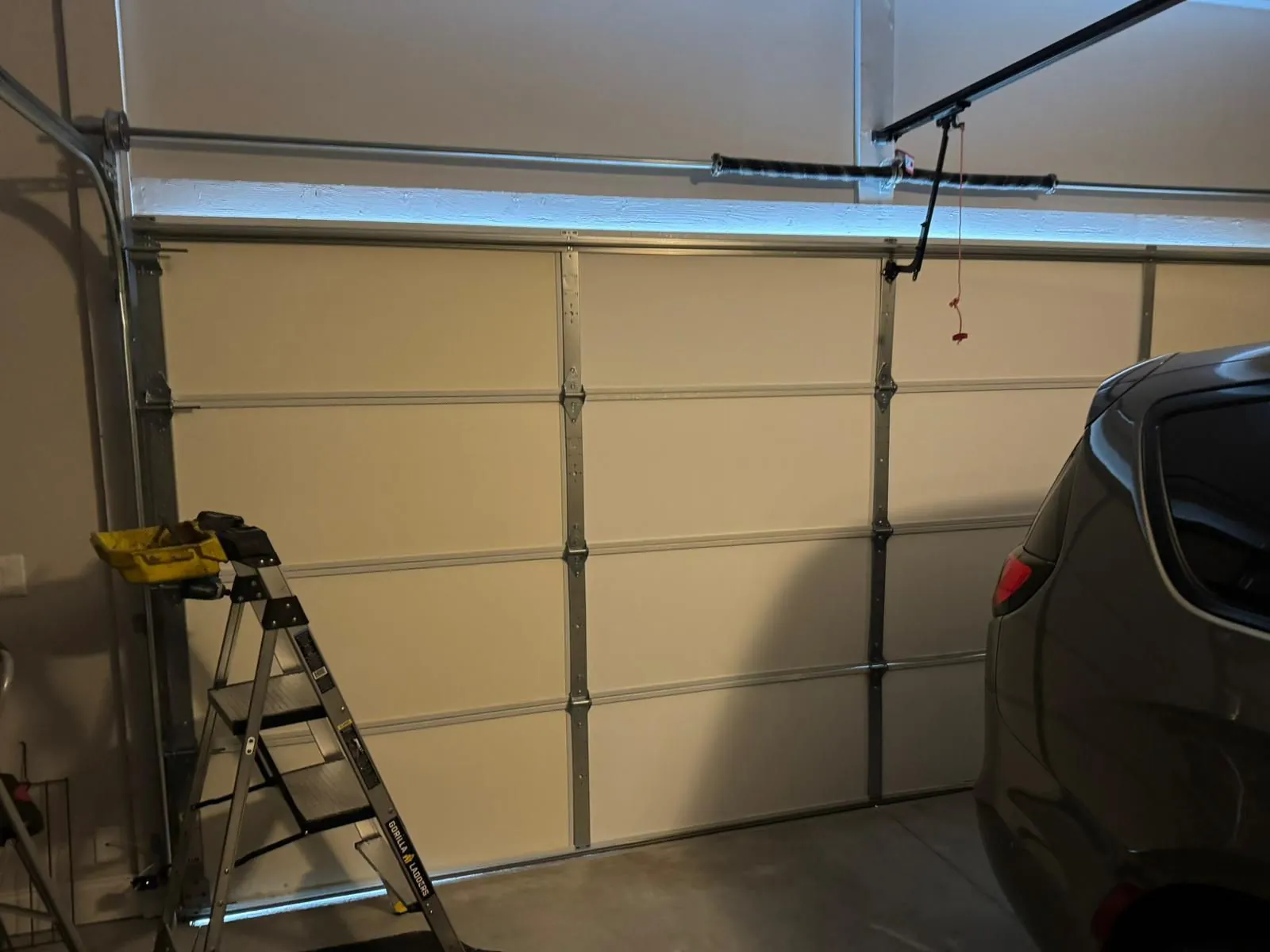
An installed torsion spring is loaded with dangerous force every minute it is installed, door up or door down, even when nothing seems to be moving. Changing one means letting the old spring down and then winding the replacement up by the correct number of turns, a quarter turn at a time, with steel bars pushed into a winding cone. Throughout that work the spring’s whole force sits in the bar you are holding. One slip, or one set screw released too soon, and the bar spins with enough force to break bones. People are badly hurt doing exactly this.
That same force runs through the lift cables into the steel plates they hook onto low on the door. Unbolting one of those plates while the springs are intact can fling the plate and cable upward. Extension springs carry their own hazard: one that snaps without a containment cable running through its middle can whip across the bay.
So the safe rules for an owner are short. Never put a tool on a torsion spring or its winding cone. Leave every bolt on the corner plates at the foot of the door where it is. Keep the opener switched off while a spring is broken. And leave the red release handle alone if the door is up with a snapped spring, since once the trolley lets go there is nothing holding that weight.
What a spring visit involves
- Parts come in together. From your description, the likely springs, cones, bearings and cables are carried in from the street at once, so the bay is not left open while someone fetches more.
- The opener is taken out of the circuit. It is unplugged and released so it cannot fight the work.
- The door is held fast. Locking pliers or clamps on the rails stop it moving while the tension is handled.
- The old spring is unwound safely. Any remaining tension is let off with winding bars before anything is removed.
- The door’s weight sets the new spring. Springs are matched to the door, not just to the old spring, since the old one may have been wrong.
- Cables and drums are checked. Cables that have frayed or slipped while the spring was broken are replaced and seated evenly on both drums.
- The new spring is wound and the door balanced. The technician raises the door partway by hand and lets go, to see that it hangs there without creeping.
- The opener is reconnected and tested. Travel, force and the safety reverse are set against the door’s new balance.
Replace one spring, or both?
Where a door has a pair of torsion springs, they went up together and have flexed through an identical number of lifts. The surviving partner is rarely far from its own break. Fitting a fresh spring beside an old one can tip the door off balance, and the old spring tends to go soon afterwards, which means a second visit. In most cases, renewing the pair at once is the sounder job, and the reasoning is explained before work starts.
Some doors run on a single torsion spring where the door’s weight would be better shared between two. A visit is a good time to raise that, especially on a heavier door, such as an insulated door fitted to keep a bay under living space warmer, or an older wooden door that has absorbed years of street damp. A heavier door asks more of each spring, and splitting the load between two coils, each sized for half the weight, lets both work more gently and usually last longer. The same thinking applies to extension springs, which are always replaced as a pair so both sides pull evenly.
Signs a spring is wearing before it breaks
Plenty of springs give notice first. A door that takes more effort to raise by hand than it used to, or that no longer stays put when the opener stops partway, is losing spring tension. A door that rises unevenly, or creeps closed on its own, points the same way. Squeaking coils, a dry rasping sound as the door turns over the top of the opening, and visible rust on the spring all suggest it is near the end of its life.
In a bay under a house, these signs often reach the rooms above as a change in the sound of the door, or a longer, harder strain from the opener. Booking garage door spring repair in Bay Village, MA at that point, rather than after the break, means the work can be planned at a convenient hour and the car is not caught inside. A tired spring can be measured, the right replacement brought in from the street, and the door balanced while it is still working.
Getting a car out when the spring has gone
The most common spring call from a bay under a row house is simple: the car is inside, the door is down, and the spring above it has snapped. On a suburban street the car might wait on the driveway for a day; here there is no driveway, and often no other way for the car to leave than through that one door.
The temptation is to pull the release cord and heave the door up by hand, or to let the opener try again. Both are risky. A door with no working spring is dead weight, and lifting it means holding the whole door over your head; letting the opener try can strip its gears and leave the door stuck halfway. The safer course is to leave the door down, leave the car where it is, and call.
Once the new spring is in and the door is balanced, the car comes out under a door that rises the way it should. If the bay is also the main way into the house, mention it on the phone, and the visit then centres on getting the door working rather than around one part. In that sense garage door spring repair in Bay Village is less about the spring than about the door working again at street level, and the spring is simply the part that makes that possible.
Repair or replace the door?
A snapped spring is rarely, by itself, grounds for a whole new door. The coils, cables, drums and bearings are parts made to be swapped, and a rebalanced door should go back to running as it always did. Replacement only comes into the conversation when the sections themselves are failing, when a door has been damaged by running on a broken spring, or when the weight of an old door has become hard to balance well. If that is the case, our page on new garage doors in Bay Village explains what changing the door involves.
The rest of the door, and other help in the neighbourhood
A spring visit usually reveals the condition of everything around it. Rollers that have worn while the door was heavy, a cable starting to fray or a bent rail are noted and explained. For anything beyond the springs, see our general repair page for this neighbourhood. If the opener struggled or failed while the spring was broken, our opener repair page for Bay Village covers motors, remotes and sensors. And because a snapped spring rarely waits for a convenient time, the page on urgent callouts here sets out the steps to take if the door fails late at night.
Call about a broken spring
A spring can break at any hour, and calls are taken at any hour. When you ring, tell us if the door sits raised or lowered, if a vehicle is parked behind it, and whether you can make out a single spring or a pair over the opening. That detail is how the right springs are chosen for garage door spring repair in Bay Village, MA, before anything is carried in from the street. Our wider garage door spring repair page covers the service across Boston, and the Bay Village page gathers our work on these row-house garages in one place. For a snapped spring or a door that is stuck on the ground, call us or book online.
Spring questions from Bay Village
Something in the garage under the house went off like a shot. What was it?
Nine times out of ten that noise is a torsion coil cracking. From well back, check the coil above the opening for a visible break, and leave the opener switched off until a technician has seen it.
My car is inside and the spring has broken. Can I lift the door by hand?
Please don’t. With the spring gone, every bit of the door’s weight is on you, and it can come down without any warning. Keep it shut and phone us; freeing the car is part of the job.
Should both springs be replaced at once?
In most cases. A matching pair has flexed through the same lifts, so the second spring is usually close to failing too, and renewing both keeps the door evenly weighted.
Are extension springs dangerous as well?
Yes. They are under strong tension, and a spring without a safety cable through its centre can fly loose when it snaps. Their cables and pulleys are not for owner repair either.
Can my garage under the house have springs fitted if headroom is tight?
In most cases, yes. The spring and tube are fitted to suit the space above the opening, and the headroom is checked on the visit before the right arrangement is chosen.