
Old garages behind Oak Square two-families
Behind the nineteen-twenties two- and three-families off Washington Street and around Oak Square, most garages stand on their own, back past the house, where a long driveway shared between the units finally runs out. Nearly all of them are single-car bays, and a good number still hang the timber door they were built with. Our garage door repair in Brighton takes in every working part of those doors: torsion and extension springs, lift cables and drums, wooden or steel sections, the opener plus its remotes and wall switch, rollers and track, doors that have slipped off that track, and the two photo-eye sensors near the slab.
Age ties most of these faults together. A wooden door that has hung in one frame for generations has swelled and dried through many winters, has had its hardware swapped one piece at a time, and was usually given an opener long after the garage went up. Each of those layers is a place where something can let go.
Before picking up the phone, look for three things without touching anything:
- Is the door shut tight, jammed open, or tilted so one side sits lower?
- Can you see a break in the coils over the doorway, or a limp spring hanging beside a track?
- Does the opener hum, click, or give no sign of life when the button is pressed?
What fails on these old single bays
Snapped springs
A torsion spring on the bar over the opening, or two extension springs stretched beside the side tracks. Once one breaks, the door is all weight and no lift. See spring repair.
Cables and drums
When a lift cable frays, snaps or unwinds off its drum, it leaves the door hanging askew in a tight opening. See cable repair.
Wood sections
Bottom panels that have drunk in rain, cracked stiles, and hinge screws working loose in soft timber.
Openers and remotes
Openers bolted up years after the garage was framed, remotes shared by several units, and wall buttons wired across an unheated building.
Tracks and rollers
Rollers worn out of round, track kinked by a bumper, brackets loose in old studs, and doors that have jumped the rail. See off-track repair.
Safety sensors
Photo eyes nudged sideways in a cramped bay, or clouded by leaves and grit blown in off the yard.
How an old wooden door carries its weight
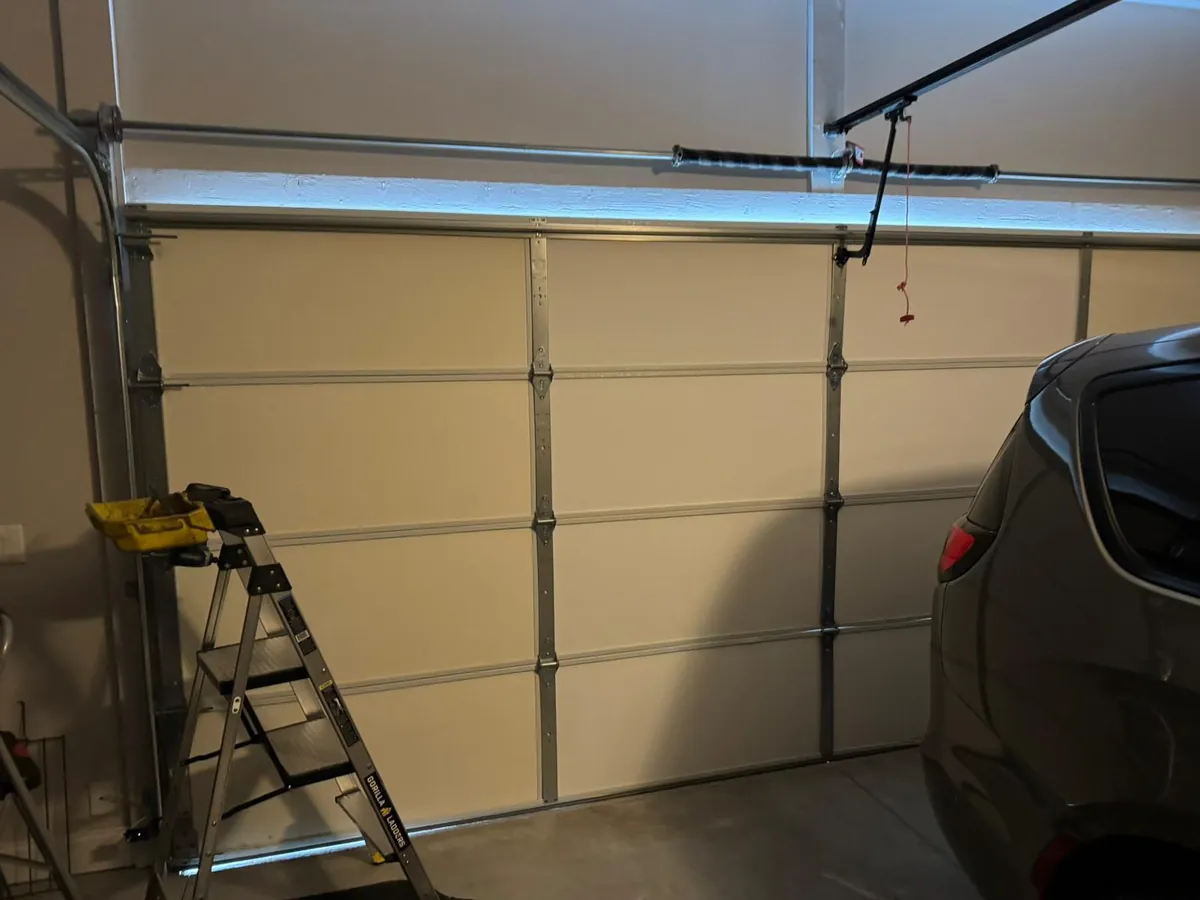
A garage door looks like one flat slab, yet it only glides because it is balanced. On a sectional door the panels are hinged to one another and roll on wheels inside two tracks, one each side of the opening. Springs carry the load, not the opener and not the arm of whoever is lifting. In a torsion arrangement, one or two coiled springs wrap a steel shaft fixed above the opening; drums on each end of that shaft reel in the cables tied to the bottom corners. In an extension arrangement, still common on older single-car doors, a long spring above each horizontal track stretches as the door lowers and draws it back up through a pulley and cable.
Well balanced, a single-car door rises under one hand and stays wherever it is left halfway. Once a spring weakens or breaks, the door suddenly weighs what it truly weighs. A wooden door, painted over many times and carrying moisture in its bottom rail, can be a good deal heavier than a steel door of identical size. That added weight is why springs on old timber doors tire sooner than most, and why they so often fail first.
Some of the original doors here are not sectional. A one-piece door swings out and upward on pivoting arms, with a heavy spring on each side. The parts look different, but the idea holds: springs bear the load, and every other part simply guides it.
Long shared driveways and garages that stand alone
How these lots are laid out shapes nearly every job. A garage set well back from the house is its own little building, often fed by a power line run out from the house, sometimes on a circuit added long after the garage existed. An opener that suddenly goes dead may just have lost its outlet, its breaker back indoors, or a cord gnawed through over the winter. Those checks come first, before anyone blames the opener itself.
Distance plays a part as well. A remote that works fine from the back porch may fall short of a garage tucked away behind the house down a long strip of pavement, and a button on the garage wall does nothing for someone standing at the house. Where a single garage belongs to several units of one building, its opener may answer to a handful of remotes, and a lost or faulty one can be cleared out and the rest reset.
A shared drive also means one stuck door can hold up more than one household. A car shut in behind a door that refuses to open can block a neighbour’s way out, while a door jammed open leaves everyone’s stored belongings on show. Making the door secure, open or closed, is usually the first goal on these calls, and garage door repair in Brighton is planned around it: the van comes up the drive, the door is made safe, and then the real cause is traced.
Tight side room and tired framing
These bays leave only a slim margin between the door edge and the side wall. In plenty of older garages the tracks are screwed to studs barely wide enough to take them. When a track gets kinked, there may be no space to slide a replacement in until the brackets come off, and an old stud may refuse a fresh lag screw in the hole where the last one stripped.
Clearance overhead is often short too. A garage sized for the cars of its day may leave only a modest band of space below the rafters. That band dictates where a torsion shaft can go, how an opener rail can be hung, and whether a low-headroom track kit is the answer. A fix that would be routine in a newer garage needs more thought here, and parts are picked to suit the room the building really has.
The frame is part of the door. Jambs and headers in an old outbuilding can be punky at the base where rainwater has run down them for years, and a spring bracket or track bracket driven into soft wood will not hold. When that turns out to be why a track sags or a spring anchor has pulled loose, you will hear about it, because fresh hardware cannot grip rotten timber.
What a garage door repair visit in Brighton looks like
Each visit begins with the door as a whole, not with the one part named on the phone. For garage door repair in Brighton that means walking up the drive, studying the opening inside and out, and only then choosing what to touch first.
- Any opener is unhooked from the door, so the technician can work the door by hand and no remote in a pocket can start it moving.
- Balance gets tested. A door that drops, or will not hold at the halfway mark, points straight at the springs.
- Springs, cables, drums or pulleys, and the bottom brackets where the cables anchor are each inspected.
- Every roller and hinge is checked, and each track is sighted end to end for kinks, loose bolts and gaps.
- The opener runs on its own, and the sensors and wall button are tried apart from the remotes.
Nothing is replaced until you know what has broken and why. After the faulty parts are sorted, the door is rebalanced, the opener’s limits and force are matched to it, and its auto-reverse is proven by lowering the door onto a block laid on the floor.
Winter where the driveway ends
A garage set back at the end of a long drive takes the brunt of the season in ways an attached garage does not. Snow cleared off a shared driveway has to go somewhere, and it often ends up banked against the garage door or along its sides. A bank of packed snow pressing on the bottom section can hold a door down, or force a wooden panel inward, and an opener asked to lift against it will either strain its gears or rip the bottom seal off. Clearing a strip along the door before pressing the button saves a lot of trouble.
Where a driveway slopes down toward the garage, meltwater runs to the threshold, freezes overnight, and glues the bottom seal to the slab. The door then either refuses to move or tears loose with a jolt that can pop a roller or stretch a cable. A frozen door is best freed gently along its bottom edge before it is run. Repeated freezing and thawing at the threshold also lifts and cracks old concrete, so the floor under the door may no longer be level, leaving a gap at one corner that lets in water and leaves.
Cold makes everything stiffer. Grease on rollers and hinges thickens, the opener works harder, and spring steel becomes more brittle, which is why so many springs give out on the first truly hard mornings. An unheated detached garage gets as cold as the yard it sits in, so its door hardware feels every frost.
Rollers, hinges and the sound of a worn door
Long before anything breaks, a tired door usually starts to complain. Rollers with worn bearings grind and wobble in the track; cracked nylon or rusted steel wheels catch at the same spot on every trip. Hinges between sections wear their pins oval, and the door begins to flex in the middle as it travels, which shows as a bow or a scrape halfway up. A track bracket that has worked loose lets the rail shift a little each time, and the gap between the rollers and the track grows.
On a wooden door these small wears add up quickly, because the door’s weight magnifies every bit of slop in the hardware. Much everyday garage door repair in Brighton is exactly this: replacing a set of rollers, tightening or renewing hinges and resetting the track brackets, work that often turns a noisy, juddering door back into a quiet one.
Wooden doors: weight, swelling and rot
Original timber doors, still common on these garages, have charm but ask for more upkeep than steel. Wood soaks up water, worst of all along the lowest section, where rain splashes and snow lies piled against it all winter. A soaked door is heavier, and a door that weighs more in March than it did in September leaves its springs straining for months at a time.
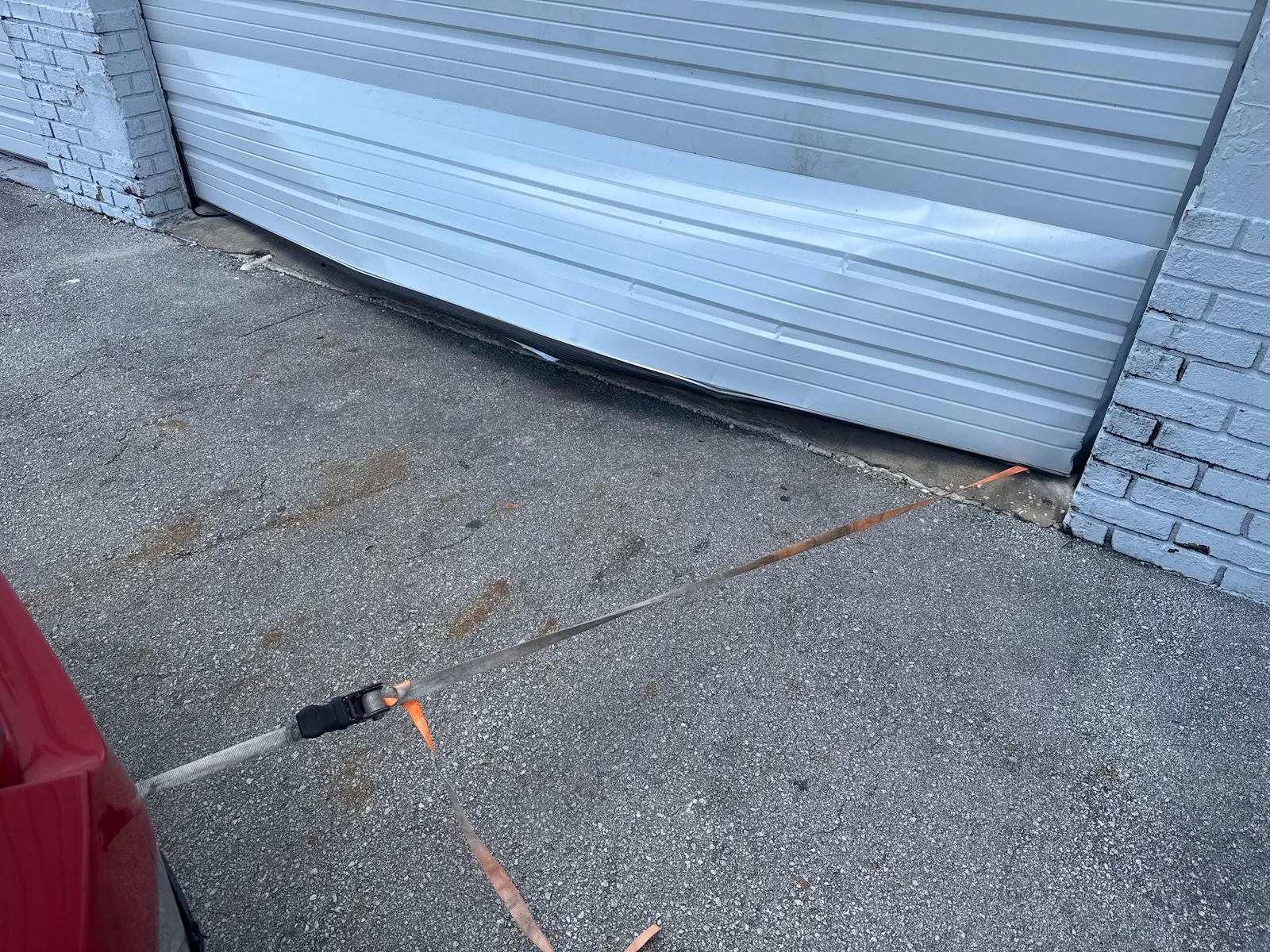
Swelling brings its own trouble. Panels that meet neatly in summer may rub one another or the jambs in a damp spring, and hinge screws in wet wood loosen as the grain softens around them. Where the bottom rail has started to rot, the bracket the cable pulls on can tear out, and then the door hangs off one side.
None of that means an old timber door must go. Loose hinges can often be refixed into sound wood, a perished bottom seal replaced, and springs adjusted or renewed to suit the door’s real weight. The skill lies in knowing which sections are sound and which are past saving, and that judgement is part of every inspection.
While you wait: what to try, what not to touch
Some harmless checks are worth a minute:
- With the door stuck midway, pull the opener’s plug so it cannot make another attempt.
- Wipe both sensor lenses; a single cobweb or leaf is enough to stop a door from closing.
- Fit a fresh battery in a silent remote, then press the wall button: if that works, the remote is the culprit; if not, look to the opener.
- If the opener is completely dark, try the breaker indoors or the outlet in the garage.
- Move anything propped against a track, such as a bike, a snow shovel or a trash barrel.
Other parts are dangerous. A torsion spring, along with the cables and bottom brackets it pulls on, holds enormous stored energy at every point in the door’s travel. Letting that energy go the wrong way can fling a winding bar or bracket hard enough to cause serious injury. Spring work is not for a homeowner with a screwdriver, whatever an online video suggests. If a spring has snapped, keep the door closed; raising it by hand or with the opener means taking its entire weight with nothing holding it up.
Repair it, or replace it
Most doors deserve a repair. A spring swap, a fresh pair of lift cables, replacement rollers or a trued-up track keeps a sound door running for a long while. Replacement starts to make sense once several parts are failing together, when more than one wooden section has rotted through, when the door has grown too heavy for any reasonable spring, or when the frame around it is so soft that nothing stays fixed. You will get a straight answer about where your door stands. If a new door is the better call, the page on new garage doors in Brighton explains how one is supplied and hung in an older opening.
Related work for the same garages
Some faults have pages of their own. A snapped spring is the most common urgent call by far, and spring repair in Brighton goes into torsion and extension springs closely. Openers, remotes, wall buttons and sensors have a page too: opener repair for Brighton. If a door has died overnight with a car stuck inside, the emergency repair page explains how to keep everyone clear of it until it is secured. Our citywide garage door repair page describes the whole range of repairs, and everything for this neighbourhood sits together on the Brighton page.
Booking a repair
Doors break at bad moments: early on a winter morning with the car parked inside, or late in the evening with the door refusing to come down. Calls are taken whatever the hour, so there is no need to sit on a broken door until morning. When you get in touch about garage door repair in Brighton, mention how the door is acting, anything visibly broken, whether a car is shut in, and whether the drive is shared, so the visit can be planned around everyone who needs to get in and out. To set up a visit, call us or book online.
Questions from Brighton
My garage sits far back from the house and the remote barely reaches. Is the opener failing?
Not necessarily. Range falls off with distance, with a weak battery and with metal between remote and garage. Put in a new battery and test the remote close to the door. If it works near the garage but not from the house, the opener’s receiver and antenna can be checked, and a worn-out remote can be replaced and programmed.
The bottom of my wooden door feels soft. Can it still be saved?
Often it can. It depends on how deep the rot goes and whether the bottom bracket, where the cable is anchored, still has firm wood to grip. A door with one damaged section may stay in service; a door whose bottom rail can no longer hold its hardware usually needs replacing.
Several households share one garage. Can a single remote be removed?
On most openers, removing one remote means wiping them all and reprogramming the ones being kept. That is a quick part of any visit, and worth doing whenever a remote goes missing or a unit changes hands.
Why does my door stick in wet weather but run smoothly in summer?
Timber swells as it absorbs water. Sections bind against one another or rub the jambs, and hinges loosen in softened wood. Adjusting hinges and rollers, sealing the bottom edge and making sure the springs match the door’s true weight usually cures it.
Can I drive out if the door is hanging crooked?
Better not to move the door. A tilted door usually means a cable or roller has failed on one side, and running it can drag it further out of its tracks or bring it crashing down. Leave it where it is and ring for help.