
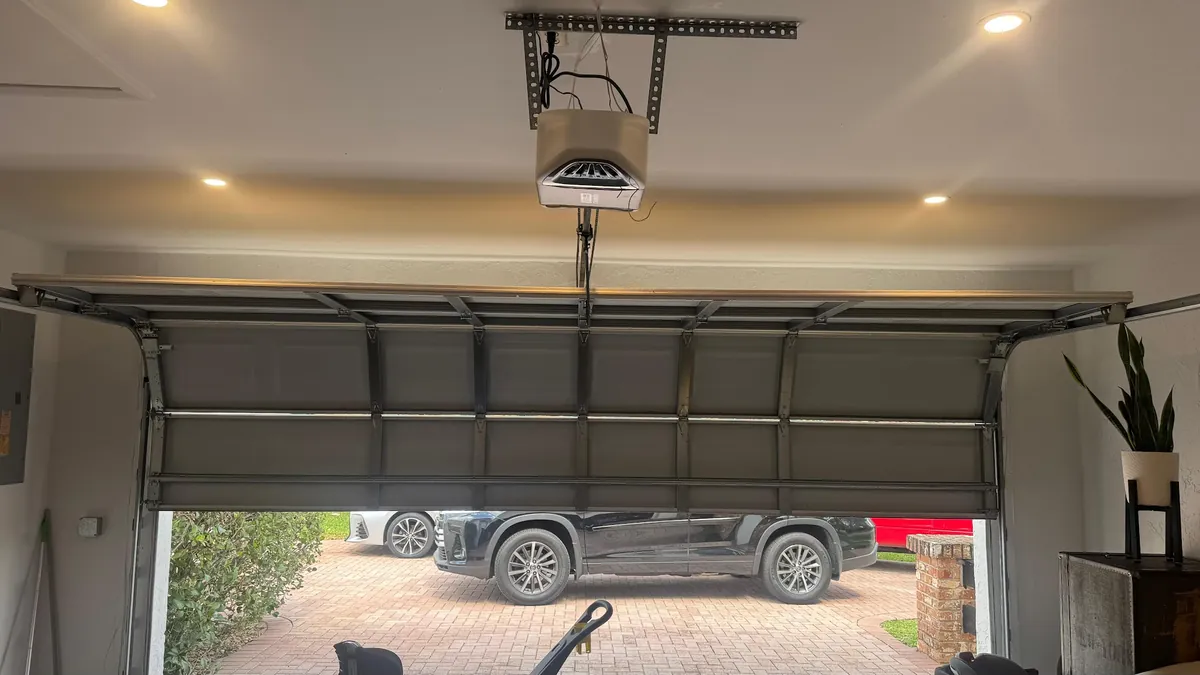
Openers added to garages built without them
The detached single-car garages behind Brighton’s nineteen-twenties two- and three-families were framed for doors raised by hand. Openers arrived later, screwed to whichever rafters were handy and powered by whatever cable could be strung out across the yard. That history accounts for most of the faults we find, and it shapes how garage door opener repair in Brighton is carried out: motor, remotes, wall switch and the two photo-eye sensors are all judged as one system, together with the old door they have to move.
An opener pushes and pulls; it does not lift. Springs carry the door’s weight, while the opener merely steers a door that is already balanced and halts it when something crosses its path. Once a door falls out of balance, the opener tends to be the first part to protest.
Three quick checks narrow things down before you ring:
- Press the button and watch the opener’s light. No light at all usually means a power fault.
- If the remote fails but the switch on the garage wall works, suspect the remote or its battery.
- Look at the little lamps on the two floor-level sensors. A blinking one usually means they are out of line.
Opener faults we fix
Motor hums, door stays put
Often a stripped drive gear, a seized trolley on the rail, or a door made too heavy by a broken spring.
Remote range problems
Remotes that work at the garage but not from out by the street, or that work for one unit of the house and not another.
Dead wall switches
Low-voltage wiring stapled along old framing in an unheated building can corrode, snap or be chewed through.
Sensor faults
Photo eyes bumped askew, wired loose, or dazzled by sun, cobwebs or wet leaves, so the door refuses to shut.
Door reverses or stops short
Travel limits and force settings that no longer suit a door whose weight has changed, or a door binding in its track.
LiftMaster openers
LiftMaster units are among the openers we repair and replace. More on our LiftMaster opener repair page.
Power to a garage that stands on its own
Most garages near Oak Square and off Washington Street are separate outbuildings at the end of a long shared driveway, and their electricity was added after the fact. Some have a proper circuit buried underground from the house; others make do with a single receptacle fed by a cable extended more than once. When an opener goes completely silent, no lamp and no click, the fault often lies upstream of it.
Start simple. Is the opener plugged in? Is that receptacle live? Has a breaker in the house tripped, or has a ground-fault outlet somewhere along the circuit cut out after a damp night? In an unheated outbuilding, condensation inside a receptacle can be enough. Only once power is confirmed does it make sense to take the opener’s cover off and test the logic board, the capacitor or the motor.
Any garage door opener repair in Brighton that skips this step risks replacing a healthy opener hanging on a dead outlet. Where the wiring itself looks unsafe, we say so plainly and leave it for an electrician rather than patching over it.
Remotes, distance and shared garages
Distance is the other defining feature of these lots. A garage behind a long drive can sit a fair way back from the street, and further still from the front door of a three-family. A remote’s signal has to pass through a garage wall, sometimes past a parked car, often from a moving vehicle at the bottom of the drive. Tired batteries, a receiver antenna squashed against a metal duct, or a remote that has simply aged can all cut its reach.
Where one garage serves more than one unit, the opener may answer to several remotes. When one goes missing or a tenant moves on, the usual approach is to wipe the opener’s memory and reprogram every remote still in use, a short job at any visit. A wireless keypad mounted outside the garage is another option where several people need to get in, as it does not rely on anyone keeping track of a handset.
Range problems can also come down to the opener’s age. Older units used fixed codes set by tiny switches inside remote and receiver. They still work, but those codes are easy to copy and awkward to manage across several households. Replacing an old fixed-code opener with a rolling-code model is one of the most frequent reasons for a new opener on these garages.
Many cars also carry buttons in the visor or the mirror that can learn an opener’s signal. On a garage shared by several units, those built-in buttons are easy to forget when remotes are cleared, and a car that still opens the door after a reset usually means its button kept the old code. They can be paired again, or cleared, alongside the handsets, and newer openers sometimes need a step at the opener itself before a car’s button will learn them.
Photo eyes in a cramped single bay
Those two sensors sit just above the slab on either side of the opening and send an invisible beam between them. Interrupt that beam while the door is coming down and the opener halts, then backs the door up. In a single-car garage there is very little clearance between a car’s flank and the track, so the sensors get bumped. A handlebar, a recycling bin or a snow shovel stood by the door can nudge one out of line, and the opener will then refuse to lower the door at all, or will lower it only while the wall switch is held down.
Sunshine causes trouble too. A detached garage facing south or west can catch low winter sun straight into its receiving eye in the late afternoon, blinding it. Swapping the sensors to opposite sides, or fitting a small hood, usually cures that. Leaves, cobwebs and grit blown in off the yard settle on lenses set so close to the ground, and a gentle wipe with a soft cloth clears up more sensor calls than anything else does.
The brackets matter as much as the lenses. Sensors are often mounted on thin sheet-metal brackets screwed to the track or to an old jamb, and in a tight bay those brackets get kicked and bent until the eyes point at the floor or the ceiling. The thin wires that run up the wall to the opener are stapled close to the ground, where a broom, a mower handle or a winter of damp can damage them. Realigning a pair of eyes is quick work; finding a broken sensor wire behind a stack of stored belongings can take longer, so it helps if the area around both sensors is clear before the visit.
A garage door opener repair visit, step by step
When we come out for garage door opener repair in Brighton, order matters, because an opener can only be judged once the door it drives is known to be sound.
- The release cord is pulled to separate opener and door, and the technician raises the door by hand to feel its balance. If it is heavy or will not rest midway, a spring is at fault, and that comes first.
- Power is traced: receptacle, breaker and any fuse inside the opener.
- The opener is run with the door unhooked, so its drive, gears and trolley can be watched and heard working on their own.
- Every handset, the wall switch and any keypad get tried, and both photo eyes are checked for line and wiring.
- Once the door is reattached, the up and down limits and the force setting are adjusted, and a block laid under the door proves the auto-reverse.
Before any part is changed, you will know what failed and whether repairing or replacing makes better sense.
Repairing an opener, or replacing it
Plenty of opener faults can be fixed. Drive gears, trolleys, logic boards, capacitors, photo eyes, wall switches and handsets can be swapped on most models. Repair is the sensible route when the motor is healthy and the unit is not so old that parts have dried up.
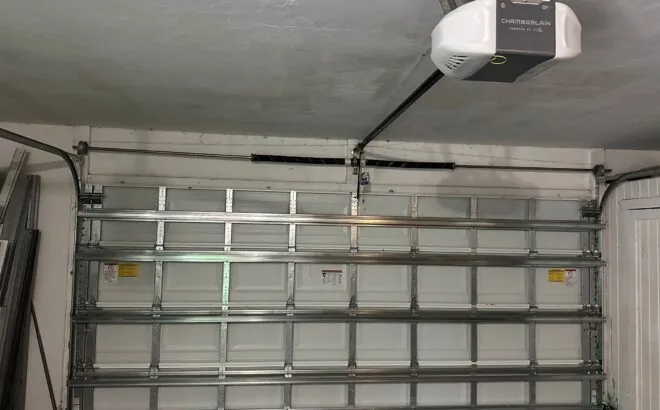
Replacement starts to win in a few situations:
- Parts for the model are scarce, or it still runs on fixed codes.
- The motor has burned out, often after straining against a door whose spring had snapped.
- It has no working photo eyes.
- The garage ceiling has changed, say after a storage platform went in, and another style of opener would suit it better.
A new opener is chosen to suit both garage and door. In old detached garages the ceiling height and rafter spacing decide where the rail can run and what extra bracing it needs to hang securely. Once mounted, its limits and force are tuned to the door, the photo eyes are lined up, and handsets for every household using the garage are programmed.
Chain, belt and screw drives in an outbuilding
Rail openers move the door in one of a few ways. A chain drive pulls the trolley along the rail with a bicycle-style chain; it is tough and simple, but noisy, and a chain that has stretched slaps against the rail and needs tensioning. A belt drive uses a reinforced rubber belt in place of the chain and runs far more quietly. A screw drive turns a long threaded rod. There are also openers that mount on the wall beside the door and turn the torsion shaft directly, which leaves the ceiling clear.
In a detached garage, noise matters less than in a garage tucked under a bedroom, so a chain drive is often perfectly sensible. Cold matters more. Grease on a screw drive stiffens in an unheated building in January, and a chain or belt opener copes better with a cold rail. A wall-mount unit can be a neat answer where low rafters leave little room for a rail, though it needs a torsion spring shaft to attach to, which rules it out on many older extension-spring doors. The right choice for a given garage comes down to its ceiling, its door and the springs on that door, all of which are looked at on site.
Wall switches and wiring across a cold outbuilding
The switch on the garage wall is connected to the opener by thin low-voltage wire, usually stapled along a stud and across the ceiling. In an unheated detached garage that wire lives through every freeze and thaw, and over the years staples cut into it, insulation cracks and mice find it. A wall switch that works only intermittently, or a door that sometimes starts on its own, can be a short somewhere along that run rather than a fault in the opener.
Older switches are simple push buttons that close a circuit. Newer ones talk to the opener digitally and often carry a light switch and a lock button as well, so a switch from one opener will not always work with another. When an opener is replaced, the wall switch usually goes with it, and the old wiring is checked or renewed at the same time. A lock button is worth knowing about on a garage shared by several households: pressed, it stops every remote from opening the door until it is released, which can look exactly like a broken opener to someone who did not know it had been pressed.
When the power goes out
Many of these outbuildings have a single big door and no side entrance at all. If the power fails, the opener cannot move it, and there may be no other way in. The release cord hanging from the trolley unhooks the door from the opener, after which it can be lifted manually, provided nothing in the spring system has broken. From outside, a small keyed release in the top section of the door does the same job, where one has been fitted; on a garage with no side door it can be the only way to reach the car during a power cut.
Some openers carry a battery backup that will run the door a few times without mains power. When a door has been released by hand, it has to be reconnected to the trolley before the opener will drive it again, usually by running the opener until the trolley clicks back into place. Part of any garage door opener repair in Brighton visit is showing whoever uses the garage where the release is and how it works, so a power cut does not turn into a trapped car.
Openers on heavy wooden doors
The original timber doors still common here outweigh most modern steel doors of the same size, and their weight shifts with the weather. A door that balances nicely in dry autumn air can feel noticeably heavier after a wet spring. If nobody adjusts the springs for that, the opener carries the difference, and the result is a slow, grinding opener that sooner or later chews through a gear or cooks its motor. Part of every garage door opener repair in Brighton on a wooden door is checking that the springs still match it, so a repaired or new opener is not set up to fail the same way. Spring work has its own page: spring repair for Brighton garages.
Other work on the same garage
An opener fault is sometimes a symptom of something else. Cables, rollers, panels and tracks come under Brighton garage door repair. If your door will not budge at night with the car inside, urgent help in Brighton explains what to do meanwhile, and if the door itself is beyond saving, read about replacing the door in Brighton. Our citywide opener repair and replacement page goes deeper into openers, and the Brighton neighbourhood page brings together all our work nearby.
Getting your opener looked at
Openers have a habit of failing just as someone needs the car. Our line is staffed at every hour, so you can report a fault the moment it shows up. It helps to tell us whether the opener lights up, whether the wall switch works, whether a sensor lamp is blinking, and whether the door feels heavy when lifted by hand. When you have those answers, call us or book online for a visit.
Questions from Brighton
The opener runs, yet the door does not move. Why?
Either the opener has been unhooked from the door, its drive gear has stripped, or a broken spring has left the door too heavy to lift. Pull the release cord and try raising the door by hand. If it feels very heavy, keep it shut and stop running the opener.
Why does my door only go down while I hold the wall switch?
That is the opener’s way of saying its photo eyes cannot see each other. Clear anything from the beam, wipe both lenses and check the lamp on each sensor. A dark or flickering lamp means the pair needs realigning or its wiring checking.
Can another unit in the house get its own remote?
Yes. Most openers accept several handsets, and a wireless keypad outside the garage is a handy alternative for a garage shared by more than one household.
Is an older opener worth repairing?
That depends on what failed and whether parts can still be had. A worn gear or faulty photo eye is usually worth fixing; a burned-out motor in an old fixed-code unit is usually the cue to replace it.
Can you fix a LiftMaster opener?
Yes. LiftMaster units are repaired here, and replaced when one has reached the end of its useful life.