
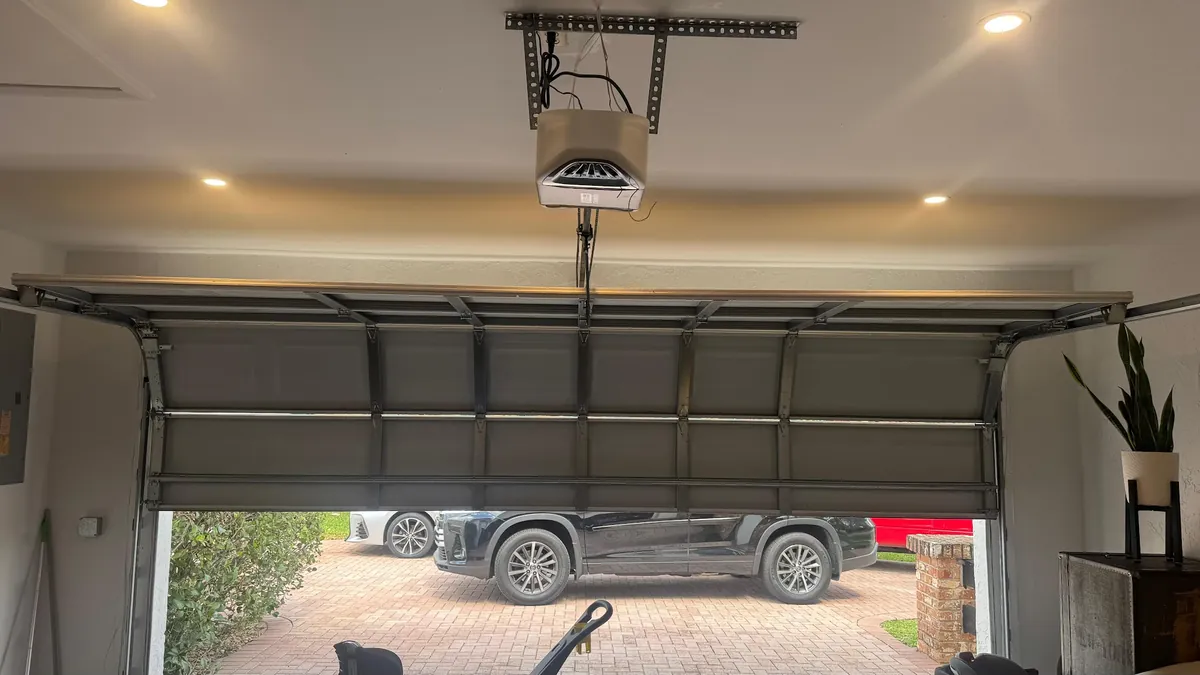
An opener that lives under the house
Down by the Navy Yard, where the newer townhouses were built with garages, the opener is bolted overhead with bedrooms or a kitchen directly on top, and the garage door it drives is often the main way in and out of the house. Garage door opener repair in Charlestown deals with every part of that system: the motor unit, the rail and its chain, belt or screw, the remotes, the wall button, any outside keypad, and the two beam sensors guarding the doorway. Openers are repaired where repair makes sense and replaced where it does not.
Before calling, try to pin down which of these three your opener is doing:
- Silent, with no light and no click, from either the remote or the wall button.
- Humming or clicking, with the door going nowhere.
- Moving the door, then stopping short, reversing or refusing to close.
Opener faults we handle
Motor and drive gear
A motor that runs without moving the trolley usually has a worn drive gear or sprocket, a common failure on a heavily used opener.
Chain, belt and rail
A slack chain that slaps the rail, a belt that has stretched or frayed, or a rail that has worked loose from its ceiling bracket.
Remotes and keypads
Handsets with flat cells or forgotten codes, and weatherbeaten entry pads on the outside wall.
Wall buttons and wiring
A dead wall button, a cracked console, or a low-voltage wire pinched by a staple or chewed loose.
Safety sensors
Beam units nudged askew by a bike or bin, smeared lenses, loose brackets and broken wires, all of which stop the door closing.
LiftMaster openers
We fix LiftMaster units and swap them out when they are past saving, just as we do for every other home opener.
What the opener actually does
An opener is often blamed for faults it did not cause, so it helps to know its job. The opener does not carry the door’s weight; the springs do. The opener’s motor drives a trolley along a rail, and a bent arm joins that trolley to a bracket on the door’s top section. When you press the button, the motor pushes or pulls the trolley, and a door that is already balanced by its springs follows along.
Inside the head unit there is a motor, a gear or sprocket that turns the drive, a logic board that reads the remotes, the wall button and the sensors, and two settings that matter most: the travel limits, which tell the opener where fully open and fully closed are, and the force setting, the amount of resistance it will tolerate before giving up. Outside the head unit are the safety sensors, a transmitter on one jamb and a receiver on the other, just above the slab. Interrupt that invisible line during a downward run and the head unit halts the door and sends it back up.
Most opener calls come down to one of those pieces. A dead logic board or a blown fuse gives total silence. A stripped gear gives a motor that runs while the trolley sits still. Wrong travel or force settings give a door that stops short or bounces back. A sensor problem gives a door that will open but will not close.
Garage door opener repair Charlestown townhouse garages call for
Most garage door opener repair in Charlestown takes place in the townhouse garages near the Navy Yard, and those bays have a few things in common. The opener sits overhead in a garage that shares its ceiling with living space. The door is usually a single sectional door. And the garage tends to be the route for groceries, bikes, deliveries and people, which means far more open-and-close cycles than a garage used only for parking.
All that use wears the drive. The plastic or nylon gear inside many residential openers is designed to be the part that gives way first, protecting the motor, and on a busy door it eventually does. The fix is a gear and sprocket kit rather than a new opener, as long as the motor and logic board are sound.
Noise is the other complaint. A chain drive bolted to a ceiling with a bedroom above transmits every rattle into the house. A loose chain, a rail that has worked its bracket loose, or a head unit hung on bare metal straps without anything to soak up vibration all make it worse. Tightening, re-hanging and adjusting cures much of it. Where the noise is the drive itself, a belt-drive opener is the quieter choice for a garage under living space, and replacing the unit is worth discussing.
Remotes, keypads and wall buttons
When the remote stops working but the wall button still opens the door, the fault is almost always in the remote rather than the opener. A flat battery is the first thing to rule out. Next most likely, the handset has dropped out of the opener’s memory, which a power cut can cause, or the receiver in the head unit can stop listening to a handset it used to accept. Re-pairing remotes to the opener, clearing old codes that may belong to lost handsets, and adding new remotes are all part of a visit.
Outside keypads take a beating on a short apron where the car pulls right up to the door. A keypad near the street side of the garage is exposed to rain, road spray and the odd knock from a mirror. Water inside a keypad is a common cause of failure, and replacing the pad is usually more sensible than drying it out.
The wall button inside the garage is on a low-voltage circuit. If it does nothing while the remote works, the problem is the button, its wire, or the terminal on the back of the head unit. Wires stapled along a ceiling or wall can be pinched, cut by a careless screw, or pulled loose when something is hung in the garage. Tracing and repairing that wire is quick once the break is found.
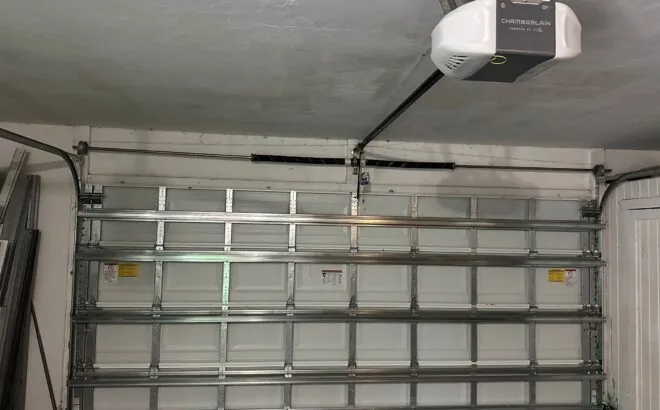
Safety sensors in a small, busy garage
Safety sensors are the commonest reason a door will open but refuses to close. In a compact garage full of bikes, bins and the rest of a household’s overflow, they get bumped constantly. One eye knocked a few degrees out of line is enough to break the beam. Each sensor has a small indicator light, and a steady light on both usually means they can see each other; a blinking or dark light means they cannot.
Simple checks are safe: wipe both lenses, clear anything from the path between them, and look at whether either bracket is bent. If the lights still will not settle, a technician realigns the eyes, tightens or replaces the brackets, and checks the wire for damage. Low sun can also blind a receiving eye at certain times of day, and the cure there is to swap the sending and receiving eyes so the receiver faces away from the light.
Sloping floors and the close setting
On a steep lot, the floor at the garage door is not always level, and that confuses openers. A door that touches down at one corner before the other meets resistance earlier than the opener expects. If the force setting is tight, the opener reverses; if the close limit is set past the point where the door first touches, the opener keeps pushing and bows the top section. Either way, the result looks like an opener fault.
Getting this right means adjusting the door and the opener together. The cables are checked so the door comes down as squarely as the floor allows, the close limit is set to where the door actually seals, and the force is set just high enough to close the door reliably and no higher. That last part matters for safety: an opener turned up to overcome a binding door will also push harder against anything in its way.
What a visit involves
An opener visit begins by separating the opener from the door. The trolley is released and the door is moved by hand, which shows straight away whether the door is balanced and runs without binding. That step matters: an opener straining against a broken spring or a binding roller will keep failing however well it is repaired, and many opener calls turn out to be door problems underneath.
With the door confirmed sound, the opener is tested on its own. The head unit is opened up if needed to check the gear, the sprocket and the logic board. Remotes, keypads and the wall button are tried one by one. Each beam unit is sighted against its partner and its cable followed back to the head. Nothing is ordered or fitted until you have heard the diagnosis and whether this particular unit merits the money.
After the repair, the trolley is reconnected, travel limits and force are set for this particular door, and the reverse function is proved with an offcut of two-by-four set flat on the slab, which the descending door has to touch and bounce back from. A second test, waving something through the beam mid-travel, confirms the sensors are doing their part. Handsets get paired, and someone in the house is walked through the red release cord. If the head unit sits close to a bedroom ceiling, the run is watched and listened to from inside the house as well, so any remaining rattle can be tracked down before the visit ends.
Older bays with little headroom
Where a garage has been squeezed into an older Federal building beside the Training Field or just off Main Street, the space above the door can be tight. A rail-type opener needs clearance for the trolley above the door’s highest point, and a low bay may have almost none. Rails can sometimes be shortened or the head unit repositioned, and in some tight garages a wall-mounted opener beside the door, which turns the spring shaft directly instead of running along a rail, is the better fit. When an existing opener in one of these bays fails, the replacement has to suit the room as well as the door.
Power cuts and the manual release
When the power goes, an opener goes with it, and a townhouse whose garage is also its everyday entrance is suddenly awkward to get into. Every residential opener has a manual release: a cord, usually red, hanging from the trolley on the rail. A firm tug unhooks the trolley, after which a sound, well-sprung door slides up under your own effort.
A few points make that safer. Disengage it with the door shut where possible, since a raised door on a tired spring may fall once freed. Grip the handle or the lowest panel, and keep fingers clear of the joints between sections. Once power returns, the trolley usually re-engages the next time the opener runs, or it can be clipped back by hand. If the opener loses its remotes or its travel settings after the outage, those are reset on a visit. Certain models hold a standby battery to ride out a brief outage; whether one suits your garage can be discussed when the opener is looked at.
What fitting a new opener involves
When an opener is replaced, the old head unit, rail and hangers come down, and the ceiling fixing points are checked, since a bracket screwed into a single thin board will not hold a new unit any better than it held the old one. In a garage below living space, the new unit is hung from solid framing so vibration is kept down. The rail is attached to the header above the door, the trolley arm is connected to the door’s top section, and new safety sensors are mounted and wired at each side of the opening. The wall console is wired, remotes and any keypad are paired, and the up and down stops and the push strength are dialled in for this door. Finally the reversing test is run, and you are shown the release cord and how the remotes are programmed.
Fixing the unit or fitting a new one
Plenty of opener faults have a sensible repair: a gear kit, a new logic board, re-programmed remotes, realigned sensors or a fresh keypad all restore an opener that is otherwise sound. Replacement becomes the better answer when the motor itself has burned out, when the logic board and gear have both failed, when parts for an older model are hard to find, or when the opener is too loud for a garage beneath bedrooms. An opener that lacks the safety reversing sensors altogether should be replaced, not repaired. Garage door opener repair in Charlestown always comes with a straight answer about which route makes sense, and LiftMaster openers can be repaired or replaced like any other.
When the opener is not the real problem
An opener that has been doing the springs’ work will eventually fail, and fixing the opener alone leaves the cause in place. If your door feels heavy when lifted by hand, or will not stay halfway up, the springs need looking at; see spring repair in Charlestown. Bent tracks, worn rollers or a frayed cable also make an opener labour, and those fall under general garage door repair in Charlestown. If the door is old enough that the opener is the least of its problems, our new garage doors in Charlestown information sets out the alternative. And when an opener dies at night with the car shut in, emergency garage door repair in Charlestown covers what to do next.
Arranging an opener visit
To arrange garage door opener repair Charlestown MA residents can phone whatever the hour, or use the booking form. Useful details to have ready: the opener’s response to a press, any difference between handset and wall console, and the colour and behaviour of the little lights on each beam unit. The wider opener repair and replacement page covers openers elsewhere in Greater Boston, and the Charlestown page lists each service offered in the neighbourhood. Call us or book online, today or tonight.
Questions from Charlestown
Our opener is right under a bedroom. Can it be made quieter?
Usually, yes. Tightening the chain and the rail, re-hanging the head unit with proper fixings, and replacing worn rollers on the door all reduce noise. If the drive itself is the problem, a belt-drive opener is much quieter than a chain and is worth considering.
The remote stopped working after a power cut. Is the opener broken?
Probably not. First change the remote’s battery. Still nothing? It probably needs re-learning to the head unit. Try the wall button: if it works, the opener is fine.
The door opens but will not close unless we hold the button down. Why?
Keeping the console pressed is the manual override for a blocked or misaimed beam, so the head unit is reporting a sensor fault. Clean the lenses, clear the beam and check the sensor lights; if they will not stay steady, the sensors need realigning or their wiring checked.
Do you work on LiftMaster openers?
We do. A LiftMaster unit in a Charlestown garage gets the same diagnosis as any other: repaired when the fault is fixable, replaced when it is not.
The opener has died and the car is shut in. What now?
If the door is fully closed and the springs are intact, give the red cord on the trolley a firm pull and lift the door by hand. Should it fight you, or slide back down when released, stop: a spring is likely broken, and the door should be left down until it is repaired.