
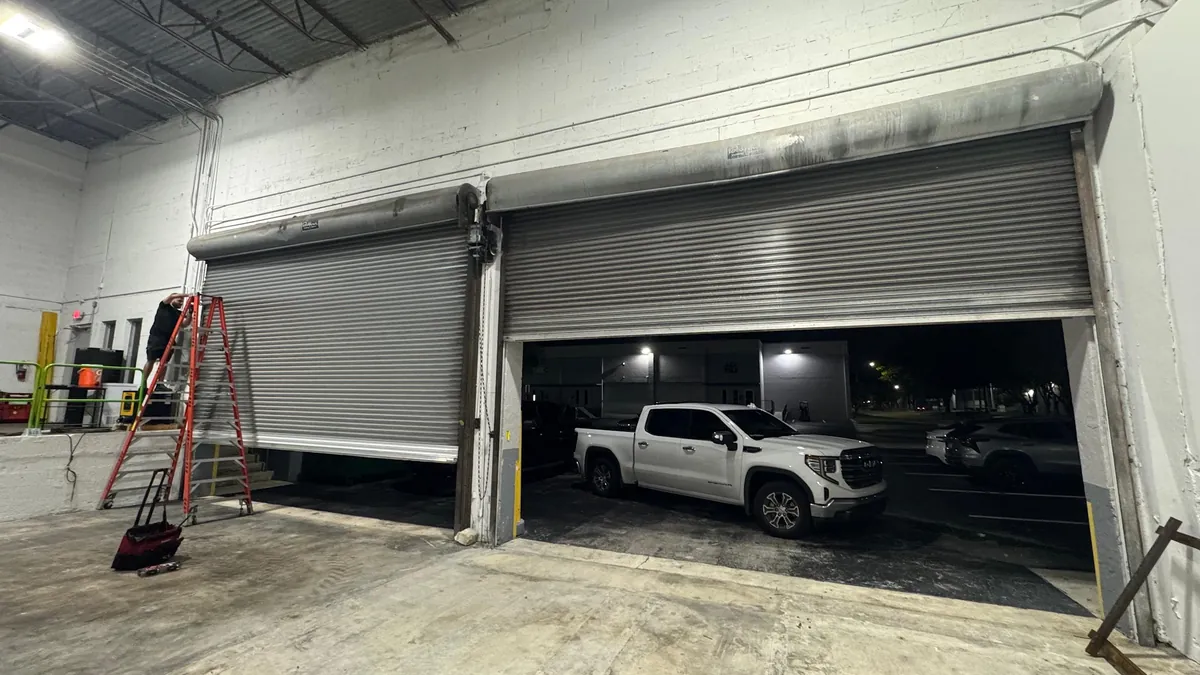
A door that fails when the street is dark
Chinatown’s doors are mostly commercial roll-up shutters set at pavement level along the narrow streets leading off Washington, guarding loading entrances and storerooms in dense mixed-use buildings. When one of them fails late in the evening, the problem is rarely a car stuck in a garage. It is a ground-floor space open to the street that cannot be locked, or goods due at first light behind a door that will not budge. Emergency garage door repair Chinatown MA calls can be made at any hour, since someone is on the line whenever you ring, late night and early morning alike.
While you wait to speak to someone, three things are worth noting:
- Whether the door is stuck open, stuck closed or hanging partway.
- Whether you heard a bang, a snap or a grinding noise before it stopped.
- Whether the door hangs level, or sits crooked in its guides.
Emergencies we take calls for
Stuck up at closing time
A curtain or sectional door stuck up, leaving a ground-floor space open to the street.
Shut fast with goods waiting
A door locked down with stock or deliveries waiting on the other side of it.
A broken spring
A loud bang overhead and a door that suddenly will not lift, or that came down hard.
A door out of its guides
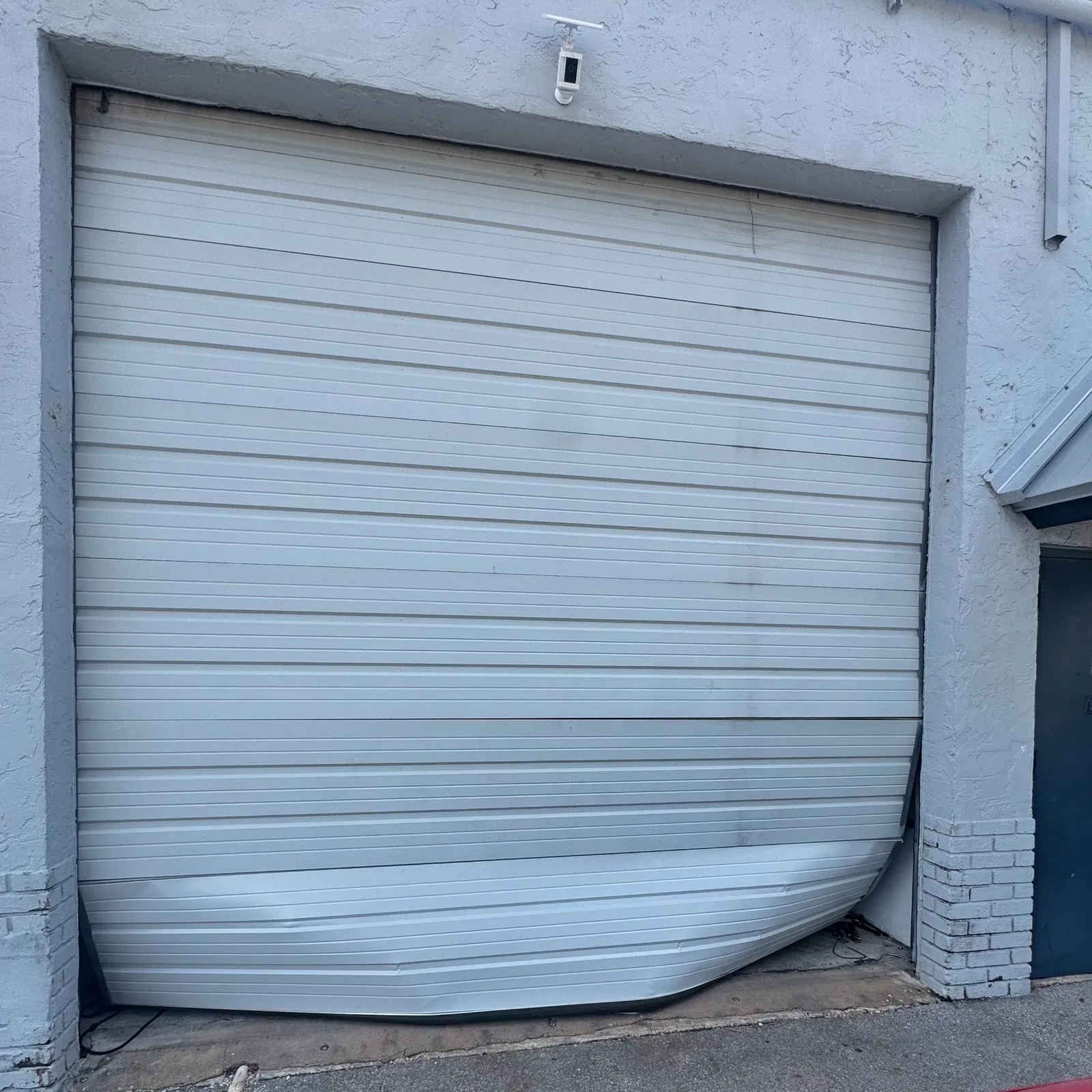
A curtain pulled out of a guide, or a sectional door off its track and hanging crooked after a knock from a vehicle.
A door hanging partway
A door stopped halfway that will not move in either direction, which is the most hazardous position of all.
What counts as an emergency on these streets
On a suburban driveway, a broken garage door is mainly an inconvenience: the car stays put until someone comes. On a narrow side street in a dense block, the same failure can leave a ground-floor opening on a public sidewalk exposed overnight, or a loading entrance blocked just as the morning’s deliveries begin. Loading access and delivery windows shape the day here far more than any driveway does, so a door that fails at the wrong moment has effects well beyond the door.
Situations that usually lead to a call for emergency garage door repair in Chinatown:
- The door is stuck open and the space cannot be secured.
- The door is stuck shut and something essential is behind it.
- The door is hanging partway, crooked, or out of its guides, and could come down.
- A spring has snapped and the door came down hard or will not move.
- A vehicle has struck the door and bent the curtain, the bottom bar or a guide.
A door that is noisy, slow or occasionally reverses is worth booking a normal visit for, and the garage door repair in Chinatown page covers that kind of work.
Staying safe while you wait
Forcing a damaged door is what turns a breakdown into an injury. Until help gets there, stick to these rules:
- Do not run the operator again. If the door has stopped or jammed, pressing the button repeatedly can bend the curtain, strip the drive or pull the door further out of line. Isolate the operator at its switch or plug.
- Keep everyone out from under it. A door hanging partway, or one with a broken spring, can drop without warning. On a street-level door, that means keeping the sidewalk in front of it clear as far as you reasonably can.
- Leave the springs and cables alone. A torsion spring holds dangerous tension however calm it looks, and its brackets and fittings share that load. No part of it is suitable for a DIY repair.
- Never heave a heavy curtain upward yourself. If the door feels much heavier than normal, the spring has probably failed, and nothing is holding the weight except you.
- Note what happened. A bang, a vehicle, a gust of wind or a door that simply stopped: whatever came before the failure helps diagnose it.
What to tell us when you call
Emergency garage door repair in Chinatown goes more smoothly when the first call carries the right detail. Useful things to mention:
- Whether the door is a roll-up or a sectional door, and roughly how big the opening is.
- Whether it is stuck open, stuck shut or hanging partway, and whether it hangs level.
- What happened just before it failed.
- Whether the opening is currently secure, and whether anything inside needs protecting.
- The street it faces, and whether a service vehicle can stop nearby on that side street.
- When the next delivery is expected, if the door is a loading entrance.
Nobody can promise an arrival time from here, as it hinges on the hour, the roads and the other jobs already under way. You can count on a person picking up and noting the details, however late it is.
How an urgent visit runs
Priority one on an urgent visit is a safe door and a safe sidewalk. The second is to secure the opening. A full repair can follow straight away where the parts and conditions allow, or it can be completed on a return visit.
- Make it safe. Power to the operator is cut, pedestrians are kept back from the doorway, and any curtain sagging loose from a guide is propped up against a fall.
- Find the cause. Each part is looked over in turn: springs, slats or panels, side guides or tracks, lift cables where fitted, the bottom bar and the operator.
- Secure the opening. Where the door can be lowered and locked safely, it is. Where it cannot be repaired on the spot, the options for securing the space are discussed with you.
- Explain the choices. You are told what broke and what fixing it involves, and nothing goes ahead without your say-so.
- Repair and test. New parts go in, the springs are set until the curtain hangs balanced, the door is worked up and down repeatedly, and the reversing system is checked against an obstruction.
Why a stuck door here is different from a stuck door in the suburbs
Elsewhere in Greater Boston, a garage door emergency usually involves a house, a driveway and a car. In Chinatown the picture is different, because private garages are so rare. The doors that fail are the working doors of mixed-use buildings: loading entrances, storerooms, service bays and the shuttered fronts of ground-floor premises. That changes who is affected and what is at stake.
A shutter that sticks open does not just let the cold in. It leaves a ground-floor space and whatever is stored there exposed to the street through the night. A shutter that sticks shut can hold up the morning’s deliveries for a whole building, and on narrow streets a delivery vehicle that cannot unload may have nowhere to wait. A curtain hanging partway over a sidewalk is a hazard to everyone walking past, not only to the people who use the door.
For those reasons, the first questions on an urgent call here are often about the street rather than the door: can the opening be made secure, is the sidewalk safe, and when is the next delivery due?
Doors in the dark and the cold
Failures do cluster at certain times. Springs tend to break on the first hard frosts. Operators can trip out when moisture gets into a wall station or a sensor after heavy rain. Shutters see their heaviest use as premises open up and lock up, so that is when a part already near the end of its life is most likely to give out, and that is often when the street is darkest.
Working on a street-level door at night needs more care than in daylight. The work area is lit, the sidewalk in front of the door is kept clear, and a damaged curtain is supported before anything else is done. If there is a street light or building light near the door, telling us about it on the phone helps.
Delivery mornings
Many urgent calls in these blocks come early in the day, when a shutter that closed normally the night before will not lift for the first delivery. Often the cause is a spring that broke overnight as the cold set in, or an operator that has failed after a power interruption. A few things are worth trying before that call, all of them safe:
- Check whether the building has power, and whether the operator’s supply has tripped.
- If the operator has a manual chain or crank and the curtain feels balanced, try raising it gently by hand.
- If the curtain is heavy, will not move or makes a grinding sound, stop and leave it down.
If the door cannot be opened, it may be possible to bring goods in through another entrance while the repair is arranged. That decision is yours, but it is often better than forcing a door that is not ready to move.
Broken springs at night
Springs top the list of reasons a door abruptly stops working. On a rolling door, the torsion spring inside the barrel balances the curtain; on a sectional door, springs on a shaft above the opening do the same job. When one snaps, often with a loud bang, the door loses its balance. Pressing the button usually makes the operator hum or strain, and if the door was up, it may come down hard.
Freezing nights raise the odds of a break, since cold leaves spring wire less forgiving, and street-level doors exposed to the weather feel it most. With a snapped spring, leave the door precisely as it sits. How the replacement itself is carried out, once things are safe, is laid out on our Chinatown spring page.
Doors struck by a vehicle
On narrow side streets where delivery vehicles back up close to the building, a door is easy to clip. A bumper or tailgate can bend the bottom bar, crease several slats, or push a guide out of line so that the curtain pulls out of it. A sectional door can be knocked off its track, with rollers dangling outside the rail and a cable gone slack.
A door in that state is unstable. It should not be run, closed by hand or lifted. Emergency garage door repair Chinatown MA visits after an impact start by taking the weight off the door and supporting it, then working the curtain or rollers loose, then straightening or replacing what is bent. If the curtain is creased beyond use, damaged slats can often be replaced; if the door is badly torn, the new garage doors page for Chinatown explains replacement.
Operators that fail out of hours
On some calls the curtain is undamaged and only the motor unit has quit. If the door feels balanced when the operator is disengaged, it can often be lowered with the hand chain, the crank, or by hand on a sectional door, and locked until a repair can be arranged. That alone can turn an emergency into a booked visit. If the door is heavy, or the hand chain will not turn it, the problem is more than the operator. The opener repair page for Chinatown covers operators, remotes, wall stations and sensors.
Making the opening secure for the night
For a ground-floor space on the street, securing the opening is often the most pressing concern. A door that can be lowered and locked solves that. When it cannot, because it is too badly damaged or the curtain is out of its guides, the immediate aim is to make the door safe and leave it in a stable position, and you hear plainly what can and cannot be done that night. The full repair then follows when the parts are in hand.
Leaving a door overnight when it cannot be fixed straight away
Sometimes a door cannot be fully repaired in the middle of the night. A curtain that is torn, a barrel that is damaged, or a component that has to be ordered in can all mean the full repair has to wait for a return visit. Then the job becomes leaving the doorway as safe and as lockable as circumstances permit until the return visit.
That might mean lowering a damaged curtain under control and securing it at the bottom so it cannot be lifted from outside, or supporting a door that cannot be lowered so it cannot fall, and leaving the operator isolated so nobody runs it by mistake. You will be told clearly what has been done, what is still needed, and whether the door can be used at all in the meantime. If it cannot, it is worth putting a note on the wall station so that nobody in the building tries it.
Telling the rest of the building
In a mixed-use building, more than one business or household may rely on the same door, or on the sidewalk in front of it. When a street-level door fails, letting the other users know helps: they can hold back deliveries, keep clear of the doorway, and avoid pressing the wall button. If the building has a manager or an owner who looks after the doors, they will want to know too, since the repair may affect when the opening can be used over the next day or two.
Finding out why it failed
Once the shutter is working again, ask what set the failure off. A spring that gave out after a long working life simply wore out. A spring that broke because the curtain was binding in a bent guide will break again if the guide is not dealt with. A door struck by a vehicle may need a bumper post or a change in how deliveries back up to it. These are conversations worth having once the door is running again.
Calling about an emergency
Emergency garage door repair in Chinatown rests on one thing we can state firmly: somebody answers the phone at any hour, on every day of the week. Describe the door, what it is doing, and whether the opening is secure. Our emergency garage door repair hub has more detail, or see all the services in the neighbourhood on the Chinatown page. Call us or book online.
Questions from Chinatown
Is anyone there if the shutter jams at three in the morning?
There is. Someone takes calls through the small hours as well as the day, so a jam discovered after closing or before first light can be reported the moment you notice it.
How soon will someone arrive?
No time is promised. It depends on the hour, the traffic and what other calls are in progress. Describing the door and whether the opening is secure helps the call be handled in the right order.
The door is stuck open and the space is exposed. What should I do?
Isolate the operator, keep people out from under the door, and call. If the door is balanced and undamaged, it may be possible to lower it with the hand chain or by hand; if it is heavy, crooked or out of its guides, leave it alone.
A truck hit the door. Can I still close it?
Not if anything is bent, creased or out of line. A damaged door can bind and drop, or pull further out of its guides. Leave it where it is and call.
The door only misbehaves now and then. Does that count as urgent?
Usually not. A door that hesitates, reverses now and then or is louder than usual is better dealt with on a booked visit, before it fails completely.