
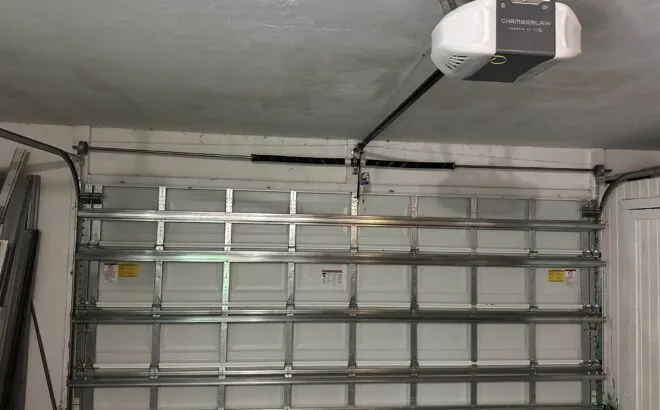
Why springs give out in Dorchester’s rear garages
Head up the side drive of a typical triple-decker or Victorian in Codman Square, Savin Hill or Ashmont and you arrive at a separate garage well behind the house. Many were built in the 1920s around a single-car opening, and plenty still carry a wooden door that has been painted, patched and soaked through over the years. That combination is hard on springs, and garage door spring repair in Dorchester, MA is one of the most frequent calls from these garages. We replace torsion springs and extension springs, and set the door’s balance so the new spring is matched to the door it actually has to lift.
A spring rarely breaks quietly. Look for these signs from a safe distance:
- A crack like a gunshot somewhere out back, and afterwards the door barely leaves the ground.
- A gap of a hand’s width or so between two coils of the spring above the opening.
- On a door with springs running along the tracks, one spring hanging loose or a pulley out of place.
Springs and the parts that work with them
Torsion springs
Coiled springs on a steel shaft across the head of the door. They wind as the door comes down and unwind to lift it. Most snaps happen here.
Extension springs
Long springs stretched beside each horizontal track, common on older and lighter doors. They pull the door up through pulleys and cables.
Safety cables
A cable threaded through each extension spring so that, if the spring snaps, its pieces stay on the cable instead of flying across the garage.
Drums, cables and bearings
The drums at the ends of the torsion shaft, the cables they wind, and the bearing plates that carry the shaft, all checked when a spring is renewed.
How a spring carries the door
The motor on the ceiling gets the credit, but the spring does the lifting. When the door closes, a torsion spring is twisted tighter on its shaft and stores the energy needed to raise the door again. When the door opens, the spring unwinds, turning drums at both ends of the shaft, and the cables wrapped on them draw the lower corners of the door upwards. Set correctly, the spring cancels out almost all of the door’s weight, so the door feels light by hand and the opener has only a small push to make.
Extension springs do the same job a different way. They run above each horizontal track, attached at the back to the ceiling framing and at the front to a pulley. As the door closes they stretch; as it opens they contract and draw the cable over the pulley, which lifts the door. Because they stretch and relax rather than twist, they need a safety cable running through their centre to hold the pieces if they break.
Either way, the spring is a wear part. Every opening and closing is one cycle, and the steel tires a little each time. Eventually a coil cracks, and the spring parts at that point.
Why springs fail on older Dorchester doors
The wooden doors that many 1920s single-car garages still carry are a particular test for springs. Wood soaks up water through cracked paint and open joints, especially along the bottom rail where meltwater pools at the end of a long driveway. Over the years, a door can grow noticeably heavier than it was when its springs were last chosen. A spring that was the right size for the door years ago may now be undersized, working at the edge of its strength every cycle and wearing out faster as a result.
Cold matters too. Steel springs are under the most strain in the depth of winter, and a spring that is already tired often breaks on the first sharp morning of the season. A detached garage has no heat from the house to soften that, so springs in these garages see the full range of the weather.
Then there is age. Many garages in the neighbourhood have had their door, or their springs, replaced piecemeal over the decades. It is common to find a door with two springs of different sizes, a spring that has been stretched out of shape, or extension springs with no safety cables at all. Garage door spring repair in Dorchester often starts by sorting out what someone else did before.
Torsion and extension in a narrow, low garage
The space inside a 1920s single-car garage shapes which spring fits. A torsion spring needs room above the opening for the shaft, the drums and the centre bracket. Where the headroom is reasonable, a torsion system is usually the smoother and safer arrangement, because the spring sits on a shaft and the door lifts evenly from both sides.
Where the ceiling or the rafters come down close to the top of the opening, extension springs may be the practical choice, or a torsion arrangement designed for low headroom. Extension springs also suit some lighter doors. On a door that already runs on extension springs, each one is checked for a safety cable, and one is added where it is missing.
Changing from extension to torsion is sometimes worth doing when a door is being re-sprung anyway, but it depends on the framing above the opening being sound enough to carry the brackets. In an old detached garage, that framing is checked before anything is fixed to it.
Keep your hands off the spring
A torsion spring holds dangerous tension. Open or shut, an unbroken spring is wound hard and is straining on the shaft, both drums, both cables and the fittings where those cables anchor near the floor. Adjusting one calls for solid steel bars made for the job and a strict sequence, and a slip with the wrong tool can let the spring spin with enough force to break bones. Loosening a set screw on a drum or the bolts on a bottom bracket can release the same energy without warning.
Extension springs are not much kinder. Under tension, a stretched spring stores a lot of force along its length, and one without a safety cable can fling metal when it breaks or when someone unhooks it. Please do not try to replace or adjust either type yourself, and do not try to lift a door whose spring has snapped. Without its spring, the door’s full weight sits on whoever is underneath it.
What is safe: unplug the opener, keep people and pets clear of the door, and leave the door where it is, open or shut. Then call.
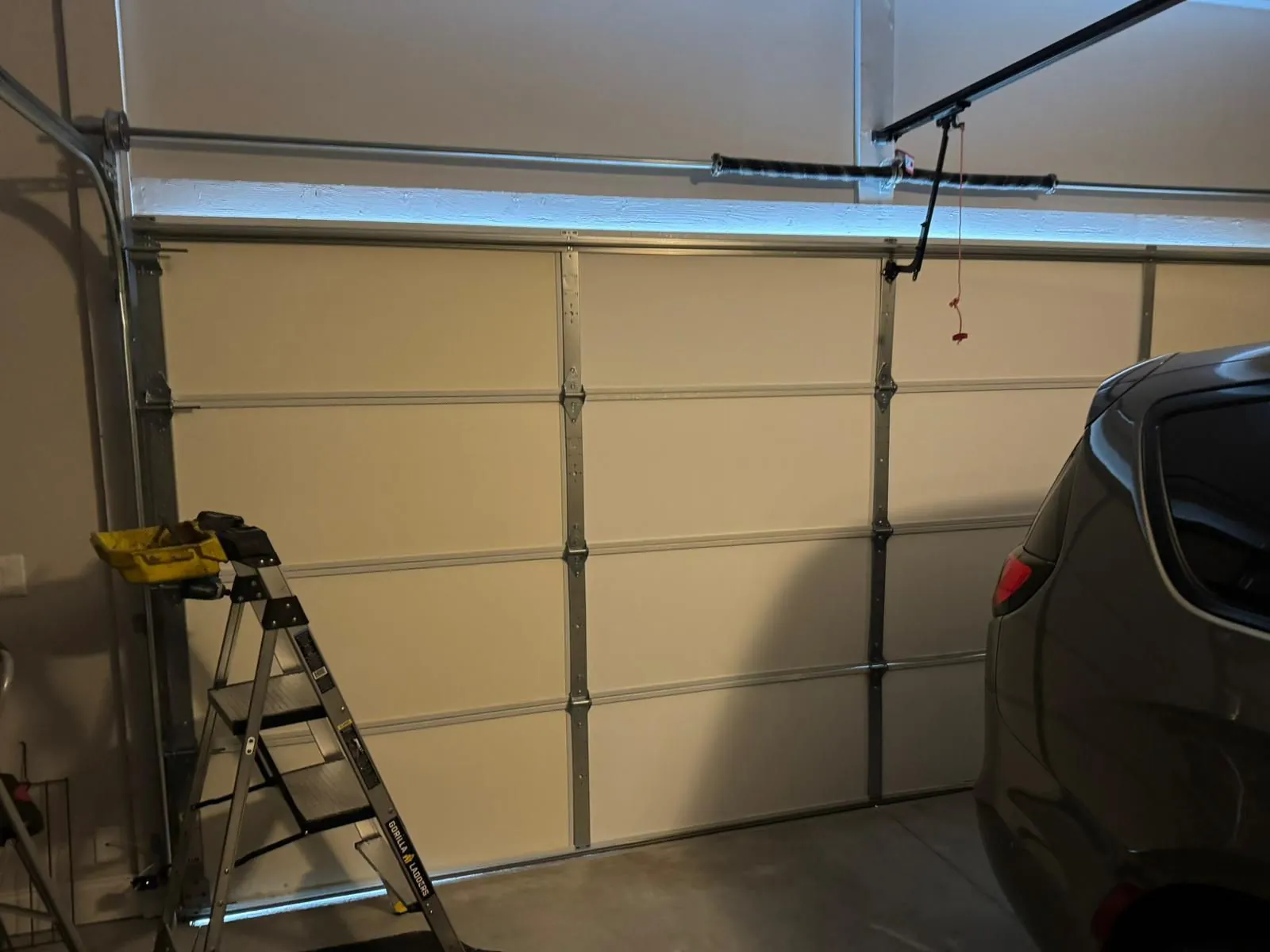
What a spring replacement visit involves
The technician starts by making the door safe: the opener is unplugged, the door is clamped in the track so it cannot move, and the broken spring is looked at where it broke. The old spring is measured for wire thickness, inside diameter, length and the direction of its wind, because a replacement has to match the door rather than simply match what was there.
On older doors, especially wooden ones, the door’s weight is the real starting point. A door that has taken on water, had a window section added, or been reinforced with extra struts may need a heavier spring than it had before. Getting that right is what stops the new spring from failing early.
With torsion springs, both are usually replaced together on a two-spring door, because the surviving spring has lived through every one of the same openings and is rarely far behind. The drums, the bearing plates and the centre bracket are checked, and the cables are inspected and replaced if they are frayed or kinked. On extension springs, the pulleys and the cables that run over them are checked, and safety cables are fitted.
When the new spring is in and wound, the door is balanced by hand: lifted to about halfway and released, it should stay where it is. After that the opener goes back on, its travel limits and closing force are reset for a door that now weighs almost nothing to it, and the auto-reverse gets tried against a block on the floor. That is how garage door spring repair in Dorchester, MA ends: with a door that is light by hand and an opener that is not straining.
Early warnings from a tiring spring
Plenty of springs hint at trouble first. Raising the door manually takes more effort than it did last year. It drifts down when left halfway rather than staying put. The opener sounds strained, or the door starts to open and then stops near the top. On a torsion spring, you may see the coils have spread unevenly, or there may be rust along the length of the spring. On extension springs, one side may sit lower than the other when the door is open, because one spring has stretched more than its partner.
Any of those is a reason to have the springs checked before they fail outright. A spring that is replaced on a planned visit is easier on everyone than one that snaps with the car inside on a winter morning.
Telling which spring your door has
You can usually tell which kind of spring a door uses without going near it. Stand inside the garage with the door closed and look at the wall above the opening. A thick coiled spring on a horizontal bar, with a drum at each end of the bar, is a torsion setup. If instead there is nothing above the opening but you can see long springs running back from the door along the ceiling, parallel to each horizontal track, the door uses extension springs.
Mention which one you spotted when you phone. It also helps you see the break: a torsion spring that has snapped usually shows a clear gap somewhere along its coils, while a broken extension spring often hangs slack from its pulley or lies in pieces along the track. Look, but do not touch, and shut the side door so youngsters and animals stay out until the door is secured.
How often the door runs, and why it matters
A spring is made for a certain number of cycles, one up and one down, and how fast those cycles are used up depends on the garage. A detached garage behind a triple-decker is often the only way in for the car, and frequently for bicycles, a mower and the bins too. If the overhead door is opened and closed several times a day, the spring ages quickly, whatever its size.
A door that is used only now and then wears its spring differently. Long periods sitting closed leave the spring wound and still, and moisture in an unheated garage can start rust on the coils. Rust roughens the surface of the steel and makes the coils rub against each other as the spring turns, which both shortens its life and makes the door noisier.
When a replacement spring is chosen, the way the garage is used is part of the decision. A door that runs often can be fitted with springs built for a longer cycle life, so the next break is further off. Telling us roughly how the garage is used, daily car parking or occasional storage, helps match the spring to the job.
Pulleys and safety cables on extension-spring doors
On doors with extension springs, the spring itself is only part of the system. Each spring pulls on a pulley, and a lift cable runs over that pulley and down to the bottom of the door. Pulleys wear, their bearings stiffen, and a cable that rides badly in a worn groove frays. When a spring is replaced, both pulleys and both cables are looked at, and anything worn is changed so that the two sides pull evenly.
The safety cable is the part most often missing on older garages. It runs through the middle of the spring and is anchored at both ends, so a breaking spring stays captured. Without one, a breaking spring can lash sideways through the bay, which in a narrow single bay leaves very little room for anyone standing nearby. Fitting safety cables is part of any extension-spring visit.
The rest of the door when a spring has broken
A broken spring puts strain on everything around it. If the opener has been run after the spring snapped, it may have bent the top section, stripped its gear or pulled the rail away from its header. The cables may have jumped their drums. On a wooden door, the top section, where the opener arm attaches, may have cracked. All of that gets inspected whenever a spring is renewed; the broader run of fixes, from rollers to panels, sits under garage door repair in Dorchester.
Should the motor have suffered from fighting a spring-less door, opener repair in Dorchester explains what can be repaired and when a new opener is the better choice.
Repair or replace the whole door
A broken spring is not usually a reason to replace a door. A new spring on a sound door is the normal answer. But a spring failure is also the right time for an honest look at the door. If a wooden door has rotted along the bottom, is heavy with water, and is now needing much larger springs just to stay balanced, it may be closer to the end than the spring alone suggests. If so, we will say it, and you can read about a lighter replacement under new garage doors in Dorchester.
For more on how spring work is done across Greater Boston, see the garage door spring repair service page. Everything else we do nearby is gathered on the Dorchester page.
When a spring snaps out of hours
Springs do not keep business hours. A spring that breaks overnight leaves the car shut in for the morning, and one that breaks in the evening can leave the door stuck open. Calls are picked up whatever the time, weekends included, so you can ring the moment you hear the bang. Our emergency garage door repair in Dorchester advice walks through handling a door jammed up or down until help arrives.
Booking garage door spring repair in Dorchester
Useful details: was there a bang, does the spring sit over the opening or beside the rails, is the door timber or metal, and is it jammed up or down. If you can see the broken spring from a distance, a description of where the gap is helps. For garage door spring repair in Dorchester, MA, call us or book online.
Questions from Dorchester
Only one of my two springs snapped. Do both need changing?
On a two-spring torsion door, usually yes. The two springs have opened and closed the door the same number of times, so the remaining one is living on borrowed time. Changing the pair keeps the door balanced evenly and avoids a second call soon after.
My old wooden door has springs along the tracks. Is that a problem?
Not in itself. Extension springs are common on older and lighter doors. What matters is that each one has a safety cable running through it, that both springs match, and that they are sized for the door’s present weight. All three are checked.
Could I just haul the door up and drive away?
Not with a snapped spring. Nothing but your arms would be holding the door, and it can come down in a rush. Keep the door down, pull the opener’s plug and phone us.
Why did the spring break in the cold?
Steel springs are under the most strain in very cold weather, and one that is already near the end of its life often fails on the first hard frost. A detached garage gets no warmth from the house, so its spring feels the full cold.
Can a heavier spring help an old door that feels heavy?
Sometimes. A timber door swollen with years of rain may need a spring sized for its present weight rather than its original one. If the weight comes from rot, though, a bigger spring treats the symptom and not the cause, and replacing the door may be the better answer.