
When the only way in or out stops working
Below Downtown’s office and residential towers, cars share underground levels, and one overhead door at the ramp often serves the whole building. When that door jams, emergency garage door repair in Downtown Boston is not about one inconvenienced household. Cars may be trapped on the levels below, arrivals may be backing up on the street, and a door stuck open leaves the whole garage unsecured until it is closed.
Calls are answered whatever the hour and whatever the day, letting a building log a failed door as it happens, whether that is before dawn, in the middle of the evening or late at night. What follows is a practical guide to the first few minutes: what is safe to do, what is not, and what to have ready when you call.
Before anything else, three quick checks from a safe distance:
- Is anyone or any vehicle under or close to the door? Clear the area first.
- Is the door level in the opening, or hanging crooked with a roller out of its track?
- Did something visibly break, such as a spring over the door or a cable at one side?
Common garage breakdowns downtown
Door will not open
Cars trapped on the parking levels below and a door that will not rise, or rises a few inches and stops.
Door will not close
Stuck in the up position with the garage left exposed, or reversing each time it nears the floor.
Broken spring
A sharp crack overhead, a split in the coils on the shaft, and a door that is suddenly a dead weight.
Off-track door
A door hanging crooked in the opening, often after a vehicle has clipped it on the ramp.
Snapped cable
One side of the door lower than the other, with a loose cable hanging beside the track.
Roll-up door jammed
A steel roll-up door on a side street stuck halfway down over a service entrance or shopfront.
The first few minutes
The most important thing in any garage door emergency is to stop making it worse. Serious injuries and expensive damage tend to follow when someone keeps pressing the control, tries to force a stuck door, or drives under one that is not fully open. On a shared garage, with many people coming and going, that risk is higher.
- Stop using the door. Do not keep pressing the remote, the wall button or any other control.
- Where the operator is safe to reach, cut its power so it makes no further attempts.
- Keep people and vehicles clear of the opening, especially if the door is crooked or partway open.
- Do not pull the emergency release on a door that is partway open with a broken spring or cable; it can drop.
- Call, and describe what the door is doing and what happened just before it stopped.
If it can be done from a safe spot, take a photograph of the door and of the area above it where the springs sit. A picture of a crooked door, a loose cable or a gap in a spring tells the technician a great deal before arrival and helps decide what needs to come on the van. Never climb a ladder near the spring assembly to get the shot.
These steps are safe for building staff. Everything beyond them, including anything to do with springs, cables or bent track, should wait for a technician.
What makes a garage emergency different under a tower
A shared parking garage has more riding on a single door. On a house, a stuck door is one car and one driveway. Under a tower, it can be whole levels of parking with only one way in and out, and a ramp that may run straight up to a busy street. A door stuck closed traps vehicles; a door stuck open means anyone can walk or drive in; a door stuck halfway is a hazard to every car that tries to squeeze under it.
The doors are typically bigger and weightier than residential ones, and the operators that drive them are often commercial units mounted on a wall or in an equipment room. More weight means more stored energy in the springs and more force behind a door that falls. Emergency garage door repair in Downtown Boston has to start with making that weight safe before anything else is touched.
Broken springs at the worst moment
Of all the reasons a door quits without warning, a snapped spring comes first. The spring carries the door’s weight, and a shared door winds and unwinds it far more often than a household door would, so it wears out sooner. The break is usually loud, and from then on the door cannot be lifted by its own system. The operator may lift it a few inches and stop, or hum without moving it at all.
A torsion spring holds dangerous tension even after one has broken, because a door may have more than one spring on its shaft, and the cables and bottom brackets are still under load. It is not a DIY repair, and nobody should try to wind, loosen or remove a spring. Hauling the door up by hand is just as unwise, since nothing now supports its weight. The spring repair page for Downtown Boston explains how springs are replaced once the door is safe.
Doors knocked off the track on the ramp
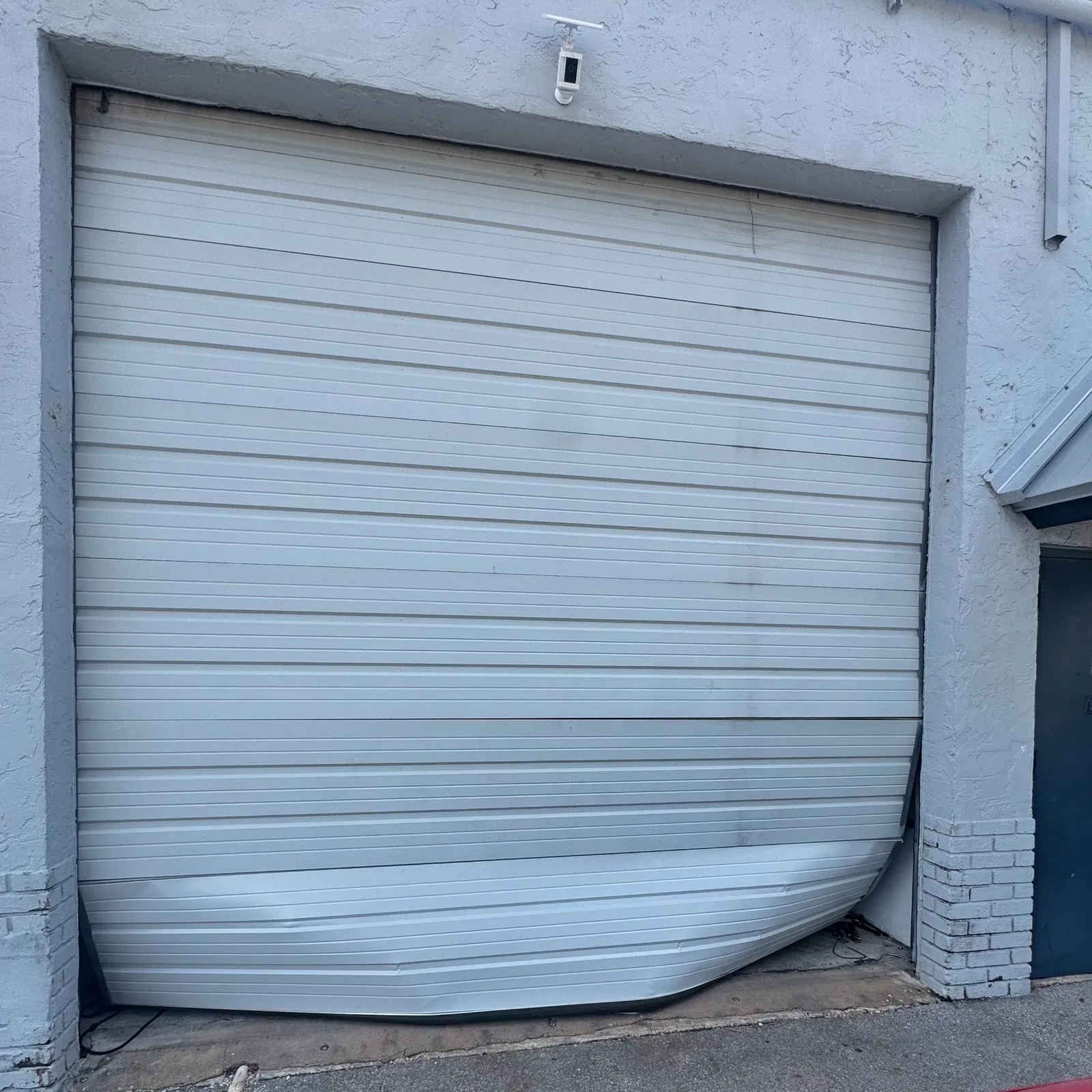
A vehicle that clips a closing door is the classic way a garage door ends up off its track in a parking garage. The bottom section takes the hit, rollers are pulled out of the rail, and the door twists in the opening. A cable that snaps on one side does something similar, letting one side drop while the other stays up.
A door out of its track is unstable and may come down. Do not run it with the operator, do not try to push it back by hand, and keep vehicles from passing beneath. The technician relieves the door’s weight before easing the rollers back and straightening or renewing the damaged rail. Cables are set even on both sides before the door is run again.
A snapped cable on one side
The lift cables run from drums at the top of the door to brackets at the bottom corners, and between them they carry the door’s full weight. If one parts, its side sags while the opposite side holds, wrenching the door askew. It may jam in the tracks or hang at an angle with a gap at one side. A broken cable lashing about can also catch the door or anything near it.
A door in that state is held up unevenly and can shift or fall. Keep vehicles and people clear, do not run the operator, and do not try to lift the low side. Replacing the cable means taking the spring tension off the door safely first, so this is work for a technician.
Who calls, and who meets the technician
Downtown, emergency work is arranged with building management, not with a homeowner at the door. It may be a property manager answering their own phone at night, a superintendent who lives on site, or a front desk the building keeps staffed overnight. Whoever calls, these details make the visit much simpler:
- Which entrance is affected, if the building has more than one.
- Whether vehicles are trapped inside, or the garage is open and unsecured.
- What happened just before the door stopped: a bang, a vehicle strike, a grinding sound.
- Where the operator is mounted, and who can unlock its room or panel.
- Where a work vehicle can park close to the garage entrance.
If you are a resident or tenant and the garage door has failed, report it to the building’s management or front desk straight away. They can arrange the emergency repair and direct cars to another exit if there is one.
What happens when the technician arrives
On any emergency garage door repair in Downtown Boston, making the door safe comes before everything. People are moved back, the operator is unhooked and the door is clamped against any sudden movement. Then the cause is found: a broken spring, a snapped cable, a door off its track, an operator that has failed, or sensors that will not let it close.
Building management hears what has happened and what the options are before work starts. Sometimes the emergency can be fixed on the spot; sometimes the safest step is to secure the door closed or open while parts are found, so that the building is protected in the meantime. Either way, once the repair is made the door’s balance is set, the operator is adjusted, and its reversing safety is proven before cars use the entrance again.
Doors that will not close at night
A door that will not close is often more urgent than one that will not open, because it leaves the garage open to the street. The most common causes are the safety sensors, which may be dirty, knocked out of line or obstructed; an operator whose limits have drifted; or a door binding in its tracks so the operator thinks it has hit something.
Wiping the sensor lenses and clearing anything from the beam is safe to try. Should it still refuse to shut, never keep the button pressed to force it, and do not try to drag it closed by hand. Call, and say whether the door is level and whether anything looks broken. The garage door opener repair page for Downtown Boston explains sensor and operator faults in more detail.
An operator that fails with the door shut
Now and then the fault lies purely with the operator: the motor hums and does nothing, the control panel shows no sign of power, or the drive turns without moving the shaft. With cars waiting to leave, the question is whether the door can be opened by hand in the meantime. If the door is fully closed and level, and its springs and cables look intact, the release or chain hoist can usually be used to open it, as the questions at the foot of this page explain. If anything about the door looks wrong, or it is very heavy when tried by hand, leave it closed and call. Operators of all kinds are repaired, and the detail of that work is on the opener page linked above.
Keeping the garage usable during the repair
A shared garage cannot simply close for the day. When the door at the ramp is out of action, building management usually has to decide how cars will get in and out, whether the garage needs someone at the entrance while it is open, and how users will be told. Knowing what the fault is helps with all of that, so building management hears early whether the door can be put back into service on the visit, secured open or closed for a while, or needs a part brought back later.
Frozen doors on cold mornings
On the coldest mornings, water that ran down the ramp the day before can freeze the bottom seal of a garage door to the ground. The operator tries to lift the door, meets the resistance and stops, or strains until something gives. A door frozen to the floor can tear its bottom seal, bend its bottom section or overload the operator if it is forced.
On a bitter morning, with the springs looking whole, a door that refuses to rise should not be pressed again and again. Clear any ice from along the bottom edge by hand if it can be done safely, without hammering at the door, and try once more. If it still will not move, or if the operator strains or the door rises unevenly, stop and call.
Securing a door until the repair is complete
Not every emergency can be fully repaired in one visit. A door badly damaged by a vehicle, an operator that has failed outright or a spring of an unusual size may need parts that are not immediately to hand. In those cases the aim is to leave the building safe in the meantime: the door secured closed so the garage is protected, or secured open with its weight made safe so cars can come and go, depending on what the building needs most. Building management decides which, with the options explained plainly, and the permanent repair is planned from there.
Side-street roll-ups in an emergency
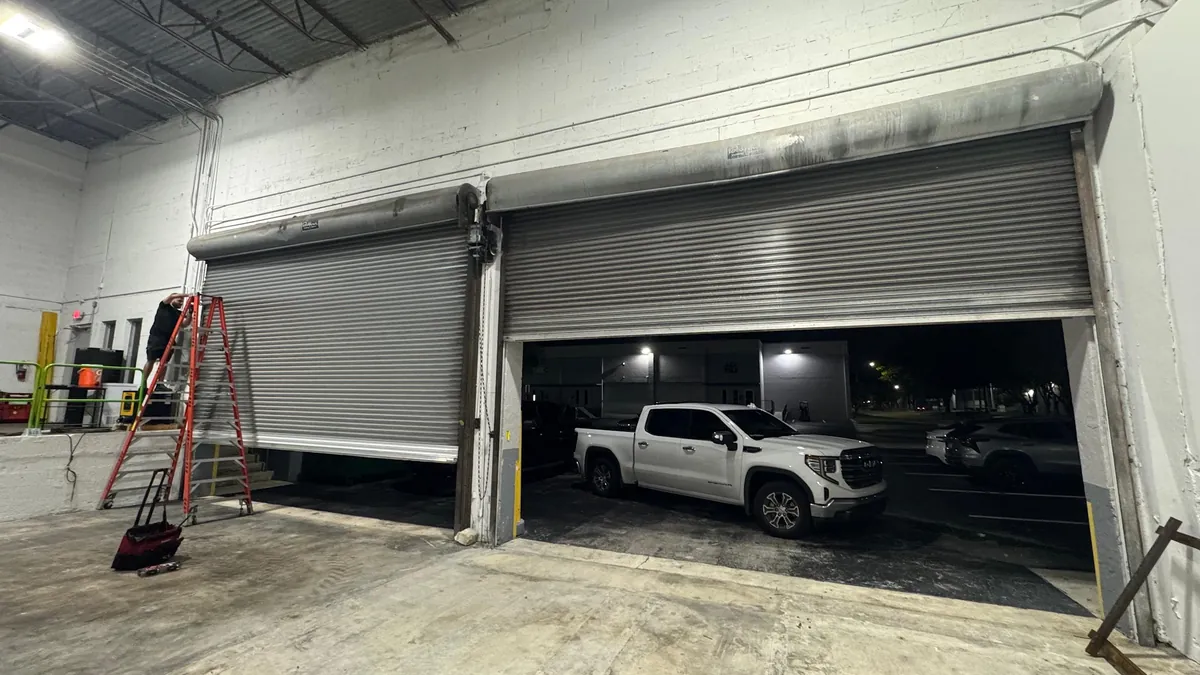
Steel roll-ups over shop fronts, loading bays and delivery doors break down at inconvenient hours as well: a curtain stuck halfway down after a cart hit the bottom bar, a spring that has let go so the door will not lift, or an operator that stops with the door open. A roll-up door stuck open leaves a business exposed; one stuck shut blocks deliveries. The same rule holds for them: stop using the door, keep people back and ring. More on them is under commercial garage doors.
Learning from the breakdown
With the door back in service, consider whether the failure was a warning. A spring that broke often has partners on the same shaft close to the end of their lives. A door struck by a vehicle may have hidden damage in its hinges or bottom section. An operator that failed may have been straining for a long time against a door that was out of balance. Building management hears what was found, so the next repair can be planned rather than urgent.
When a door has been damaged too badly to be worth repairing, the new garage doors page for Downtown Boston describes choosing and fitting a replacement. General repairs are covered on the garage door repair downtown page, and urgent work across Greater Boston is described under emergency garage door repair.
Calling at any hour
A garage door emergency does not wait for office hours, and neither does the phone. Since the line never closes, management can raise the alarm the minute a door fails. For emergency garage door repair in Downtown Boston, management should call us or book online, naming the entrance, whether cars are stuck inside or the garage stands open, and who will be there to meet the technician. Our other local services are gathered under Downtown Boston.
Questions from Downtown Boston
Cars are trapped in the garage. Can we pull the emergency release?
Only if the door is fully closed, level in its tracks, and the springs and cables are intact. Then the release frees the door from the operator and it can be lifted by hand. If the door is partway open, crooked, or a spring has broken, do not pull it; the door can drop. Call for emergency garage door repair in Downtown Boston instead.
Our garage door is stuck open and the building is unsecured. What now?
Keep people and vehicles clear, stop pressing the control and try wiping the sensor lenses. If it still will not close, call and describe what the door is doing. Sometimes the door can be secured in place until a part is replaced.
Is it safe to drive out under a door that is partway open?
No. A door that has stopped partway may have a broken spring or cable and can come down without warning. Keep vehicles back until the door has been checked.
Is anyone there to take a call late at night?
Yes. Night or day, weekday or weekend, someone answers, so a failed door can be reported whenever it happens. A building’s manager, superintendent or front desk usually makes the call.
Do you handle emergencies on roll-up doors as well?
Yes. An urgent fault on a roll-up over a shop or loading bay is handled just like one on a parking-ramp door.