
Why Hyde Park’s wider doors and bigger garages need repair work
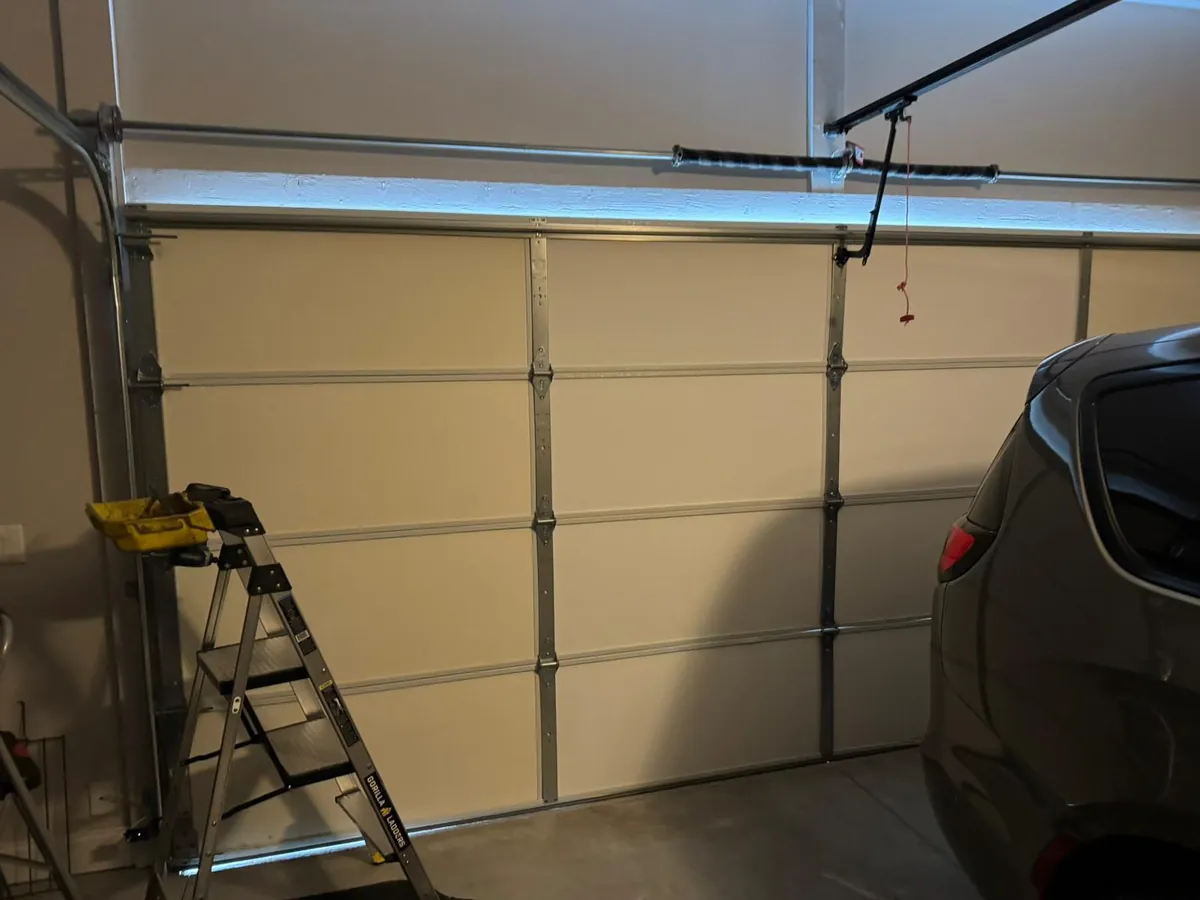
Hyde Park is the most suburban corner of the city. Around Cleary Square and out toward Readville the houses are single- and two-families on larger lots, and the garages beside them are a mix of attached bays and separate buildings set back at the end of a real driveway. Garage door repair Hyde Park MA owners ask about is shaped by that: more of the doors here are double-width, which means heavier sections, stronger springs and more hardware working together every time the door moves.
A wide door does not fail in exotic ways. It fails in the same places as a single-car door, but the stakes are higher at each one. A spring that gives out has more weight to drop. A cable that frays lets a broader door twist in its opening. A run of sections that spans the width of two cars bows in the middle if nothing stiffens it. On an attached garage, a door that will not shut is also an open way into the house.
Before calling, a quick look from inside the garage, without touching anything under tension, tells you a lot:
- Whether each spring on the shaft over the opening is one continuous coil, or has a visible break in it.
- Whether the door hangs level across its full width, or one end sits lower than the other.
- Whether the top sections curve downward in the middle when the door is open.
What a Hyde Park repair can cover
Springs, torsion and extension
Two-car doors tend to run on paired torsion springs over the header, or on heavy extension springs beside each horizontal rail. A snapped spring leaves the opener trying to haul the full weight.
Lift cables and drums
Each bottom corner is tied to a steel cable that coils around a grooved drum as the door rises. Fraying or slack on either side tips a broad door out of level.
Sections, hinges and struts
Long sections flex. Cracked hinges, split end stiles and missing reinforcing struts show up as a sag across the middle or a scrape on every trip.
Openers, remotes and wall buttons
Motors that run but leave the door where it is, handsets that have to be pressed right at the threshold, and wall controls that no longer respond.
Tracks, rollers and off-track doors
Flattened or seized rollers, brackets working loose from the jambs, and doors pushed clear of the rails by a bumper or a jam halfway up.
Safety sensors
The photo eyes at floor level on each side of the opening. A smeared lens or a bracket nudged askew leaves the door refusing to shut, or bouncing up again just short of the floor.
A double-width door is a heavier machine
Most garage door repair in Hyde Park comes back to size. A door wide enough for two cars has more steel or timber in it, and every part that moves it has been specified for that load. The torsion shaft is longer and usually sits on a centre bearing plate as well as the two end plates. There are often two springs instead of one, sharing the weight between them. The cables are under more strain, the drums carry more torque, and the rollers bear more weight at each hinge point.
That matters when something wears. On a pair of springs, one can break while the other still holds, so the door may lift partway, feel lopsided or only move with the opener groaning. Fitting a single fresh spring beside an old partner rarely gives a door that stays balanced for long. The practical answer is almost always to renew both together so they wear out at the same rate. Our Hyde Park spring repair page goes into the springs in detail.
A broad door also gives more leverage to anything out of true. A track bracket that has worked loose at one side, a cable a touch longer than its partner, or a roller seized in its stem can each pull the whole door off square. On a narrow door that might only show as a slight rub. On a wide one it can be enough to bind the door in its tracks or roll a roller out of its rail.
Attached or detached: why the repair differs
Around here both kinds are common, and each brings its own set of concerns.
An attached garage shares a wall with the house, and often a door into the kitchen or a hallway. When its overhead door will not close, the house is open; when it will not open, the car is stuck. The opener is usually mounted under a finished ceiling with living space above, so noise and vibration from worn rollers or a struggling motor are felt indoors. Insulated doors are more usual on attached garages because the room is heated or sits against heated rooms, and insulated sections are heavier still, which loads the springs further.
A detached garage stands on its own, out at the back or side of the lot. It may be on its own electrical circuit, sometimes fed from the house underground or overhead, and the first question when an opener goes dead in a detached building is whether power is reaching it at all. Detached garages are also more often cold and damp inside through the winter, which stiffens grease on the rollers and hinges and makes metal parts rust faster. A door that seems to slow down in January and recover in April is usually telling you its moving parts need attention.
A driveway with room to work
Proper driveways make a real difference to how a visit goes. There is space to park the service vehicle close to the garage, room to stand ladders and lay out a new section or a length of track, and no alley or neighbour’s wall pressing against the outside of the door. Most garage door repair Hyde Park MA homes need can be done with the door accessible from both sides, which is the easiest arrangement for any repair.
It also helps to think about what usually sits in a driveway. If cars are parked nose to the door, moving them before the visit saves time. If the door is stuck shut with a car inside, say so when you call, because getting the car out comes first. In winter, a cleared strip in front of the door lets the bottom section be inspected and the seal checked properly.
The parts a wide door depends on
Every overhead door runs on the same basic system, but a double-width door relies on a few parts that are often missing or less important on a narrow one.
- Reinforcing struts. Horizontal steel struts fixed across the top section, and often others lower down, stop long sections bowing as they turn the curve at the top of the track. A wide door that sags in the middle when open usually has a missing, bent or loose strut.
- The centre bearing. The torsion shaft on a long door passes through a bearing plate in the middle of the header. If its bolts work loose or the bearing wears, the shaft wobbles and the springs wind unevenly.
- More hinges and rollers. A wider door has more intermediate hinges across each joint. One cracked hinge in the middle of a long section transfers its load to its neighbours, which then crack in turn.
- A longer bottom seal. The rubber seal at the base runs the full width of the opening. On a driveway that has settled or heaved over the years, it may touch at one end and leave a gap at the other.
How a repair visit runs
Diagnosis comes before any part comes out of the vehicle. With the opener’s trolley released, the technician lifts the door by hand and lets go somewhere near waist height. A door with healthy springs hovers there. One that sinks to the floor, or rises unaided, has a balance fault, and that shapes the rest of the visit.
Then comes a methodical pass along the whole door. That means each spring or spring set, the two cables and their drums, the centre bearing and the end plates, all the hinges and rollers from one jamb to the other, and both runs of track along with the brackets fixing them into the framing. The panels get a look for cracks, for rust creeping along the lowest edge and for any dip across the middle. If the motor is under suspicion too, it gets run with the door uncoupled, each handset and the wall control get tried, and the sensor beam gets checked across the opening.
After that you get a plain account: the failed part, the reason it failed and anything else that is close behind. Work begins only when you say so. Afterward the door’s balance is set again, the opener is adjusted to the new weight and travel, and the auto-reverse is proved against a block laid on the floor under the door.
Safe checks before anyone arrives
A few things carry no risk and can narrow the problem down:
- With a door jammed halfway, unplug the opener at the ceiling so no one in the house tries the button again.
- Check the sensor lenses, one low down on each jamb. Across a two-car opening they sit well apart, and a bin, a bike or a bag of salt left beside one is enough to block the beam. Clear the space and wipe both lenses.
- When the wall control works and a single handset does not, swap the battery in that handset before suspecting the opener.
- On a detached garage with a dead opener, check whether the lights in the garage work. If not, the problem may be power to the building rather than the opener.
Anything carrying the door’s weight is a job for a technician. Torsion springs, the cones and set screws that anchor them, both cables, both drums and the corner brackets at the foot of the door all stay loaded at every point of travel. A two-car door stores more of that energy than a single one, and a winding bar that slips or a bracket undone too early can injure someone badly. Torsion springs hold dangerous tension, and spring or cable work is never a DIY repair. If a spring has gone, the door stays put: no heaving it up by hand and no more presses of the opener button.
Sagging sections and cracked hinges
Long sections are the part of a wide door most likely to give trouble that a single-car door never sees. As the door rolls up, each section turns through the curve in the track and ends up hanging horizontally under the ceiling. Unsupported across a wide span, steel sections droop in the middle, and over time that droop becomes permanent.
The first signs are small: a door that does not close quite flat, a gap of daylight in the middle of a joint, a hinge that has started to crack around its fixing holes, or a roller that rides high in the track. Left alone, a section can fold at a joint and jam the door. The repair is usually a combination of new hinges, a correctly fitted strut across the affected section, and sometimes a replacement section if the original has bent too far to straighten. Wooden doors have a version of the same problem, where the end stiles split around the hinge screws and the section starts to come apart.
When the door runs crooked
A door that rises with one side ahead of the other is unbalanced from side to side, and on a wide door it shows clearly. The most common causes are a frayed or stretched cable, a cable that has slipped a turn on its drum, a drum whose set screw has loosened on the shaft, or one spring in a pair that has broken or weakened. The door may close with a gap under one end, or stop and reverse because the opener feels it binding.
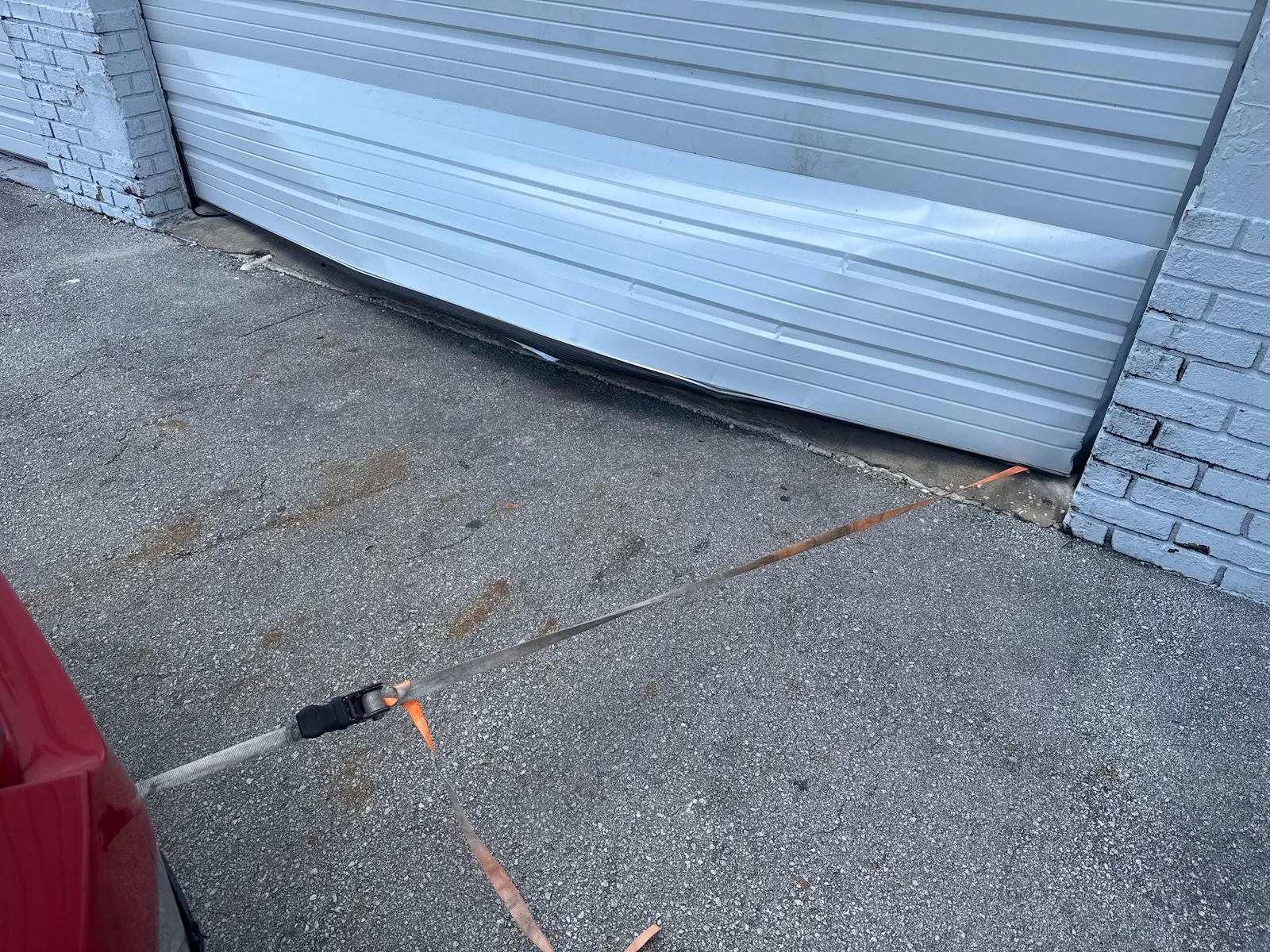
That kind of fault deserves prompt attention. A door running crooked puts uneven strain on the tracks and rollers, and the side that is ahead can pull its rollers out of the rail. A door whose rollers have left the rail can come down without warning. If yours has come out of its tracks already, the off-track garage door repair page describes how it is secured and put back, and the cable repair page covers cables and drums in more depth.
Opener trouble on a two-car door
An opener lifting a heavy double-width door works harder than one on a single-car door, and it is the first thing to struggle when the door itself is out of balance. Many opener complaints turn out to be door complaints: the motor runs but stops partway, or the door reverses for no clear reason, because a weak spring or a sticking roller has raised the load beyond what the opener’s force setting allows.
Where the opener itself has failed, the faults we meet most are teeth worn off the drive gear, a slack or fraying belt or chain, a circuit board killed by a power surge, or a wall button whose wiring has been damaged. LiftMaster openers are part of the opener work we take on, repaired or replaced. More on remotes, wall buttons and sensors is on the Hyde Park opener repair page.
Repair or replace
Fixing the door usually wins. Wearing parts such as springs, cables, rollers, hinges and opener components are expected to be swapped out over the years, and a door with sound sections will keep working once they have been.
There are times when a new door is the better spend. Steel sections rusted through along the bottom edge, several sections bowed beyond straightening, a timber door that has soaked up enough water to throw its balance off, or a door so old that matching sections can no longer be found all point that way. On an attached garage, some owners also choose to replace an uninsulated door with an insulated one because the garage sits against heated rooms. Every garage door repair Hyde Park MA owners book comes with an honest opinion on whether the door is worth keeping. Where it is not, new garage doors in Hyde Park explains how a new double or single door is supplied and fitted.
Getting the door looked at
A spring rarely snaps at a tidy moment. Calls reach a person overnight and on Saturdays and Sundays too, so a breakdown at midnight can be phoned through then and there instead of waiting for daylight. When the door is wedged open, will not rise or has slipped out of its rails, the Hyde Park emergency repair page explains how to keep things safe until help gets there. How this service works citywide is set out on the garage door repair page, and the Hyde Park page brings together all our work in the neighbourhood.
Booking garage door repair in Hyde Park goes smoother when we know whether the garage joins the house or stands apart, whether it holds one car or two, how the door behaves at the press of the button, and whether a vehicle is trapped. Tell us that when you call us or book online, so the technician arrives ready for your particular driveway.
Questions from Hyde Park
Our double garage door has started sagging in the middle. Is that serious?
It should be looked at soon. A sag across a wide door usually means a reinforcing strut is missing or loose, or hinges along the middle have cracked. Left alone, a section can fold at a joint and jam the door partway.
One side of the door rises before the other. What causes that?
Usually a cable that has frayed, stretched or slipped on its drum, or one spring in a pair that has weakened or broken. Stop using the door, because a crooked door can come off its tracks, and leave the cables and springs alone.
The opener in our detached garage has stopped working completely. Where should I start?
Check whether the garage lights work. A detached building may be on its own circuit, and a tripped breaker or a fault in the supply would stop the opener too. If the power is fine, the opener or its wall button may have failed.
Only one of our two springs snapped. Should the other be changed as well?
In nearly every case, yes. The surviving spring has done the same amount of work and is close to the end of its life, and pairing fresh steel with tired steel leaves the door out of balance.
Is it worth repairing an old double-width door?
Often, yes. If the sections are sound, renewing the springs, cables, rollers and hinges can keep it working for a long time. If the bottom section has rusted through or several sections are badly bowed, a new door may be the better value.