
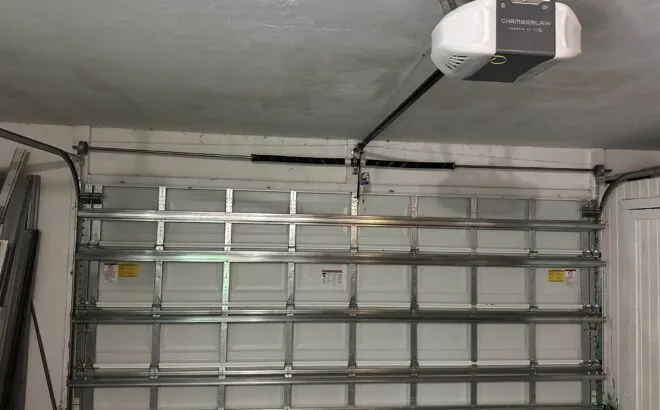
Why springs on Hyde Park’s two-car doors work so hard
A garage door weighs far more than it feels, and the springs are what make it feel light. Around Cleary Square and toward Readville, where single- and two-family houses sit on bigger lots with attached and detached garages, a lot of those doors span two cars. That puts garage door spring repair Hyde Park MA owners need in a heavier class than it is in the tighter parts of the city: more steel or timber to counterbalance, longer shafts, and often two springs sharing the load instead of one.
Every time the door goes up, the springs release stored energy to lift it. Every time it comes down, they are wound or stretched again. That cycle wears the steel a little each time, and eventually a spring snaps, usually at the end of a long run of normal use rather than because anything was done wrong. A wide door simply concentrates more force in each spring, so when one breaks the change is dramatic.
If you suspect a spring has gone, three things are worth checking from a safe distance:
- A visible gap in a coil on the shaft over the door, or an extension spring hanging loose beside a track.
- An opener that manages only a hand’s width of lift before quitting, or a door that feels like lead.
- A loud bang from the garage shortly before the door stopped working.
Spring problems we deal with in Hyde Park
Snapped torsion springs
The coil over the header breaks, usually with a sharp report, and the door can no longer be lifted safely by hand or by the opener.
Broken or stretched extension springs
On doors with springs running beside the horizontal tracks, a spring can break outright or lose its pull, leaving one side heavy.
One spring of a pair gone
Two-car doors often carry two torsion springs. When one fails, the door may still move, but crooked and with the opener straining.
Worn-out springs before they break
A door that drifts down when left half open, or that the opener struggles to lift, often has springs near the end of their life.
Mismatched springs from past repairs
Springs that do not suit the door’s weight leave it unbalanced, wearing out the opener and the cables faster.
Spring hardware
Winding cones, centre and end bearings, safety cables on extension systems and the shaft itself are checked and renewed with the springs.
Torsion or extension: which your garage has
There are two main spring systems on residential doors, and both turn up in Hyde Park.
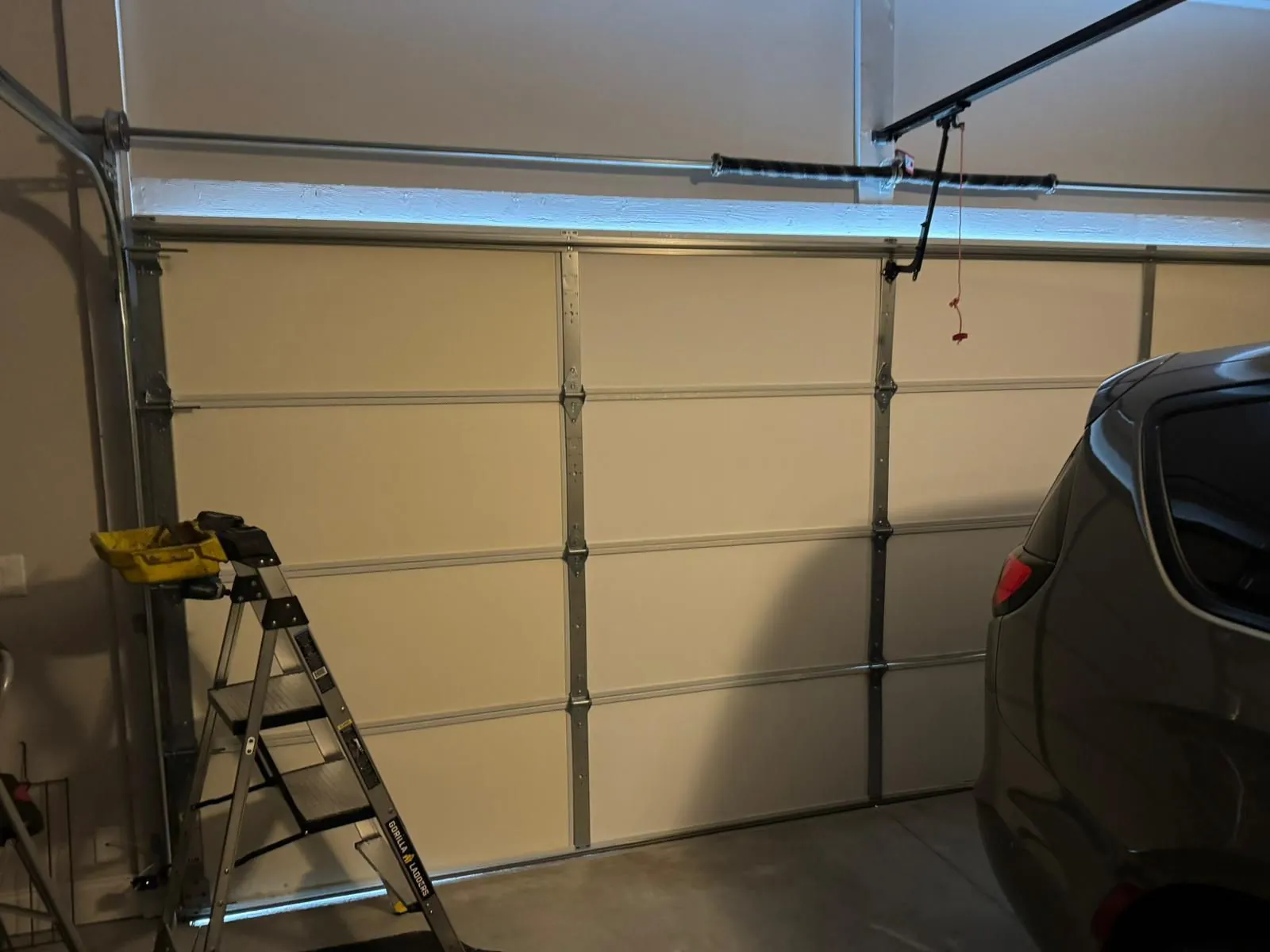
Torsion springs sit on a steel shaft running above the door opening. They are wound tight, and as the door rises they unwind, turning the shaft, which turns the cable drums at each end and lifts the door. Most modern sectional doors use torsion springs, and a double-width door typically has two of them on one shaft, steadied at mid-span by a bearing bolted to the header.
Extension springs run alongside the horizontal tracks near the ceiling, one on each side. Lowering the door draws them out; raising it lets them shorten again, pulling on cables that run over pulleys to the bottom corners. They are more often found on older doors and on garages with limited space above the opening. Some detached garages on older Hyde Park lots still carry extension systems. A restraining cable ought to pass down the middle of every extension spring, so that a snapped coil is caught instead of becoming a projectile.
Knowing which one you have helps when you call. If you can see a spring on a bar over the door, it is torsion. If you see long springs stretched beside the rails overhead, it is extension.
Leave the spring to a technician
A torsion spring holds dangerous tension, even with the door closed. Adjusting it, or letting it off, involves steel winding bars pushed into a cone at the end of the coil, a quarter turn at a time. One slip, or one set screw slackened out of turn, and the coil whips the bar round hard enough to break an arm. On a double-width door the springs are larger and the tension higher.
The risk with extension springs is of another kind. Stretched taut along the ceiling, one that parts with no restraining cable through it can lash sideways into a car, a wall or a person. Removing or adjusting one with the door in the wrong position puts the full load on whatever is holding it.
So the rule is simple: a broken or tired spring is a job for a technician with the right bars, clamps and replacement springs matched to the door. Garage door spring repair in Hyde Park is about getting the door working again without anyone getting hurt in the process, and that starts with leaving the spring alone until it can be dealt with properly.
What happens when a spring breaks
The moment a spring snaps, the door loses most of its counterbalance. With a single torsion spring, the door becomes almost too heavy to lift. With a pair, the door may still move on the opener, but it will be lopsided and the opener will labour. With extension springs, one corner of the door sags below its partner.
The motor overhead expects the springs to do the heavy lifting, and is sized on that assumption. Press the button after a breakage and the opener may manage a few inches before its force limit stops it, or it may keep straining and damage its gear or bend the top section of the door where the arm is attached. On a two-car door, that bending risk is greater because the top section is long and the arm pulls from the middle.
What you should do is straightforward: stop using the opener, unplug it at the ceiling, keep vehicles and family well back from the opening, then ring us. A door stuck in the raised position should be left up; dragging it down by the handle can bring it crashing to the floor. If it is closed with a car inside, the car stays in until the spring is replaced.
How a spring visit runs
The first job is to confirm what has failed and why. The technician looks at the broken spring, checks the other spring if there is one, and looks at the cables, drums, bearings and shaft. A spring that broke after years of service is one thing. A spring that broke early may point to a door that has become heavier than its springs were sized for, or to rollers and hinges that have been forcing the springs to work harder.
New springs are chosen for this particular door, not pulled off a shelf at random. That means accounting for the door’s weight and height and the size of the drums, then choosing springs with the right wire size, inside diameter and length so that the door ends up balanced through its full travel. On an insulated attached-garage door, the extra weight of the insulation is part of that calculation.
With the door secured, the old springs come off, the new ones go on, and they are wound or tensioned to suit the door. Cables are checked for fraying and set to equal tension at each drum. Bearings, rollers and hinges get a look, because a stiff roller adds load that the springs then have to overcome. Last of all the balance is felt by hand, the opener is reconnected and adjusted, and the safety reverse is tried.
Double-width doors and paired springs
Two-car doors are ordinary in Hyde Park in a way they are not further in, and their spring arrangements deserve a closer look. A heavy wide door is usually hung on two torsion springs, one either side of a centre bearing. The two springs are sized to share the door’s weight, and they age together.
If one of them fails, its twin has lived through every lift and every closing alongside it and will not be far behind. Swapping out the casualty alone leaves a fresh coil fighting a fatigued one, which means uneven torque on the shaft, a door that is harder to balance, and a second breakdown not long after. For that reason it is usually best to replace both springs on a two-spring door at the same visit.
Wide doors also put more strain on the shaft and the centre bearing. A bearing plate that has worked loose lets the shaft flex, and that flex wears the springs and the drums unevenly. Those parts are checked at the same time as the springs, along with the cables, which on a heavy door take a lot of load and fray at the bottom brackets.
Doors that gained weight over the years
Springs are sized for the door that was hung at the time. Plenty of garages on the larger Hyde Park lots have had their doors changed since: insulation panels pressed into the back of steel sections, a row of glazed inserts added along the top, a replacement section from a different door, or a timber door that has taken on years of paint and moisture. Every one of those changes leaves the old springs lifting a load heavier than the one they were wound for.
A door that has quietly become heavier shows it in small ways. The opener takes longer to start the lift. The door no longer stays put when left at half height. The springs break sooner than they should, and the replacements fitted last time seem to wear out quickly too. Matching new springs to the door as it actually is now, rather than as it was first installed, is the cure, and it is one reason the door’s weight is taken into account rather than simply copying the size printed on the old spring.
Uneven weight matters as well. A wide door with a heavier glazed section on one side, or a repaired section that does not match its neighbours, can pull one cable harder than the other. Garage door spring repair Hyde Park MA owners book on a door like that looks at the cables and drums as closely as the springs, so the door ends up level as well as balanced.
Attached garages, detached garages and spring life
Where the garage sits makes a difference to how springs wear.
On an attached garage, the door is often used many times a day, as the household’s everyday entrance. Steel in a spring tires with each wind and unwind, so a door that rarely rests goes through springs faster. Attached garages are also more likely to have insulated doors, which are heavier and need stronger springs, and the opener noise of a struggling door is heard indoors.
A detached garage further back on the lot may be used less often, but it is usually colder and damper. Moisture rusts spring coils, and rust adds friction between the coils and weakens the steel. A spring coated in rust tends to fail sooner, and cold winter mornings are a common time for a weakened spring to give way. A light coat of lubricant on the springs, applied without touching their tension, helps slow that rust down.
Warning signs before the snap
Springs rarely break without some warning. Watch for:
- A door that slowly drifts down when left part way open, or that creeps up on its own.
- The opener sounding strained, or the door opening slower than it used to.
- Gaps appearing between the coils of a torsion spring, or coils looking stretched on an extension spring.
- Heavy rust on the springs, especially on a detached garage.
- A door that seems heavier when lifted by hand with the opener disconnected.
None of those mean the door has to stop being used immediately. A spring that is wearing out can sometimes be stretched further by a well-oiled door with smooth-running rollers, but it cannot be made young again, and the moment it fails is never chosen by you. Planning the replacement while the door still works means the car is not trapped and the opener is not damaged in the meantime. It also gives the chance to check the cables and bearings at a calm moment rather than in a rush.
Repair the springs or replace the door
New springs bring most doors back to good working order. A spring is a wearing part, and replacing it is a normal part of owning a garage door.
The question of replacing the whole door only really comes up when the springs are not the only problem. If the sections are rusted through, cracked or badly bent, if a timber door has drunk in enough moisture that it no longer balances well, or if the door has been modified over the years in ways that make it hard to balance at all, then a new door with a spring system designed for it can be the better value. Any garage door spring repair Hyde Park MA homes call us for includes an honest view of that. Supplying and hanging a replacement is described under new garage doors in Hyde Park.
Other help nearby
Spring breakages are often found alongside other faults. If the cables have come off the drums or the door has twisted in its tracks, that side of the work is described under Hyde Park garage door repair. If the opener has been damaged by trying to raise a door whose spring had failed, the Hyde Park opener repair page deals with that. For a breakage after dark, the Hyde Park emergency repair page sets out the safe steps to take until a technician arrives. For the service as a whole across the city, see garage door spring repair, and for the neighbourhood as a whole, see Hyde Park.
Ready when the spring goes
Springs give out on their own schedule, and our phone is staffed overnight and through the weekend, not only in the daytime. To get garage door spring repair in Hyde Park moving, it helps to tell us three things: which spring system the door uses, whether it covers one bay or two, and which position the door is stuck in. Call us or book online, keep the household clear of the door, and the broken spring stays untouched until it is swapped.
Questions from Hyde Park
Something cracked like a gunshot out in the garage, and the door has not moved since. Why?
Most often, that noise is a torsion coil letting go all at once. From a safe spot, glance at the shaft over the opening: a split in the spring will be easy to see. Pull the opener’s plug and leave the door down.
Our two-car door has two springs and only one is broken. Does the other need replacing?
Usually, yes. The pair have shared every lift, so the one still intact is likely to fail before long. Fitting two new springs at once gives even torque across the shaft and spares you a repeat call.
Can I drive my car out if the door will lift a little?
It is better not to. With its counterbalance gone, the door can slam down without warning, and forcing it up with the opener can bend the top section or damage the opener. Wait until the spring is replaced.
Our detached garage has springs along the tracks, not over the door. Are they safe?
Extension springs are safe when each has a safety cable running through it and they are in good condition. If you cannot see safety cables, or the coils look rusty or overstretched, ask for an inspection.
Why did the spring break when the door was closed?
A closed door is when a torsion spring is wound tightest, so that is when a weakened spring is under the most stress. Springs commonly give way with the door down, often on a cold morning.