
Why the detached garages off Blue Hill Avenue keep calling for repairs
On the side streets off Blue Hill Avenue and River Street, the garage usually stands apart from the house, well back on the lot, where a driveway as long as the single- or two-family home beside it finally ends. Garage door repair Mattapan MA owners ask us about most often starts at one of those back-lot garages, and very often on an older wooden door that still rides on its 1950s hardware: springs, hinges, rollers and track brackets that have been worked for decades and adjusted by more than one owner along the way.
A door like that seldom fails all at once. It grows heavier as the wood takes on damp and coat after coat of paint, the springs give up a little more of their lift each year, and the rollers wear flat spots until the door shudders on its way up. Then a cold morning, or one more push from the opener, finds the weakest part and something lets go.
Standing back in the driveway, and keeping your hands off the hardware, look for three things before you call:
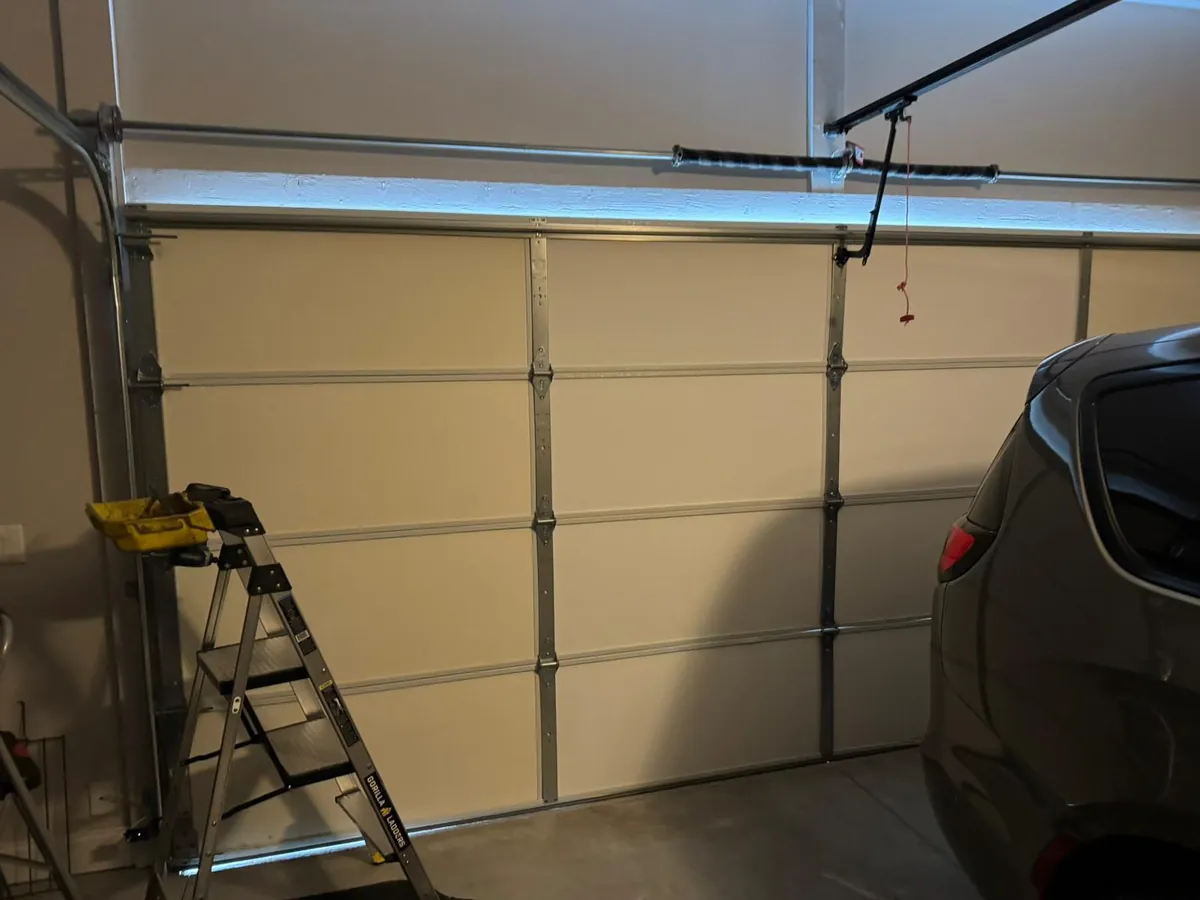
- A break in the spring mounted above the opening, or in either of the long springs running beside the overhead tracks.
- Whether the door hangs square in the frame, or one side sits lower than the other.
- Whether any roller has come out of its track on the way up.
What gets fixed on these older doors
Springs that have snapped or gone weak
Springs fitted for a door’s weight when it was new are often lifting a heavier, wetter door now. Once one breaks, the door will barely move. Our Mattapan spring repair page goes into both torsion and extension types.
Lift cables and drums
A cable frays where it chafes on a worn bottom bracket, or slips off its drum when the door binds. With one side slack, a corner drops and the whole door twists in the frame.
Wooden sections and panels
Wood that has faced many winters at the top of a driveway splits along the rails, softens along the bottom edge and loosens at the joints. One section can sometimes be renewed on its own.
Openers, remotes and sensors
An opener hauling a heavy wooden door wears out before its time. Remotes, wall buttons and the safety photo eyes are dealt with on the Mattapan opener repair page.
Rollers, hinges and tracks
Old steel rollers worn flat and rusty, and hinges whose pin holes have stretched oval, make a door run rough until it binds partway.
Doors that have jumped a track
Once a door leaves one or both tracks it hangs crooked and may fall. It has to be secured before anything else is touched.
Wooden doors still running on 1950s hardware
The single most common find in this part of the city is a wooden sectional door, or sometimes a one-piece tilting door, working on hardware that was put in decades ago. That combination behaves differently from a modern steel door, and any honest garage door repair Mattapan MA homeowners pay for has to start by recognising it.
Wood is heavy to begin with, and it does not stay the same weight. A wooden section soaks up rain driven against it from the driveway, swells in a humid summer and dries out again in winter. Every repaint adds a skin of weight, and so does any plywood patch screwed over a split panel. The springs, though, were chosen for the door as it was when it went in. Over the years the gap between what the door weighs and what the springs can lift keeps widening, and the opener, the cables and the rollers make up the difference until one of them cannot.
The hardware itself is a product of its time. Older doors very often run on extension springs, the long springs that stretch out beside each horizontal track, and on older installations those springs were not always fitted with a safety cable threaded through the middle. A safety cable is what stops a snapped extension spring from whipping across the garage. Hinges on old wooden doors are usually screwed straight into the timber, and after enough cycles the screws work loose in holes that have gone soft. Roller stems wear, track brackets bend, and bottom brackets rust where they sit nearest the wet floor.
None of that means the door is finished. It means a repair on one of these doors looks at the whole assembly rather than the one part that broke, because a new spring on a door with loose hinges and seized rollers simply moves the strain somewhere else.
A garage at the end of a full-length driveway
A detached garage stands out in the weather on every side. There is no house wall to shelter it, so wind, rain and snow come at the door from the open driveway, and the bottom section takes the worst of it. Snow shovelled or blown off the driveway tends to finish up banked against the door, where it melts in the afternoon and freezes again at night. A door whose bottom seal has frozen to the slab will not open, and an opener that keeps trying may rip the seal, buckle the lowest panel or strain the bracket that holds the cable.
Distance is the other factor. The garage may sit a long way back from the street, so everything for the job, from a spring to a length of track to a ladder, is carried the length of the driveway. On a two-family lot, where the driveway serves both units and cars are parked nose to tail down its length, that walk can be blocked entirely. If those cars can be moved before a visit, the work goes much more smoothly.
Detached garages can also be harder to see into. With no door through from the house, the only way in may be the overhead door itself, which is exactly the door that has stopped working. If there is a side door, say so when you call, and make sure its key is to hand. If there is not, a door that is jammed shut is opened from outside with care, and that is worth mentioning as well.
The parts that keep a door moving
Every overhead door, old or new, works on the same principle. The springs carry the weight, the cables carry that lift down to the door’s bottom corners, the rollers keep it running true, and the opener only has to move a door the springs have already balanced.
Springs come in two kinds. A torsion spring sits on a steel shaft above the opening and winds up as the door closes; an extension spring stretches along each upper track as the door comes down. Both are under heavy load whenever the door is shut. When either breaks, the full weight of the door lands on whatever is still trying to lift it, which is usually the opener, and the opener stalls after a few inches.
The cables run from a bracket at each bottom corner up to the drums on a torsion shaft, or over pulleys on an extension-spring door. They fray where they rub, and they come off their drums when a door is forced or catches on something. A single slack cable is enough to tilt the door and pull a roller out of its track.
Rollers and hinges are the parts that wear quietly. A roller that no longer turns drags through the track instead of rolling. A hinge that has split lets the sections fold slightly against each other, so the door bows as it travels. Neither stops the door straight away, but both make every other part work harder.
What a visit involves
Each visit for garage door repair Mattapan MA homes call us about starts the same way, by taking the opener out of the picture. Once the trolley is unhooked, lifting the door by hand tells straight away whether the springs are doing their job: a balanced door, lifted to about waist height, stays more or less where it is put, while one with a weak or broken spring drops back or refuses to rise.
Then every part is looked at in turn. Both springs and any safety cable through them, both lift cables and their drums or pulleys, the bottom brackets, each roller and hinge, every length of track, and the brackets fixing the tracks to the jambs and ceiling. On an older wooden door the condition of the wood where hinges and brackets are fixed gets particular attention, because a screw in rotten timber will pull through again whatever is attached to it. When the opener is suspect too, the motor is tested with the door unhooked, every remote and the wall button are tried, and the photo eyes are checked.
You hear which part gave out, the reason, and whatever else is wearing thin, and the work starts only once you say yes. With the worn parts renewed, spring tension is trimmed until the door hangs evenly, the opener is reset for how far and how hard it now needs to drive, and a length of timber laid in the doorway proves that the door turns back when it meets something.
Safe checks, and the parts to leave alone
Some things carry no risk and are worth doing while you wait:
- A door halted mid-travel should not get another go, so unplug the opener at the ceiling.
- Look at the two small photo eyes either side of the opening, near the floor. A rake, a bag of leaves or a bin leaning on one is a common reason a door reverses. Clear it and wipe the lenses.
- If the door will not lift in winter, check whether the bottom seal is frozen to the slab. Brushing snow off the bottom section is fine; prising the door off the ground is not.
- When one remote stops but the wall button still runs the door, the remote’s battery is the usual culprit.
The parts under load are a different matter. The springs, the cables, the bottom brackets the cables hook onto and, on a torsion door, the winding cones and set screws all hold a great deal of stored force, whether the door is up or down. Loosening any of them in the wrong order can throw a bracket, a cable end or a winding bar with real force, so springs and cables are never a DIY job. Leave a door whose spring has snapped where it is rather than hauling it up yourself, and stop pressing the button; once the spring has broken, the door’s weight has nothing left to carry it.
Two households, one detached garage
Behind many two-family houses the garage is shared. One unit parks in it, the other stores bicycles and tools, or both units each have a remote. A door used by two households cycles more often than one used by a single family, and it often stays in daily use after a fault has started, because one household may not know the other heard a bang the day before.
That pattern shows up in the wear: rollers worn through, a cable starting to fray at the bottom corner, an opener that has been reversing for weeks before it finally stops altogether. For an owner looking after a two-family, a few habits pay off. Show both units how to unplug the opener so either can stop the door. Keep a note of how many remotes are programmed to the opener. Treat a new noise, a jerk in the door’s travel or a door that suddenly closes faster than it used to as a reason to call, not as something to put up with until the door stops.
Doors off their tracks
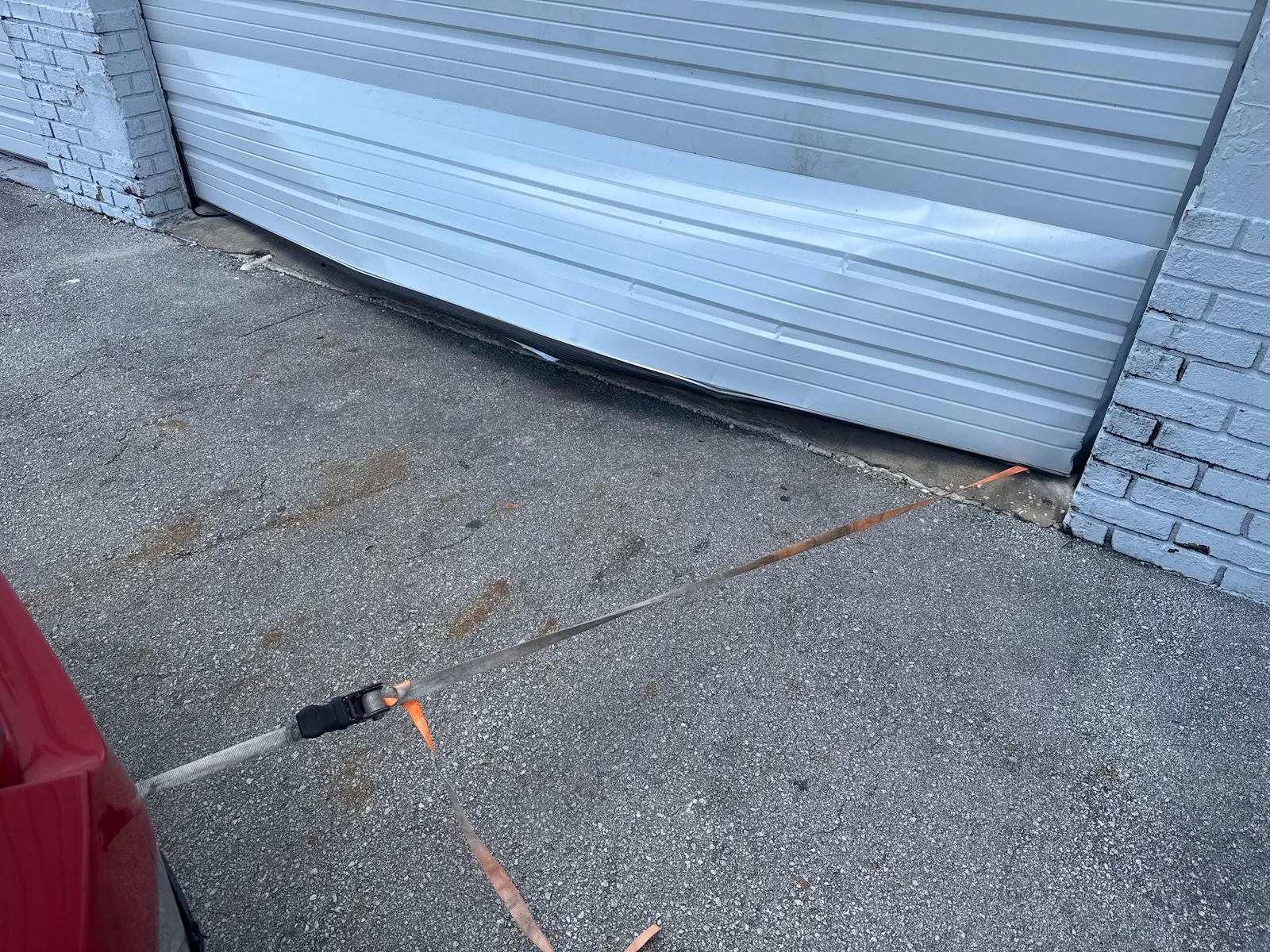
On a long, narrow driveway a car often backs out at an angle, and a bumper corner only has to clip a door still hanging a little below the header. A gust can do the same to a half-open door on a garage standing alone in the yard. Either way, a roller jumps out of its track, the door twists, and if the opener keeps running it drives the door further out of line.
The right response is to stop. Pull the opener’s plug, move everyone and every car well away, and leave the door exactly where it hangs. The fix starts with supporting the door so the rollers carry no load; then each roller is guided home, a kinked rail gets trued or renewed, and both cables are matched in tension before the door moves again. Derailed doors get fuller treatment on our off-track garage door repair page.
Repair or replace
Usually, fixing wins. Springs, cables, rollers and hinges are consumables on any overhead door, and a wooden door whose sections are still sound can run for a good while longer once they have been renewed.
There are signs that point the other way. Wood that has rotted through along the bottom rail, panels split in more than one section, joints that have parted so the middle of the door droops, or a door that has become so heavy with water and paint that no sensible spring will balance it, all suggest that more money spent on the door is money poorly spent. Garage door repair Mattapan MA owners book with us comes with an honest verdict on whether the door deserves more work. Where replacement makes more sense, new garage doors in Mattapan explains how an old wooden door and its hardware are taken out and a new door is fitted to the existing opening.
When the door stops at night
Doors do not choose a convenient moment to fail. A car shut inside a detached garage before work, or a door stuck open after dark with the garage’s contents on show from the street, is the usual way people find out. A person answers our line at any hour on any day, so a door that quits after dark need not wait for morning to be reported. For a door jammed shut, stuck open or hanging off its rails late in the evening, our Mattapan emergency repair page lists what to do first.
Getting the door looked at
Before you phone or book a garage door repair Mattapan MA homes need, gather a few details: whether the garage is detached and how long the driveway is, whether there is a side door, what the door is doing or not doing, any part that looks snapped or loose, and if your car is trapped behind it. Our citywide garage door repair page has more on the service, and the Mattapan page brings together all our work nearby. Once you have the details, call us or book online.
Questions from Mattapan
Our old wooden door has become very heavy to lift by hand. Is that a spring problem?
Usually, yes, though the wood can be part of it. Springs lose some of their lift over time, and a wooden door gains weight as it takes on damp and paint. When the two drift far enough apart, the door feels heavy and the opener strains. A visit checks the balance and the springs and tells you which is to blame.
The garage is at the far end of the driveway. Do we need to clear anything before a visit?
It helps to move any cars parked down the driveway so parts and a ladder can be carried to the garage, and to clear the floor just inside the door. If there is a side door into the garage, have its key ready.
Is an old wooden door worth repairing?
Often it is. Springs, cables, rollers, hinges and brackets are all renewable on an older wooden door. Replacement makes more sense when the wood has rotted through, several sections are split, or the wood now weighs more than a reasonable spring can carry.
The door froze to the ground overnight. What should we do?
Do not keep pressing the button or try to force the door up. Unplug the opener, shovel the drift off the bottom section, and give the seal time to let go as the day warms. Should it stay stuck, or should anything look bent or slack, call us.
Both units in our two-family use the garage. Can the remotes be checked as part of a repair?
Yes. If the opener is part of the visit, the remotes and the wall button are tested, and any that are not working are looked at. It helps to gather all the remotes in use before the visit.