
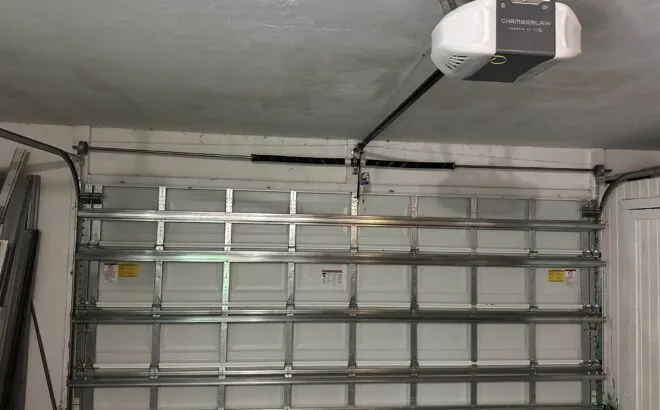
What a snapped spring means on a steep street
It usually starts with a crack like a dropped plank somewhere in the garage, and afterwards the door refuses to rise. On the climbing streets off Tremont, where the brick row houses and triple-deckers mostly have no garage of their own and the kerbs are lined with parked cars, losing one of the few working garages is no small thing. Garage door spring repair Mission Hill MA owners need tends to arrive together with a car stranded behind the door and no obvious kerb to move it to once it is out.
Think of the spring as a counterweight made of coiled steel. Each time the door comes down, the spring soaks up energy; each time it goes up, the spring hands that energy back, carrying almost the full mass of the door. Once it fractures, every pound lands on the opener, the lift cables and anyone reaching for the handle. Broken springs top the list of urgent calls for exactly that reason, and they are not a weekend job for a ladder and a pair of pliers.
Three clues point to the spring, and you can spot each one without going near it:
- Two separate lengths of coil on the shaft over the opening, parted by a visible space.
- A motor that labours for a second or two and quits with the door hardly moved.
- A door that slams to the floor the moment the opener’s release cord is pulled.
Spring problems we deal with
Fractured torsion coils
By far the most frequent failure. The steel cracks clean through one turn, usually close to a cone, and the shaft instantly loses all its wind.
Tired extension springs
Side-mounted springs above each rail slowly lose their pull over years of stretching, so the door creeps heavier until the opener struggles.
No safety cable
Every extension spring should have a restraint cable running through its centre. Without it, a failing spring can lash across the bay.
Mismatched springs
A replacement from long ago that was never sized for this door leaves it drifting upward or thumping down, and grinds away at the opener.
Two kinds of spring on these garages
Residential doors are balanced in one of two ways, and garages on these streets have both.
Torsion. One or two heavy coils are threaded onto a steel tube spanning the head of the opening, with a grooved drum at either end. Lowering the door pays cable off the drums and winds the coils tighter. Raising it lets the coils relax, spinning the tube and gathering the cable back up. A break releases that wind in a fraction of a second, and the tube stops driving the drums.
Extension. Here a long spring runs parallel to each overhead rail, fixed at the rear and pulled out by a cable and sheave as the door descends. As the door rises the springs draw back in. Older garages with little room above the opening often use this arrangement, and each spring must have a restraint cable through its middle so that a fracture cannot fling it loose.
The type decides the parts, the method and sometimes the options. On a brick garage whose opening has been reworked more than once, it is common to find springs, drums and brackets that came from different doors at different times. Sorting that mixture out while the springs are being changed saves trouble later.
What wears a spring out
Steel springs are built to last a set number of trips, a trip being one rise and one fall. Each cycle flexes the steel, and sooner or later a fatigue crack forms and runs through. A garage shared by the flats in a triple-decker, or one that is opened every time a car comes and goes because parking on the street is so scarce, eats through those cycles much faster than one that is opened a few times a week.
Some conditions speed it up. Moisture is the first: a garage that lets in rain or road salt under a worn seal leaves a film of rust on the coils, and cracks like to start in pitted steel. Extra weight is the second: a timber door that has drunk water, or one carrying many coats of paint or a heavier replacement panel, asks more of the spring on every lift. Binding is the third: a door that sticks on one side, as doors on an uneven floor sometimes do, sends a jolt into the spring each time it unsticks.
Winter is not the cause, but it is often the moment. A spring with only a handful of cycles left in it is at its most brittle on a frosty morning, which is why so many breakages are reported when the weather turns cold.
Garage door spring repair in Mission Hill: why it is never DIY
A torsion spring holds dangerous tension: enough, once wound, to raise the entire door, and it keeps that tension in reserve whether the door is up or down. To replace it, the force has to be let off in controlled quarter turns using proper winding bars, and the new spring has to be loaded the same way. If a bar slips or a set screw lets go, the stored energy comes out in one burst and the bar or the cone can hit the person holding it with serious force.
Extension springs carry their own hazard. Stretched under load, they can snap or come off a hook and fly across the space, and without a restraint cable nothing stops them.
So the advice is simple. Torsion spring work is not a DIY repair, and the side springs should be left alone too. Do not loosen anything, do not try to heave a door with a failed spring, and do not keep pressing the opener’s button. Pull the opener’s plug, shut the garage to anyone who might wander in, and phone us.
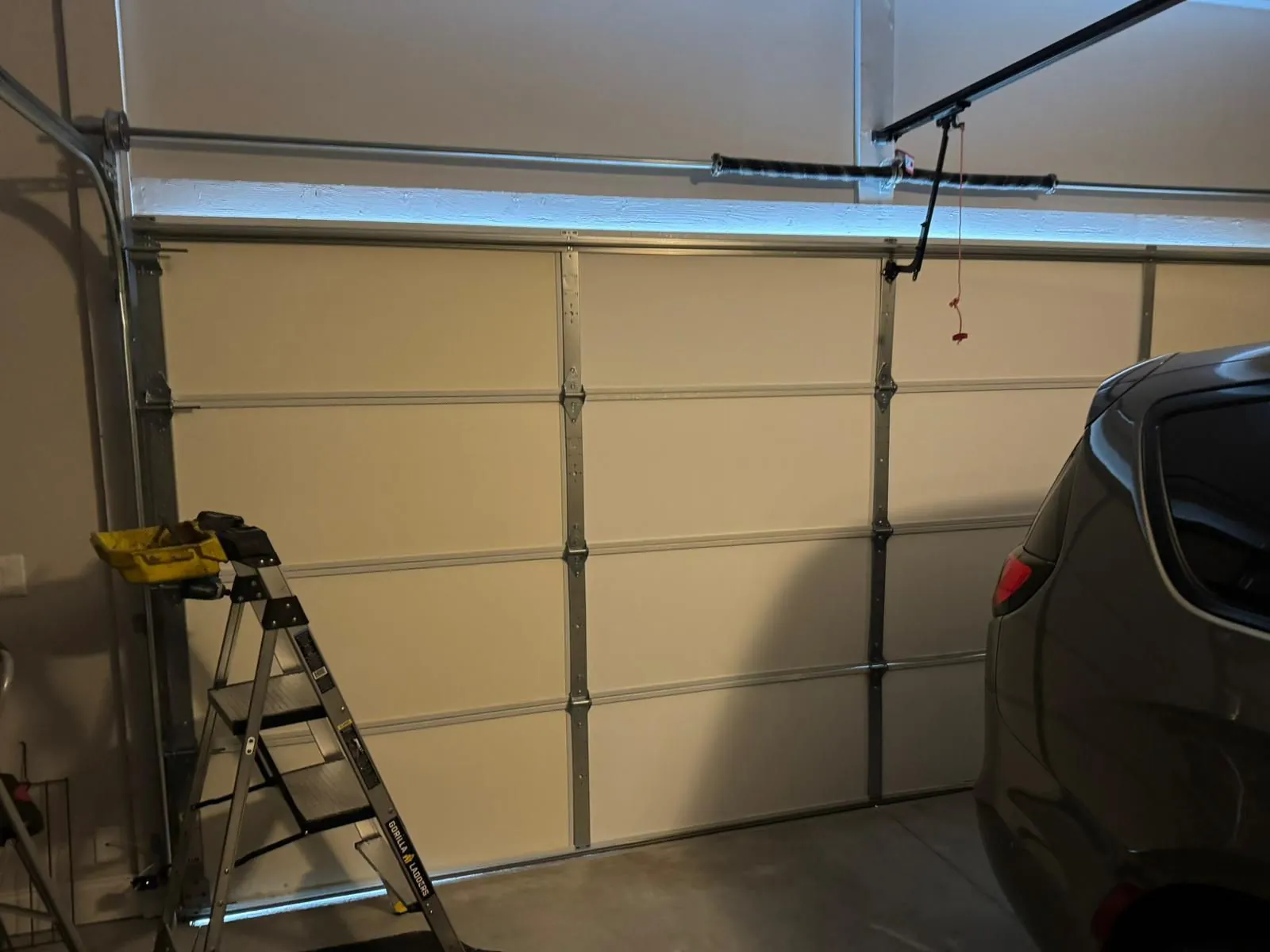
The steps of a spring replacement
Safety comes before anything else. A door caught partway up is locked with clamps on its rails, and the opener is unhooked from it. Then the failed spring is studied: the point where it broke, the condition of its partner if there is one, and any knock-on damage such as a cable thrown off its drum or a bracket twisted by the shock.
After that, the right spring is worked out for the door as it stands today. That means its true weight, how far it travels and the drum size, rather than whatever spring happened to be on it before. Doors gain weight over the years through paint, water and replaced sections, and a spring sized for the door’s original weight will leave it out of balance.
On a door with a pair of torsion springs, both are renewed when one fails: the surviving coil has worked through exactly as many cycles and seldom lasts much longer. Pairs of extension springs are handled the same way. The new springs get the correct number of turns, the cables are set to equal tension on each drum, and the balance is proved by hand, with the door raised to about chest height and released. It should hover. Only after that is the opener hooked back up, its travel and force tuned to the newly evened-out door, and its auto-reverse tried against a block on the floor.
Bringing springs up the hill
Parking is tight on these streets, so the van may end up a little way from your garage, with springs, bars and clamps carried up the slope by hand. That is routine and does not slow the repair much. Two things do help: keeping the apron outside the garage clear of cars, so the door can be raised all the way once it is balanced, and leaving a patch of floor clear inside, so a ladder can stand firmly beneath the shaft.
If the way into your garage is through a passage, a rear lot or the building itself, say so when you call. The spring is the same either way, but knowing the route helps plan how the parts reach the door.
Springs and a floor that slopes
Plenty of garages on a grade have a slab or apron that falls toward the road. That alone does not snap springs, but it affects every close. The bottom section touches the high side first, and an opener told to keep pushing until both sides land makes the springs fight the floor at the end of each trip. Uneven landings can also let a cable go slack at the bottom, so it rides off its drum when the door next goes up.
That is why, on a sloping floor, new springs are fitted along with a look at the cable lengths, the bottom seal and the opener’s down setting. Garage door spring repair Mission Hill MA homes on a grade need covers that whole setup, so the replacement springs start their life on a door that closes properly.
Early warnings worth acting on
Springs seldom fail out of nowhere. Watch for these:
- A door that has grown noticeably heavier to raise by hand, or that sinks when it used to hold its position.
- An opener that sounds laboured, or has begun reversing for no reason anyone can see.
- A small space appearing between two coils, or orange rust spots along the spring.
- A side spring that stays visibly stretched even with the door open, or a bottom edge that has started to tilt.
- A door that comes down faster than it did, or lands with a thump.
Catching a worn spring at this stage means replacing it on a day that suits you, rather than with a car stuck inside on a day that does not. On streets where finding another place to leave the car is hard, that planning is worth a good deal: a spring changed by appointment costs you an hour of the garage, while a spring that fails on its own terms can cost you the garage until the repair is done.
The cables that work with the springs
A spring never lifts the door directly. Its effort reaches the door through two lift cables, one on each side, fixed to brackets at the bottom corners. On a torsion door the cables wrap onto the drums; on an extension door they run over pulleys at the front and back of each rail. So a spring problem is very often a cable problem too.
When a torsion spring breaks, the drums suddenly stop turning while the door is still moving, and a cable can pile up loosely or slip off its drum altogether. When an extension spring breaks, its cable can drop out of a pulley. Either way, fitting a new spring onto a door with a cable off its track simply loads the door unevenly. The cables are therefore taken off, checked for frayed strands or kinks along their length, and either re-seated or replaced, so that both sides start lifting at the same moment. A frayed cable, especially one that has been rubbing against a bracket on a door that closes unevenly on a sloping floor, is replaced rather than reused.
A simple balance check for a working door
Once the springs are new, it is worth knowing how to check them now and then. With the door fully closed, pull the opener’s release cord so the door is uncoupled from the motor. Lift it by hand to about halfway and let go carefully. A balanced door stays roughly where you left it, or drifts slowly. If it shoots up, or falls back down, the spring tension is no longer right and the door should be looked at before the opener starts doing the springs’ job.
Never try this on a door you suspect has a broken spring, and never pull the release cord with the door open: if a spring has failed, the door will come straight down. If the test shows a problem, the right next step is garage door spring repair Mission Hill MA owners can book in the ordinary way, before the spring breaks outright.
When the break did other damage
The moment a spring snaps, a shock runs through the rest of the door. Cables often jump their drums at the same instant, and the opener may have strained against a dead load before its safety limit stopped it. Rollers and hinges that were already near the end can be pushed over it. All of that is checked while the springs are replaced, and anything further is explained before it is touched.
If the door has left its rails or the opener’s drive gear has stripped, those repairs are covered on our pages for Mission Hill garage door repair and Mission Hill opener repair. If the sections themselves have rusted or rotted beyond saving, it may be time to consider new garage doors in Mission Hill. Because the steepness of the hill makes delivering a whole new door awkward, a sound door is usually well worth keeping with fresh springs.
A spring that breaks at night
Springs keep their own schedule, and plenty break long after dark or on a holiday morning. Our line is staffed late in the evening, in the small hours and on holidays alike. If your car is shut in, or the door is jammed open onto a busy street, the Mission Hill emergency repair page tells you what to do in the meantime. Spring work elsewhere in the city is described on our general garage door spring repair page, and every service we offer locally is gathered on the Mission Hill page.
Book a spring repair
Every garage door spring repair Mission Hill MA visit finishes in the same place: a door that balances on its own, an opener set to match it, and a safety reverse proved before we go. When you contact us, mention where the spring sits, on a shaft over the opening or beside the rails, whether the door came to rest open or closed, and if a car is trapped. Then call us or book online, and keep clear of the spring until the technician arrives.
Questions from Mission Hill
My opener raises the door a few inches and cuts out. Is that the spring?
Most likely. Without the spring the opener suddenly meets the door’s whole weight, and its overload protection stops it. Unplug the opener, leave the button alone, and look for a break in the coil over the opening.
Is there a safe way to get the car out with the spring broken?
Not by lifting the door yourself. With no spring, the door is far heavier than it looks and can drop in an instant. Keep it shut, ring us, and expect the car to stay put until new springs are fitted.
Only one of our two springs has broken. Why change both?
They have done the same work for the same number of years, so the other one is usually near its own breaking point. Changing them as a pair keeps the door evenly balanced and saves a second call-out a few weeks later.
Our springs run along the side rails. Are they safer to handle?
No, just risky in another way. Side springs are stretched hard under load and can whip loose if they snap or slip a hook, more so if there is no restraint cable through them. Leave them be and have them inspected.
Why do springs seem to break when the weather turns cold?
The wear builds up over years of cycles. Cold steel is less forgiving, so a spring that was already on its last few cycles often gives out on a freezing morning. The weather picked the day; the wear was already there.