
Why openers here get asked to do so much
On the steep streets running up from Tremont, a garage is a rare thing. The brick row houses and triple-deckers were mostly built without one, so where a garage does exist it tends to be in constant use, and the opener above its door gets very little rest. With every kerb packed with parked cars, nobody wants to idle in the street with the hazard lights blinking while a sluggish door makes up its mind. Garage door opener repair Mission Hill MA garages need usually comes down to exactly that: a motor, a handset or a sensor that has stopped answering promptly, on a door that has to work every single time.
An opener is a compact machine with several jobs. It hauls a carriage along a rail, keeps count of how far the door has gone, watches a pair of light beams for anything in the doorway, and listens out for a handful of handsets. Any one of those jobs can go wrong on its own, and the symptom rarely announces which. A door that bounces back for no visible reason, a handset that only works from the doorstep, a motor that drones without moving anything: each points to a short list of suspects.
Before you ring, three observations from floor level are worth making:
- Does the button on the wall still move the door when the handset will not, or is everything silent?
- Are the little lamps on both floor-level eyes lit and steady, or is one flickering or out?
- Does the motor unit make any noise at all, a click, a hum, a whirr, when the button is pressed?
Opener faults we fix
Motor and gearing
A unit that drones without turning, or turns without moving the carriage, normally means a stripped nylon gear, a dead start capacitor, or a snapped belt or chain.
Handsets and keypads
Flat cells, lost pairing, a cracked transmitter, or a receiver that no longer hears it. Handsets can be paired again or swapped for new ones.
Wall controls and wiring
A dead or temperamental wall control is often a loose terminal behind the button or at the back of the motor head.
The photo eyes
Two small sensors at ankle height. Bumped, grimy or with a damaged lead, they refuse to let the door shut or reverse it partway down.
Limits and force
Badly set limits leave a door short of the floor, crush its seal, or make it recoil as soon as it lands.
Inside the machine
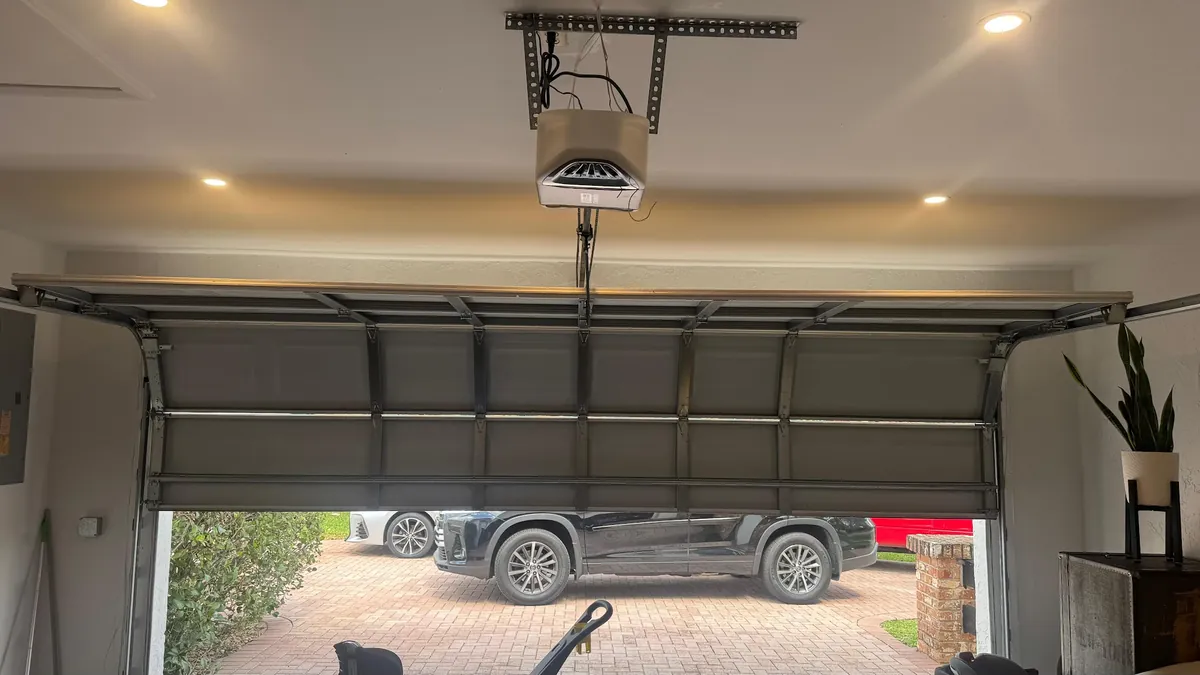
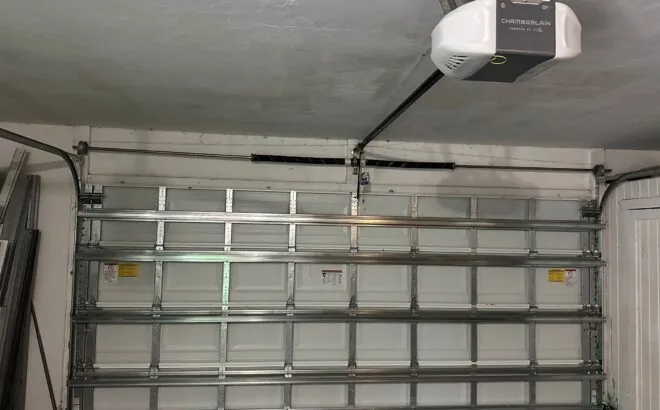
The usual opener is hung from the garage ceiling: a motor housing toward the back, and a long rail reaching forward to a bracket fixed over the door. Along that rail runs a carriage, drawn by chain, belt or screw drive, and a short bent arm joins the carriage to the uppermost section of the door. Run the motor, the carriage slides, and the door goes with it.
A different design sits on the wall beside the opening and turns the spring shaft itself, with no rail across the ceiling. It suits low garages, or ones with joists, ducts or a header crowding the space above the door, as is common in older buildings where an opening was cut into brickwork that was never laid out with an overhead door in mind.
Either way, the opener keeps two positions in its memory, fully up and fully down, known as its travel limits. It also holds a figure for how much effort the trip should take, its force setting. Meeting more resistance than that figure, it assumes something is under the door and backs off. The two photo eyes near the floor add a second guard: interrupt the beam between them while the door descends and the door goes back up.
That arrangement explains why so many complaints about the opener are really complaints about the door. The springs are supposed to do the lifting; the opener only steers. A weak spring, a seized roller or a rail that pinches loads the opener beyond its settings, and it gives up or reverses. Swap the opener in that state and the new one hits exactly the same wall.
Handsets on a crowded street
A handset is supposed to have the door rising as you draw up. Where cars are parked bumper to bumper and there is seldom anywhere to pull in, range stops being a nicety. A handset that only responds from directly outside the garage leaves you stopped in the lane while the door climbs and the traffic queues behind.
Short range has a few usual culprits. A cell running low inside the handset is the first and cheapest. Beyond that: the receiver’s aerial, a short wire dangling from the motor housing that can get folded, snipped or tucked out of reach; interference from lighting or other electronics in the garage; and a handset that has simply lost its pairing. Very old openers on fixed codes may also respond to stray signals, which is a security worry as much as a nuisance.
Handsets can be paired afresh to the existing opener, or replaced. Where a garage is shared by several flats, each household can have its own. If one has gone missing, wiping the opener’s memory and pairing the remaining handsets again shuts the lost one out for good.
Garage door opener repair in Mission Hill on a sloping floor
The photo eyes sit low on either side of the opening, one throwing an invisible beam and the other catching it. They only do their job when they stare straight at one another. In a garage with a flat slab that is easy. In a garage cut into a hill, where the floor or apron slopes, the eyes may sit at slightly different heights, and their thin brackets are easier to nudge out of true with a bin or a bicycle.
With the beam broken or misaimed, the handset will not close the door, or the door starts down and immediately climbs again. One of the eyes usually shows a dark or winking lamp when this is going on. Sometimes careful re-aiming is all it takes. Other times the low-voltage lead back to the motor has been pinched in the track or nibbled through, or an eye has been spoiled by water pooling at the threshold. Rain running down a sloped street toward the door can reach eyes set very low, and an eye that has been soaked again and again starts failing on and off.
Raising the eyes on the jamb, within the height the opener’s design allows, and rerouting their leads away from pinch points and puddles, often ends months of ghost reversals. On garages where the floor tilts, that is one of the most frequent fixes we make.
The order a visit follows
Every opener visit begins at the door rather than the motor. With the carriage uncoupled, the door gets raised and lowered manually, to feel whether it glides and whether it hangs in place halfway. If it binds or drops, the opener is not the true culprit, and springs, rollers or rails come first. That side of the work is explained under door repairs in Mission Hill and spring repair in Mission Hill.
Once the door passes, attention moves to the opener: motor, drive, carriage and its run along the rail. Each handset is tried, then the wall control. The eyes are tested for power, aim and a steady signal, and their leads are followed back to the motor head looking for damage. If the unit flashes a diagnostic code, that narrows the hunt.
You are told what has gone and what your options are before any part is changed. Afterwards the door is coupled up again, the down limit is set so the door seals on this particular floor without squashing the weatherstrip, the force is set low enough that the door turns back on real contact, and the reverse is proved twice: once by stepping through the beam, once by lowering the door onto a short length of timber.
Fix it or fit a new one
A good share of opener faults are worth putting right: a chewed gear, a stretched belt or chain, a dead capacitor, a damaged eye or a broken wall control. These are well-known wear points, and an opener sound in every other respect carries on for a long while afterwards.
A new opener earns its place when the motor has burnt out on an old unit, when the logic board has died and a replacement board is hard to come by, when the opener has no working photo eyes, or when it was never matched to the door it drives. A heavy wooden door that has been grinding along on a light-duty unit for years is a familiar case, and so is a unit chosen for a door far lighter than the one hanging there now.
Among the openers we repair and replace are LiftMaster units. When a new opener is the better route, it is chosen for the weight of the door and the room in the garage; under a low ceiling, a wall-mounted unit gives back the headroom a rail would use. The old unit comes down, the new one is hung and wired, eyes are fitted and aimed, handsets and wall control are paired, and the limits and force are set and proved on the door as it actually hangs.
Keypads, wall controls and noise
Not every garage is opened with a handset. A keypad fixed outside the door lets anyone with the code in without carrying anything, which suits a garage shared between several flats. Keypads live outdoors, so their faults are mostly weather faults: a cell gone flat in the cold, buttons worn smooth, or damp working into the casing on a door that faces down the hill into the rain. A keypad can usually be re-coded, given a new cell or replaced, and its code changed whenever a tenant moves out.
Wall controls range from a simple push button to a panel with a light switch and a lock. A simple button that stops working is often a broken wire behind it, chafed where it passes a door frame or stapled too tight. A panel that lights up but does nothing may have its lock switched on.
Noise is the other common complaint. A chain drive rattles more than a belt drive, and where a garage sits below or against rooms that people live in, that rattle carries through the building. A loose chain, dry rail or worn rollers on the door all make it worse. Tightening and lubricating the drive helps, and when an opener is reaching the end of its life in any case, a quieter drive is worth weighing up. Garage door opener repair Mission Hill MA owners ask about often starts as a noise long before it becomes a breakdown, and a noise is a good reason to have the opener and door looked at while they still work.
Short on headroom
Older brick garages often give an overhead door and its opener less space than they would like. A ceiling unit needs an unobstructed run for its rail and a solid fixing above the door for the front bracket. Where the ceiling is low, joists cross the line of the rail, or the header has been rebuilt at some point, finding that room takes patience.
The answers include tucking the rail up hard against the ceiling, anchoring the front bracket into masonry with fixings made for brick, or skipping the rail entirely with a wall-mounted unit on the spring shaft. Each comes with its own conditions, and which one fits depends on the door, its springs and the garage. On these older buildings the structure usually has more say in the choice than the catalogue does.
Power cuts and the red cord
Every opener has an emergency release, normally a red cord with a handle dangling from the carriage. A tug uncouples door from motor, leaving the door loose to push up or pull down by hand, which is handy when the power is out or the unit has died with the door shut.
Treat it with respect. Pull it only with the door all the way down, or with someone holding the door, since a door whose spring has failed will drop as soon as it is uncoupled. When power returns, the carriage needs to be coupled again before the opener can move the door; usually running the opener once lets the carriage catch the arm with a click.
If you have any doubt about the springs, leave the cord alone. Unplug the opener and give us a call.
Checks that carry no risk
- Handset dead but wall control fine? Put a fresh cell in the handset.
- Door refuses to close and one eye’s lamp is dark or winking? Look for a bag, a bin or leaves breaking the beam, then wipe both lenses with something soft.
- Nothing happening at all? Confirm the power lead is pushed fully into its socket, and prove the socket is live with a lamp or a phone charger.
- Many wall controls have a lock or holiday switch. Check it has not been flicked on by accident.
Do not handle the springs, either lift cable, or the corner brackets those cables hook onto. They carry heavy tension at every moment and are not a DIY repair. If the door is hanging partway or has jumped its rails, unplug the opener and stop pressing buttons.
When the opener quits after dark
An opener that gives out with the door up leaves the garage open to the pavement all night. One that gives out with the door down shuts a car in, and on streets where the parking is this heavy that is more than an inconvenience. Someone answers our line through every hour of the night and day, holidays included, and the Mission Hill emergency repair page explains how to deal with a door stuck up or down in the meantime. If the opener is healthy but the door itself is worn out, see new garage doors in Mission Hill, where fitting a new opener alongside a new door is covered too.
Opener work in other parts of the city is described on our main opener repair and replacement page, while the Mission Hill page lists what else we handle on these streets.
Booking opener work
For garage door opener repair Mission Hill MA garages can rely on, the most useful things to tell us are what happens when the button is pressed, whether the wall control and handsets behave differently, what the lamps on the eyes are doing, and how the door feels when moved by hand. Each garage door opener repair Mission Hill MA visit begins with the door itself, so anything strange about how it moves is worth a mention. Once you have that list, pick up the phone: call us or book online.
Questions from Mission Hill
Why would the door start down, then reverse back up?
The opener believes something is blocking it. Usually the eyes are misaimed or the beam is interrupted; on a tilted floor, the down limit may also be set so the door lands on the high side and reads that as an obstacle. Look at the lamps on the eyes first.
My handset only works from right outside the garage. Is that fixable?
In most cases. Put a new cell in the handset first. If range stays short, the aerial on the motor housing, interference inside the garage or the handset’s pairing are next in line, and any handset can be re-paired or replaced.
The motor drones but nothing moves. Is the opener dead?
Not necessarily. Droning without movement often means a stripped gear, a dead capacitor, or a door too heavy to move because a spring has failed. Unplug the unit and have the door checked before deciding the opener’s fate.
Will a new opener fit under our low ceiling?
Frequently, yes. The rail can sit tight to the ceiling, or a wall-mounted unit beside the door can do away with the rail altogether. Which suits depends on the door, its springs and the room over the opening.
Do you repair LiftMaster units?
We do. LiftMaster openers come to us for repair and for replacement, along with the handsets, wall controls and photo eyes that work with them.