
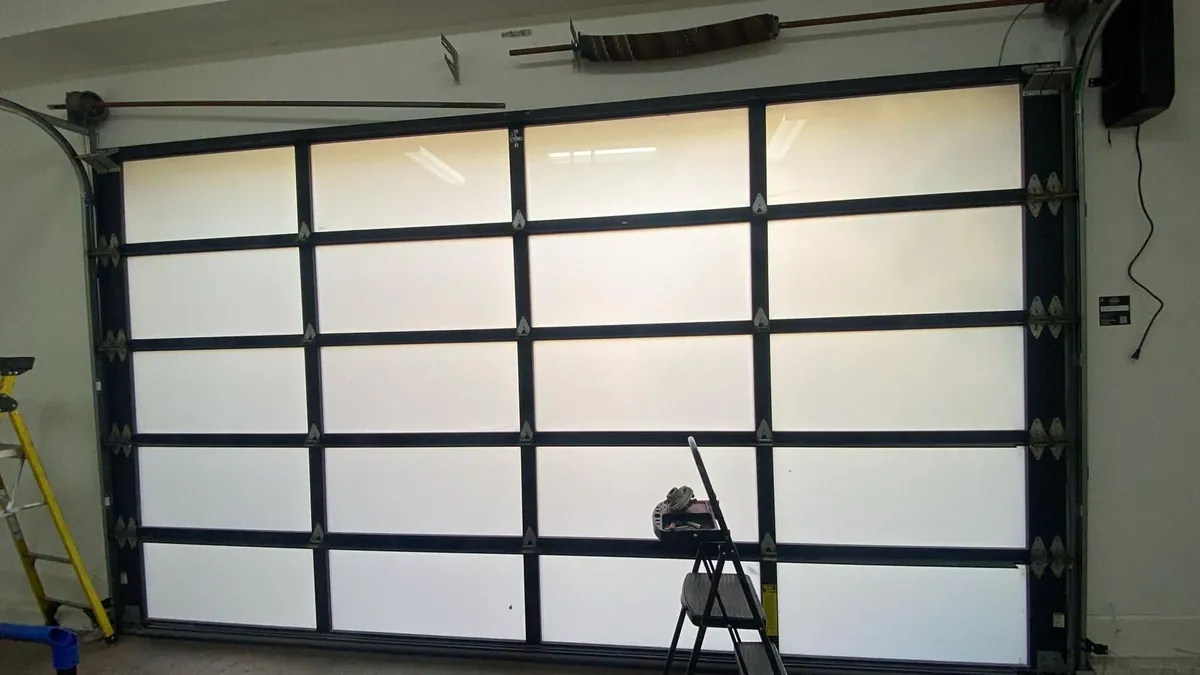
Replacing a door where garages are few and the street is steep
Climbing away from Tremont, street after street of brick row houses and triple-deckers was built with hardly a garage among them, which is why the handful that exist are kept in hard use and why their doors eventually wear out. When the time comes, swapping a door here is not quite like swapping one in a suburban cul-de-sac. The hill decides a good deal: how the new door is delivered, how it is carried to the opening, and how its bottom edge is made to meet a floor that seldom sits level. New garage doors Mission Hill MA owners ask us about are planned with all of that in mind from the first measurement.
We supply and install new doors, and take out the old ones they replace. Each job starts with the opening rather than a brochure: its width and height, the room above it for springs and an opener, the space at each side for the vertical rails, and the depth back into the garage for the horizontal ones. Older brick openings often turn up a surprise or two, such as a lintel lower at one end or a jamb that leans, and the new door is fitted to the opening as it really is.
Before we visit, three quick observations make the first conversation more useful:
- Roughly how the floor behaves at the threshold: flat, falling toward the street, or sloping from side to side.
- What sits above the opening inside: a clear wall, a low beam, pipes, or an existing opener rail.
- How the garage is approached on foot from the nearest place a van can stop.
What a new door involves here
Measuring the opening
Width, height, headroom, side room and back room, plus how far the floor is out of level. Those figures decide the door, the rails and the springs.
Taking out the old one
The worn door comes down with its springs, rails and, if it is going too, its opener, all handled safely and hauled away.
Sections, not a single slab
A sectional door arrives as separate panels, which can be carried up a steep street and through a narrow approach one at a time.
Springs sized to the door
New springs are chosen for the new door’s weight and height, so it balances properly from the first day.
Fitting to a sloping floor
The bottom section and its seal are set to meet the floor along the whole width, even where the slab falls away.
Why the hill shapes the job
The grade of the hill itself limits how a new door can be brought in. A delivery lorry cannot always stop near the garage; the kerb is usually full, and on the steepest stretches there is nowhere level to unload. A long, rigid door would be very hard to carry up a slope and round a tight turn into an opening.
That is one of the reasons sectional doors suit these garages so well. Sectional doors are built from a stack of horizontal panels that are only joined by their hinges once they are standing in the opening. Each panel can be lifted and carried by hand, and the rails, springs and hardware come in manageable lengths and boxes. Rather than a single awkward load, the new door reaches the garage as a series of pieces that can be walked up the pavement and through a passage if need be.
It also affects the old door. A worn-out sectional door can be taken apart and carried out the same way. An old one-piece tilt-up door, which some older garages still have, has to be lowered and carried out whole or cut down, and that is planned ahead so it does not hold up the work.
For you, the practical upshot is that installation day involves more carrying than a flat suburban job, and a clear route from the street to the opening helps it go smoothly.
Choosing a door that suits brick
New garage doors Mission Hill MA owners choose usually have to sit against a brick facade, often on a street of houses that look much alike. A door that suits brick is mostly a question of proportion and colour rather than decoration.
Panel style. Flat panels give a clean, modern face; raised or recessed panels give the look of a traditional carriage door. On a narrow single opening in a row of brick fronts, a simple panel pattern often looks more at home than a busy one.
Colour. White, cream and dark tones all sit well against red brick. A darker door can make a garage recede into the facade; a lighter one makes it a feature. It is worth looking at how the door will relate to the house’s windows and front door.
Windows. Glazing across the top section lets daylight into a garage that is often windowless. On a door that faces straight onto a pavement, frosted or textured glass keeps the contents out of sight.
Full view glass. Aluminium-framed doors with glass across most of their face give a very different, contemporary look. They have a page of their own: full view glass garage doors.
Materials and what they ask of you
Steel. The everyday choice for a sectional door: tough, low on upkeep and made in a wide range of panel patterns and colours. Insulated versions sandwich a foam core between inner and outer skins, which generally makes the door stiffer and quieter in use. On a door facing downhill into the rain and road salt, a well-sealed bottom edge and a good finish matter more than usual.
Timber. A wooden door has a warmth that suits older brick buildings, but it needs regular finishing and it soaks up water if it is neglected. A timber door that sits in the path of runoff from a steep street needs its bottom edge sealed and kept that way, or it will grow heavier and rot from the bottom up.
Aluminium and glass. Light, bright and modern, with the glass chosen for privacy as well as looks. The frames resist rust, which suits a damp site.
Whatever the material, the new door comes with new springs matched to its weight. Heavier doors, such as insulated or timber ones, need stronger springs, and the springs are chosen for the door being fitted, not carried over from the old one.
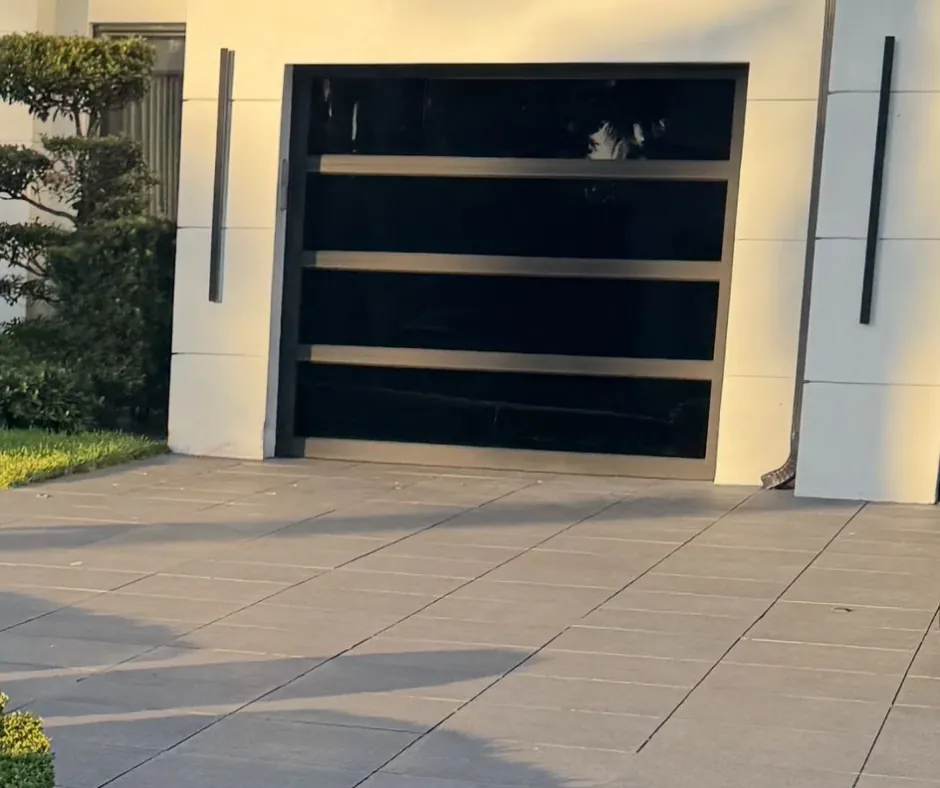
Making a new door meet a sloping floor
A garage door is built square, but many floors on a hill are not level. Where the slab dips toward the road, or tips from one jamb to the other, a new door set up as if the floor were flat touches down on the high side first and stands clear of the low side, letting in rain, leaves and draughts.
The answer is in the fitting. The rails are set plumb even where the jambs are not. The bottom section and its seal are chosen and set so the door meets the floor along its whole width. In some cases a thicker or tapered seal fills the difference; in others a threshold seal on the floor does part of the job. The opener, if one is fitted, then has its close limit set so the door seals without being crushed into the high side.
Getting this right on day one matters, because a door that closes unevenly wears its rollers, hinges and springs faster, and a gap at the bottom lets in exactly the water that rusts or rots a new bottom section.
Insulation, noise and the rooms around the garage
Where a garage sits beneath or against rooms that people live in, as happens in some older brick buildings, the door is part of the wall of the house. A thin, uninsulated single-skin door lets cold air and street noise straight into the garage, and from there into the rooms beside it. An insulated door, with its core between two skins, is stiffer and quieter when it moves, and it rattles less in the wind.
Seals matter as much as the panels. A new door comes with a bottom seal, and the sides and top of the opening can be sealed with weatherstrip against the jambs and header. On a hill, where wind and rain both come up the street, those seals do a lot of work. They are checked and adjusted as part of the installation so the door closes snugly without dragging.
The way the door moves also affects noise. Nylon rollers run more quietly than bare steel ones, a well-balanced door asks less of the opener, and a belt-drive opener is quieter than a chain. When new garage doors Mission Hill MA buildings need will sit against living space, it is worth talking through these choices before the door is ordered, not after.
How an installation day runs
Before the day itself, the opening is measured and the door is chosen, and you are told what is involved, including whether the old opener is staying or being replaced.
On the day, the old door is made safe first. Its springs are let down with winding bars first: a torsion spring holds dangerous tension however rusty and tired it looks, so this step is never hurried and never a DIY job. The old door, rails and springs are then taken down and carried out.
Next the opening is prepared. Jambs and the header are checked, loose or rotten timber is dealt with, and fixings into brick are set where they will hold. The new rails go up, the bottom panel is stood in the opening, and each panel above it is stacked on and hinged to the one below, rollers going in as the door grows. The springs and cables are installed and wound for the door’s weight, and the balance is checked by hand: raised to mid-height and let go, a correctly sprung door simply hangs there.
Last of all comes the opener, where there is one. Once hooked up, its up and down stops and its pushing force are adjusted for this particular door on this particular floor, and the photo eyes are aimed and proved. The door is run several times, the reverse is tested, and you are shown how the manual release and any lock work.
New door and opener together
Installation day is a natural moment to weigh up the opener as well. An old opener may have been sized for a lighter door, may lack working safety sensors, or may simply be near the end of its life. Fitting a new opener at the same time means a single setup, with the opener’s limits and force set for the new door from the start. Under a low ceiling, a wall-mounted opener can leave more headroom. More on motors, handsets and photo eyes is on our Mission Hill opener repair page.
Where the current opener is healthy and up to the new door’s weight, keeping it is fine. It will be reconnected and reset for the new door’s weight and travel.
Repair first, if the door is worth it
Replacement is not automatically the right call. Worn springs, cables, rollers and hinges wear out and are meant to be replaced, and sections that are still solid will carry on for years behind fresh hardware. Because of the effort of bringing a new door up the hill, a sound door that only needs new hardware is usually worth keeping.
Replacement makes sense when the sections themselves have failed: steel rusted through from the bottom, timber soft or split across several panels, timber so waterlogged no spring will balance it, or a door that has been patched so many times it no longer runs straight. What can be repaired is explained on the pages for garage door repair in Mission Hill and spring replacement in Mission Hill, and every visit includes a frank opinion on whether yours is worth saving.
Getting to the garage on installation day
Heavy on-street parking means the van may have to stop some way from your garage, and the sections, rails and springs are carried the rest of the way. A few things make the day easier:
- Keeping cars off the apron outside the garage means the old door can be lowered and the new one tested at full height.
- Clear the garage floor near the door and along both sides, where the rails will run.
- If the garage is reached through a passage, a back lot or the building, tell us in advance so the carry can be planned.
- If the garage holds your only off-street parking, plan where the car will go for the day.
When the old door fails before the new one arrives
Doors that are due for replacement have a habit of failing just before they are replaced. If yours breaks a spring, comes off its track or jams open while you are planning a new one, it can usually be made safe and secured in the meantime. Our phone line never closes, and the page on emergency repair in Mission Hill covers what to do until help arrives.
For door replacement elsewhere in the city, see new garage door installation; for the full list of local services, visit the Mission Hill page.
Starting the conversation
To talk about new garage doors Mission Hill MA garages could take, give us the approximate width and height of the opening, the lie of the floor at the threshold, anything mounted above the door inside, your plans for the opener, and the walk in from the road. Photos of the opening from inside and out are a great help. A note of anything unusual, such as a door that has been patched, a beam that has been added, or water that collects at the threshold after rain, helps us bring the right parts and plan the day properly rather than discovering it on arrival. For new garage doors in Mission Hill, the first step is the same as for any job: call us or book online.
Questions from Mission Hill
Can a new door be carried up our street if a lorry cannot stop outside?
Yes. A sectional door comes as separate panels, with rails and springs in manageable lengths, so everything can be carried by hand from wherever the van can stop. It takes more carrying than on a flat street, but it does not stop the job.
Our garage floor slopes. Will a new door close properly?
It should. The rails are set plumb, and the bottom section and seal are fitted to meet the floor along its whole width. The opener’s close limit is then set for that floor, so the door seals without being crushed on the high side.
What happens to our old door?
It is taken down, with its springs unwound safely, and carried away. A sectional door is taken apart and carried out in pieces; an old one-piece door is planned for in advance.
Can we keep our existing opener?
Provided it works well and can cope with the new door’s weight, yes. It is reconnected and its limits and force are reset for the new door. If it is old or undersized, fitting a new one at the same time is worth considering.
Which door looks best against brick?
Usually a simple panel style in a colour that suits the brick, the windows and the front door. White, cream and darker tones all work; glazed top panels with frosted glass add light without showing the contents.