
Why openers on North End service entries work so hard
The North End’s streets are old and tight, and private garages there are close to nonexistent. What the area does have is a great many powered doors of another sort: roll-ups over ground-floor openings and service entries that buildings use for refuse, deliveries, bikes and plant. Garage door opener repair North End MA buildings ask us for is mostly about the motors, remotes, buttons and sensors on those doors, and about keeping a doorway that many people rely on opening at the press of a button.
An opener on a door like this does not have an easy life. It may be asked to run dozens of times a day by different people with different remotes. It sits in a doorway that opens straight onto a narrow street, where a passer-by can step into the door’s path at any moment, so its safety reverse matters. And it is often fitted into a building that was standing long before powered doors existed, with odd clearances above and beside the opening.
When an opener stops behaving, three quick observations tell us a lot:
- Is there a click, a hum or nothing whatsoever when the button is pressed?
- Does the door move a little and stop, or reverse just before it lands?
- Does the wall button work when the remotes do not, or the other way round?
Opener faults we deal with here
Motors and drives
A drive unit that buzzes while the door sits still, one that cuts out halfway through a lift, or a drive that grinds, slips or has jumped a gear or chain.
Remotes and receivers
Some remotes working and others not, every remote dead at once, or a range so short that the remote only works inside the doorway.
Wall buttons and controls
A button that does nothing, works only when held, or reverses the door at random. Old wiring in old buildings is often part of the story.
Safety sensors
A pair of beam units nudged askew by a trolley or a bin, dirty lenses, or a sensor wire damaged at floor level, all of which keep a door from closing.
Manual release and hand chain
The cord or the chain that lets a door be moved by hand when the power is off, and which often turns out to be seized when it is needed.
Replacing an opener
When a motor is worn out or its parts are no longer available, a new opener is fitted to suit the door, including LiftMaster models.
Two kinds of opener in the same streets
Openers for these doors come in two broad families, and which one is fitted shapes how a fault shows up.
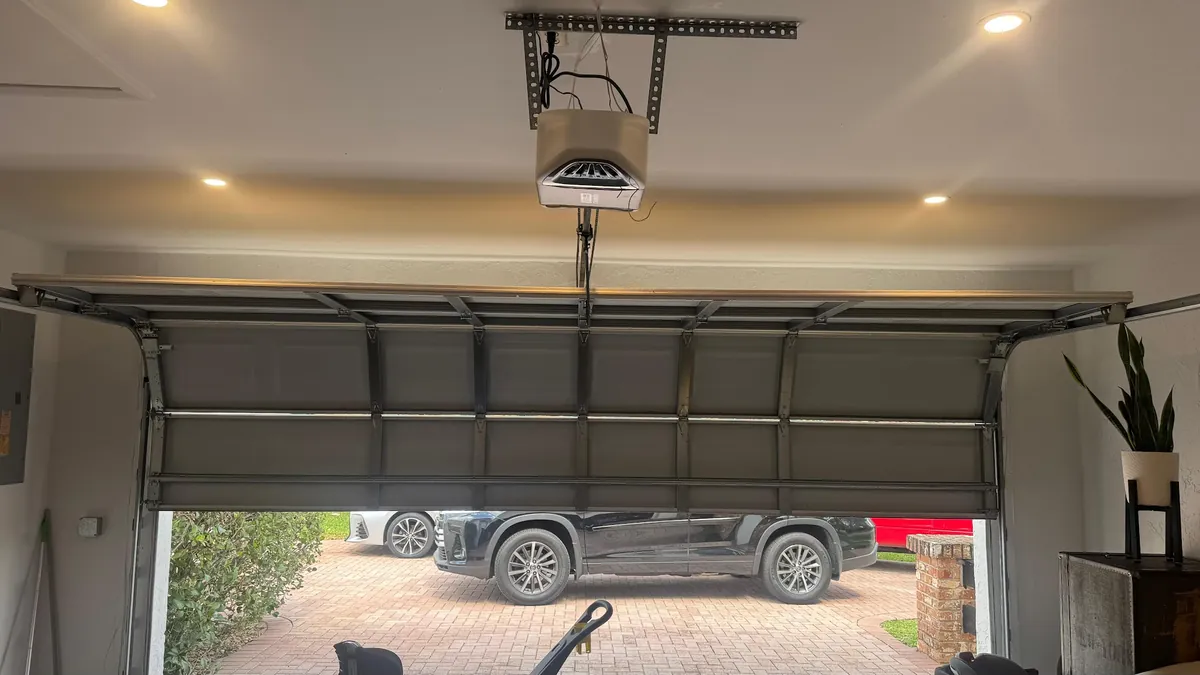
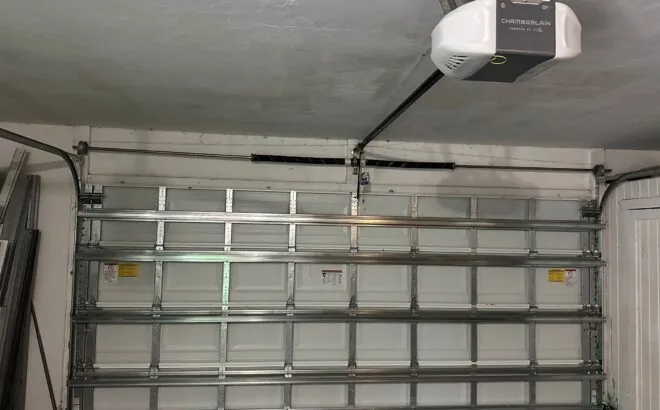
A sectional service door usually has a ceiling-mounted opener: a motor unit hung from the ceiling behind the door, with a rail running to the top of the door and a trolley that pushes and pulls it. Some are mounted on the wall beside the door instead, turning the spring shaft directly, which saves space in a doorway with a low ceiling. Both kinds rely on the door being balanced by its springs; the opener only guides and steers the weight.
A roll-up is driven by an operator mounted at one end of the barrel, usually on a bracket on the wall above and to the side of the opening. It turns the barrel through a chain or a gearbox, and it often has a hand chain or a crank as a backup. Operators like this are built for heavier doors and more frequent use, and limit switches inside them decide the two points where the curtain comes to rest, fully raised and fully lowered.
When you call, a description of what is on the wall or the ceiling helps us bring the right parts. A box at the end of the barrel with a chain hanging down means an operator; a long rail across the ceiling means a ceiling-mounted opener.
Reading what the opener is telling you
Openers give fairly clear clues once you know what to listen for.
A hum with no movement usually means the motor is trying to turn but something stops it: a seized drive, a failed capacitor in the motor, or a door so heavy, because a spring has broken, that the motor cannot shift it. Do not keep pressing the button in this case. Each attempt heats the motor further.
A door that rises a short way and stops often points to the spring rather than the opener. Feeling a load it was never meant to carry, the motor’s overload cuts in and halts it. Our page on spring repair in the North End explains what a broken spring looks like on roll-ups and sectional doors.
A door that reverses just before landing is usually a sensor or a limit setting. The photo eyes may be out of line, or the closing limit may need resetting because the ground at the threshold has changed or the bottom seal has worn.
Complete silence from both the button and the remotes points to power: a tripped breaker, an unplugged cord, a blown fuse in the operator or a failed circuit board.
Remotes failing while the button works points to the remotes or the receiver. Batteries come first, then the programming, then the receiver itself.
Any of these can be checked and put right as part of garage door opener repair North End MA doors need, and telling us which of these you are seeing lets the right parts travel with the technician.
What an opener visit involves
- When you ring, we ask what type of door and opener it is, what it does when the button or remote is pressed, and which way in is easiest for a van and a ladder.
- On arrival, the door is first checked by hand with the opener disengaged, because a door that is heavy or binding will make any opener fail and must be dealt with first.
- Power, wiring, the wall button, the remotes, the receiver and the safety sensors are tested in turn until the fault is found.
- You hear what has failed and whether it is worth repairing, or whether a replacement opener makes more sense, before any part is changed.
- After the repair, the limits and force settings are set, the safety reverse is tested with an obstruction in the doorway, and the remotes in use are checked.
- We show whoever looks after the door where the manual release or hand chain is and how to use it safely.
Remotes for a whole building
A service door shared by a building usually comes with a drawer full of remotes. Some belong to current residents, some to former ones, some to a contractor who did a job years ago. Every one of them can still open the door unless it has been removed from the opener’s memory.
That causes two kinds of trouble. The practical one is that remotes get lost, batteries die and people move, so there are always complaints that the door will not answer. The security one is that a remote nobody can account for still opens the building’s back door.
As part of an opener visit we can wipe every stored code and then pair back just the handsets people still carry, add new ones, and check the wall button and any keyed control. Keep a simple list of who holds a remote. It makes the next change much easier, whether that is a new resident, a lost remote or a decision to replace the opener.
Wall buttons and old wiring
Of all the controls, the button on the wall is the plainest, and usually the last suspect. In an old building the thin bell wire linking button and motor may have been run along a wall decades of renovations ago, stapled, painted over or pinched behind a pipe. A button that only works when held down, that behaves on Monday and ignores you on Tuesday, or that sets the door moving on its own, usually comes down to that wire or to tired contacts behind the button, not the opener at all. Tracing and renewing that run is a small job that removes a surprising number of so-called opener failures.
Sensors on a doorway that opens onto the street
Safety sensors are two small units fixed low on either side of the door opening. One sends an invisible beam to the other; interrupt that beam during a descent and the motor halts, then lifts the door clear again. On a doorway that opens straight onto a narrow street with people passing close, that is one of the most important parts of the whole installation.
They also give the most nuisance trouble. A bin rolled against one knocks it out of line. Road grime and wet weather coat the lenses. The wire that runs between them at floor level gets kicked, crushed or chewed. When any of that happens, the door refuses to close or reverses for no visible reason.
Some checks are safe for anyone. Look at the small light on each sensor: on most openers a steady light means aligned and a flashing or dark light means not. Wipe the lenses gently with a dry cloth. Make sure nothing is standing in the beam. What you should not do is tape over a sensor or bridge its wires to make the door close. A door with its safety reverse defeated is a real danger on a street where anyone can walk under it.
When the power goes off
Every opener has a way to run the door without power. A ceiling-mounted opener has a release cord, usually with a red handle, that disconnects the trolley so the door can be lifted by hand. A roll-up operator usually has a hand chain or a crank, sometimes with a lever or pull cord to switch from motor to manual.
These are worth testing before you need them, because they are often seized from years of not being used. Do not use the manual release if the door is not balanced: on a sectional door with a broken spring, pulling the release can let the door drop under its own weight. If you are unsure, leave the door where it is and call.
Once the power returns, the opener may need the door re-engaged with the trolley or the drive switched back from manual. A door that will not reconnect, or that runs but then stops short, is worth a look rather than repeated attempts.
Fitting an opener in an old, tight opening
The buildings here were put up long before anyone thought of powered doors, and the space around many doorways reflects that. A low ceiling behind the door leaves little room for a rail; a narrow gap beside a roll-up barrel limits what operator can be mounted; old masonry needs the right fixings to hold a bracket that will take the twisting of a motor day after day.
When an opener is repaired or replaced in a space like this, the fit matters as much as the motor. A wall-mounted opener leaves the ceiling clear where a rail will not go. An operator can sometimes be mounted on the opposite side of the barrel if one side is blocked. Brackets may need to be moved to sound masonry. We look at all of this on the visit and choose what will actually work in the opening rather than what would suit an open suburban garage.
LiftMaster openers
We repair and replace LiftMaster openers, and they turn up on both residential-style sectional doors and on heavier doors. The same approach applies as for any opener: check the door first, then the power, controls, sensors and drive, and only then decide whether the opener itself needs parts or replacing. Further detail sits on the dedicated LiftMaster opener repair page.
Fix the motor or fit a new one
Many opener faults are a repair: a sensor realigned, a wall button rewired, a remote reprogrammed, a drive gear or a capacitor replaced, the limits reset. If the motor and its circuit board are sound, a repair keeps it running well.
Fitting a replacement is the better course once the motor is tired out, when parts for that model can no longer be obtained, when the opener is too light for the door it is driving, or when it has been damaged by running against a broken spring or a jammed curtain for too long. Every garage door opener repair North End MA buildings book with us starts with a plain answer about which of these applies. Should the door turn out to be the weak link rather than the motor, replacing a North End door is explained on its own page.
Planning a visit around restricted streets
Opener visits usually need less carrying than spring or door work, but access still has to be planned. On Hanover Street and Salem Street the carriageway is narrow and vehicles may only come through at certain times. If a replacement opener or operator is coming, it needs to reach the doorway; a ladder needs space; and the door needs to be run repeatedly while settings are tested, which means keeping the doorway clear of passers-by for a while.
Tell us when you book about any set times for vehicle access, the best way in, and whether the opener can be reached from inside the building without using the street at all. That information is what lets us arrange garage door opener repair North End MA streets allow without getting caught by a closed road.
Booking the work
An opener that quits usually does so when someone needs the door straight away. We answer the phone day and night, all week, so you can report the fault when it happens. For a door stuck open or one that will not move at all, the North End emergency repair page lists the sensible steps before we arrive, and when the trouble lies in the door rather than its motor, North End door repairs deal with cables, panels, tracks and the rest. Our garage door opener services page covers openers more generally, while our North End hub sets out the full list of work we take on locally.
Jot down the kind of door, the noise or movement you get from a press of the button, and whether remotes and the wall control disagree. Garage door opener repair North End MA calls go quickest with those notes in hand, so call us or book online once you have them.
Questions from North End
The door goes back up just before it closes. Is the opener broken?
Usually not. A door that reverses near the ground is most often reacting to its safety sensors being out of line or dirty, or to a closing limit that needs resetting. Check the sensor lights and the lenses, and call if that does not sort it.
Some of the building’s remotes work and some do not. Why?
The ones that fail may need batteries, or may have dropped out of the opener’s memory. If none work but the wall button does, the receiver may be at fault. We can clear and reprogram the remotes in use on a visit.
Can you replace the motor on a roll-up door?
Yes. Operators on roll-up doors are repaired and replaced, as are openers on sectional doors. The operator is chosen to suit the weight of the curtain, the space beside the barrel and how often the door is used.
Can the door be opened by hand during a power cut?
Usually, yes, using the release cord on a ceiling-mounted opener or the hand chain or crank on a roll-up. Do not use the release if a spring is broken, because the door may drop. If in doubt, leave the door and call.
Is it all right to tape over a sensor so the door will close?
No. The sensors stop the door closing on someone, and on a doorway that opens onto a busy, narrow street that matters a great deal. Call instead, and the cause will be found and fixed properly.