
What a broken spring means for a Roxbury rear garage
Garages are scarce around Nubian Square and Fort Hill. Many row houses have none at all, and the three-deckers and Victorians that do usually have a single rear garage, often reached up or down a steep driveway shared with the house next door. That one door may serve several households, which means its springs count far more cycles than a door on a quiet single-family lot, and garage door spring repair Roxbury MA homeowners need is very often the result of a spring that simply ran out of turns sooner than anyone expected.
When it goes, it usually goes all at once. A crack like a dropped plank from somewhere behind the house, often late at night or on the first frosty morning of the season, and after that the door barely lifts off the slab before the opener quits. Behind a three-decker, that can leave several cars and several households waiting on one door.
Before you phone, a glance from the side door of the garage tells us plenty. Keep your hands off the hardware and simply note:
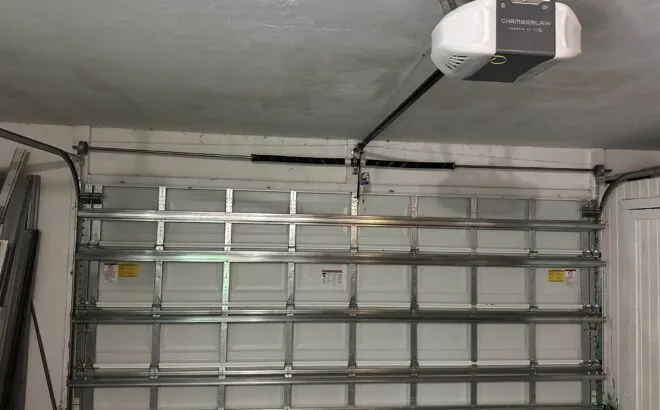
- Whether the coil above the opening has parted, so it looks like two short springs sharing one bar.
- Whether your door instead has a long spring stretched beside each ceiling rail, and whether one of them is dangling or gone.
- Whether a lift cable at either bottom corner has come away and is lying on the floor.
Spring problems we handle in Roxbury
The coil over the header has split
This is the call we get most. Once the bar-mounted coil parts, the door has no counterweight and the motor cannot cope with the load.
Side springs on older, lighter doors
Many older doors hang from a stretched spring on each side instead. One snapping leaves the door lifting lopsided, with its twin on borrowed time.
Springs that have gone soft
Nothing has visibly broken, yet the door no longer stays put halfway, and the motor groans on the way up. Fatigued steel needs replacing just the same.
Cables thrown when a spring lets go
A breaking spring often throws its cable off the drum. The cables are checked and reset as part of the job; see our garage door cable repair page for more on that side.
Rust from a wet garage
A rear garage that takes run-off from a sloping drive stays damp. Rust pits the coils, and a pitted spring breaks early.
Doors that were wrongly sprung
Springs that were never sized for the door, often after an earlier home repair, leave it heavy or wanting to fly up. Correctly matched springs put that right.
How a counterbalance spring does its work
A sectional door is heavy, far heavier than it feels on a good day. The lightness is borrowed from the springs, which soak up energy as the door comes down and hand it back as the door goes up. A torsion setup keeps that energy in one or two coils twisted tight around a shaft that spans the header. An extension setup keeps it in two long springs that stretch out beside the ceiling rails every time the door shuts.
So the lifting is the springs’ job, not the opener’s. The motor only guides the door along; the cables only pass the force down to the bottom corners. When a spring snaps, that stored energy vanishes at once, and the door’s whole weight is left hanging on the cables and pressing on the opener’s drive. Hence the shock of it: a door that rose easily on Tuesday will not budge on Wednesday.
Spring steel is rated for a set number of up-and-down trips before it fatigues. One car leaving in the morning and coming back at night spends those trips slowly. A rear garage behind a three-decker, opened by whoever in the building needs it, spends them several times faster, and its springs wear out on a schedule nobody planned for.
Keep your hands off the torsion spring
Put plainly, the torsion spring over a Roxbury garage door holds dangerous tension, and it is not a DIY repair. With the door down, that coil is wound hard enough to raise the whole door, and the only thing holding it is a pair of set screws in the winding cone at its end. Slacken those without the proper winding bars seated in the cone, or let a bar slip, and the cone spins free and hurls the bar or anything else in its path. Serious injuries happen exactly this way, usually to someone following an online video with a screwdriver in place of a winding bar.
Side springs are dangerous in a different way. If one breaks and no restraint cable runs through its middle, the broken ends fly across the garage like a whip. Older doors in rear garages do not always have those restraint cables, and adding them is part of any extension spring job we do.
Safe things to do: pull the opener’s plug, keep everyone and every car clear, and leave a closed door closed. Unsafe things: hauling a door with a broken spring up by hand, wedging it open on a ladder or a scrap of timber, touching any screw on the torsion shaft, or unhooking a side spring from its pulley or bracket.
What a broken spring does to everything else
A spring rarely fails alone. When the coil lets go it unloads suddenly, and the cables can jump off their drums, the shaft can shift sideways in its bearings, and the door can drop the last few inches onto the slab. If someone then presses the button, the motor is suddenly heaving at a door it was never built to raise unaided. Some openers stall and protect themselves; others strip a drive gear, bend the rail that runs to the ceiling, or pull the door’s top bracket out of the top section.
That is why a spring visit always includes the parts around the spring. The plates carrying the shaft at either end, plus the centre bracket, get checked for cracks and wobble, both drums are inspected for a thrown or kinked cable, and the top section is looked at where the opener’s arm attaches. For a motor that has been strained or stripped, the Roxbury opener repair page explains the options.
Garage door spring repair Roxbury MA: what the visit involves
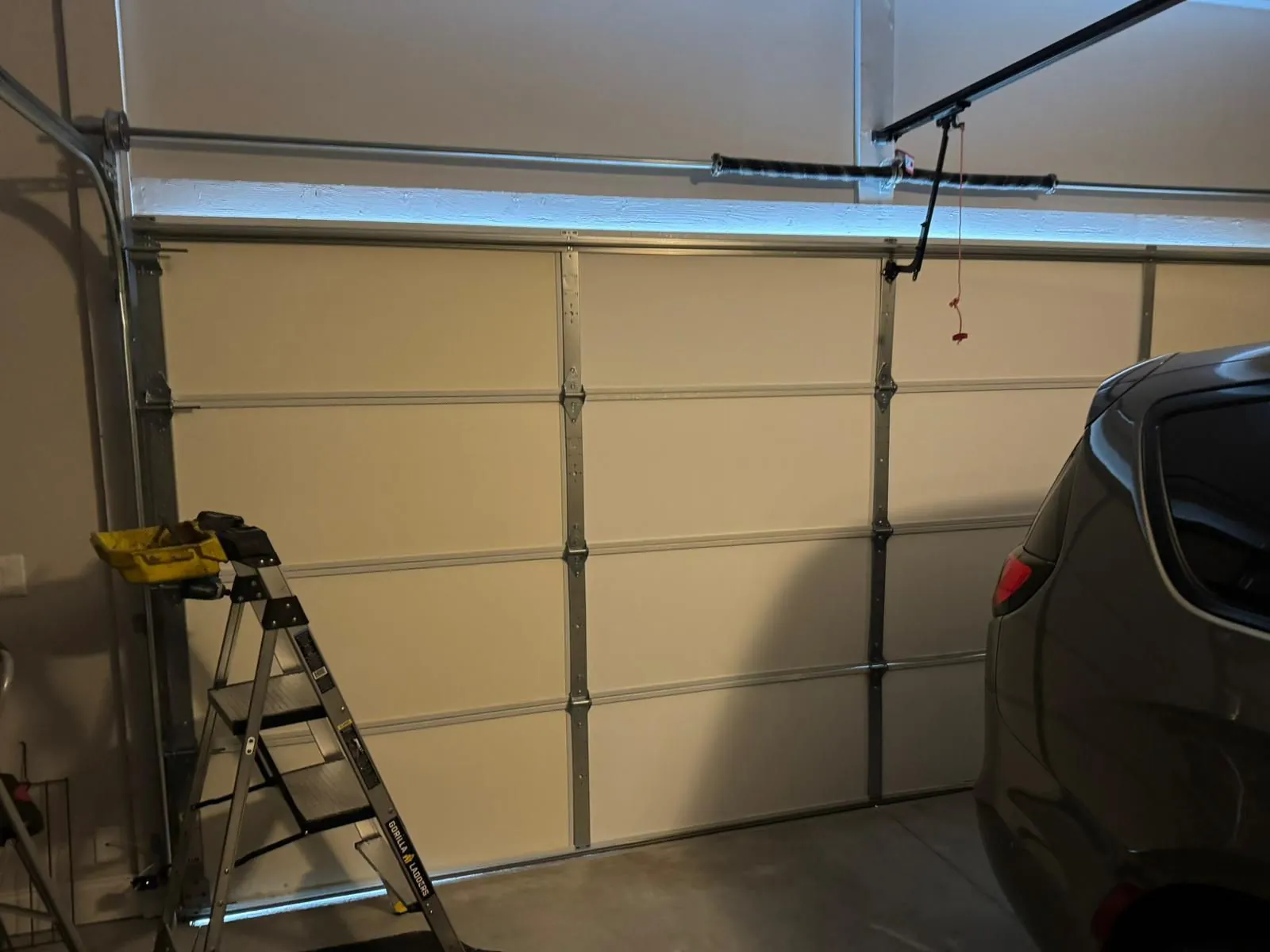
Springs are never fitted by eye. On any garage door spring repair Roxbury MA homeowners call us for, the job opens with working out the exact spring the door wants, since an undersized spring leaves the door a dead weight while an oversized one has it bouncing open and refusing to stay shut.
- With the opener unhooked, the old spring is measured: thickness of the wire, inside diameter of the coil, its overall length and which way it is wound. The size and weight of the door come into it as well.
- On a door with two torsion springs, the pair are normally changed at once. The surviving spring has done every trip the broken one did and is living on borrowed time.
- With the spring off the shaft, the surrounding hardware is examined: end bearing plates, the centre bearing, the drums and both cables.
- The new spring is wound the correct number of turns using proper bars, the set screws are tightened down, and the two cables are set to the same tension.
- The door is balanced by hand first, and the opener goes back on only after that, with its travel and force reset to suit a door that has its counterweight back.
Nothing new goes on the door until you know what broke, what else looks tired and what we suggest, and the work waits for your go-ahead.
Steep drives, wet slabs and spring wear
The grades around Fort Hill leave their mark on springs too. A slab that falls with the land means the door meets the floor at one corner before the other, and each landing jolts the spring and cable on that side harder than the other. Repeated over a few thousand trips, that lopsided loading shows up in the coils and the drums.
When the drive slopes down to the garage, so does every downpour. Water pools at the door and creeps into the slab, and the garage stays damp from autumn to spring. Spring steel suffers in that air: rust blooms between the coils, the coils grind against each other as they wind and unwind, and the pitted spot is where the break eventually comes. A wooden door in a damp garage also soaks up water and gains weight, so a spring that was the right size when fitted ends up fighting a heavier door every day.
On a door like that, garage door spring repair Roxbury MA owners book is a chance to put the balance right for the door as it now is. Sometimes that means a stronger spring, sometimes a change of seal or a look at the bottom section, and occasionally a frank word about the door itself.
Garages with little room above the door
Some rear garages behind Roxbury’s older houses leave only a slim strip of wall above the door before the rafters or joists begin. That matters for springs, because a torsion shaft needs room above the door and a standard track arrangement needs room to curve back under the ceiling. Where the headroom is tight, the door may run on side springs, or on a low-headroom arrangement with the shaft mounted differently.
When a spring breaks on a door like that, the replacement must fit the garage’s limits and the door’s weight at once. Swapping a low-headroom setup for a standard one without the room to do it leaves the door rubbing the ceiling or the opener with nowhere to mount. Part of the measuring at the start of a visit is checking what the garage itself allows, so the replacement fits the building as it stands.
Looking after a new spring
A spring that has just been fitted will last longest when the door it serves stays in balance. A thin wipe of spray lubricant made for garage doors along the coils, spring and autumn, keeps the coils from grinding against each other and slows rust in a damp garage. Keeping the bottom seal in good order helps too, because a door that lands squarely puts an even load on both sides. And in a shared garage, a door that is closed gently rather than run up and down repeatedly by children or visitors keeps more of its cycles for the jobs that matter.
None of this needs tools near the spring itself. If a coil starts to look dry or rusty, or the door begins to feel heavy again, that is a reason to call rather than to adjust anything.
Cold mornings and the sound from the garage
Spring breaks seem to bunch up when the weather turns cold, and a garage at the back of a Roxbury lot, unheated and often damp, feels every frost. Steel that is already fatigued is at its most brittle on a freezing morning, and the first person to open the door that day is the one who hears the crack. The spring was not broken by them; it was ready to go, and the cold and one more cycle finished it.
Nobody can change the weather. What can be done is catching a spring on its last legs before it fails, which beats replacing it with a car shut inside on an icy morning.
The shared driveway on the day of the repair
A replacement spring for a single-car door is long and heavy, so are the winding bars, and the shaft sits high enough to need a ladder. When the garage sits at the top or bottom of a steep shared drive, all of that travels on foot from wherever the van can stop. Clearing cars from the shared stretch, leaving room just inside the door, and letting the neighbours know about the visit all make the job go more smoothly.
If a car is trapped behind a door with a broken spring, resist the urge to force the door. Fitting the new spring frees the car with far less risk than a pry bar. If it really cannot wait, the Roxbury emergency repair page sets out how to keep the door safe until help arrives.
Signs a spring is getting close to breaking
Springs usually drop hints first, and in a building where several households share one garage, everyone should know what they sound and look like:
- Lifting the door by hand has become noticeably harder.
- Left halfway, the door slides down, or rises by itself.
- The motor labours, or the door slows near the top.
- A thin gap, or a crust of orange rust, has opened between two coils.
- Instead of settling gently, the door has started to slam down.
Spot any of these and book a spring check while the door still opens.
Repair the spring, or replace the door?
In most Roxbury rear garages a broken spring is a repair and no more. Once matched springs are fitted and the cables and bearings are sorted, the door goes on as before. A new door only enters the conversation when the door itself is the trouble: sections rotted or rusted through by run-off, a timber door so waterlogged it cannot be balanced, or panels so battered by knocks on a cramped drive that the door no longer runs straight. Those cases are covered under new garage doors in Roxbury.
Spring work is one branch of our wider garage door spring service. Other faults these garages throw up, from rollers and rails to panels, are on the Roxbury garage door repair page, and the full local picture sits on the Roxbury page.
Getting a broken spring replaced
A spring never picks a convenient moment, but whoever answers our phone is there at any hour on any day, so the break can be logged the minute someone finds it. To make the first call about garage door spring repair Roxbury MA homes need go faster, tell us whether there is one coil above the header or a spring along each rail, whether a car is stuck inside, and how the garage is reached from the road. With that, call us or book online, whichever is easier.
Questions from Roxbury
There was a loud crack in the garage and the door barely moves now. A spring?
Almost certainly. A torsion spring parting sounds like a gunshot or a dropped board, and afterwards the motor can lift the door only an inch or two before giving up. Pull the opener’s plug, leave the door down and look up for a gap in the coil.
Could I fit a new torsion spring with a set of tools from the hardware store?
Please do not try. Because the coil stores enough force to lift the whole door, the winding cone can spin and fling a bar if anything slips. This is work for someone with proper winding bars who does it every week.
Only one of our two springs snapped. Why change both?
They have done exactly the same number of trips, so the survivor is near the end too. Changing both keeps the two sides pulling evenly, and you avoid a repeat call when the older one gives way.
Why do the springs on our shared garage break so often?
Every trip uses up part of a spring’s working life. A rear garage serving several households cycles far more than one serving a single family, and a damp garage at the foot of a sloping drive speeds up rust on the coils.
Our door has long springs beside the overhead rails. Is that a different job?
Those are extension springs, still common on older and lighter doors. They are changed as a pair, a restraint cable is run through each one, and the door is rebalanced before the opener goes back on.