
Why openers on Roxbury’s rear garages have a hard life
A rear garage behind a three-decker near Nubian Square, or behind a Victorian up on Fort Hill, often has one opener doing the work for a whole building. Row houses nearby tend to have no garage at all, so the garages that do exist get used hard, and the opener above the door is pressed into service every time anyone in the house needs the car, the bikes or the storage. Garage door opener repair Roxbury MA owners ask for is usually about a motor that has simply been run more, and asked to do more, than the one on a typical single-family garage.
The setting adds its own strain. A door that closes onto a sloping slab gives the opener a confusing signal about where the floor is. A car waiting on a steep shared driveway while the door creeps up makes every slow or stuttering opening feel urgent. And a garage tucked at the back of the lot can sit right at the edge of a remote’s reach.
Three quick observations help us before you ring, and none needs a screwdriver:
- When someone presses the button, does the ceiling unit’s lamp light up, and can you hear the motor try?
- Does the door obey the button on the wall but ignore the handheld remote, or is it the reverse?
- Does the door set off downward, then halt and climb back up of its own accord?
Opener faults we fix in Roxbury
Motor running, door going nowhere
A worn plastic drive gear, a weak start capacitor, or a snapped spring leaving the motor far too much to lift. Finding which matters; spring failures are covered on Roxbury spring repair.
Handheld remotes gone quiet
Sometimes it is just the battery. Sometimes the remote has dropped out of the opener’s memory, or the garage sits so far down the shared drive that the signal barely gets there.
The button by the side door does nothing
The switch itself may be cracked, or the thin bell wire stapled along the studs to the ceiling unit has been nicked, pinched or pulled loose.
Eyes that keep reversing the door
Those two little sensors near the slab need an unbroken line of sight. A slab that tilts, a rolled bin or a swung car door easily throws them off.
Stopping short, or pressing too hard
Travel and force settings drift out of step with the door, especially after a new seal or spring, or when the slab itself has shifted.
Units too far gone to save
Where the motor, the logic board or the rail has failed beyond sensible repair, we install a new opener. LiftMaster is one of the makes we repair and replace; more on LiftMaster opener repair.
Inside the box on the ceiling
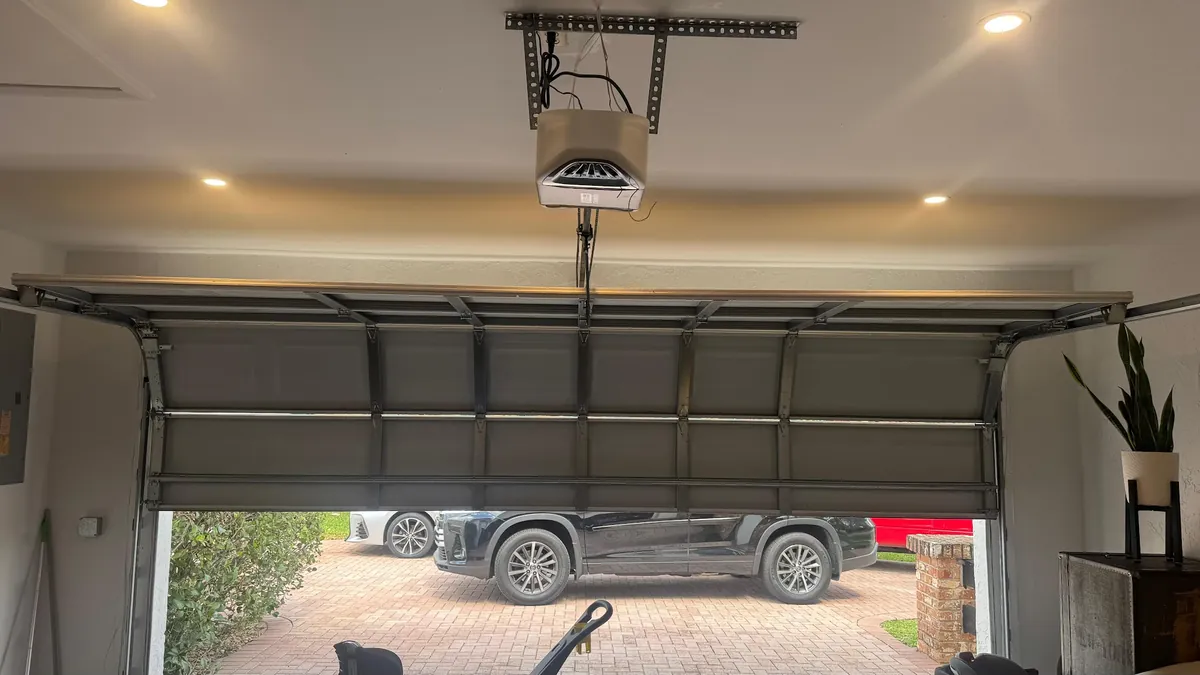
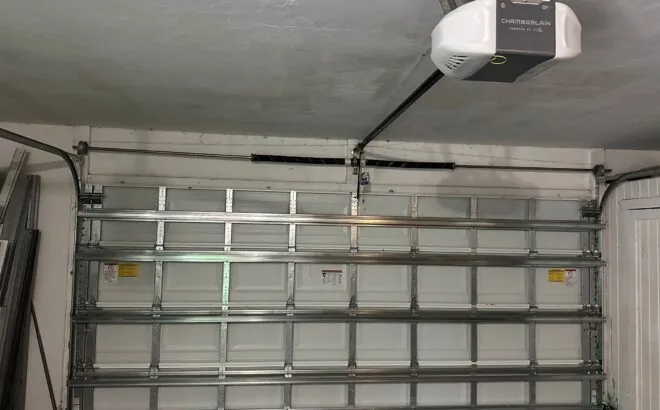
Look up in most Roxbury rear garages and you will find the same arrangement: a powered head unit screwed to the joists, a long rail running from it to the header over the door, and a carriage on that rail joined to the top section by a bent steel arm. Inside the head, an electric motor drives a chain, a toothed belt or a long threaded rod, and that drags the carriage back toward the head to raise the door or pushes it forward to lower it.
The head unit was never designed to be a crane. Its job is to steer a door that the springs have already made nearly weightless, and a sound door, unhooked from its carriage, rises under one hand. Weaken a spring and the motor is suddenly heaving dead weight; that is how gears strip and boards cook. So any garage door opener repair Roxbury MA homeowners book begins by looking at the door first and the motor second.
The logic board inside the head also runs the safety side. It reads the photo eyes, it remembers how far to travel up and down, and it keeps a force limit that tells it when resistance means an obstruction rather than just a heavy door.
Sloping slabs and the opener’s sense of the floor
Around Fort Hill the slab under many rear garages follows the fall of the lot, or the driveway runs downhill straight into the opening. Openers are set up assuming a flat floor. When the slab is lower at one jamb than the other, the high corner of the door touches first, the board reads the extra resistance, and depending on how the limits and force are set the door either stops early and leaves a gap on the low side, or keeps pushing and crushes the seal on the high side.
Either way the opener is being asked to do something awkward hundreds of times a year. A door that reverses for no obvious reason just as it reaches the floor is often this: the board thinks it has hit an obstacle when it has only hit the high side of the slab.
The answer is setting the opener up for the floor that is actually there. The down limit is set to stop the door when the seal meets the slab along its length, the force is set high enough to close properly but low enough to reverse if something is in the way, and the seal itself may be changed or trimmed to fill the uneven gap. Our Roxbury garage door repair page explains how the rest of a door is set up on a tilted slab.
One opener, a whole building’s remotes
When a rear garage serves several units of a three-decker, the opener may have half a dozen remotes paired to it, some of them long since lost or taken away when a unit changed hands. Every remote still in its memory is a remote that can open the garage. Tidying that up is a routine part of an opener visit: the opener’s memory is cleared, and the remotes that are actually in use are paired again, one by one.
Range is the other issue. A garage at the back end of a lengthy shared driveway, or tucked behind a house on a steep grade, can be at the very edge of what a remote can reach from the street. Before deciding a remote has failed, it is worth trying it standing right in front of the door. If it works up close but not from the car, a fresh battery, repositioning the opener’s antenna or adding a receiver closer to the drive often fixes it.
Wall buttons on shared garages take their share of knocks too. A button mounted by the side door, jabbed by everyone in the building with their arms full, wears out or gets knocked off its screws, and the wire behind it gets stapled through, pinched or chewed by something living in the garage.
The photo eyes on a tilted slab
Low down on each side of the doorway sits a small sensor, and the pair talk to each other with an invisible beam. Should anything cut across it while the door is coming down, the board flips the door’s direction. Lose the beam altogether and the remote will not close the door at all, or the door will dip an inch and spring straight back.
Rear garages on Roxbury’s slopes give those sensors a rough time. Recycling bins dragged past clip the brackets. Snow pushed off the drive piles against them. A car door flung open in a single-width garage knocks one sideways. And with the slab out of level, the two eyes rarely sit at the same height above the concrete, so lining them up by eye is harder than it looks.
Most eyes carry a tiny indicator lamp. Matching steady lamps mean the beam is getting through; one lamp dark or winking means it is not. Anyone can safely polish both lenses with a dry cloth and shift whatever is leaning on a bracket. Wrenching a bracket back into place by hand usually makes the aim worse, so if the lamps still disagree, leave the realigning to us.
Frozen seals and winter mornings
On a lot where the drive tips toward the garage, water runs to the door and sits there, and on a cold night it can freeze the bottom seal to the slab. The next morning someone presses the button and the opener strains against a door glued to the floor. Depending on the force setting, it either reverses straight away, or it keeps pulling until the seal tears, the top section bends where the arm is bolted on, or the drive gear gives up.
When a frosty-morning door refuses to rise, leave the button alone, unplug the head unit and look at the bottom of the door: if the seal is frozen down, it can be freed with gentle warmth, never with a crowbar or a kettle of boiling water that will refreeze in the gap. Sweeping away standing water and slush before a hard frost helps, and a seal and down-limit set correctly for the slope leave less of a channel for water to gather in.
Garage door opener repair Roxbury MA: what a visit involves
The door gets examined ahead of the head unit, because no motor survives long on an unbalanced door. With the carriage unhooked, we lift the door ourselves to feel how well the springs are carrying it. A failed spring gets dealt with first; mending a head unit only for the same dead-weight door to wreck it again would be money wasted.
The opener is then tested one piece at a time:
- The motor runs with the door unhooked, so we can hear whether the gear or chain is slipping.
- Each remote gets tried twice, once beside the door and once from the bottom of the drive, and the wall button too.
- The two eyes are checked for aim, damaged wire and a clean beam.
- Travel and force settings are compared with the real door on the real, sometimes sloping, slab.
- The rail is checked where it meets the header and where it hangs from the joists, since a rail that shifts makes the carriage bind.
Nothing is fitted or replaced until you know what has gone and which options make sense, mending the existing unit or fitting another, and you have said yes. To finish, travel and force are set on site, the remotes still in use are paired, and a scrap of two-by-four laid across the threshold confirms the auto-reverse does its job.
Sounds worth mentioning when you call
An opener usually complains before it quits, and the sound says a lot about which part is going. A grinding or clicking from the head unit, with the carriage not moving, points to a worn drive gear. A slapping or rattling chain means slack in the chain or a loose rail. A loud hum with no movement can be a failed start capacitor, or a motor fighting a door that a broken spring has left too heavy to move. Squealing from the door itself, rather than the head unit, is usually dry rollers or hinges, which make the opener work harder on every trip.
On a shared rear garage, ask whoever uses the door most what it has been doing lately. A note of the sounds, and when they started, makes garage door opener repair Roxbury MA homeowners book far quicker to diagnose, and it sometimes shows that the opener was the victim rather than the cause.
Getting to the garage on the day
The head unit lives on the ceiling just behind the door, so the work needs a ladder in the garage and room underneath it. On a garage reached by a steep shared driveway, it helps if the cars can be moved out of the shared stretch, if the floor under the opener is cleared, and if the neighbours who share the drive know a visit is planned. Should the motor die with the door down and the car trapped, see the Roxbury emergency repair page for freeing it by hand safely, springs permitting.
Using the manual release when the power goes
Hanging from the carriage on every opener is an emergency release, normally a cord with a red handle. A firm pull unlatches the carriage, and the door becomes an ordinary manual door. That is handy in a power cut or when the motor has died, but only when the springs are sound. If the door feels like lifting a car, or a spring has visibly snapped, do not try; that weight lands on you, and the door can fall.
Pull the release with the door shut wherever you can. Unlatching a door that is open on a weak spring can let it crash down. When power returns, running the opener once usually re-engages the carriage by itself; if it does not, the latch can be clicked back by hand.
Mend the opener or replace it?
Plenty of opener trouble comes down to small, simple parts: an eye knocked off aim, a remote that has lost its pairing, a cracked wall switch, a chewed drive gear or a tired capacitor. With a healthy motor and a straight rail, mending is normally the better call.
A new unit earns its place once the motor windings have gone, when the logic board has fried in a unit old enough that replacement boards are scarce, or when a long fight with a broken spring has wrecked the drive. It also makes sense when the old unit simply suits the garage badly, such as a rail too long for a low rear garage. A new opener is set up on the spot for this door and this slab, with travel, force, eyes and remotes all tested before we pack up. Openers are one strand of our garage door opener service.
When the door is beyond saving as well, fitting the new opener alongside the new door is the sensible order; new garage doors in Roxbury covers that. Every service we offer in the neighbourhood is gathered on the Roxbury page.
Booking an opener repair
A head unit that quits with the Roxbury garage shut, or refuses to close it at bedtime, wants sorting promptly, and someone takes our calls at any hour, weekends and holidays included. Garage door opener repair Roxbury MA homes need goes faster when we know four things up front: whether the lamp and motor come on, whether the wall switch or the remotes are at fault, whether the door turns back on its way down, and how we reach the garage from the road. Note those, then call us or book online, whichever suits.
Questions from Roxbury
The lamp on the opener lights up, yet the door stays put. Why?
Usually a chewed drive gear, a chain or belt slipping on its sprocket, or a door suddenly too heavy because a spring has let go. Pull the plug and check the coil above the door for a gap before anything else.
Our door dips, then climbs back up instead of closing. What causes that?
The board believes something is blocking the doorway. Most often the eyes are knocked off aim or grimy, or the travel and force no longer match a sloping slab. Clean both lenses and clear the area; if it carries on, ring us.
Can old remotes be locked out of our shared garage?
Yes. Clearing the opener’s memory wipes every remote it knows, and we then re-pair only the ones the building is still using.
My remote only works from right beside the door. Is it dead?
Possibly not. Swap the battery first. Where the garage sits at the far end of a long or steep shared drive, moving the antenna or adding a receiver nearer the street often restores the range.
Is a LiftMaster in our garage something you can fix?
Yes. LiftMaster is one of the makes we repair and replace, together with its remotes, wall controls and photo eyes.