
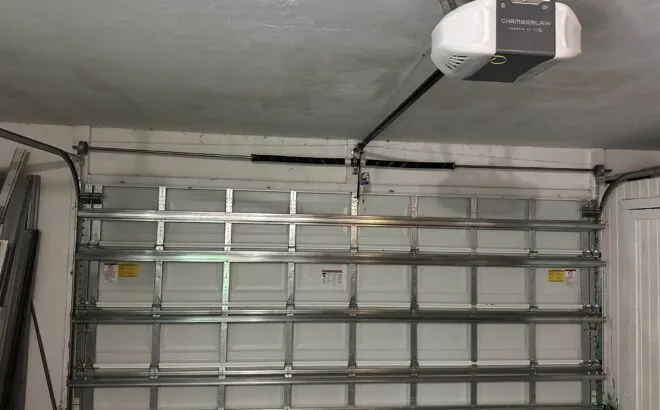
Why springs fail so often on Seaport’s parking and loading doors
Seaport is new construction, and its housing keeps cars in parking structures built into each building instead of private garages. What keeps those buildings moving is a set of commercial overhead doors at the vehicle entrances and loading-bay doors round the back, and on every one of them it is the springs that do the lifting. Garage door spring repair Seaport MA buildings need is usually a matter of springs that have simply run through their working life far sooner than they would on a house door, because the door they balance opens and closes all day.
A spring is rated for a number of open-and-close cycles. A house door might take years to use that up. A parking-entrance door that opens for every resident, every visitor and every delivery can use it up in a fraction of the time. Once that count runs out, the steel cracks through, the whole weight of the door lands on the operator, and the operator gives up.
Before calling, and without going near the spring or the shaft, look for:
- A visible gap in the coils of one of the springs over the opening, or a spring hanging loose beside a track.
- Cables slack or hanging off the drums at either end of the shaft.
- A door that stopped after rising only a short way, or will not rise at all, with the operator straining or humming.
The springs on these doors
Torsion springs on a shaft
Most wide sectional doors in a parking structure are balanced by torsion springs wound onto a steel shaft above the opening. Large doors often use two or more springs sharing the load.
Springs inside a roll-up barrel
A rolling steel loading door hides its springs inside the barrel the curtain coils around. They are adjusted from the end of the barrel and carry the curtain’s full weight.
Extension springs
Lighter sectional doors, such as a service door at the back of a building, may use extension springs that stretch along each horizontal track. They need safety cables run through them.
Cables and drums alongside
A spring failure often takes a cable with it, or leaves a cable off its drum. The cables are checked and replaced as part of the same job; broader fixes are on the Seaport garage door repair page.
Why the number of cycles matters so much here
A garage door spring is a length of hardened steel wire coiled under tension. Every time the door closes, a torsion spring is wound a little tighter; every time it opens, it unwinds. Each of those movements flexes the wire, and over enough cycles the steel fatigues and a crack forms, usually where the spring is gripped by its winding cone or at a point in the coil that carries the most stress. The spring does not wear gradually in a way you can see. It holds, and holds, and then it breaks.
That is why, for garage door spring repair in Seaport, the usage of a door matters more than its age. A door in a Seaport building may be new, painted, clean and quiet, and still be close to the end of its springs because it has done in a short time the work a suburban door does over many years. A door that serves a busy parking entrance, with a close timer that brings it down after every car, may run more cycles in a day than a house door does in weeks.
When a spring on a door like this is replaced, it is worth talking about how it is sized. Springs are made in many wire thicknesses, diameters and lengths, and a spring with heavier wire and more coils spreads the stress over more steel and lasts more cycles. Matching the spring to how the door is actually used, rather than only to what was fitted when the building opened, is the most useful decision in the whole job.
Warning signs before a spring lets go
There is rarely much notice, but on a door that is watched there are often clues:
- The door has started to feel heavier when it is moved with the operator disconnected, or it no longer holds when stopped partway.
- The operator sounds as though it is working harder, or the door slows near the top of its travel.
- The door closes faster or harder than it used to.
- On a door with two springs, one shows a gap in its coils while the door still runs on the other, unevenly.
- A loud bang from the parking entrance or dock with no obvious cause. That is very often a spring letting go.
A building that logs these reports from the security desk or the parking attendant is in a good position to have a spring replaced on a planned visit rather than in a hurry.
Why spring work is never a DIY or general maintenance job
A torsion spring on a wide commercial door holds dangerous tension. It is wound tight enough to counter the whole mass of a heavy steel door, and that stored energy stays in the spring whether the door is up or down. The cones at each end are held to the shaft by set screws, the shaft is held by bearing plates, and the cables are tight on the drums. Loosen any of them out of sequence, or with an improvised tool, and the spring can unwind instantly and hurl a winding bar, a cone or a cable end hard enough to break bones.
This is not a repair for a resident, and it is not a task for a building’s general maintenance staff either. It needs proper winding bars, clamps to secure the door, the right replacement spring, and the experience to know what the shaft, drums and cables should look like before and after. Extension springs are hazardous in a different way: a stretched spring with no containment cable threaded through it can whip across the room when it breaks or when a hook is released.
Once a spring has broken, the door stays exactly where it stopped, people and cars stay back, and nobody tries to raise it by hand, by the manual release or with the operator.
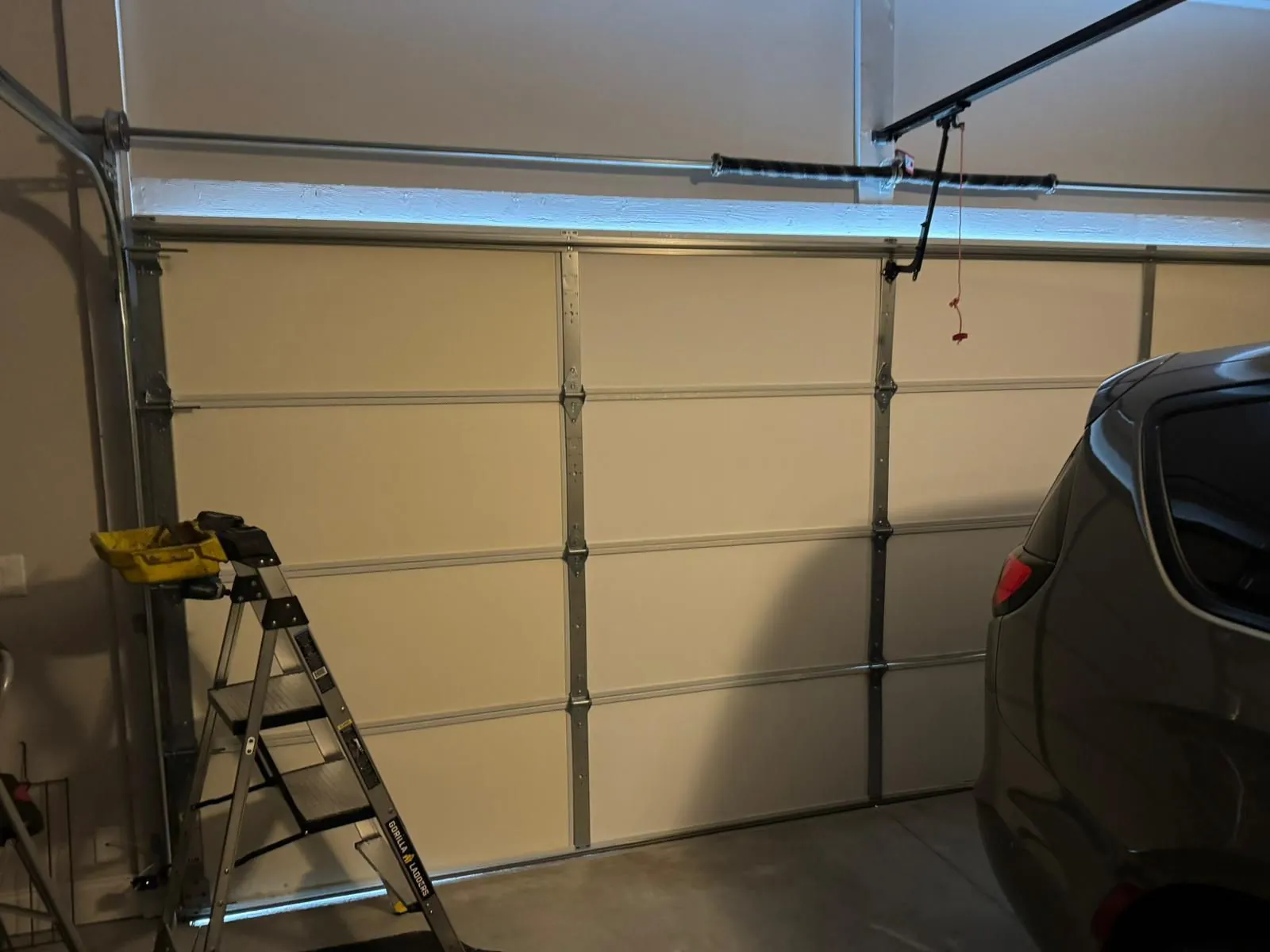
What a spring replacement visit involves
The visit starts with access and safety. Building management clears the technician into the parking structure or the dock; the area under the door is closed with cones or someone stationed to stop traffic; the operator’s power is cut so no card, fob or button can start the door mid-job.
The door is then secured. On a sectional door that is usually clamps on the tracks so the door cannot move once the counterbalance is released. On a roll-up, the curtain is held and the barrel’s tension managed from the tension end.
Any tension still in the springs is let down in a controlled way. The broken spring is measured for wire size, inside diameter, length and wind direction, so that its replacement balances the door properly. On a door with more than one spring, the other spring is normally replaced at the same time: it has worked every cycle its partner did and will not be far behind.
The new springs are fitted and wound to the turns that balance the door. The cables are checked, re-seated on the drums and set to equal tension. The bearings and drums are checked for wear. Then the door is tested by hand: a balanced door raised partway should stay close to where it is left. Finally the operator is reconnected, its limits and force are set for the newly balanced door, and the safety reversal is tested before the ramp or dock is reopened.
Long springs, freight elevators and getting parts on site
Springs for a big commercial door are long and heavy, and sometimes the shaft has to come out as well. In a Seaport building, getting those parts to the door is part of planning the job. A parking entrance at street level can be reached directly; a door on an upper parking level, or a loading door reached through the building, means springs, shafts, ladders and clamps travel in the freight elevator.
The freight elevator is booked for moves, deliveries and other trades, so a planned spring replacement works best when the time is agreed with management and the elevator is reserved for the start and end of the visit. Where a spring has broken unexpectedly, it still helps to say on the call how the door is reached and who controls the elevator, so the visit is planned around it.
It is also worth sending a photo of the springs and the label on the door or operator, if there is one, when you get in touch. That helps make sure the right replacement is on hand. A clear photo of the winding cones and the drums at each end of the shaft is just as useful, since it shows how the springs are mounted.
Garage door spring repair on roll-up loading doors
A roll-up loading door does not look as though it has springs, but it does: they sit inside the barrel the curtain wraps around, and a tension wheel or plate at one end lets them be adjusted. When one breaks, the curtain becomes too heavy to raise, or it drops unexpectedly when the operator lets go.
Garage door spring repair in Seaport MA loading bays starts with taking the curtain’s weight off the barrel and releasing the remaining tension safely. The barrel may need to be lowered from its brackets to get at the springs, which on a wide door is heavy work at height, with the bay closed while it goes on. The springs are replaced, re-tensioned, and the curtain is run through its full travel to check it coils and uncoils evenly and stays where it is stopped.
Extension springs on smaller service doors
Not every door in a Seaport building is a big parking-entrance door. Smaller sectional doors at a bike room, a storage area, a trash room or a secondary service entrance are sometimes balanced by extension springs instead of torsion springs. These run alongside each horizontal track, stretch as the door closes, and pull the door up through a set of pulleys and cables as it opens.
Extension springs wear in the same way, by fatigue, but they fail differently. When one breaks, the door lifts crooked on the remaining spring, and the broken spring can whip across the room unless a safety cable runs through the middle of it to contain it. Doors that were fitted without those safety cables, or where the cables have been removed, should have them put back when the springs are replaced.
Extension springs are always replaced as a pair, with the pulleys and cables checked at the same time, since a worn pulley or a frayed cable on one side will unbalance even a new pair of springs. The door is then adjusted so it travels level and holds its position when stopped partway.
Planning spring changes instead of waiting for a break
For a building, a spring that breaks in the middle of the evening rush is the worst way to find out it was worn. Because a parking or loading door’s springs fail by cycle count rather than age, a building can plan around them. Some useful habits:
- Keep a simple log of when each door’s springs were last replaced and anything reported since.
- Ask the security desk or parking staff to note any change in how the door sounds or moves, and to report a bang straight away.
- When one door’s springs are replaced, ask whether a sister door that runs a similar number of cycles is likely to be close behind.
- Where a door runs far more cycles than it was specified for, talk about heavier springs sized for the real use.
Garage door spring repair Seaport MA property managers book in advance can be timed for a quiet part of the day, with the freight elevator reserved and residents told about the closure, which is far easier on everyone than an unplanned breakdown.
What a broken spring damages on the way
A spring failure takes other parts with it more often than people expect. A door that drops when its spring fails can bend its bottom section or bottom bar on the floor. A cable that suddenly loses tension can jump its drum and tangle. An operator that keeps trying to lift a dead weight can strip its gears or burn out its motor. A door run lopsided on one spring can twist and pull its rollers out of the track.
This is why a spring visit includes a look at everything the spring connects to, and why the door should not be run once a spring has gone. Where the operator has been damaged, the Seaport opener repair page covers what can be done. If the door itself is bent past saving, read new garage doors in Seaport on planning a replacement around building access.
Broken spring at night
Springs break when the door moves, and parking doors move at every hour. A spring that breaks late in the evening can leave residents’ cars shut in, or a parking entrance unable to close. Someone picks up our line whatever the time, any day of the week, so the break can be reported straight away; Seaport emergency repair lists the safe steps for the meantime.
Booking a spring replacement
Spring work city-wide is explained under garage door spring repair. Our Seaport hub lists all our services in the neighbourhood, and larger doors for businesses appear under commercial garage doors.
When you ask for garage door spring repair Seaport MA buildings depend on, give the building contact, which door and which level, whether the freight elevator is needed, and the door’s current position, open, shut or in between. Then call us or book online to set up the visit.
Questions from Seaport
There was a loud bang at the parking entrance and the door has stopped. What broke?
Almost certainly a spring has broken. The bang is the spring snapping and unwinding. Stop anyone from triggering the door, keep cars clear of it, and call. Running the operator against a door with a broken spring can damage the operator and the cables.
The door still works but one spring has a gap in it. Can it wait?
It should not wait long. The remaining spring is carrying the whole door and has done the same number of cycles as the broken one. The door is also lifting unevenly, which strains the cables and tracks. Book a visit soon and avoid running the door more than you must.
Why replace both springs when only one has broken?
On a door with two springs, both have worked through the same cycles. The one still intact is usually close to the end too, and changing the pair at once leaves the door evenly balanced and avoids a return trip.
Could the building’s own maintenance team swap the spring?
We would advise against it. A torsion spring on a commercial door holds dangerous tension, and releasing or winding it needs the right tools and experience. Leave the door alone and phone us.
Does the freight elevator need to be booked for a spring replacement?
Only if the door is reached through the building, such as an upper parking level or an internal loading dock. If it is, reserving the elevator for the start and end of the visit keeps the job to one trip.