
Why springs break so often in South Boston’s tight garages
A snapped spring is the call we take most often, and garage door spring repair in South Boston MA has its own wrinkles. Out behind the triple-deckers and row houses, the little garages tucked at the end of the lots on the numbered streets leave little headroom over the door and little room at the sides, which limits what kind of spring fits and where it can sit. The newer townhouse garages along the waterfront have more space, but their doors tend to run many times a day, and every run takes a little life out of the spring.
Whichever garage you have, nearly all of the door’s weight hangs on its springs. When it lets go, the door is suddenly far heavier than the opener was built to raise, and the usual result is a door that refuses to budge while the car you need sits behind it.
From a safe distance, these three checks tell you if a spring is the culprit:
- A visible gap partway along a coiled spring above the door.
- A stretched or dangling spring beside one of the horizontal tracks.
- A loud bang from the garage earlier, followed by a door that barely moves.
Spring problems we fix in South Boston
Torsion springs
Coiled springs wound tight around a metal bar mounted over the door. They store a large amount of energy and are replaced, never repaired, when they break.
Extension springs
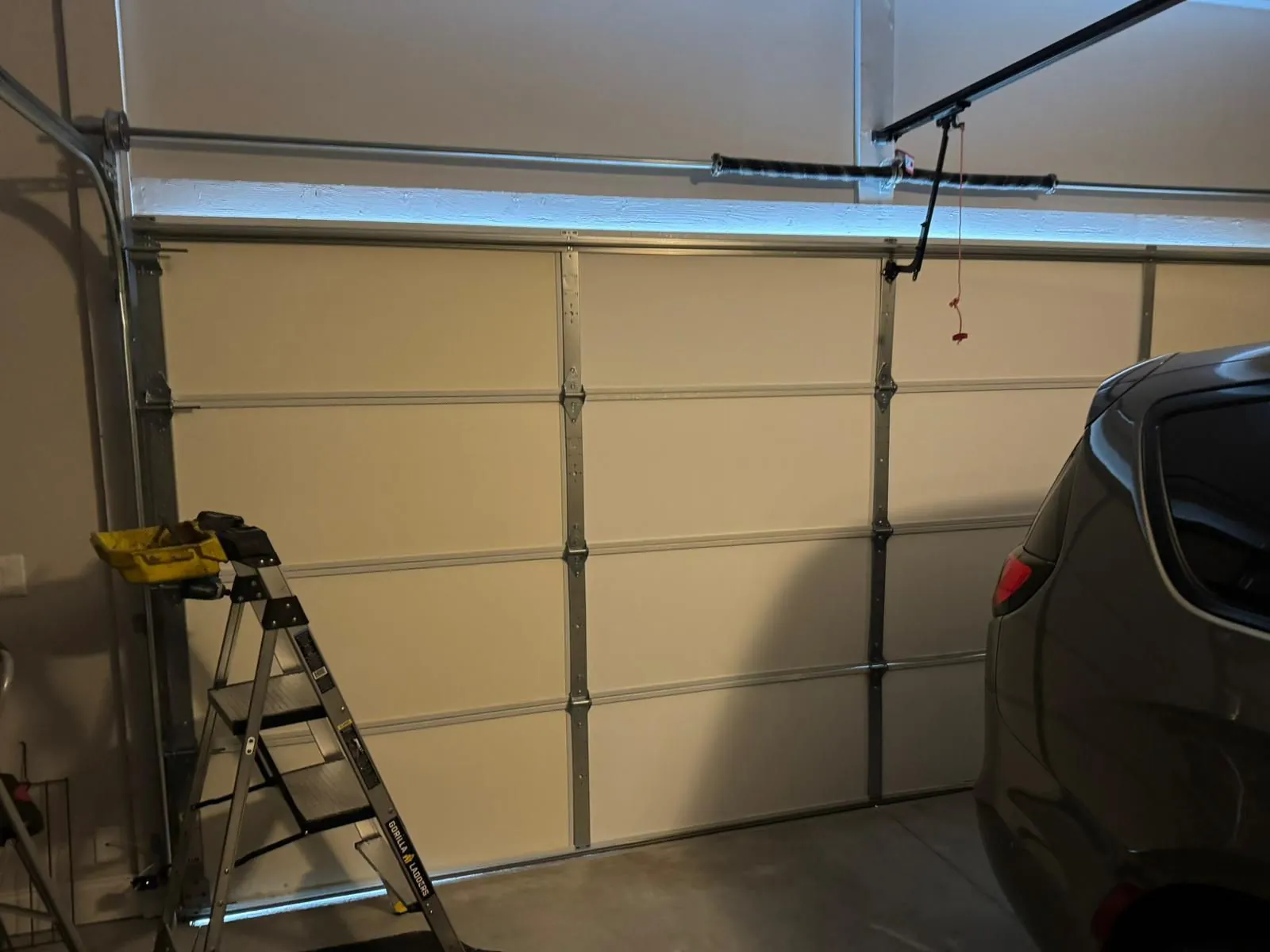
Long stretch springs that run back toward the rear wall, one over each horizontal rail. They should always run with a safety cable threaded through them.
Broken spring calls
A door that has dropped, will only rise a little, or is stuck shut after a bang. We make the door safe before anything else.
Matched replacement
A spring is chosen for the weight and the height of your particular door. On a two-spring door, both are normally renewed together so the pair stays balanced.
Torsion and extension: which one is in your garage
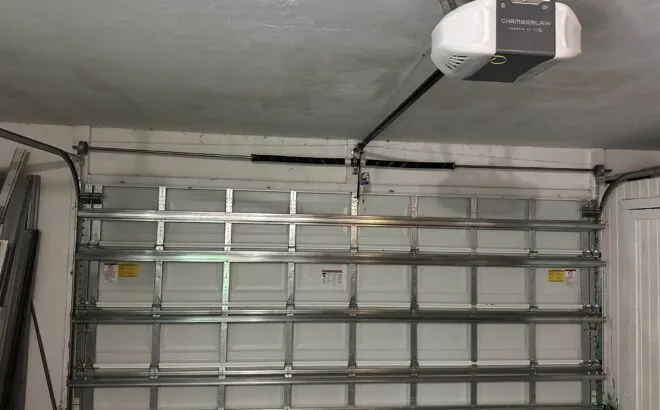
Look up at the inside of the door with it closed. If one or two thick coils sit on a rod spanning the header, with a drum at each end winding a cable, the door is on torsion springs. Stretched springs above each horizontal rail, joined to pulleys and cables near the back wall, mean extension springs.
Both kinds turn up in this neighbourhood. In some small rear garages the header leaves so little room that the spring hardware has to be chosen around the space rather than the other way round. Townhouse garages near the water usually have a little more height to work with. Telling us which type you see, and taking a photo of it from the floor, helps us bring the right springs on the first trip.
The two types also fail differently. A torsion spring normally breaks with a single sharp bang and stays on its shaft, showing a gap in the coil. An extension spring can snap and lash around the garage when nothing is threaded through its centre to hold it, which is why that cable matters, and why an old installation missing one is worth putting right even before anything breaks.
Leave the springs to us: the safety side
This needs saying plainly. A wound torsion spring holds dangerous tension, enough to break bones if it is released by accident. Unwinding or winding one takes proper winding bars, the right sequence and an understanding of where all that stored energy goes. A screwdriver or a loose bar in the winding cone is how people get hurt.
Extension springs are not much kinder. Under load they are stretched hard, and the brackets, pulleys and cables they work through are all carrying that force. Unhooking a loaded extension spring or loosening the bottom bracket a cable is tied to can turn a stuck door into a falling one.
So please leave the springs alone. The safe things to do are simple: unplug the opener, keep everyone out from under the door, and call. Garage door spring repair in South Boston is a job for someone who handles these parts every working day.
What changes when the spring snaps
The door itself has not got heavier; the spring was simply holding most of its weight, and now it is not. A single-car door that felt light as you raised it by hand becomes a dead weight. That has knock-on effects:
- The opener strains, lifts a few inches, then gives up, or it may grind until its own drive gear is damaged.
- The cables, suddenly slack on one side, can jump off their drums and tangle.
- If the door was open when the spring went, it may drift down or drop as soon as anything disturbs it.
That last point is why the red cord on the opener stays alone whenever a door with a dead spring is hanging part-raised. With the opener disconnected, nothing is holding the door up.
How we handle a spring visit
The first job on most calls here has nothing to do with springs: it is finding somewhere to put the van. The numbered streets fill quickly and driveways are narrow, so tell us when you ring where a vehicle might stop and whether a car blocks the way to the garage.
At the garage, the work follows a fixed order:
- The door is checked as it stands, and made safe if it has dropped or sits crooked.
- We confirm which spring has failed and check the other one, the cables, the drums and the centre and end bearings.
- The door’s weight and height decide the size of the new spring or springs.
- You are told what has to be replaced and why, and the work goes ahead once you agree.
- The new springs are fitted and set, the cables are seated evenly on their drums, and the door is balanced so it stays put halfway up.
- With the motor hooked back up, the door makes several full trips while we watch and listen.
That half-open test is a good one to remember. A properly balanced door, lifted by hand to waist height with the opener released, should stay there. If it creeps down or rises on its own, the springs are out of balance.
Cramped garages and spring hardware
A small garage changes the job in practical ways. With a ladder that only fits in one spot, the order of the work is planned in advance. A torsion shaft that runs close to a side wall leaves little room to work a winding bar, which affects how the spring is set. Where the header is short, the type of hardware has to fit the headroom the building actually gives.
None of that rules out garage door spring repair in South Boston for a tight rear garage. It is the reason we ask how big the garage is, how far the door is from the side walls, and whether boxes or bikes are stored along the walls near the springs. Clearing a path to the spring ends before we arrive makes the visit quicker and safer.
Water, salt and rust on springs
Garages close to the water live with damp air, and salt in that air speeds up rust on bare steel. Springs are coated, but the coating wears where the coils rub against each other, and corrosion on a spring creates weak points that crack under load. Rust on the cables and the drum set screws follows the same pattern.
If your garage is near the waterfront, look at the springs every few months. Orange staining between the coils, flaking, or a spring that looks rougher at one end than the other is worth mentioning when you call. A light spray of garage door lubricant on the coils, wiped of excess, slows the rust and quietens a noisy spring; it does not make a worn spring last forever.
Warning signs before a break
Springs rarely fail without some notice. These signs suggest one is near the end:
- With the opener released, lifting the door is harder work than you remember.
- It no longer stays put halfway up, or it closes faster than normal.
- The opener has started to strain or slow on the way up.
- One side of the door rises ahead of the other.
- You can see stretched coils on an extension spring, or a widening gap in a torsion spring.
Any of these is a reason to book before the spring breaks, rather than wait for the bang at an awkward hour. Swapping a tired spring at a time you choose also spares the opener, the cables and the drums the shock of a sudden break, so the repair often stays smaller. If you are unsure, describe what you have noticed when you call and we can say whether it sounds like a spring near the end or something else, such as a dry roller or a loose hinge.
Shared garages and spring life
Every trip up and back wears a spring a little, and the springs are made for a set number of trips. In a triple-decker where the garage is shared, or a townhouse where it is the main way in and out, the door may move far more often than it would for a single household. Those extra trips use up a spring’s working life more quickly, nothing more mysterious than that.
If your door is in that kind of daily use, it is worth asking for higher-cycle springs when the time comes to replace them. Garage door spring repair South Boston MA buildings with a busy garage need is the same job either way; the difference is how long the replacement lasts.
Old wooden headers and the spring anchor
A torsion spring does not just push against the door; it twists against a fixed anchor bracket bolted to the wall above the opening. On a newer garage, that bracket goes into solid framing. On an older rear garage, the header behind it may be original timber that has dried, split or been drilled several times over the years by earlier installers.
That matters because the anchor carries the full twisting force of the spring. If the wood around its bolts is soft or cracked, the bracket can rotate or pull away under load, which is far more dangerous than a broken spring. So on an older garage, part of any spring visit is checking what the anchor is fixed to. Where the timber is poor, a backing board or a new fixing point is set into sound wood before a new spring is wound. Extension spring setups have the same issue at the rear track hangers, which hold the spring’s pull from the back of the garage.
When a door has been changed but the springs have not
Springs are matched to one door’s weight. Over the years, doors in older garages are sometimes replaced, insulated, fitted with windows or patched with a heavier section, and the springs are not always changed to suit. The result is a door that never quite balances: it drifts down from halfway, slams the last few inches, or makes the opener labour on every lift.
A mismatch like that wears every part faster, including the new spring if only the broken one is swapped like for like. When we replace springs, the door is weighed by its balance rather than by what the old springs were, so the new ones suit the door as it is now. If you know the door has been altered or swapped since the garage was built, say so when you call; it helps us bring the right spring sizes.
Getting a car out past a broken spring
The most common reason for an urgent spring call is simple: the car is inside and someone needs it. It is tempting to pull the release cord and drag the door up, and with a light door and two strong people it sometimes even works. It is still a bad idea. Without the spring, the door can come down without warning, and in a narrow rear garage there is nowhere to step aside if it does.
Mention the stranded car as soon as we answer. We can talk through whether there is any safe way to get it out before we arrive, which there sometimes is not, and the visit is planned with that in mind. Nobody drives through that opening again until the new spring is set and the door has proved it holds its own weight.
What else a spring call turns up
A spring call often turns up other wear. Cables fray at the bottom brackets, drums crack, rollers wear flat, and an opener that strained against a dead door may need its gear looked at. We check those parts on every spring visit and tell you what we find. Where the cables are the problem, our garage door repair in South Boston page covers the wider repair, and for the motor side, see South Boston opener work.
Where the sections are giving out along with the springs, it may be time to consider a replacement instead. New doors for South Boston garages explains how a new door is fitted to a tight opening.
Calling about a broken spring
Springs tend to choose bad moments, like an early morning with the car shut in. Our line is answered overnight and on Saturdays and Sundays, so a spring that goes at midnight can be reported at midnight. If the door is stuck open or hanging crooked, the emergency page for South Boston sets out the steps to take until we get there. For spring work anywhere in Boston, see our garage door springs page; for every service we offer locally, see South Boston.
When you ring, let us know whether you see torsion or extension springs, whether the door is stranded open or shut, and where a van could stop. Then give us a call or book online.
Questions from South Boston
There was a loud crack from the garage and the door is stuck down. A spring?
Almost certainly. A torsion spring usually breaks with a loud crack. Look from the floor for a gap in the coil above the door, pull the opener’s plug and stay out from under the door until we have seen it.
The car is inside. Can I just heave the door up?
Not safely with a broken spring. The door is now at its full weight and could drop. Call first; if you need the car urgently, say so when you ring and we will explain on the call which steps are safe.
Only one of our two springs broke. Why replace both?
With a pair, it is normally best to replace both. They have done the same number of trips, so the second is usually close to failing, and mixing a fresh spring with a tired one throws the door off balance.
Our garage is very small. Will a new spring fit?
Yes. The spring is chosen to suit the door and the space above it. Garage door spring repair in South Boston often means working with limited headroom, and the parts are picked for that.
The springs on our waterfront garage are rusty but still working. Should they be replaced?
Have them checked. Rust weakens a spring, and a rusty one can fail without the usual warning signs. If they are sound, a light lubricant helps; if they are pitted, replacing them before they break is the safer choice.