
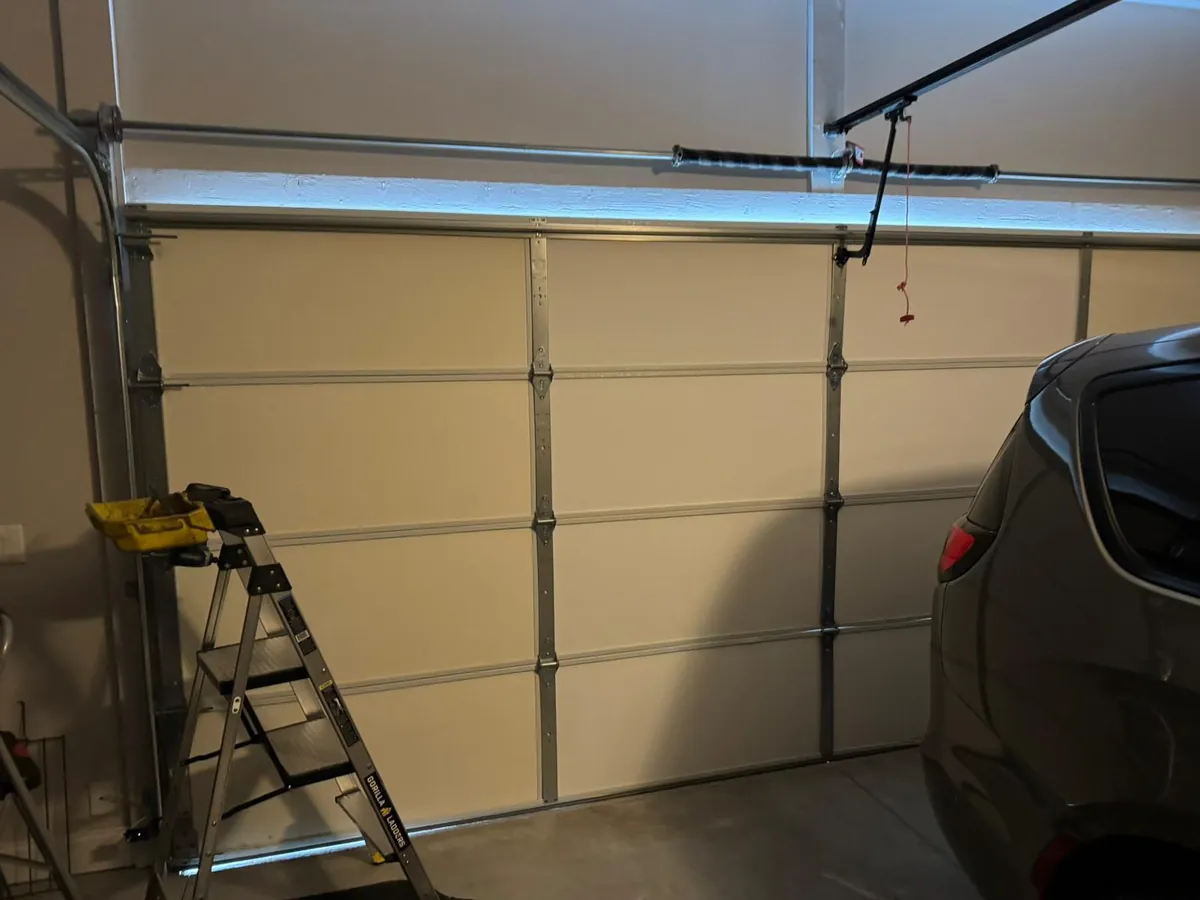
Carriage houses, rear alleys and the doors squeezed into them
Our shop sits on these very streets, so the doors we know best are the ones within walking distance: brick carriage houses facing the rear alleys behind the row houses on Shawmut, Tremont and Columbus, plus the odd single bay set beneath a building’s upper floors. Garage door repair in South End MA terms almost never means a roomy two-car garage on a suburban lot. It means a modern sectional door living inside a masonry opening that was laid up for some other purpose, worked hard, and given very little room around it.
Everything that goes wrong with a garage door goes wrong here too: springs and cables, dented panels, worn tracks and rollers, openers and their remotes, derailed doors, and sensors that refuse to let the door shut. Nearly all of it is fixable without buying a new door.
From a sensible distance, three glances tell you a good deal before you ring:
- Up at the spring, or the pair of springs alongside the overhead rails: a clean break in the coils is easy to spot.
- Down at both lower corners: a limp cable, or one unwound from its drum, means the lifting system has failed on that side.
- Along the floor: a gap that tapers from one end to the other says the door has dropped on one side.
The faults we fix on South End garage doors
Snapped springs
A torsion spring over the opening, or two extension springs beside the rails, does the lifting. Once one lets go, the door weighs like a slab of brickwork. More on spring repair in the South End.
Cables and drums
Steel lift cables wind onto grooved drums at either end of the shaft. When one frays through, a corner sags and the door skews inside a narrow opening.
Creased or split sections
A bumper easing into a short carriage house, or a recycling bin rolling downhill into the door, can crease a panel. Often one section can be swapped without touching the rest.
Openers and controls
Motors that hum without pulling, remotes that only answer from a yard away, wall buttons with no response at all. See opener repair in the South End.
Rails and rollers
Kinked rails, brackets pulling out of old mortar, rollers with chipped wheels or locked bearings, and doors that have jumped clean out.
Photo-eye sensors
The low pair of beams beside the opening. Nudged out of alignment, they stop the door ever reaching the floor.
Who does the lifting, and why one worn part spreads
The motor on the ceiling gets the blame for most breakdowns, simply because it is the bit with a button. Its real job is modest. The weight is carried by spring steel. A torsion spring tightens as the door descends, banking energy, then gives that energy back on the way up by turning the drums mounted on its shaft. Cables run off those drums to fixings at the foot of each side, so the spring hauls both edges together. Doors fitted with extension springs do the same with a pair of long coils stretched beside the overhead rails, pulling through sheaves and cable.
The door is a stack of hinged panels. Small wheels at the ends of every panel ride in the upright rails beside the opening, round the curve and back along the ceiling rails. Set up correctly, the whole thing lifts with one hand and will hover at waist height when let go. All the motor does is steer that balanced load and turn back if its sensors see an obstacle.
Because the parts share the load, trouble travels. Lose some spring tension and the motor labours on every cycle. A wheel that has stopped spinning gets dragged, grinding a flat into its rail. One fraying cable lets its side lag, and the door climbs crooked until it wedges. That is why a proper fix starts with the whole door, rather than stopping at whichever part broke last.
Alley carriage houses and what they do to a door
A large share of garages in this neighbourhood stand at the rear of the lot and open onto the alley, not the street. They are brick carriage houses, and their openings predate overhead doors by a long way. That history shows in nearly every job.
Headroom comes first. Between the head of the opening and the joists there is often only a short course of brick, which leaves little space for a torsion shaft. Some of these doors have extension springs or a low-clearance rail layout because nothing else fits, and those layouts bring their own weak points: pulleys, longer cable runs, and a rear rail hung tight to the ceiling.
Then there is the masonry itself. Old brick jambs are seldom truly plumb, and an opening a little out of square leaves a door scuffing one side or showing a wedge of daylight at the threshold. Brick moves slightly through freeze and thaw, so a door set up nicely some winters ago can start catching on one jamb. A good deal of garage door repair in South End carriage houses is really about re-hanging rails and brackets so the door runs straight in an opening that does not.
Finally, the alley. A tight approach means cars turn in close, and lower panels collect knocks from bumpers, wheelie bins and hand trucks. Rainwater and snowmelt draining along the alley pool at the threshold, which punishes the rubber seal and the foot of each rail.
Single bays under brick buildings
A handful of garages here are single bays let into the ground floor of a building, with flats or rooms overhead. They come with their own priorities. The bay’s ceiling is somebody’s floor, so the motor rail and spring hardware are bolted to a structure that carries vibration upward very well. A tired wheel, a loose rail bolt or a slack drive chain turns into an evening rumble for whoever lives above.
These bays are often the building’s main way in for the car, and sometimes for bikes and bins too. A door jammed open leaves that ground floor open to the pavement, which makes a stuck door more pressing here than in a detached carriage house at the back of a lot. New nylon wheels, snugged-up fixings and a motor tuned to the door take most of the noise out of it.
What a garage door repair visit in the South End involves
Garage door repair in South End garages runs through the same sequence each time, whatever was mentioned on the phone.
- The motor is uncoupled so the door can be tried by hand. Its weight, and whether it hovers mid-way, reveals at once how the springs are doing.
- Springs, cables, drums and the lower corner fixings are inspected for breaks, broken strands and wear.
- Every wheel and hinge gets a look, and each rail is eyed end to end for kinks, dents and loosened fixings.
- If the motor features in the complaint, it gets run uncoupled; then the wall button, every remote and both photo eyes get tested in turn.
- You get the diagnosis first: what broke, the reason it broke and how it will be fixed, all before any tool comes out.
Once the faulty parts are replaced, the door gets rebalanced and the motor is coupled back up. Its travel limits and closing force are set to the newly repaired door, and the safety reverse is proven by lowering the door onto something placed on the floor. The job is not finished until the door rises, lowers and backs off as it should.
When a door has jumped its rails
A door out of its rails hangs at an angle, with a wheel or two sitting outside the channel. In an alley carriage house the usual culprits are a nudge from a car, a lift cable snapping at one corner, or an opener left grinding against a door already stuck fast. A door in that state is unstable and can come down, so leave the motor off and do not try to shoulder it back into line.
The fix starts by taking the load off the door. Wheels are then eased back into the channel, kinked rail is straightened or swapped, brackets are re-anchored into sound brick or timber, and both cables are checked for matching tension before power goes back on. If a knock to the bottom panel caused the trouble, that panel gets checked too, since a creased section will keep forcing its wheels out of true.
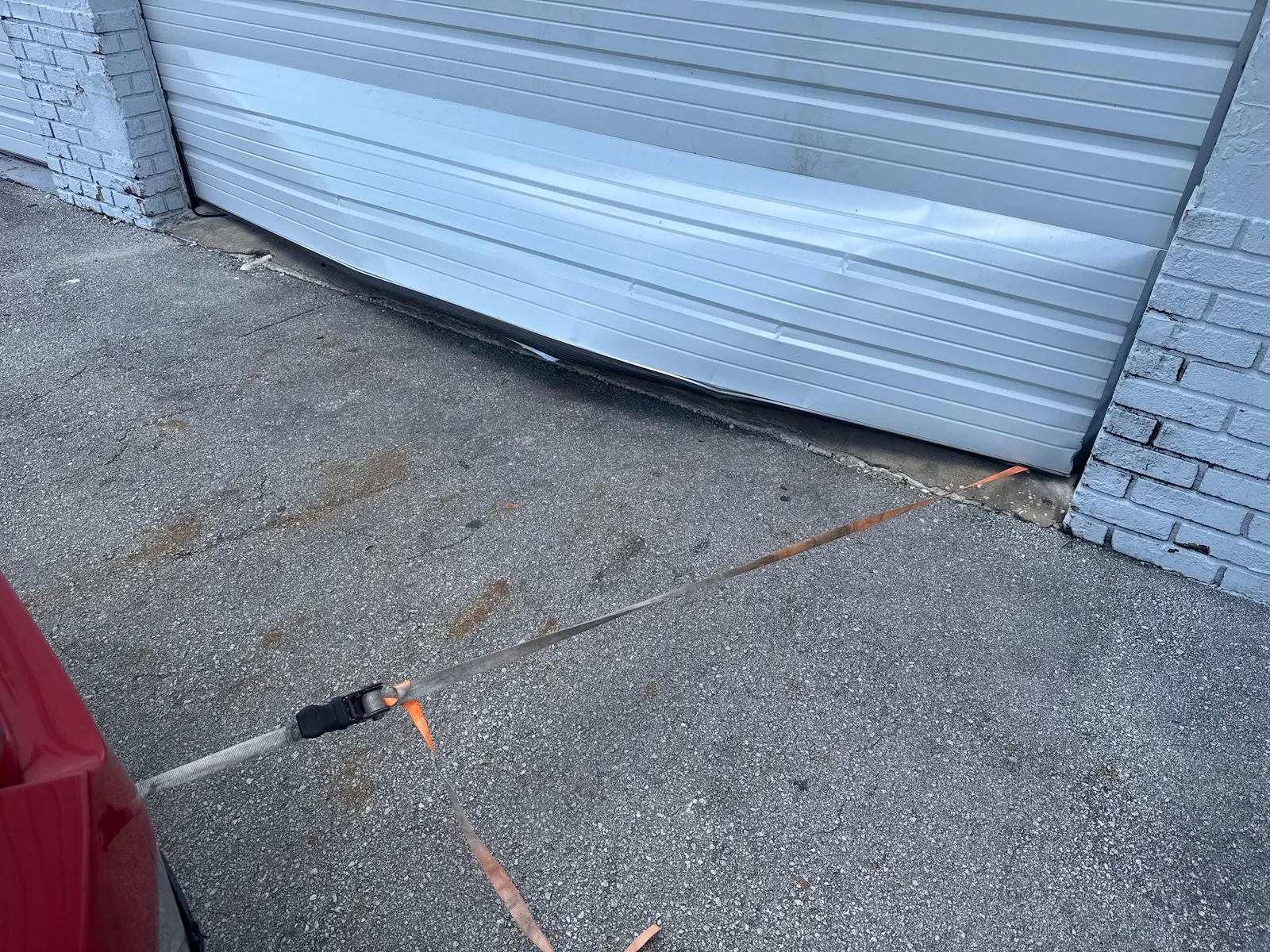
Cables and drums in a tight opening
Cables get less attention than springs, but in a narrow carriage house they take a beating. Each one is wound in the grooves of a drum at the end of the spring shaft and runs down the side of the door, often only a finger’s width from the brick jamb. A door that rubs the masonry, or a roller that catches, can let a cable go slack for a moment; slack cable jumps its groove, and the next time the door moves it winds on crooked or not at all. That is how a door ends up hanging from one corner. Frayed strands near the bottom fixing are the other warning sign, usually where salty meltwater has sat against the steel. It usually makes sense to renew both cables together and set them to equal tension, because a new cable on one side and a stretched one on the other will pull the door out of square again.
Photo eyes, remotes and wall buttons
A door that starts down, travels a hand’s width, then climbs back up is nearly always reporting a sensor problem. The two photo eyes sit just above the floor, one on each jamb; in a cramped carriage house a bike pedal, a shovel or a bin can easily knock one askew. Once they lose sight of each other, the motor treats the gap as blocked.
Controls fail in their own ways. A remote that only works from right beside the door may simply need a battery, or it may be pointing at a weak receiver inside the motor. When a wall button goes dead, the culprit is often a broken wire somewhere along its run down the brick. All of these are traced and put right along with the motor. Where a motor is past saving, a new one can go in, LiftMaster openers included; the opener page for the South End goes further into that.
Panels, seals and what winter does
Damage to panels here is mostly mechanical: a bumper, a gust grabbing a door left open, a bin trundling into the lowest section. A cracked hinge between two panels lets the stack bend while it travels; you see it bellying inward halfway up, or hear a scuff at one fixed point on each trip. One damaged section can frequently be changed by itself, as long as a section can be found to suit the rest of the door.
Winter makes all of it worse. Spring steel turns more brittle in deep cold, so breaks bunch up on the first proper frosts. Road salt and slush, carried in on tyres or washed down the alley, attack the rubber seal, the lowest panel and the fixings that hold each rail’s foot to the jamb. Once that seal is torn or squashed flat, water sits against the door and the threshold, and that is where rust and rot get started. Renewing a worn seal is one of the quickest jobs we do, and one of the most worthwhile.
What you can check, and what to keep your hands off
Several checks carry no risk at all, and they are worth making before you call:
- If the door has halted part way, pull the motor’s plug to stop it trying again.
- Clean both photo-eye lenses and see whether their little lights glow steadily.
- Fit a fresh battery to a remote that has gone quiet, then try the wall button to work out which of them is at fault.
- Walk the length of both rails looking for anything propped against them.
Some parts are off limits. Even closed, the door’s torsion spring holds dangerous tension, and the cables and the lower corner fixings they hook onto are under that same load. Slackening a set screw on the shaft, or levering one of those corner fixings off the door, can let all of that go in a split second. This is not a DIY repair. With a broken spring, the door’s whole weight is unsupported; nobody should lift it by hand, and the motor should not be asked to either.
Fixing the door, or fitting a new one
Most doors deserve repairing. A replacement spring, a fresh pair of cables, new wheels all round or a trued-up rail gives a structurally sound door plenty more use. The scales tip toward replacement once failures start arriving in clusters, once the bottom sections are rusted or rotted right through, once two or more panels are past rescue, or once an old wooden door has soaked up enough water to outweigh any spring sized for it. You will be told straight which side of that line yours sits on, and garage door repair in South End homes is always weighed first. When a new door really is the better answer, our page on new garage doors in the South End explains how one is supplied and fitted into an older brick opening.
Getting a repair booked
These alleys and bays are on our own doorstep. When you ring, let us know how the door is behaving, whatever looks broken overhead or at the lower corners, whether it is a carriage house or a bay beneath a building, and whether a car is trapped inside. Doors that fail late at night can still be reported straight away, because the line is staffed whatever the hour; advice on keeping a broken door safe until help comes is on the South End emergency page. Our main garage door repair page covers the wider service across Greater Boston, and the South End page gathers every service in the neighbourhood in one place. To arrange garage door repair in South End homes and garages, call us or book online.
Questions from South End
My carriage house door lifts a few inches, then stops. Why?
That is the textbook sign of a broken spring. The motor can shift the door a little before its force setting trips, because it is trying to raise the full weight unaided. Stop pressing the button, pull the plug and check the coils overhead for a break.
The door in the bay under our building has become very loud. Can that be fixed?
Nearly always. Worn wheels, dry hinges, loose rail bolts and a slack drive chain all add noise, and in a bay with rooms over it the sound carries straight up. Fresh wheels and properly tightened hardware cure most of it.
Our door scrapes one side of an old brick opening. Does it need replacing?
Rarely. Rails and brackets can be re-hung so the door travels straight even when the masonry is slightly out of square. If the scraping has bent a panel, that panel may need attention as well.
Why does my door only close while I hold the wall button?
That is the motor working around a sensor fault. The photo eyes near the floor are probably misaligned or dirty. Wipe the lenses and clear anything between them; if a light keeps blinking, the sensors or their wiring need checking.
Do you repair commercial doors in the South End too?
Yes. Roll-up and sectional doors on shops and businesses get the same attention to springs, cables, rails and motors that home doors do.