
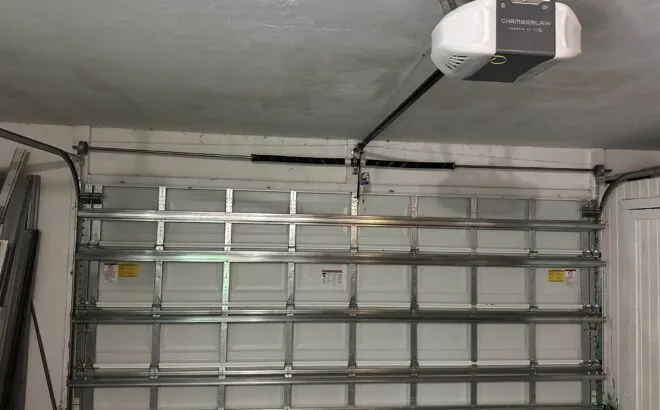
One sharp crack, and the carriage house door stays down
Spring calls nearly all open with the same story: one loud report from the carriage house, frequently after dark or on a frosty morning, followed by a door that refuses to rise. On our own patch, garage door spring repair in South End MA alleys is the urgent job we hear about most, whether the door sits among the brick row houses lining Shawmut, Tremont and Columbus, in the carriage houses behind them, or in the occasional bay cut beneath a building.
Being a few streets away does not change what a spring job involves, but it does mean these buildings are familiar: the narrow alleys, the short brick walls over the openings, the doors that have been swapped and re-hung more than once over the life of a carriage house.
Springs are the reason an overhead door can be lifted at all. Each one is chosen and tensioned to counter the door’s weight. Lose one, and the door turns into dead weight that no opener will shift and nobody ought to wrestle with.
Three things worth noticing, from a respectful distance and with hands in pockets:
- Over the opening: a snapped torsion coil leaves an obvious split somewhere along its length, a little like a stretched-out slinky.
- Up beside the ceiling rails: a failed extension coil may dangle, sag, or be lying in two bits on the concrete.
- Low on each side: a lift cable gone limp frequently accompanies a break, since the spring is no longer pulling it taut.
Springs and the parts around them
Torsion coils
Wound steel on a shaft running above the opening, one or a matched pair. A break leaves the shaft unable to turn the cable drums hard enough to raise anything.
Extension coils
Long stretched coils, one beside each ceiling rail, hauling through pulleys. Older and lighter doors use them, as do certain carriage houses with almost no headroom.
Safety cables
A thin steel line threaded down the centre of each extension coil. It keeps a snapped coil captive instead of letting it lash about. Doors without them should have them added.
Drums, pulleys and lift cables
These carry the spring’s pull to the door. A violent break can unspool a cable or gouge a pulley, so they are inspected on every spring visit.
Why springs give out
Think of a spring as a part with a ration of cycles. Each opening twists or stretches the wire; each closing lets it relax. Every one of those movements leaves a microscopic mark, and eventually a hairline crack forms at the most stressed point in the coil and grows until the wire parts. No accident is needed. The spring has simply spent its ration.
Several things spend it faster. A door shared by a whole building, swinging open and shut from early morning to late evening, gets through its cycles quickly. Rust pits the wire’s surface and hands a crack somewhere to start. Frost makes steel brittle, so the first properly bitter mornings of each season bring a wave of breaks, usually at the moment someone lifts the door after a freezing night. A door out of balance, or one with a seized wheel dragging along its rail, also asks for extra effort on every trip.
Little of that is visible from the floor. What does show is a door that suddenly feels heavier, a door that drifts down instead of hovering when you let it go halfway, or an opener that groans more than it used to. Those are the warning signs, and garage door spring repair in South End carriage houses is a calmer job when it is booked then, before a break shuts a car in.
A torsion spring holds dangerous tension
Plain words matter here. A torsion spring holds dangerous tension all the time, and most of all when the door is down, since that is its tightest point. Adjusting one calls for purpose-made winding bars, a careful order of work and respect for how much energy is packed into that coil. A screwdriver jammed into the winding cone, or a set screw slackened on a cable drum, can let it all go in an instant and fling metal, or a hand, across the room. This is not a DIY repair. The lift cables and the bottom corner brackets they hook to are part of the same loaded system, so they stay untouched as well.
Extension coils carry their own risk. They sit stretched along the ceiling rails whenever the door is shut. Without a safety cable running through the middle, a snapping coil can send its broken ends hurtling around the garage, and in a slim carriage house with a car, bicycles and shelving all fighting for floor space, there is nowhere for those pieces to go but into something.
Your part is brief: keep people and pets back, leave the door exactly where it stopped, pull the opener’s plug so no one hits the button out of habit, then pick up the phone.
How carriage houses shape spring work
Behind the row houses, the garages were built as carriage houses, generations before sectional doors existed. Nothing in them was planned around a spring, and springs need room.
A torsion assembly normally lives just above the head of the opening, yet many of these buildings leave only a narrow strip of brick between that head and the joists. Where space is that tight, you may find a low-headroom kit, extension coils running beside the ceiling rails, or a torsion shaft mounted at the far end of the rails instead of over the door. Each layout loads its springs and cables differently, and any replacement must fit the available room, not merely the door’s weight.
The door itself is the second variable. Plenty of these carriage houses have had new doors over the decades: sometimes a heavier insulated door hung on the old springs without anyone recalculating, sometimes a timber door that has quietly gained weight as it soaked up damp. A coil matched to the wrong weight wears out early and leaves the opener straining. So on every visit we work out what the door weighs today, not what it weighed when it went in.
Bays under buildings
A handful of garages here occupy single bays in a building’s ground floor, with flats above. When a torsion coil breaks in one of those, the crack travels straight through the floorboards, and often it is the neighbours upstairs who hear it first.
Those bays usually have a solid ceiling just over the door, so the spring brackets are fixed to the building’s own structure rather than to open framing. A properly balanced door and a firmly anchored centre bracket matter more there, because any shudder or rattle is passed directly into the rooms overhead. And because such a bay is often the building’s only way in for a car, a door pinned shut by a dead spring can upset several households’ mornings at once.
What garage door spring repair in South End involves
When we come out for garage door spring repair in South End garages and bays, each visit runs to a fixed routine.
- The opener is uncoupled and the door clamped in its rails, so it cannot shift while the springs are being handled.
- The broken coil is measured: wire gauge, inside diameter, overall length, and the direction of its wind. Those figures decide what replaces it.
- Drums, bearings, pulleys and both lift cables are checked, since a sudden break often damages its neighbours.
- The replacement coil goes on and is wound, or stretched, to suit this particular door, and the two cables are brought to matching tension.
- The door is tested by hand until it floats at mid-height without help, and only then is the opener coupled back and adjusted.
You hear what broke and what is going in before any of that starts.
Balance: the test that settles it
A spring job is judged by one simple test. With the opener uncoupled, the door is hoisted by hand so its lower edge reaches hip height, then released. A correctly sprung door hangs right there, floating, as if it weighed almost nothing. If it creeps downward, the springs are too weak for it; if it drifts upward, they are wound too hard. Either way the opener ends up fighting the door on every run, and the new coil wears faster than it should.
Getting that float right in a carriage house can take more care than in a modern garage. Rails fixed to old brick may not be perfectly parallel, a door that has been re-hung may sit slightly off-centre in its opening, and a timber door may weigh more on one side than the other where damp has got in. Each of those is checked and corrected before the job is called finished, because a spring can only balance a door that runs true.
The test is worth knowing for your own use too. Every so often, with the opener released, try lifting the door by hand. If it has started to feel heavy, or no longer stays put at half height, the springs are losing their strength and it is time to book a look, long before anything snaps.
Matched pairs
Plenty of doors run two torsion coils, one each side of a centre bracket, splitting the weight. When one goes, its partner has lived through exactly as many openings and is usually not far behind. Fitting a single new coil next to a tired old one leaves the pair pulling unevenly, which throws the balance out and tends to bring a second call before long. That is why renewing the pair together is often the sensible route; if the surviving coil genuinely looks healthy, you will be told so.
The same logic holds for extension coils. One sits on each rail, and a fresh coil paired with a worn one hauls the door up lopsided, which twists it in its rails and loads one cable far more than the other.
What a broken spring does to the opener
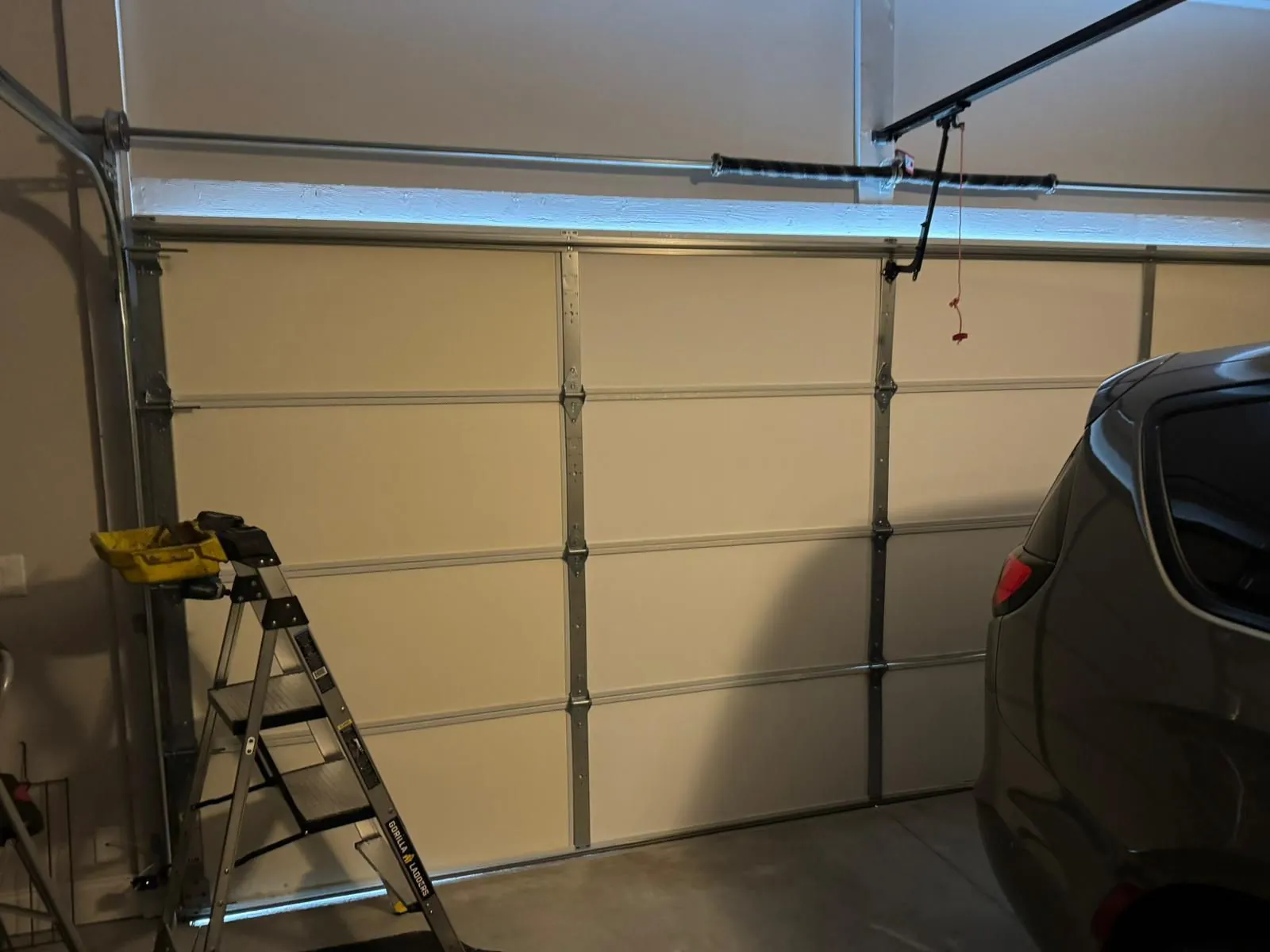
An opener is designed to steer a balanced door, never to hoist a dead one. While a coil is quietly weakening, the opener has been making up the shortfall on every run; and once the coil snaps, someone has usually pressed the button once or twice before realising. Those attempts can strip a nylon drive gear, stretch a chain or belt, or kink the arm that links the trolley to the top panel.
So after the new coil is in, the opener gets run against the rebalanced door, and its travel limits and closing force get set again to match. Should it have suffered, it can be repaired or replaced, LiftMaster openers included; our page on opener repair in the South End runs through that work.
Winter, damp and the alley
The coldest weeks are the busiest for broken coils. Hard frost robs steel of some toughness, so a coil approaching the end of its ration is likelier to part on an icy morning than on a mild one. Moisture adds to it: alley garages collect meltwater and road salt at the threshold, and the clammy air inside an unheated carriage house lets rust creep along the wire.
No spring lasts indefinitely, but a thin film of garage door lubricant along the coils slows the rust, and a door that rolls easily in its rails spares the spring extra work. If the door begins to feel heavy or sluggish once the weather turns, that is the moment to have the springs looked over rather than waiting for the bang.
Springs on shopfront and commercial doors
The same streets have businesses as well as homes, and commercial doors use springs too. A sectional door on a service entrance or a loading bay runs on torsion coils just like a home door, only larger and cycled far more often. A roll-up door hides its spring inside the barrel it coils around, above the opening, and when that spring weakens the door becomes hard to raise or will not stay up. Both kinds are repaired, and the same rule applies: the stored tension is not something to experiment with. On a busy service door the cycle count climbs quickly, so a commercial spring that has started to sag is worth replacing before it strands a delivery or leaves a shopfront unable to lock up for the night.
When a new door is the better answer
A snapped spring alone never condemns a door. Put a correctly sized coil on a sound door and it carries on for a long while yet. It is different when the coil failed because the door has put on more weight than a sensible spring can counter, when the lower panels have rusted or rotted away, or when half the hardware is worn out at once. In those cases a replacement door may serve you better than another round of parts, and our South End new door page describes how a new door is fitted into an older brick opening. Far more often, though, garage door spring repair in South End homes is the whole of what the door needs.
When the spring breaks out of hours
Coils do not wait for office hours. If one goes late at night or before first light with a car stuck behind it, ring whatever the hour, weekends included. Our South End emergency page explains how to leave the door safe in the meantime. Anything else wrong with the same door, from cables and rollers to dented panels and photo eyes, is covered on garage door repair in the South End. The service across Greater Boston has its own spring repair page, and the South End page gathers all our work in the neighbourhood together.
When you ring, mention whether there was a bang, whether a split coil or a slack cable is visible, and whether the door is down, up or stranded somewhere between. Call us or book online.
Questions from South End
Something went bang in the carriage house overnight and the door is stuck. Is that a spring?
Almost certainly. When a torsion coil parts it gives off a sharp report that carries through walls and floors. Keep the door down, switch the opener off at its plug, and from a few steps back look for a split in the coil above the door.
Could I just lift it by hand to get the car out?
Please do not. Without a working spring the door’s whole weight is unsupported, and once raised it may slam back down. Keep it shut and give us a ring.
Torsion or extension: which kind does my door have?
Torsion coils ride on a shaft running across the head of the door. Extension coils stretch along each ceiling rail. In carriage houses with very little headroom you may find extension coils, or a torsion shaft set at the back end of the rails.
One coil of a pair has broken. Should its partner be renewed too?
Usually it is wise, since both have done identical work and the remaining coil is likely near the end of its own life. If it looks fit to keep, you will hear that.
What makes springs fail on the first freezing morning?
Cold steel is less forgiving, and a coil that has nearly used up its life tends to snap the first time the door is lifted after a hard frost. Damp in an unheated carriage house adds rust to the mix.