
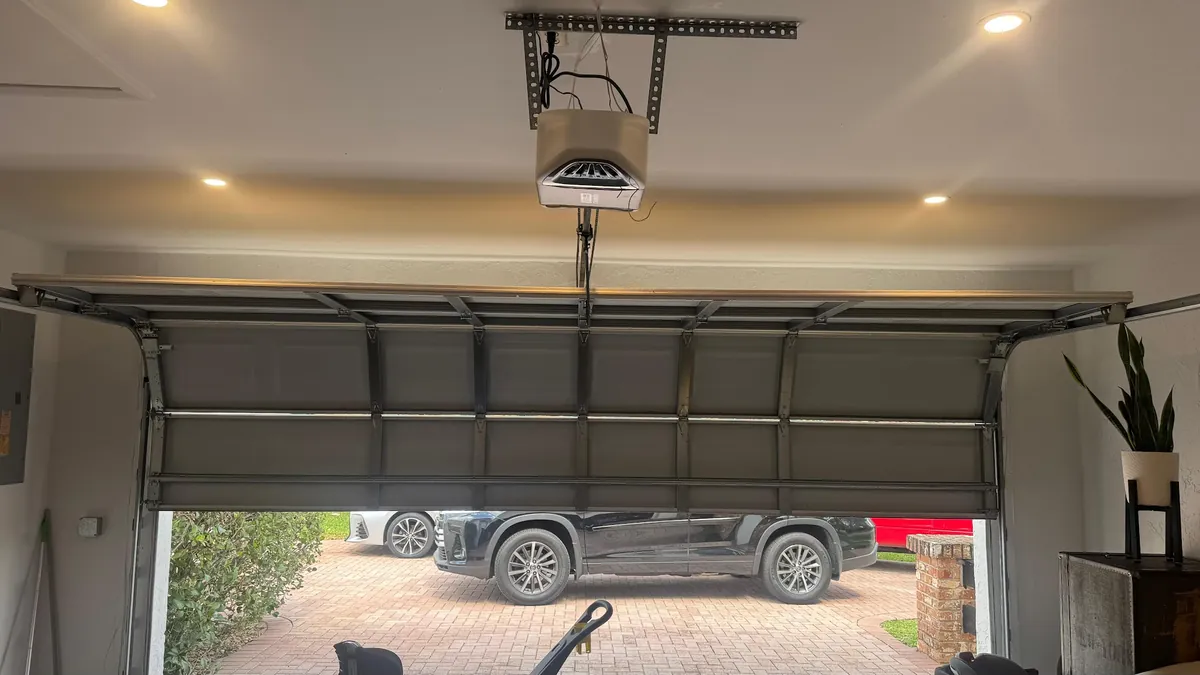
What drives the doors under the West End’s towers
In the West End, garages are shared spaces beneath post-renewal towers, and their doors are building roll-ups or gate systems rather than private overhead doors. The motor on such a door is a commercial operator, called by a great many remotes and fobs every day, so garage door opener repair in the West End means working on a machine that carries a building’s worth of traffic.
When an operator falters, residents notice at once: a door that will not respond to their remote, one that starts up and stops, or one that closes and then rises again for no clear reason. Every one of those calls tends to land on building management first, because that is where everything in these garages is arranged.
Before reporting a fault, it helps to look at three things:
- Does the operator make any sound, or show any light, when the door is called?
- Does every control fail, or only some remotes while the wall station still works?
- Do the indicator lights on the photo eyes either side of the opening glow steadily?
Parts of the opener system we deal with
The operator itself
The motor, gearbox, drive chain or direct drive, brake and the board that runs them. Hum without movement, grinding, overheating and a door that stops short all start here.
Remotes and transmitters
Hand-held remotes that no longer register, or that work only from very close. Often a battery, sometimes a remote that needs pairing again, occasionally a receiver fault.
Wall stations and push buttons
The open, close and stop buttons inside the garage. A dead station, a stuck button or damaged wiring can leave the door ignoring everyone.
Photo eyes and safety edges
The beam across the opening and the sensing edge on the bottom bar that tell the operator to stop and reverse. Misaligned, dirty or damaged sensors cause most phantom reversals.
Why shared-garage operators work so hard
A household opener might run a handful of times between morning and night. The operator on a West End tower garage door runs for every car that comes in or goes out, and for many that never fully finish a cycle because another car arrives as the door is closing. That workload is the main reason garage door opener repair in the West End comes up more often than on detached houses, and it shapes which parts wear first.
The motor heats as it runs. On a busy ramp it may get little rest, and an operator whose thermal cut-out trips will simply stop answering until it cools. The gearbox and drive carry every start and stop; teeth wear, chains stretch, and a brake that holds the door in place can slip. The control board takes the knocks from power surges, damp and age. None of these is unusual. They are the ordinary wear of a machine that never gets a quiet day.
The door itself affects the operator too. A roll-up curtain that binds in a bent guide, or a sectional door whose springs are tiring, asks the motor to push harder than it was built to. The operator’s force setting then trips, the door reverses, and the fault looks like an opener problem when the real cause is elsewhere. That is why the door is always checked alongside the motor.
How commercial operators differ from house openers
On a single-family garage, the familiar opener hangs from the ceiling on a rail and pulls the door along with a trolley. Shared garage doors under towers usually use something heavier. Many have an operator mounted on the wall beside the door, driving the roll-up barrel or the sectional door’s shaft through a chain or directly. Some have hoist operators with a hand chain for raising the door when the power fails. Others mount the motor at the end of the shaft on a bracket.
These operators have more to set up: open and close limits, a stop position for part-open use, timers that close the door after a vehicle passes, inputs from external triggers, and monitored safety devices. They are also built to be serviced, with parts that can be replaced individually rather than the whole unit being swapped as soon as something fails.
Remotes, fobs and everything that calls the door
In a tower, the door can be called by far more than one remote. Each resident may have their own transmitter. There may be a wall station inside, a pull cord, a key switch, a timer, a card or fob reader at the ramp and a loop in the driveway that senses a waiting car. Any one of those inputs can fail, and from the driver’s seat they all look the same: the door does not open.
Our part of that chain is the operator, its receiver and remotes, its wall controls and its safety sensors. Readers, fob systems and ramp loops are often supplied and looked after by a separate access-control company. A good part of any opener call is narrowing down which link has broken, so that management knows whether the fix is ours or belongs to someone else. Where a gate sits ahead of the door, the same applies: it may have its own operator and its own supplier.
Checks management can safely make first
These are reasonable steps for a building manager or concierge before a technician arrives, and none of them involves the door’s springs or cables:
- Try the wall station inside the garage. Should the button run the door while handsets fail, the motor is fine and the trouble sits with the transmitters or the radio receiver.
- Look at the photo eyes. Steady glows on both mean the beam is made; a flashing or unlit eye suggests grime on the lens, a bracket nudged askew, or a wiring break. Clean each lens with a soft cloth and clear any bin, cone or bike from the line between them.
- Check whether the operator has power: look for lights on its control box and check whether the breaker feeding it has tripped.
- If the door keeps reversing, make sure nothing has been left under it and that the bottom edge is not damaged.
Leave the drive, the springs and the cables alone. A roll-up barrel spring and a torsion spring both hold dangerous tension, and disconnecting an operator from a door whose spring has failed can let the door drop without warning.
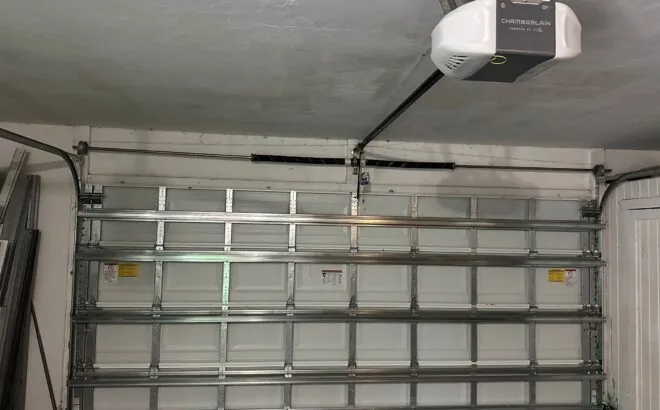
What an opener repair visit involves
Because access to the garage runs through management, the visit begins by settling on a quiet window for the work and how residents’ cars will get in and out meanwhile. Then:
- The door is disconnected from the operator where it is safe to do so, and moved by hand or by its hand chain to see whether the door itself runs freely and is balanced.
- The operator’s power supply, board, motor, brake and drive are tested.
- Remotes, wall stations and other inputs are tried one at a time to find which, if any, has failed.
- The photo eyes and any safety edge are checked for alignment, damage and wiring.
- Limits, force and any close timer are reviewed against how the door behaves.
Management hears the diagnosis, and the remedy proposed, before a single component is swapped. Afterwards the operator completes whole cycles from every control in turn, and the reverse is proven against a test block set on the threshold.
Repair the operator or replace it
Plenty of operators are worth repairing. A new board, a drive chain, a brake or a set of sensors can bring an older unit back into steady use. Replacement deserves a conversation if the motor windings have burned out, if an ageing unit’s components can no longer be sourced, when the operator has been undersized for the door from the start, or when repeated faults are costing the building more disruption than a new unit would.
A replacement operator is sized against the door’s span, its heft and its daily cycle count, set up with its limits and timers, and paired with the building’s remotes and wall controls. Our garage door opener repair in the West End covers LiftMaster openers too, repaired or replaced. Our Boston-wide approach to motors and controls lives under garage door opener repair on the service pages.
Faults that look like opener problems but are not
A good share of calls that start as opener trouble turn out to be something else. A door that hums but does not move may have a broken spring, so the operator cannot lift it. One that reverses halfway down may be catching on a bent guide or a damaged slat. One that opens unevenly may have a slipped cable. Fitting a new operator to a door with any of those faults would only wear out the new motor.
So the door is always looked at as a whole. If the spring has gone, the West End spring repair page explains that work; when rails, rollers, cables or sections are to blame, turn to West End garage door repair.
Limits, force and timers: the settings that drift
An operator decides where the door stops and how hard it may push by its settings. The open limit tells it where to stop at the top, the close limit where the bottom bar meets the slab. Its force setting is the ceiling on push: meet more resistance than that, and the motor quits and backs up. On a busy shared door, these settings can drift as the chain stretches, the brake wears or the door’s balance changes.
The symptoms are easy to spot once you know them. A curtain that stops a hand’s height short of the floor, leaving a gap that lets in leaves and cold air, usually has a close limit that has crept. A door that slams into its stop at the top, or overruns and jams the bottom bar into the hood, has an open limit that needs resetting. A door that reverses on a cold morning but behaves at midday is meeting more resistance than its force allows, and the reason needs finding before anyone simply turns the force up. Turning force up to hide a binding door takes away the protection the setting is there to give.
Close timers deserve the same care. Set too short, the door starts coming down on the bumper of the next car in the queue and relies on its sensors every time. Set too long, the garage stands open longer than management wants. Getting the timer right for the building’s traffic is part of a proper setup.
Pedestrians, cyclists and the ramp
A tower garage is not only for cars. Residents walk through it to reach the lifts, cyclists ride down the ramp, and delivery staff wheel trolleys past the door. That mix makes the operator’s safety devices matter more than they would on a private garage that only its owner uses. A photo eye mounted at bumper height may miss a child or a bicycle wheel; an edge that has split will not register a trolley handle. When an opener is serviced, the sensors are checked against the way the opening is really used, and any gaps in protection are pointed out to management so the building can decide what to change.
Upgrading safety on an older door
Some older operators on shared doors were installed with fewer safety devices than a busy garage now calls for: a single photo eye, no monitored edge, or a sensing edge that has long since split. Where an operator is being repaired or replaced, it is worth asking whether the door’s safety arrangement still suits a garage that pedestrians, cyclists and cars all pass through. Photo eyes can be repositioned to cover the opening better, and a damaged edge can be renewed so that the door reverses on contact as well as on a broken beam.
Power cuts, cold and damp
Operators in shared garages are exposed to the same conditions as the ramp. In winter the moving parts stiffen and a rubber threshold seal can bond to icy concrete overnight, so the operator meets more resistance than usual and may trip on its force limit. Melting slush and salt find their way into low-mounted photo eyes and wiring. After a power cut, some operators lose their settings or need resetting before they will run.
During an outage, when cars must get out, use the manual release or hand chain only if the springs are intact and you know how it works on that door. Otherwise leave it closed and phone us; someone picks up whatever the hour. A door that has stopped altogether at night is covered on the West End emergency repair page.
Keeping track of paired remotes
In a tower, remotes come and go as residents move in and out, and an operator’s receiver can hold only so many. Over time it may fill with transmitters that are no longer in anyone’s hands, some of them lost or never returned. That is a security worry as well as a practical one. When the operator is serviced, it is worth asking about clearing its memory and pairing again only the remotes still in use, and management may want to keep a simple list of who holds which remote so the record stays current.
Noise from the operator
In a tower, the garage often sits directly beneath homes, so the operator’s noise is heard upstairs. A grinding gearbox, a chain that slaps its guard, a brake that clunks or a motor that whines under strain are all signs of wear worth looking at before they lead to a breakdown. Most of the racket traces back to tired drive components or a poorly counterweighted door, and both can be dealt with on an ordinary visit for garage door opener repair in the West End.
Booking the work
Whoever notices the fault can ring us whatever the clock says, Sunday included, so a fault can be reported when it happens. For garage door opener repair in the West End, tell us the building and garage entrance, what the door does when it is called, which controls still work, and whether vehicles are stuck inside. Our full West End line-up sits on the West End garage doors page, and the West End new garage doors page covers replacing a door outright. To get an opener looked at, call us or book online.
Questions from West End
Only some residents’ remotes have stopped working. Why?
If the wall station and other remotes still work, the operator is fine and the fault lies with those particular remotes. A flat battery is the usual cause; some remotes also need pairing again with the receiver. If many remotes fail together, the receiver or its antenna may be the problem.
The door closes and then goes straight back up. What is wrong?
Usually the safety system. A photo eye bumped off its aim, a smeared lens or a split edge on the bottom bar will make the operator reverse. A door that binds partway can also trip the force setting and cause the same thing.
Can a remote be added for a new resident?
Remotes are part of the opener system we look after. Ask when you call and say which operator the building has, and we will explain what is needed.
There is a hum from the motor box yet the door stays put. Has the motor died?
Not necessarily. A broken spring, a tripped brake or a door frozen to the floor can all stop the door while the motor runs. Switch it off so it does not overheat, and call us.
Is a LiftMaster unit something you handle?
It is. We repair LiftMaster openers and fit LiftMaster replacements, along with other operators on home and commercial doors.