
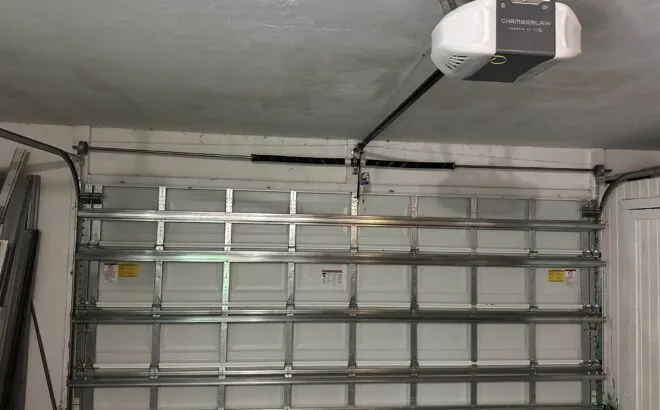
Heavy double doors, attached garages and the springs that lift them
On the single-family streets along Centre Street and around Bellevue Hill, the garage is usually built into the house or tacked onto one side, it opens onto a wide driveway, and the door across it is often a double, sized for two cars. Those broad, heavy doors put real work on their springs, which is why garage door spring repair west roxbury ma homeowners ask for so often turns out to involve a pair of torsion springs, not a single one, and a door that weighs far more than anyone guesses.
Of all the urgent calls a garage door produces, the broken spring comes first by a distance. It is also the most startling, because the failure usually arrives as one sharp report through the wall of an attached garage, after which the opener cannot shift the door at all.
If you suspect a spring, these three observations, all made without touching anything, help us understand what we are walking into:
- Glance up at the steel bar spanning the header. A snapped torsion spring is obvious: its coils stand apart either side of a clean break.
- On a door with extension springs, one of the long springs beside the ceiling tracks may hang loose, dangle from its safety cable, or be missing altogether.
- Note whether the door sits level on the floor, and whether either lift cable hangs slack at the bottom corners.
The spring work we carry out
Broken torsion springs
The most frequent job on a wide door. A snapped spring on the header shaft is replaced and the system wound and balanced to the door’s real weight.
Paired springs on double doors
Most two-car doors run two torsion springs. When one fails the other has done the same work for just as long, so we talk through replacing both together.
Extension springs
Older or lighter installations stretch a spring along each horizontal track. These are replaced as a matched set, with safety cables threaded through them.
Springs that have weakened
A spring does not need to break to cause trouble. One that has lost tension lets the door drift down, slam the last stretch, or overload the opener.
Cables knocked loose
When the spring gives way, the sudden slack frequently unspools a lift cable or lets it jump the drum. Re-seating or renewing those cables belongs to the same job. More on cable repair.
Why the spring, not the opener, lifts the door
People are often surprised to learn that a garage door opener does not really lift the door at all. A sectional door, especially a two-car steel or wood one, is far too heavy for a residential opener to raise unaided. What makes it feel light is the spring system.
With torsion hardware, the springs, one or a pair, are threaded onto a steel tube running across the header. Lowering the door lets the cables pay out from the drums, and that rotation twists the springs tighter, banking energy. Raising it reverses everything: the springs relax, the tube and its drums turn, and the cables reel the bottom corners upward. A door with healthy springs feels almost weightless when lifted by hand.
The extension type works on a stretch instead of a twist. Each spring lies alongside a ceiling track and, through a little sheave and its cable, hauls on the lower corner of the door. They are more common on older and lighter doors and less common on the double doors we usually find on newer attached garages here, but plenty remain.
Once you understand that, a broken spring explains itself. Without it, the opener is suddenly trying to haul the full dead weight of the door. Most openers sense the overload and stop, which is exactly what they are meant to do.
Signs a spring has gone, or is about to
Some failures are impossible to miss. Others creep up slowly. These are the patterns worth knowing:
- A crack like a gunshot when the door was sitting idle. Torsion springs are wound tightest with the door down, so that is when most of them choose to fail.
- The opener strains, the door rises a few inches, then stops or reverses. The opener is meeting the full weight of the door.
- The door looks lopsided as it moves. On a double door with two springs, one failing leaves the other trying to lift alone, and the door twists.
- The door crashes down the final stretch. Weak springs no longer catch the door’s weight as it closes.
- A visible split in a torsion spring, or a stretched-out extension spring that no longer sits evenly with its partner.
- Cables hanging slack at either bottom corner, or one cable wound unevenly on its drum.
If any of these apply, stop using the door. Running an opener against a broken spring can strip its gears, bend the top section where the opener arm connects, or drag a cable out of its groove.
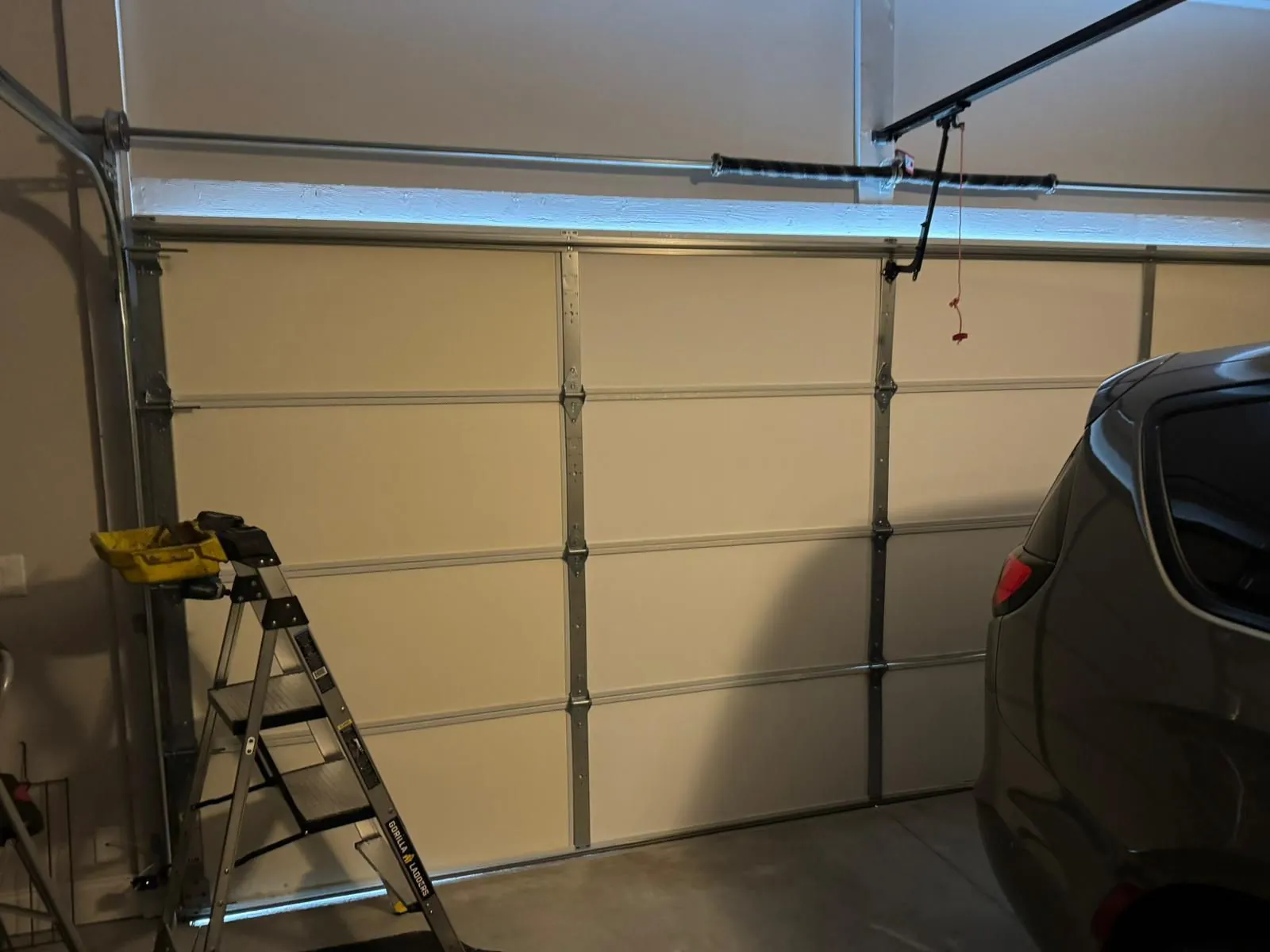
Matching springs to a two-car door
The double-width doors on so many attached garages here need their springs sized properly. Getting garage door spring repair west roxbury ma right on these doors starts with the door’s actual weight and height and the drum it winds onto; on a door with a pair, the two springs share the load and are wound so the door stays level from one end to the other. A door that has had a section replaced, gained insulation, or had a heavy window insert fitted may no longer weigh what its original springs were chosen for.
This is where many earlier repairs go wrong. A spring that is close but not right will lift the door, but it will leave it slightly heavy or slightly light. A heavy door makes the opener work harder every cycle; a light one wants to float up on its own and can be hard to keep closed. Neither is obvious on the day, and both shorten the life of the opener and the new spring alike.
When we replace springs on a two-car door, we size them for the door as it hangs today, not for the door as it left the factory, and set the springs and cables so that it balances properly. Where a door has one spring and would plainly be better served by two, we say so.
Why replacing both springs often makes sense
Twin springs on one shaft went in on the same day and have turned through every open and close together. Once one snaps, its partner is living on borrowed time and often follows before long. Swapping only the broken one also pairs a stiff new spring with a tired old one, and the door can start lifting out of level.
For that reason, on a two-spring door we generally recommend replacing the pair together. It means one visit instead of two and a door that lifts evenly. If you would rather replace only the broken spring, that is your choice, and we will explain how it affects the balance.
Extension springs follow a stricter version of the same rule: they are only ever changed as a pair, so each side of the door gets an equal pull.
How a spring job unfolds on the day
Each garage door spring repair West Roxbury MA visit runs in a fixed order, chosen with safety ahead of speed:
- Locking the door in place. Clamps go on the tracks first, so the door cannot shift while anyone is near the springs.
- Checking the whole system. The cables, drums, bearings, centre bracket, rollers and tracks are inspected, because a spring break often damages something next to it.
- Explaining the findings. You hear which springs have failed, what else has been affected, and what we recommend, before any work starts.
- Unwinding and removing the old springs. Any remaining tension is released under control, with proper winding bars, never with improvised tools.
- Fitting and winding the new springs. New springs are installed on the shaft and wound to the tension the door needs.
- Balancing and testing. With the opener released, the door is raised by hand and let go at mid-height; it should hover. Then the opener is reconnected, the travel limits and force settings checked and the safety reversal tested.
Why springs are never a DIY job
This deserves a section of its own. Every torsion spring on a working door is loaded with dangerous tension, and no swap or adjustment of one belongs on a DIY list, whatever a quick online clip might suggest. That stored force is what lifts a two-car door, and let loose without warning it can fling a winding tool, break a wrist or worse. People have been badly hurt trying to adjust or replace these springs with screwdrivers, wrenches or bars not made for the job.
Extension springs are risky in a different way. Stretched under load, they can snap and whip, especially if a safety cable is missing, and a broken extension spring can fly across a garage.
What you can safely do is simple:
- Unplug the opener at the ceiling and leave the door exactly where it is, so nobody is tempted to press the button.
- Keep cars, bikes and people out of the path of the door.
- If the door is open and stuck, never haul it down by hand. If it is shut, keep it shut.
- Do not loosen any bolt on the bottom brackets, the drums or the centre plate on the header.
Then call us. Working on springs safely needs the right tools, the right replacement spring and some training.
Attached garages and the noise of a break
With nearly every garage around Centre Street and Bellevue Hill sharing a wall with the house, a snapped spring seldom goes unnoticed. The report travels through the studs, and it is easy to mistake for a shelf collapsing or glass breaking somewhere upstairs. If you heard a loud bang from the direction of the garage and the door now will not lift, a spring is the likeliest cause.
An attached garage also means the inner door into the house may be the main way in and out for many owners. If the spring lets go while the car is parked in and the door is shut, the car stays put until the spring is replaced. It is often discovered first thing in the morning, just as someone heads out to work.
Some attached garages here have a room above or beside them. A spring that is starting to fail can make a groan or a creak through the floor as it twists, and that sound is worth listening to.
Wide driveways and room to work
The wide driveways in front of these garages make a spring job more straightforward than it is on a cramped city lot. A van can pull right up to the door, the ladders and winding bars come straight in, and there is daylight to work by on an early visit. If you can, move any cars back from the front of the door before we arrive and clear the floor beneath the header shaft, so a ladder can stand square under each spring.
Inside, a double door needs a little more space than a single. The ends of the shaft carry the drums and bearings on both side walls, so anything stacked tight against those walls near the top of the opening is worth shifting.
Cold weather and newer openers
Cold mornings are when springs most often give up. Chilled steel is a touch less forgiving, and a spring nearing the end of its working life tends to choose a frosty start to the day over a mild one. Keeping the springs lightly oiled, which we do as part of a visit, helps them run smoothly through the winter.
Newer openers, common on the doors here, are often good at hiding a weak spring for a while. Many use soft-start motors and sensitive force settings that keep the door moving even as the springs lose tension. The first real sign may be the opener stopping with the door partly open, or reversing for no clear reason. If your door has started doing either, check for a spring problem before assuming the opener has failed. The West Roxbury opener repair page covers the faults that really are the opener’s.
Spring repair or a new door
A spring is a wearing part. Replacing it does not mean the door is failing; a sound door with new springs keeps working well for years. For the great majority of calls about a snapped spring, garage door spring repair west roxbury ma owners book is all the door needs.
Talk of replacing the whole door only starts once the door itself is failing: sections rusted through, more than one panel folded or split, a wood door that has swollen or rotted, or a door so far out of square that no spring setup will balance it. If that is where the door is, our new garage doors in West Roxbury page explains what a replacement involves on an attached garage. For anything else wrong with the door besides the springs, the West Roxbury garage door repair page covers cables, rollers, tracks and sensors.
Getting a broken spring replaced
Springs have a habit of snapping overnight, leaving the door down and the car shut in just when it is needed. Whatever the hour and whichever day it is, the phone is answered, so a snapped spring found at dawn or at midnight can be phoned in on the spot. If the door is jammed open or hanging crooked, the emergency garage door repair page for West Roxbury describes the first steps. For the citywide view, there is our main spring repair page, and the West Roxbury page brings together every service we offer nearby.
To set up garage door spring repair west roxbury ma without back-and-forth, gather a few details first: one-car door or two-car door, whether it has one spring above it or two, or springs along the tracks, and whether the car is trapped inside. That settled, call us or book online.
Questions from West Roxbury
One of the pair on our double door snapped. Must the other go too?
Usually it is the sensible choice. Both springs have lifted the door through the same years of use, so the survivor is close to its end too, and a fresh spring beside a worn one can leave the door uneven. We will explain the options before any work is done.
Something cracked loudly in the garage overnight and the door is stuck down. Why?
That is almost always a torsion spring snapping. They often go while the door is closed, when they are under the most tension. Unplug the opener, leave the door down and arrange a visit.
Could we pull the red release cord and lift the door ourselves?
Please do not while a spring is broken. Pulling the release drops the full weight of the door onto your hands, and on a double door that is far more than one person should try to hold. Leave it closed until the springs are replaced.
Is there any spring work I can safely do myself?
No adjustments or replacements. The tension in a torsion spring is dangerous, which puts it beyond any DIY attempt, and extension springs can whip if they break. You can safely unplug the opener, keep people clear of the door and call for help.
Does a newer opener mean the springs matter less?
No. Even the most modern opener only guides a balanced door; the springs still carry the weight. A newer opener may hide a weak spring for a while, which is why a door that starts stopping or reversing is worth a spring check.