
The back-lot garages behind Allston’s triple-deckers
Out past the triple-deckers and student rentals on the blocks either side of Commonwealth Avenue and Brighton Avenue, the garage is usually a separate little building at the very back of the lot. You reach it down a driveway barely wider than a car, and when you get there you find a single-car opening, often in a structure that has stood since the 1920s. This page is about garage doors Allston MA owners have in exactly those buildings: what goes wrong with them, what we repair, and the point at which buying a fresh door beats paying for yet another round of parts.
A garage like that was framed long before anyone expected an overhead sectional door and an electric opener to be hung inside it. Over the decades, many of these openings have carried a swing door, then a sliding one, then an overhead door or two. The framing remembers all of it: patched jambs, extra blocking above the header, old screw holes beside new ones.
A failure on a door like this nearly always traces back to one of three groups of parts:
- The lifting parts, meaning a spring that has snapped or a lift cable that has frayed or come off its drum.
- The guiding parts, meaning rollers, hinges and tracks pulled out of line by a wood frame that has shifted.
- The drive, meaning an opener, remote, wall button or safety sensor that no longer does its job.
Garage doors Allston MA rental buildings and family houses rely on
Every service we offer is available here, and each has its own Allston page with the detail. A door that sticks, scrapes, sags or bangs is a job for garage door repair in Allston. A door that suddenly weighs a ton because a coil has parted is covered under Allston spring repair. An opener that hums, clicks or ignores the remote belongs with Allston opener repair and replacement. A door that fails at a bad hour, stuck open or with a car trapped behind it, is what emergency garage door repair in Allston is for. And a door that is past saving can be swapped for one of the new garage doors in Allston we supply and install.
What ties these together on this side of the city is the building, not the service. A single-car garage on a back lot, reached on foot down a narrow strip of asphalt, with low framing and a door that may be opened by more than one household: that is the setting for most of our work in this neighbourhood, and every visit is planned around it. The rest of the neighbourhoods we cover, Brighton next door among them, are on our service areas list.
Why a shared garage wears faster
In a triple-decker or a rental building, the garage at the back is rarely used by one person. One unit may park there while another keeps bikes or storage in a corner. Each extra trip of the door is one more cycle for the springs, one more pass of every roller along its track, one more flex of each hinge between the sections. A spring rated for a certain number of cycles reaches that number sooner on a door that moves many times a day.
Shared use also changes how faults are noticed. On a door one household uses, a new noise gets heard and remembered. On a door several people use, each person may hear the grind or feel the jerk once and assume someone else has reported it. By the time the door stops, a worn roller has often chewed a groove into the track, or a frayed cable has let one corner drop and bent the bottom section.
A building owner can head off a lot of that by asking everyone with a remote to pass on a new noise or a jerky run straight away, and by making sure someone can find the opener’s plug and switch the door off at the ceiling.
Springs: the most common urgent call
When a door that worked yesterday will only rise a few inches today, a broken spring is the usual cause. Most doors on these garages carry one of two set-ups: a torsion coil riding a steel shaft over the header, or two extension springs that stretch out beside the ceiling tracks. Both store enough energy to lift the door almost by themselves; the opener only nudges a balanced door along.
Be plain with yourself about the torsion spring: it holds dangerous tension, and replacing it is not a DIY repair. The winding cones, the set screws and the bar it sits on are all loaded whenever the door is down. Releasing or adding that tension with the wrong tool, or in the wrong order, can throw a bar or a bracket with real force. The stretch-type springs are hazardous in a different way: when one lets go and nothing runs down its middle to hold it, the spring and its fittings can whip across the garage.
In a low 1920s garage, spring work has an extra wrinkle. The space above the opening may be tight, which limits where a torsion shaft can go, and some older doors here still run on extension springs simply because there was never room for anything else. Any replacement spring gets sized to the actual weight of the door that hangs there, which may not be the door the hardware was first sized for. The torsion and extension springs guide goes further into the difference.
Openers, remotes and wall buttons
Openers out on a back lot tend to work harder for their keep than ones in a garage built onto the house. It may be driving a door that has drifted out of balance for years, or one whose rollers have stiffened in a cold, unheated building. A motor asked to make up for a weak spring wears its gears and strains its drive, and eventually it stops partway or reverses for no clear reason.
Opener calls take in the motor head on the ceiling, every remote, the push button by the side door and both photo eyes low on the jambs. Sometimes the fix is simple: a remote that needs reprogramming, a wire to the wall button that has been pinched, a photo eye knocked out of line by a bike wheel. Sometimes the opener has reached the end and replacement is the sensible step. LiftMaster units are on the list of openers we fix or swap out.
In a rental building, the remotes themselves are worth thinking about. When a unit turns over, a remote may leave with the old tenant. Clearing the opener’s memory and reprogramming only the remotes still in use is a quick job, and it means the garage opens for the people who should be using it. The garage door opener services page has more on how openers are diagnosed.
A phone that answers at any hour
Doors rarely fail at a sensible time. A spring tends to snap when the door is cold and closed, which often means first thing in the morning; a door often refuses to close late in the evening, just when nobody can leave it open. A person answers our line whatever the hour, Sundays too, so a back-lot door that quits after dark gets logged that same evening, while the details are fresh.
We do not promise when a technician will arrive, because that depends on the night and on what is already booked. What we can do is talk through the door with you, explain which parts you can safely leave alone until we get there, and get the visit arranged. For a door stuck wide open on a back lot, that conversation often starts with how to secure the garage in the meantime.
Getting down the driveway
Most garage doors Allston MA driveways lead to stand well behind the house, a good walk in from the curb. That distance never stops a repair, but it does shape one. Everything we bring, from ladders and spring bars to replacement track sections and, on an installation day, the door panels themselves, is carried from the street to the garage. When cars from the front units are parked along the driveway, that carry gets longer and the working space by the garage gets smaller.
A few things make the visit smoother. If the cars in the driveway can be moved, the garage can be reached directly. Clearing a few feet of floor just inside the door gives room to set a ladder and work on the springs. And telling us when you book whether the garage is reached from the driveway, from an alley, or from both saves time on arrival.
Pratt and Gardner: alleys with no elbow room
The lanes running behind Pratt and Gardner are a particular case. Some garages open straight onto them, with so little clearance outside that there is hardly room to stand behind the door, never mind set up a ladder or lay a section on the ground. In a space like that, work that would normally be done from outside, like fitting a bottom seal or swapping the lowest section, gets worked out from the inside of the building instead.
That changes the order of a repair. The door may be raised partway and blocked securely so the bottom edge can be reached from inside. A damaged section may be removed upward rather than outward. Tracks are checked with the door in several positions, because a door that brushes the alley side of the opening on its way up is a door that will eventually catch on something. None of this is unusual for us, but it is the reason we ask about access when you call.
The frame around the door
On a garage built in the 1920s, the door is only as good as the wood it is hung from. Jambs that have absorbed decades of rain at their base go soft. A header that has sagged slightly makes the top section rub. Brackets that hold the tracks may be screwed into holes that have already been used, stripped and re-used.
That is why a repair here often includes work around the door as well as on it. A track bracket that keeps working loose gets moved to sound timber or given a backing plate. A jamb that has twisted gets checked before anyone blames the rollers for the rubbing. A door that seems to bind for no reason is checked for square, because an opening that has moved out of square will fight even a perfectly balanced door.
None of this calls for rebuilding the garage. It calls for looking at the whole opening rather than the one part that has failed, which is how a repair on an old back-lot building lasts.
Panels, seals and the bottom section
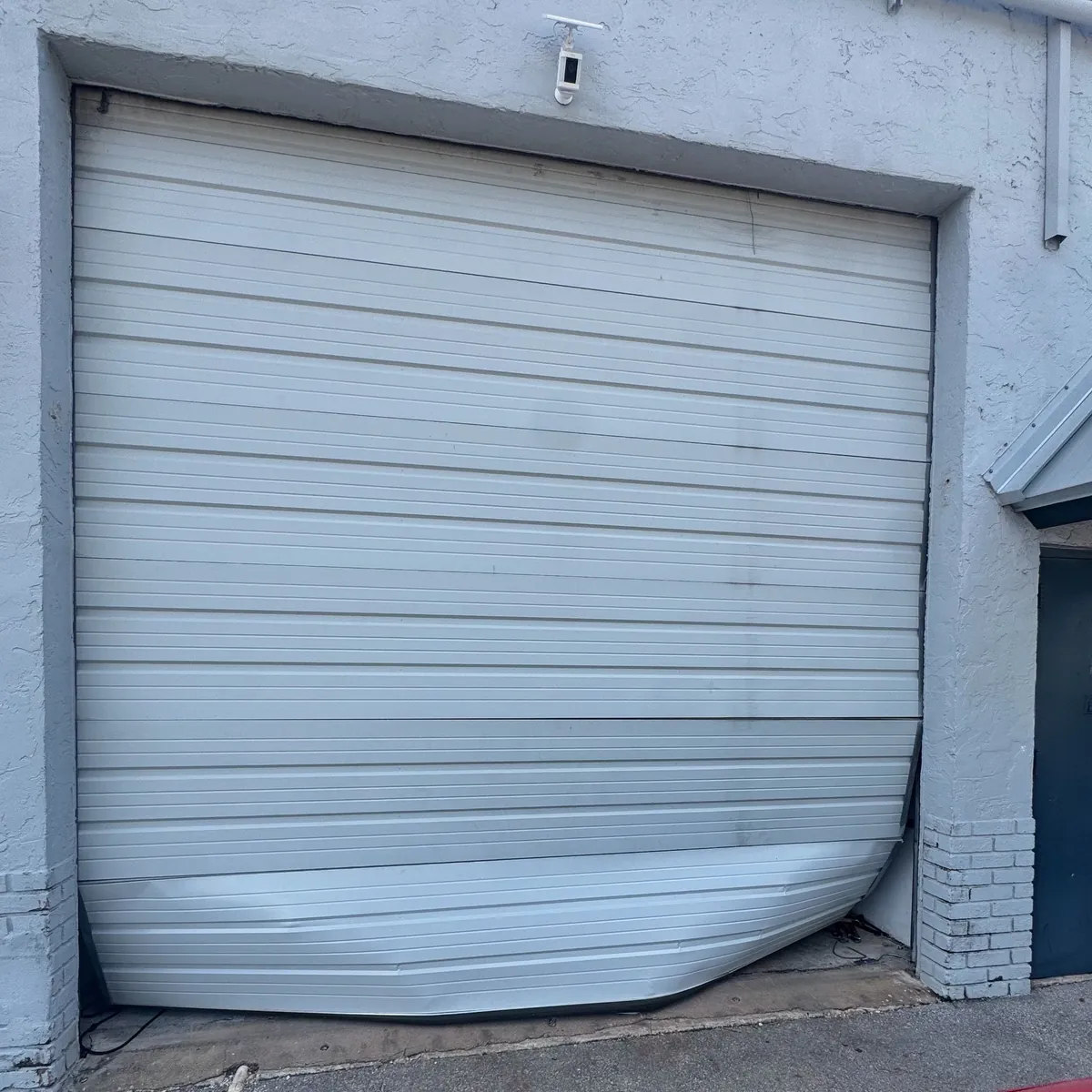
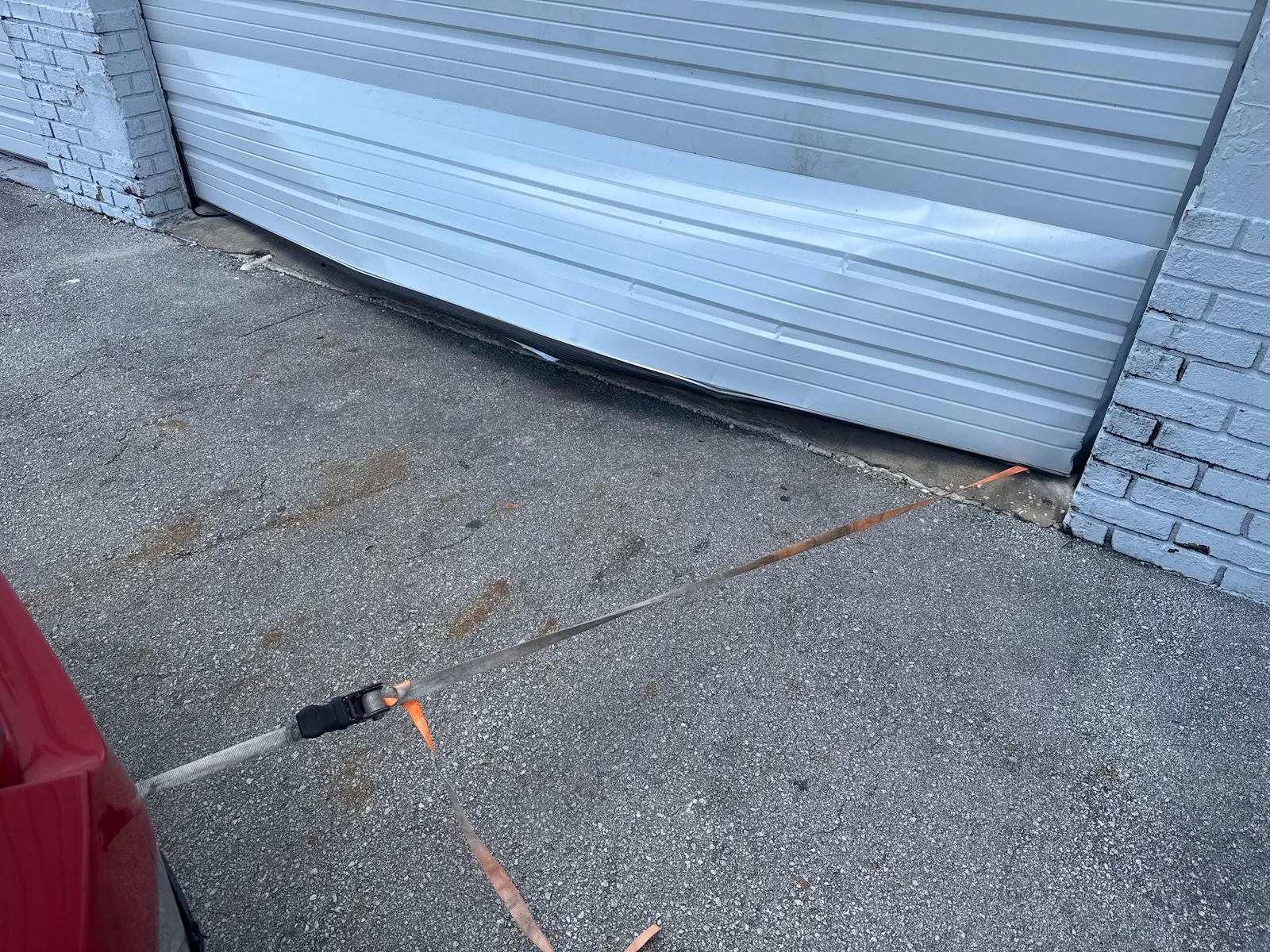
The bottom of the door takes the most punishment. It is the section a car bumper finds when a driver misjudges the final turn into the bay, and the one bins and bikes get pushed against. It also rests on a slab that, in a garage of this age, is seldom flat, so the bottom seal may touch at one end and gap at the other.
One cracked or dented section can usually come out by itself and a new one go in, provided its profile and finish can still be matched. Hinges between the sections get checked at the same visit, because a split hinge lets the door bend as it travels, and the extra flex works the rollers out of their track. A torn or flattened seal is an easy fix that keeps water, leaves and cold air out of the garage and protects the bottom of the door from rot or rust.
Doors off their track
Once its rollers leave the rail, a door hangs crooked, may lean out of the opening, and can fall. In a narrow garage this tends to happen after the bottom section has been hit, or when an opener keeps pushing a door that has already jammed. Do not run it again, and do not try to lever it back into line.
Rehanging a derailed door starts with taking the load off its rollers, then guiding each roller into its rail, straightening or replacing any bent length of track, and checking that both lift cables are seated on their drums at even tension. Only then is the door moved, by hand first and on the opener after. Where an alley crowds the outside of the garage, most of that is done from within. Our off-track garage door repair page walks through rehanging in more depth.
Repair or a new door
On these back lots, fixing the existing door usually wins. Rollers, hinges, cables, seals and springs all wear by design and are meant to be swapped, and a door whose sections are sound will keep running well once they are renewed. A door that has hung in an old opening for years has often been adjusted to fit its quirks, and that is worth something when the sections are still solid.
Replacement starts to make sense once the sections are the thing failing: steel rusted through along the bottom, wood split or soft in more than one panel, or wooden sections so waterlogged that the springs can no longer balance them. A door that has been patched so often that each repair causes the next is another sign. When replacement is the better choice, we supply and install a door sized to the opening the garage actually has, including the low header and the out-of-square jambs that many of these buildings come with. Our article on when to replace a garage door lists the warning signs.
What a new door involves on a back lot
Installing a door at the end of a long driveway is mostly a matter of planning. The old door comes down section by section and is carried out the way it came in. The opening is checked for level and square, and the jambs and header are made sound where needed so the new tracks have something solid to hold. The new door goes up in sections, then the springs are fitted and set to its weight, and the opener is connected and adjusted to the new door’s travel.
On an alley-facing garage the same steps apply, but most of the work stays inside. For any of the garage doors Allston MA back lots hold, that means a door chosen to fit the headroom and the opening, not a standard size forced into a frame it does not suit.
Three habits that keep these doors running
The doors that give the least trouble on shared back-lot garages tend to have owners who do three simple things. They watch the door move every so often, looking for a lean, a pause or a jerk. They listen for new sounds, especially a scrape on the way up or a bang at the bottom. And they keep the opening clear, so the sensors are not blocked and nothing is left where the door comes down.
Those habits catch most faults while they are still small. For garage doors Allston MA rental buildings share, they also mean a problem is reported early rather than discovered when the door finally stops.
Book a visit
If your door is stuck, noisy, crooked or simply not right, let us know whether we come in by the driveway or the alley, how the door behaves when someone tries to run it, and whether a car is stuck inside. Calls are taken at any hour. You can call us or book online.
Questions from Allston
Our garage is shared by the units in the building. Who should call?
Whoever is responsible for the building is usually best placed, since they can agree to the work. Anyone can call to report a fault, though, and it helps if the person who saw the problem can describe what the door did.
A tenant has moved out and taken a remote. Can the opener be reset?
Yes. We wipe the opener’s stored codes and pair up only the remotes still in the building, so the missing one no longer opens the door. It is a quick job and can be done at the same time as any other repair.
The garage opens straight onto a narrow alley. Is a new door still possible?
Yes. The old door is taken down and the new one assembled from inside the garage where the alley leaves no room, with the tracks and springs set up in the space the building has.
The door shakes and bangs on the way down. Is it safe to use?
Park it for now, unplugged, and get it looked at. A bang or a shudder usually means a roller, hinge, cable or spring is wearing, and running the door keeps loading the parts that are still holding.
Is our old wooden door worth fixing?
Often, yes, if the wood is sound. Springs, cables, rollers and seals can all be renewed. If panels are soft or split in several places, or the whole door now weighs too much for springs to balance, a replacement is usually the better spend.