
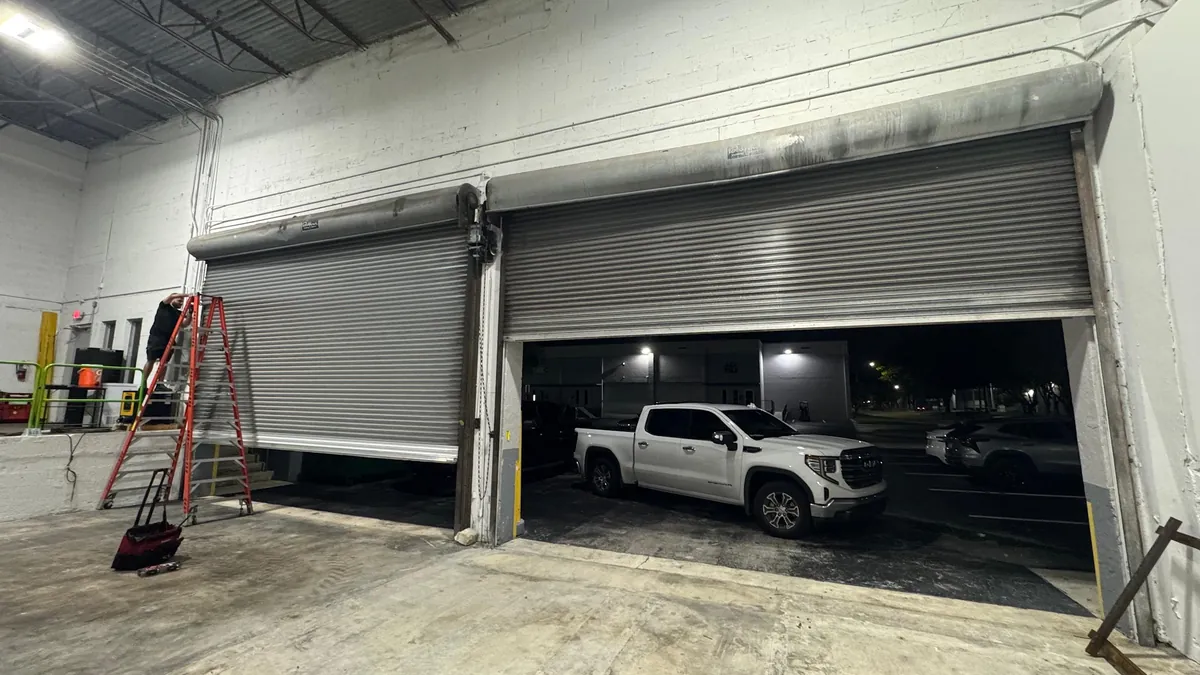
One door, a whole tower’s cars behind it
Among the office and residential towers in the middle of the city, almost nobody owns a garage of their own. Cars live below ground in shared parking under the building, and a single overhead door at the head of the ramp lets every one of them in and out. The rest of the garage doors downtown Boston MA streets hold are commercial roll-ups on the side streets, guarding loading areas, storerooms and service entrances.
Both kinds work far harder than any door on a house. A ramp door may cycle for each resident’s car, each delivery van and each contractor, morning to night. A side-street shutter goes up for every drop and comes down after it. Wear that a family door would show after many years can appear on these doors much sooner.
Three things a building manager can check before calling:
- Whether the door stops partway and reverses, or stalls in the same spot each time.
- Whether the door rises level, or one side leads.
- Whether there is visible damage to the bottom section, the tracks or the guides.
Working through building management
Elsewhere, a garage door visit is arranged with whoever opens the front door. In a tower, the arrangement runs through building management. The property manager or the building engineer usually chooses the slot in which the ramp may close, how residents and tenants will get their cars in and out while it is, and who will meet us at the loading dock or the security desk.
That is how work on garage doors downtown Boston MA buildings rely on should be planned. When you contact us, tell us who is responsible for the door, how the door is reached, what access arrangements apply, and which part of the day the ramp is quietest. If the building has a second entrance or exit that can carry traffic during the work, say so; it changes what is possible.
Residents who notice a fault with their building’s parking door should report it to their management first. Management can then call us and arrange access, which avoids two separate bookings for one door.
The doors at the top of the ramp
The entrance to below-grade parking is usually closed by a wide overhead door: a sectional door that runs up into horizontal tracks under the ceiling, or a rolling door that winds onto a barrel above the opening. Either type is heavy, and either depends on springs to carry most of its weight, cables or a barrel to lift it, rollers or guides to steer it, and an operator to drive it.
What sets ramp doors apart is their cycle count and their exposure. The door may be opened and closed many times an hour at busy periods. The ramp channels rain, sleet and road salt straight down toward the bottom section, and exhaust and grime from passing vehicles settle on the hardware. A car that turns too tight at the top of the ramp, or a van that is taller than the opening allows, can catch the door or its track.
Typical faults are a door that stops partway and reverses, a door that rises unevenly because one cable or spring is failing, a bottom section bent by a vehicle, rollers worn from heavy use, and an operator that no longer stops at the right points. Each fault gets fuller treatment on the downtown repair page. Property managers comparing ramp doors, loading shutters and their operators will find the bigger picture under commercial garage doors.
Side-street roll-ups and loading entrances
On the side streets, roll-up doors close off loading areas, service entrances and storerooms at street level. They share the problems of any commercial shutter: slats cracked by carts and pallets, bottom bars bent by vehicles reversing to the kerb, guides clogged with grit, and operators that drift out of their limits.
A loading door is also a security door. If it cannot be closed at the end of the day, the building’s back entrance is open to the street. If it cannot be opened in the morning, deliveries back up and staff carry goods through a front lobby that was never meant for it. That is why we take these calls seriously at any hour.
Springs: the force behind a heavy door
On both ramp doors and roll-ups, springs do most of the lifting. Sectional ramp doors hang from torsion coils strung along a steel shaft over the header, while a rolling door hides its coil inside the barrel. On a door cycling as often as these do, springs reach the end of their working life far sooner than on a house door.
When a spring breaks, the operator suddenly faces the door’s full weight. It may strain, stall or trip its own protection, and the door may stop where it is. Do not keep pressing the control in the hope it will move.
Springs on large commercial doors carry dangerous tension at all times, open or shut. Adjusting or replacing them is done with the door secured and the tension released in a controlled sequence. A slip can spin a shaft or barrel or release a fitting with great force. So, plainly: it is not a DIY repair, and the building’s handyman should leave the winding bars alone, however good they are with a boiler. The downtown spring repair page explains spring work more fully.
Operators, controls and safety devices
The operator on a ramp door is the part that residents notice. It drives the door, responds to remotes and wall controls, and stops and reverses the door when its safety devices detect something in the way. When it misbehaves, the whole building feels it.
The usual complaints: the door bounces back up for no visible reason, it halts a little below the header or above the concrete, the motor whines while nothing moves, or fobs and remotes work one day and not the next. Safety sensors and edges on a busy ramp door are knocked, splashed and coated with road grime, and a sensor that cannot see across the opening will stop the door closing. Limits and force settings need checking whenever the door has been repaired, because a door that has been rebalanced behaves differently.
When an operator is finished, its successor has to be rated for the door’s size and weight and for a duty cycle far beyond anything a house sees. On the occasional smaller residential door in these buildings, we also repair LiftMaster openers and put in new LiftMaster units. There is more on operator work on the downtown opener repair page.
When the ramp door fails at night
A parking door that will not open traps cars below; one that will not close leaves the building’s parking open to the street. Either way, it is a problem that cannot wait for the morning, and it often happens at the least convenient time, after a late delivery or on a busy evening.
The concierge or night engineer can ring us at any hour of any day and reach a person, not a recording. There is no promised arrival time, since that turns on the jobs already in progress across the city, but the report itself never has to wait. Meanwhile, stop using the door, keep vehicles and people clear of the opening, and post someone at the ramp if traffic needs directing. Our downtown emergency repair page has more on what to do while you wait.
What a visit involves
Work on a building’s door starts at the security desk or the loading dock, with whoever is responsible for the door. Before anything is touched, the area around the door is made safe and traffic is managed, either by closing the ramp or by directing cars through another entrance.
Then the door itself. The operator is disengaged so the door’s balance can be judged by hand or by chain hoist, which on a ramp door of this size usually takes two people. Any rust bleeding from the track anchors, any scuffs on the jambs from passing vans and any looseness in the hinges are noted at this stage, because they explain how the door reached its present state. The springs, cables or barrel, rollers or guides, tracks, sections or slats, the bottom section and its seal are all examined, and the operator, its controls and its safety devices are tested separately.
Management gets a plain account of the broken part, the reason it broke and any neighbouring parts that look tired, and signs off before the work goes ahead. With the parts fitted, the coils are wound to the point where a half-raised door neither climbs nor sinks, the operator learns fresh stops and a sensible push, and someone stands by the ramp watching a run of cycles, including one stopped by an obstruction to prove the reverse.
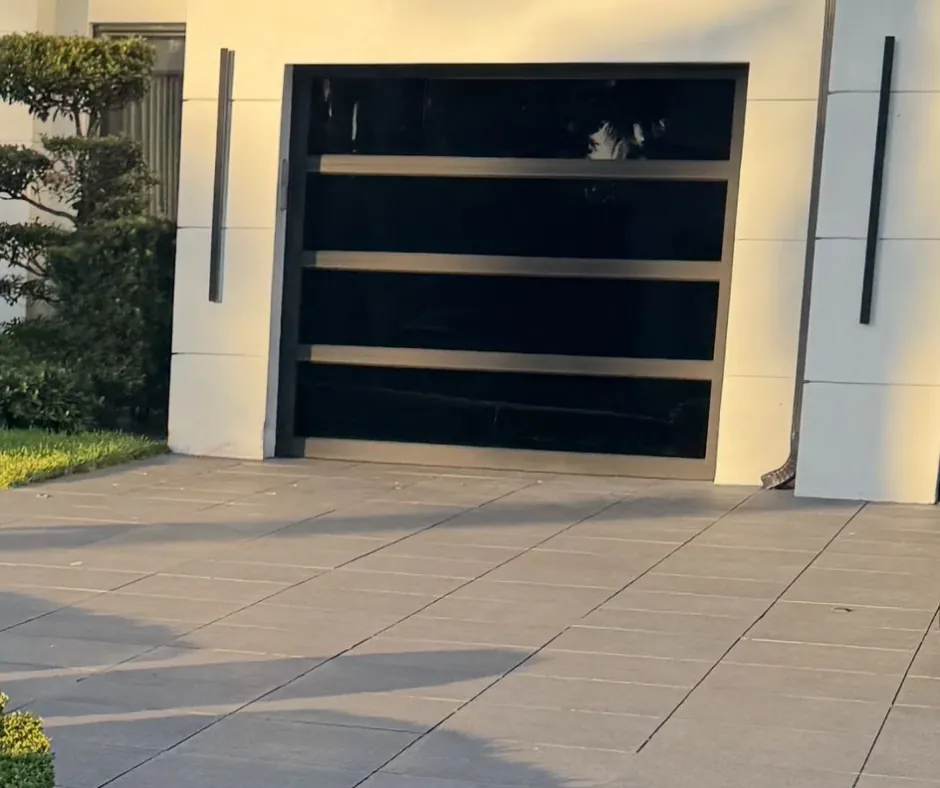
Weather, salt and the foot of the ramp
A ramp running down from street level acts as a funnel. Rain, meltwater and the brine laid on the street in winter all flow toward the door at its head or its foot, and the bottom section and lower track brackets sit in that flow for months at a time. Corrosion on garage doors downtown Boston MA ramps protect tends to start low and climb, so the bottom seal, the lowest rollers and the anchor points of the vertical tracks get particular attention on every visit.
Wind matters too. Between tall buildings, gusts can push hard against a wide door while it is moving, and a door held partway open in a strong wind puts strain on its rollers and track joints. A door that rattles or bows in a gust is often telling us that rollers or hinges have worn loose.
Ice is the winter hazard. Water that pools under the bottom seal can freeze the door to the concrete overnight, and an operator that drives against a frozen door may rip the rubber away or kink the lowest panel long before the ice gives. Clearing standing water at the threshold before a cold night is a simple step that saves a lot of trouble.
Planning around a building that never fully stops
Towers have people coming and going at every hour, so there is rarely a time when the parking door is not needed. Planning helps. A short window agreed in advance, with residents told when the ramp will be closed, makes the work smoother for everyone. Where a building has more than one entrance, routing traffic through the other while one door is worked on can avoid closing parking altogether.
For larger jobs, such as a door replacement, the planning matters even more. Measurements are taken in advance, the work is sequenced so the opening is secured at the end of each stage, and building management is kept informed throughout. That way the work fits into the building’s routine instead of disrupting it.
Repair or replace
A ramp door with straight sections and solid tracks is nearly always worth fixing. Its springs, cables, rollers and operator are wear items, expected to be replaced several times over, and swapping them returns the door to steady service.
Replacement becomes worth considering when the door itself is worn out: sections or slats damaged across much of the door, tracks or guides repeatedly knocked out of shape, corrosion that has spread from the bottom up, or a door that keeps failing despite repeated repairs. For a door that cycles as often as a ramp door, reliability counts for a great deal, and a new door can be a better use of the building’s budget than repeated callouts.
A replacement for a ramp entrance is specified around the opening, the clearance vehicles need and the number of trips a day it must survive. More on how that is handled in these towers is on the downtown door replacement page, and the citywide process is under new garage door installation.
For residents: what you can check yourself
If your remote has stopped opening the ramp door while neighbours’ remotes still work, the fault is almost certainly in your handset, so start by swapping its little battery. If no remote works but the wall control inside the garage does, the problem lies between the remotes and the operator’s receiver, and that is for management to report. If nothing moves the door at all, the operator or its power supply is the likely cause.
What residents should not do is try to force the door, prop it, or slip under it while it is moving. A ramp door is many times the weight of a house door, and its springs and cables are under heavy load. Whether it is jammed up or jammed down, tell the front desk or management, keep clear of the opening, and let them call us. That way one report reaches us with the access details already arranged, rather than several calls about the same door.
Habits that keep a busy door working
A few simple habits help a heavily used door last. Ask residents and drivers to wait until the door has fully opened before driving through. Keep the area under the door clear of bins, cones and stored items. Clear salt, slush and debris from the foot of the ramp so it does not build up against the bottom section. Log any change in noise, speed or travel with the management office on the day it is noticed.
Engineers on shift should know where the operator’s isolator and manual release are, and how the opening is secured if the door must stay up overnight. Taking a misbehaving door out of service early protects its tracks and sections from the worst of the damage, and that habit pays off on all the garage doors downtown Boston MA buildings operate.
Getting the door looked at
When building staff call about garage doors downtown Boston MA towers and businesses rely on, it helps to say what kind of door it is, whether it serves a ramp or a loading area, what it is doing, whether it can be secured now, who will meet us, and the hours the ramp could be shut. Neighbouring areas we cover are listed on our service areas page.
Calls are picked up at any hour, weekends and holidays too. For a ramp door that has stalled, a loading shutter that will not lock down, or a new door for an entrance that has outlived its old one, call us or book online.
Questions from Downtown Boston
Can the work be scheduled with our building management?
Yes. In most buildings, the property manager or building engineer arranges access and timing, and we work to that arrangement.
Our parking door keeps reversing before it closes. What is wrong?
Often a safety sensor is dirty or out of line, or the door’s balance or the operator’s settings have drifted. Stop using it if it is behaving unpredictably, and have it checked.
The ramp door has slowed down and sounds strained. Is that a spring?
It may be. When a spring weakens or breaks, the operator has to carry far more weight. Take the door out of service and phone us. The coils on a door that size store dangerous tension, and replacing them is not a DIY repair.
Can residents still get their cars in and out during a repair?
It depends on the building. Where there is a second entrance, traffic can often be routed through it. Otherwise, the work is planned for a window agreed with management.
Is it better to repair or replace a heavily used ramp door?
Most are worth repairing. Replacement makes sense when the sections or slats are damaged across much of the door, the tracks keep failing, or the door keeps breaking down despite repairs.