
Harbour air and small garages
Up on Eagle Hill and over in Orient Heights, triple-deckers sit close together with short driveways squeezed between them, and at the back many have a small detached garage. Down at Jeffries Point the pattern changes: newer townhouses tuck their garage beneath the living floors. What ties every one of them together is the harbour. Salt carried on the wind settles on everything metal, and on garage doors East Boston MA homes rely on, that means springs, cables and track hardware rust faster than they would a few miles inland.
Corrosion rarely announces itself. It shows first as orange dust under a spring, a cable that has lost its shine, a roller bearing that squeals in damp weather. By the time the door stops, the rust has usually been working for a long while.
Three things to look for, from a safe distance:
- Rust flaking from the coils of a spring or pooling on the floor beneath it.
- Loose wire ends bristling from either lift cable close to where it hooks on at the bottom.
- Track brackets streaked with rust where they meet the wall.
What salt does to the moving parts
Steel and salt water do not mix. A garage door depends on springs made of tempered steel wire, cables made of twisted steel strands, and tracks, brackets and fasteners made of steel plate. All of them are coated when new, but the coating wears with every cycle and every winter, and once bare steel is exposed to salty, damp air, rust begins.
Springs suffer in two ways. Rust on the coils increases friction as they wind and unwind, so the spring works harder and the door may feel rougher. More seriously, pitting on the wire creates weak points where a break can start. A rusted spring is more likely to snap without warning, and when it does, it usually goes in cold weather when the steel is least forgiving.
Cables fail from the inside out. Salt gets between the strands, the inner wires corrode where they cannot be seen, and the outer strands begin to break one by one near the bottom bracket, where water collects. A cable that looks a little rough can be much weaker than it appears.
Tracks and brackets corrode at their fixings. Rust works into the screw holes, the bracket loosens on the wall or the framing, and the track drifts out of line. Rollers with rusted bearings stop turning and start sliding, wearing flat spots and dragging in the track.
The small detached garages of Eagle Hill and Orient Heights
The garages behind triple-deckers here tend to be compact: a single bay, a modest opening and a short driveway in front that leaves little room to manoeuvre. Cars often swing in at an angle, and a misjudged turn is enough to clip the door frame or the bottom section.
Because these garages stand apart from the house, their doors face the weather from both sides, with no warm wall to keep the damp at bay. Condensation forms on the inside of a steel door on cold mornings, and salt-laden air finds its way in through every gap. A small garage also tends to be crowded, with bikes, bins and tools stored right beside the tracks and the safety sensors.
Work on garage doors East Boston MA triple-deckers have out back often combines several of these things: a spring weakened by rust, a bracket loosened in old framing, and a photo eye nudged sideways by a bike parked against it. The repair has to deal with all of them, not just the part that finally failed.
Townhouse garages at Jeffries Point
The newer townhouses near the water at Jeffries Point usually have their garage built into the ground floor, with living space above. These doors are newer, but they are also closest to the harbour, and the salt exposure is at its greatest. A newer door can corrode faster here than an older door further inland. For garage doors in East Boston that sit within sight of the water, it is worth checking springs and cable ends every season rather than waiting for the door to complain.
These ground-floor garages often double as the main way into the house from the car, so a stuck door shuts off more than parking. The internal door from the garage to the hall, the stair up to the kitchen and the storage along the side walls all depend on the overhead door working. When the bottom seal has perished in the salt, water also blows under the door in a storm and pools against the stored items and the foot of the internal door.
A garage under living space also means the door is heard. A rusted roller grinding in its track, a spring creaking as it winds, or an opener labouring against a stiff door all carry up into the rooms above. Often, it is a change in noise that first prompts a call.
Garage door repair in a salty climate
Most repair visits here involve some mix of springs, cables, rollers, tracks and brackets, along with panels, openers and sensors when something has been knocked or worn. The difference from inland neighbourhoods is the role rust plays. A repair that replaces only the broken part, while leaving a heavily rusted neighbour in place, often leads to a second call soon after.
So the approach is to look at the hardware as a set. If one cable has snapped and the other is shedding strands, both are replaced. If the rollers have seized, the track they ran in is checked for wear and the brackets holding it for corrosion. Where fasteners have rusted into their holes, they may need replacing and the bracket moving to sound material. Our East Boston repair page covers these faults in more depth, and our garage door cable repair page explains cable work across the city.
Springs that rust
A broken spring remains the most common urgent call, and salt air makes it more common still. When a spring breaks, the door suddenly becomes far heavier. Expect the motor to strain for a moment, raise the bottom edge a hand’s width, then give up. You may have heard a loud bang from the garage, the sound of the spring letting go.
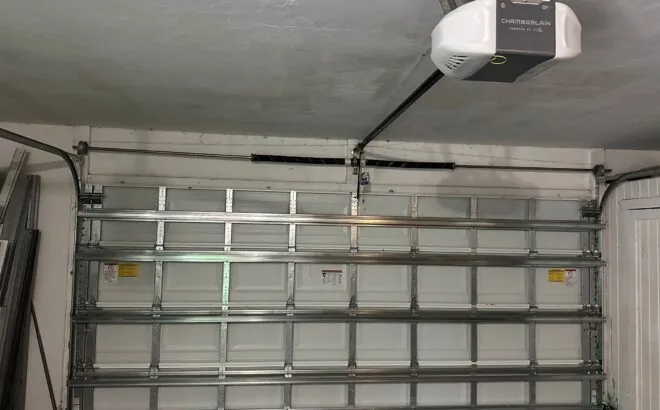
Torsion coils on the shaft over the header store dangerous tension from the moment the door is hung, open or closed. Rust does nothing to make them safer, and pitted wire behaves less predictably than clean wire. Winding one calls for proper bars and a strict order, and a slip sends steel flying. Please treat it as what it is: not a DIY repair. Let the door sit where it stopped, pull the opener’s cord from the socket, and stay out from under that shaft. Older doors sometimes use extension springs stretched beside the overhead rails instead, and each of those should have a containment cable threaded through it, so a rust-weakened spring that parts stays on its line instead of lashing out. The East Boston spring repair page explains spring replacement in more detail.
Openers, remotes and sensors
Harbour air is no kinder to the electrical side: the motor head, every remote, the wall station and the paired photo eyes near the floor. Damp, salty air gets into connections and contacts. A sensor bracket screwed into a rusted jamb works loose. Remotes left in cars parked outside see damp and temperature swings.
Look for a door that flicks back up a foot from the ground, a motor that drones on with nothing happening, a handset that only works from the driveway’s end, or a button that needs pressing twice. Often the opener is fine and the problem is the door: a stiff, rust-dragging door asks more of the opener than it was set up for, and the opener stops to protect itself.
When an opener really is finished, the new unit is sized for what that door weighs and for the ceiling space available. LiftMaster is one make we repair, and we fit new LiftMaster units too. There is more on opener work on the East Boston opener repair page.
When the door gives out at night
Rusted springs often break on cold nights, and a door that will not open the next morning can leave a car stuck in a small detached garage. A door stuck open overnight leaves the garage exposed.
A real person picks up our line whatever the hour, so the bang heard at midnight can be reported at midnight. No arrival time is promised, since it hinges on jobs already running elsewhere, yet nothing obliges you to hold off until breakfast. While waiting, kill the opener’s power, give the snapped spring or slack cable a wide berth, and leave the door’s weight to the door. More guidance for those hours is on the East Boston emergency repair page.
What a visit involves
First, the trolley is unlatched from the opener rail and the door is worked by hand. Raised halfway and released, a healthy door barely shifts; one riding on a tired or snapped spring falls away or refuses to rise.
Then the hardware is checked piece by piece, with particular attention to corrosion: the springs and their end fittings, both cables from drum to bottom bracket, every roller and its bearing, the hinges, the vertical and horizontal tracks and every bracket and fastener. Separately, every control that talks to the motor gets tried in turn.
You see the broken part, the reach of the rust around it and the pieces likely to go next, and no new part is fitted until you approve it. To finish, the springs are trimmed to the door’s real weight, the opener relearns its travel and its push, and the auto-reverse gets tested against an offcut of two-by-four set on the slab.
Signs a door by the water is due a look
On garage doors East Boston MA streets near the harbour carry, small changes are worth acting on:
- A spring that has started to creak, or that shows orange dust on the floor beneath it.
- A cable with a kink, a flat spot or a few strands standing proud near the bottom bracket.
- Rollers that slide instead of turning, leaving shiny wear marks inside the track.
- Rust weeping from the screw heads that hold the track brackets to the wall.
- A bottom seal that has hardened and cracked, letting water and grit blow under the door.
Any one of these on its own is a modest job. Together, and left for a winter, they add up to the door that fails on a cold morning with the car inside.
Winter on the waterfront
Cold weather sharpens every problem the salt has started. Steel wire that has been pitted by corrosion snaps most readily when the thermometer drops hard, which is why so many springs here fail in the first hard frost of the season. Lubricant on roller axles and hinge pins thickens like cold honey, so a door that ran quietly in autumn begins to shudder. Brine splashed up from the street during storms adds a fresh coat of salt to the lowest hardware just as the door is working hardest.
A short check before winter pays off: watch the door through a full cycle, listen for new noises, and look along the springs and both cables for rust or broken strands. If anything looks wrong, have it seen to while the weather is still mild.
Slowing the rust down
Salt air cannot be kept out, but its effects can be slowed. Rinsing the lower part of the door and the bottom brackets after a winter of road salt helps. Keeping the garage as dry as possible, with leaves and slush cleared from the threshold, reduces the damp that drives corrosion. Watching the springs and cables for new rust, and acting early when it appears, can head off a sudden break.
Listen to the door as well. A new squeal, a grinding noise or a jerk in the travel often means a roller bearing has rusted or a cable is starting to fray. Caught at that stage, the fix is a single part rather than a chain of damaged ones.
Short driveways and knocked doors
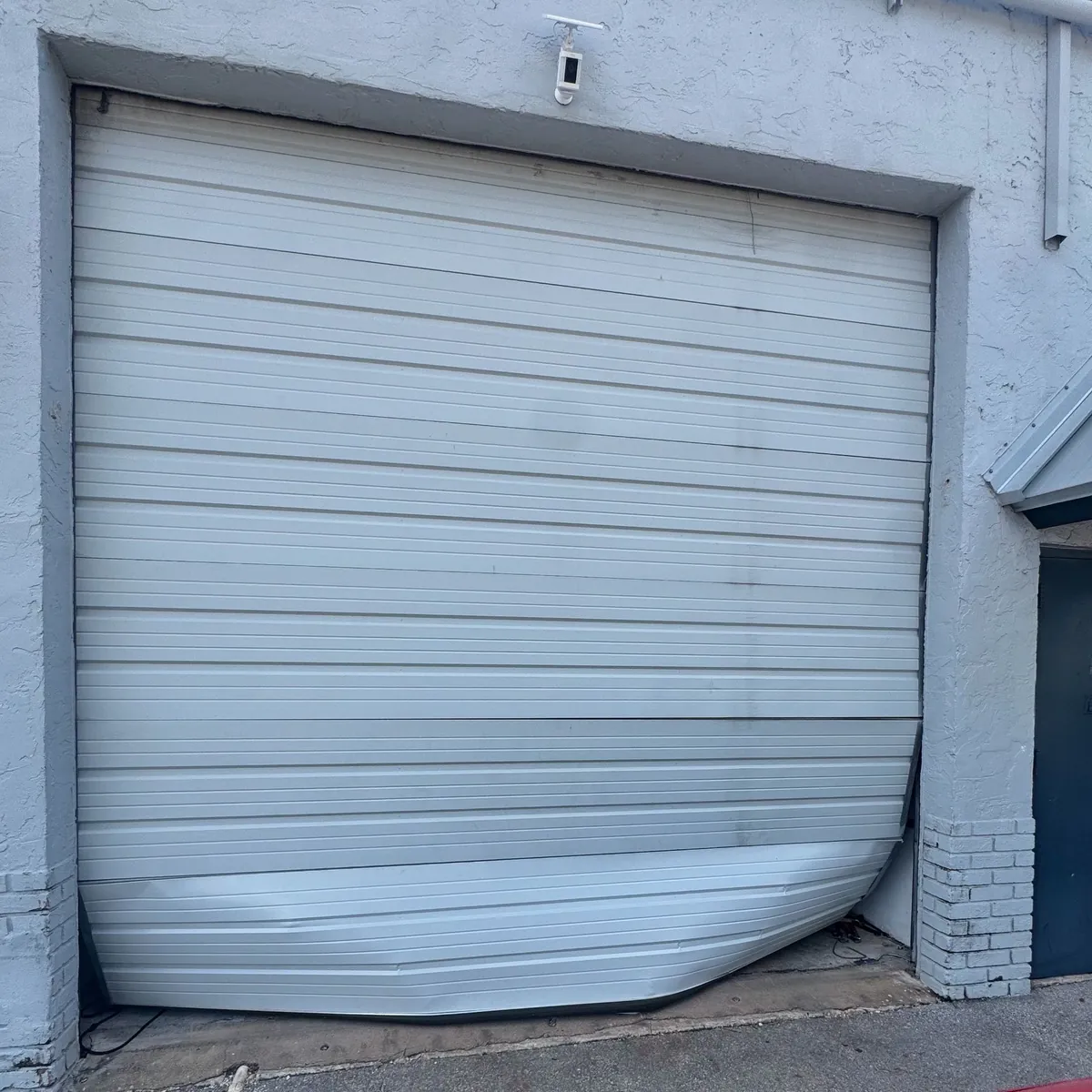
Short driveways leave little space to straighten a car before it enters the garage, and many doors here carry the marks of it. A bumper nudging the bottom section, a mirror catching a track, or a door closing onto the back of a car parked too close can all bend panels and push the door out of line.
Once a roller jumps its rail, the door hangs askew and could come down. Running the motor or shoving it straight both make matters worse, so cut the power, step back and ring us. The cure is to brace the door, coax each roller home, swap any kinked rail and even up the cables before anything moves. A fuller account of rerailing appears under off-track garage door repair, along with the signs that a door is about to leave its track.
Repair or replace
Repair is the usual answer. Hardware near the water wears out sooner, but every bit of it is replaceable by design, so any door whose panels are still solid can go on for years with fresh springs, cables and rollers.
Near the harbour, though, the sections themselves can corrode. Steel panels rusting through at the bottom, rust spreading up from the bottom section, or a door where corrosion has reached the hinges and struts across much of its height are signs that a new door may be the better choice. A new door also means new hardware throughout, which resets the clock on corrosion.
Replacement doors are measured to the opening and fitted with the harbour air in mind. The East Boston door replacement page takes this further, and new garage door installation shows the process citywide. For districts beyond this one, see service areas.
Before you phone
When you call about garage doors East Boston MA properties depend on, tell us whether the garage is a detached one behind a triple-decker or built into a townhouse, what the door is doing, whether you can see rust, a broken spring or a frayed cable, and whether a car is shut inside. It helps us plan for the parts likely to be needed.
Any hour suits us for that call. For a rusted spring, a fraying cable, a noisy townhouse door or a replacement for one the salt has beaten, call us or book online.
Questions from East Boston
Springs and cables near us rust quickly. Why?
The salt air off the harbour settles on bare steel and speeds up corrosion. Springs, cables and track hardware are all steel, so they show it first, especially on doors close to the water.
Our spring is rusty but still working. Should it be replaced?
It is worth having it checked. Rust can pit the wire and create weak points, making a sudden break more likely. A spring that is heavily rusted is often best replaced before it fails.
The cable has a few broken strands. Is that urgent?
Yes. A fraying cable can snap without warning, and the door can drop on one side. Stop using the door, unplug the opener and call.
Our garage is under our townhouse and the door has become noisy. What is causing it?
Usually rusted rollers or bearings, dry hinges, or a spring rubbing as it winds. Replacing worn parts and rebalancing the door generally quietens it.
Is it worth replacing a rusted door rather than repairing it?
Solid panels mean repair is normally the sensible route. If corrosion has spread through the panels or hinges across much of the door, a new door with new hardware throughout may be the better choice.