
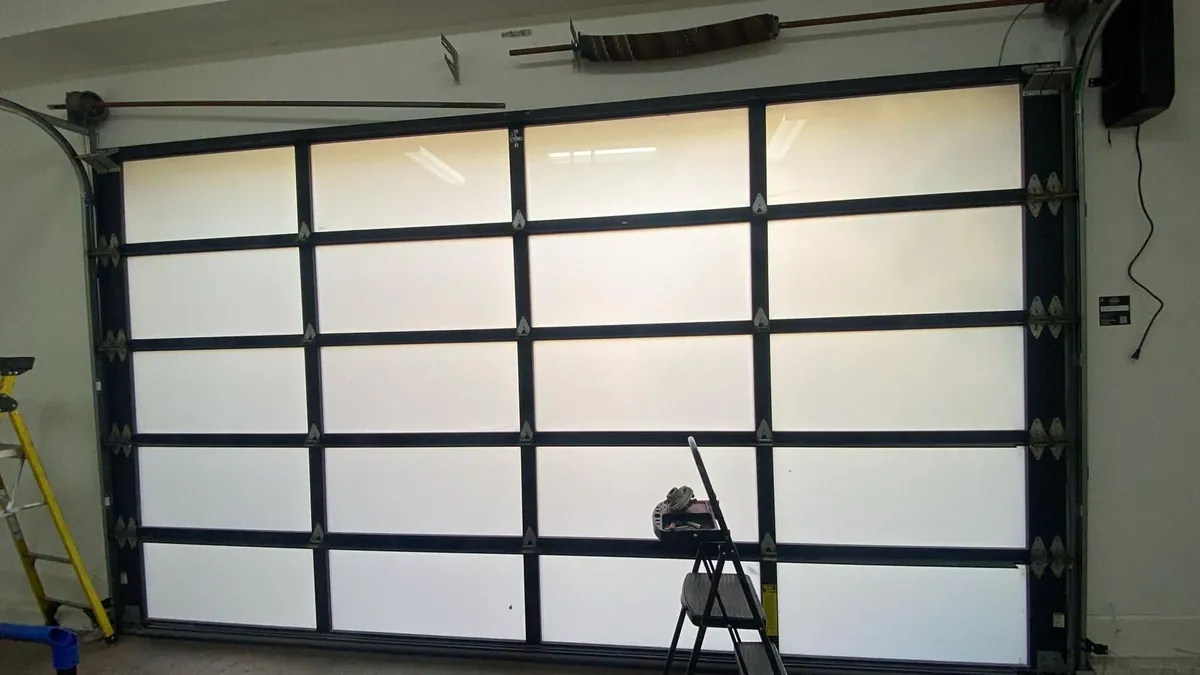
Single-car openings from the twenties and thirties, at the end of the drive
Around Roslindale Village the usual arrangement is a single- or two-family house near the street and a detached garage well behind it, reached by a driveway that runs most of the way down the lot. A great many of those garages date from the nineteen-twenties and thirties, and their openings were cut for a single car of that era. Most calls about garage doors Roslindale MA homes depend on start with one of those narrow openings and the door that has been fitted into it, often a door that is much newer than the building around it.
An opening that old brings its own set of quirks. The framing has had decades to settle, the header may be lower than a modern door expects, and the side jambs are rarely perfectly plumb. A door fitted to that opening works well when it is set up for it, and wears quickly when it is not.
Standing back from the door, without lifting it, take note of:
- Whether there is a visible gap in one of the coiled springs above the door or along the tracks.
- Whether the door has started to rub on one jamb as it moves.
- Whether the cable at each bottom corner is still tight against its drum or bracket.
Garages built for smaller cars
A single-car garage from the nineteen-twenties or thirties was planned around a narrow, short car and a door that probably swung or slid rather than lifted overhead. When those buildings were later fitted with sectional overhead doors, a modern product was squeezed into a hole framed for something quite different. That history explains a lot of what goes wrong.
Low headroom is the first constraint. A standard torsion spring rides on a steel rod spanning the header, and it wants a strip of empty wall above the lintel, below where the joists start. Some of these low garages simply do not have that strip, so their doors hang from stretched extension springs beside the overhead rails, or use a low-headroom track layout that moves the springs elsewhere. Each arrangement fails in its own way, and any new part must match whichever layout this particular garage was given.
Narrow side room is the second. With little wall on either side of the opening, the vertical tracks are fixed close to the edge of the framing, and their brackets go into old wood that may already carry holes from an earlier door. When a bracket loosens, the track shifts, and the door starts to bind or scrape.
Long driveways and what they mean for a door
Out behind the house, such a garage is a long walk from the kitchen door. That matters in a few ways. On a winter night it is a long walk to a door that has stuck shut. A remote that works from the street when the batteries are fresh may stop reaching the opener as they weaken, or as the antenna on the motor gets knocked out of line. And a door that is opened rarely, because the car lives in the driveway, can sit unused for weeks and then be asked to work in the cold.
When a door at the end of the drive will not open, start at the house end before walking to the garage:
- Walk the remote right up to the garage and press it there, rather than from the car at the street.
- If the garage has power, try the wall button inside.
- If both fail, look over the door from a few steps back for the usual suspects: a coil with a gap in it, one cable hanging limp, or a roller that has escaped its rail.
Two-family houses often share one driveway and sometimes one garage, with each household using one side or taking turns. Mention that arrangement when you ring, because a door cycled by two households wears its rollers, springs and motor down sooner than one used by a single family.
Garage door repair on older single-car doors
The everyday repairs on these doors are the ones you would expect from a door that has lived a long time in an old garage: worn rollers that grind or jump, hinges that have cracked between sections, a bottom section dented by a bumper or a bicycle, a bottom seal that has flattened and lets in water and leaves, and tracks whose brackets have worked loose in old framing. Our Roslindale garage door repair page goes through each of them in more detail.
Among garage doors Roslindale MA houses keep out back, what sets a repair apart is often the opening rather than the door. A door scraping one jamb can be in fine shape itself, with the old upright having leaned in toward it. A door that will not close evenly may be sitting on a floor that has sunk at one corner. Before any part is changed we look at how the door sits in the opening and whether the problem lies in the door, the tracks or the building, because replacing the wrong part only moves the problem.
Springs: the most common urgent call
A broken spring is the call we hear most often. One morning the door will not lift, the motor grinds for a moment and quits with the door barely off the slab, and a gap shows in the coils of a spring. On these older single-car doors that spring is either one torsion coil mounted over the opening or two long extension springs stretched above the overhead rails.
Torsion springs are wound up with enough stored energy to injure someone badly. Do not loosen the set screws, do not try to unwind one and do not attempt to change it yourself; this is work for someone with the right bars and training, not a DIY job. Extension springs are easier to inspect yet still stretched tight whenever the door is down, and an elderly pair with no restraint cable threaded through them can lash across the garage when one lets go.
Once a coil has snapped:
- A shut door stays shut; no heaving it up by hand.
- Do not run the opener. The motor cannot carry the weight a spring was carrying.
- If the door is open and the car needs to come out, call us before moving it.
Spring replacement has its own page, Roslindale spring repair, covering both kinds of spring.
Openers in a garage set back from the house
Many of these detached garages were wired long after they were built, sometimes with a single outlet on the ceiling, and the opener hangs from joists that were not always meant to carry it. The faults we are called about most are a motor that drones while the door stays put, a remote that works only from a few feet away, a wall button that does nothing, and a door that reverses just short of the floor because one of the two ankle-height photo eyes has been bumped off its aim.
Before calling, plug a lamp into the ceiling socket that feeds the motor to see whether it is live, and look at the two small sensors on either side of the opening, which should face each other squarely. A rake or a bin leaning against one is a common cause. LiftMaster openers are among the units we fix and replace. The Roslindale opener repair page has more on openers, remotes and wall buttons.
In a low garage the choice of opener matters as well. A unit that hangs too low can foul the door as it lifts, so the opener has to suit the headroom the building actually has.
A door that fails late at night
A garage at the back of a long driveway tends to fail when nobody is near it: after dark, in the cold, or when the car has to leave before the house is awake. Ring at three in the morning or on a holiday afternoon and somebody picks up; whoever answers will say which parts of the door you can safely handle while a visit is lined up. We never promise how quickly someone will be there; we tell you honestly when we can come.
If a door is stuck open overnight and the garage holds a car or tools, the first concern is often securing it. When a coil or a cable has failed, neither the motor nor your arms should be used to drag the door down. Call us, describe what you see, and we will say whether there is anything safe to do before we arrive. More detail is on the Roslindale emergency garage door repair page.
Cables, drums and doors off their tracks
With torsion springs, each lift cable climbs from a bracket at a lower corner of the door to a grooved drum at the end of the spring rod. Should one of those wires fray through, its side sags and the door tilts across the opening. On an old door that has been patched more than once, the cable is often the first part to go, especially if the bottom of the door has been taking on moisture and the bracket that holds the cable has rusted.
A crooked door can also come off its track altogether. In a narrow garage, a door that is out of square has little room before a roller leaves the track. Do not try to push it back in or run the opener. The door is still held by springs and cables, and a section can drop or fold. Our citywide pages for cable repair and off-track doors explain both repairs.
What happens on a visit
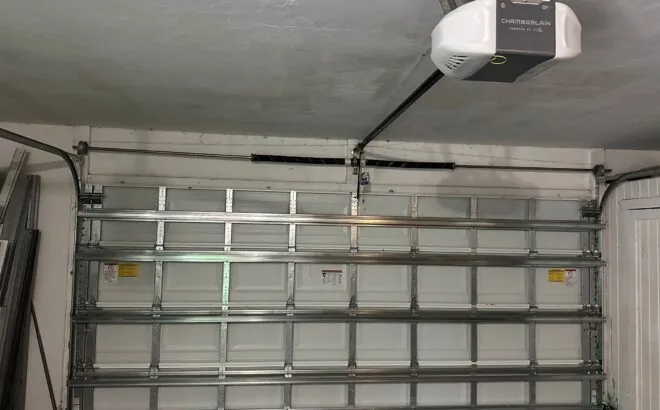
On a visit to one of these garages, the route from the street is part of the job. We will ask whether the driveway is clear to the garage, whether a car is parked in it, and whether there is power in the garage. Then the work goes in a set order:
- A look at the door and opening before anything is touched: every coil, cable, roller and hinge, the rails and their brackets, and the old jambs themselves.
- A check of the balance, where the door can be safely lifted by hand with the opener released.
- A look at the opener, its sensors, the wall button and the remotes.
- A plain account of the fault and your options, given before a tool is picked up.
- The repair, then several full cycles of the door to check it runs smoothly, stops at the floor and reverses when the sensors are blocked.
A door is not left in a worse state than it was found. If a part must be fetched, the door is left closed and secure.
Repairing an old door, or replacing it
Many single-car doors in these garages can be repaired and will run well for a long time after. Rollers, hinges, cables, springs, a single bent section and a worn bottom seal are all ordinary repairs. A new door becomes the better answer once more than one section is cracked, when a timber door has softened along its lower edge, when patch upon patch has left it too uneven to balance, or when the door simply does not suit the opening it hangs in.
When a door is replaced in a garage like these, the new one is sized to the opening that is really there, crooked framing and all. A new door for a nineteen-twenties opening may need its tracks set up for low headroom, or its jambs straightened before it is hung. We supply the replacement, hang it, and haul away whatever came down; see new garage doors in Roslindale for more.
Questions worth weighing up:
- Is the trouble in the door, or in the opening and the framing around it?
- Does the door still balance once its springs are adjusted, or has it grown too heavy?
- How is the garage used now, as a car space, storage, or a workshop?
Weather, slabs and old framing
The nineteen-twenties and thirties garages around the Village were often built on slabs or floors that have since settled. A floor that has dropped at one corner leaves a gap under one side of a closed door, which lets in water, leaves and cold. A new bottom seal helps up to a point, but a door that has to close onto an uneven floor will not seal well at both ends. In some cases the limit settings on the opener also need adjusting so the door closes fully without forcing itself against the slab.
Old framing moves with the seasons too. A jamb that is sound in summer can swell in a wet spell and start to rub. Track brackets screwed into soft wood loosen over time, and a door that once ran quietly starts to rattle. Repairs here are about solid fixings: moving brackets to sound timber, adding a backing where the original holes have stripped, and setting the tracks plumb before the door runs in them again.
Garage doors in Roslindale often sit in buildings like these, where the door and the frame have to be thought about together. A careful repair treats the slab, the jambs and the door as one problem rather than three.
Getting your door seen to
A back-of-the-lot garage is easy to ignore until its door finally refuses to budge. If the door has started to grind, rattle, rub or labour, it is better to have it looked at while it still moves. Describe the noise or the stall, say which spring type you can see over the door, and explain how a van gets down the drive; you will hear back what is safe to do until the visit. For the full list of neighbourhoods and towns we work in, see service areas.
When it comes to garage doors Roslindale MA owners have at the back of the lot, the age of the garage shapes the repair as much as the door does. Whether it is a broken spring or an opener that has stopped answering the remote, call us or book online.
Questions from Roslindale
The remote stopped working from the street, and the garage is way back behind the house. Has the opener died?
Not necessarily. Stand beside the garage with the remote and press it, then try the button inside. If both work up close, tired batteries or a bent antenna on the motor are likelier culprits than a dead opener. If neither does anything, check that the ceiling socket has power before calling us.
The garage is very low inside. Can a new spring or opener still fit?
Usually, yes. A cramped garage can take stretched side springs or a rail kit designed for tight ceilings, and some openers are built to tuck into very little height. Measuring that clearance is one of the first things done on a visit.
I can see a split coil above the door. Is it OK to raise the door manually?
Do not try. Without its spring, the door weighs many times what you would guess, and any torsion coil still intact remains wound tight with dangerous energy. Leave the door alone, keep the motor switched off, and ring us.
Two households share our garage. Does that change anything?
A door shared by two households opens and closes more often, so rollers, hinges, springs and the opener wear sooner. Let us know who uses it and how, so the parts we fit suit the way the door is actually used.
The door rubs on one side as it goes up. Does it need replacing?
Often not. In an older garage the jamb or a track bracket may have moved rather than the door itself. We check how the door sits in the opening before deciding whether anything on the door needs to change.