
The door starts up, gets as far as your knees or your chest, and stops. Sometimes it pauses and reverses, sometimes it just hangs there. When a garage door only opens partway, the opener is reacting to something: a travel setting that tells it to stop too early, a door that has become too heavy for it to carry, or a door that is binding somewhere in its tracks. Each of those has a different fix, and only one of them is something a homeowner should adjust.
Why a door stops in the middle of its travel
An opener does not simply run until the door hits the top. It watches two things: how far the trolley has travelled, and how hard the motor is working. When the door reaches its programmed limit, the opener stops. When the motor has to pull harder than it expects, the opener treats that as an obstruction and stops or reverses, which is a safety feature doing its job.
So when a garage door only opens partway, the question is which of those two the opener is reacting to. If the door stops at exactly the same height every time, smoothly and quietly, a travel limit is the likeliest cause. If it stops at different heights, labours before it stops, or jerks, the door is fighting the opener.
Reading the symptoms
Stops at the same point every time, no strain. The up limit on the opener is set short. This can happen after a power cut, after someone has adjusted the opener, or after a new door has been fitted to an old opener.
Climbs slowly, then stops and drops back a little. The door is too heavy. A spring has weakened or broken, and the opener cannot carry the extra weight past a certain point.
Stops with a bang or a jolt at one spot. Something in the track is catching. A kinked length of track, a split roller or a bracket that has worked loose will do it.
One side rises ahead of the other before it stops. A cable is fraying, slipping on its drum or has snapped. The door twists as it rises and wedges in the opening. The guide to a garage door crooked or uneven goes further into this.
Worse on cold mornings, better in the afternoon. Cold stiffens the grease on rollers and hinges and takes a little out of an ageing spring, so the door is heaviest when the temperature is lowest.
What you can safely check
- Look along both vertical tracks with the door down. Anything propped near a track, a bike, a shovel or a bin, can snag the door as it rises.
- Look for a dent or kink in either track and for a roller that has come out of its channel. Note what you see, but do not hammer a track back into shape.
- Check the overhead rail of the opener for anything hanging from it or rubbing against the trolley.
- Try the wall button rather than the remote. If the door behaves the same way from both, the controls are not the cause.
- With the door fully closed, watch the springs as the opener starts. A torsion spring with a visible gap in its coil, or one extension spring stretching less than the other, tells you the springs are the problem.
If the door stops at the same point smoothly every time, and you have the opener’s own manual to hand, its up-limit setting is something many owners adjust. If in doubt, leave it for a technician.
What to leave alone
Do not keep pressing the button to make the door go further. Each attempt drives the opener against a load or a jam that is already too much for it, and a half-open door that drops can land hard.
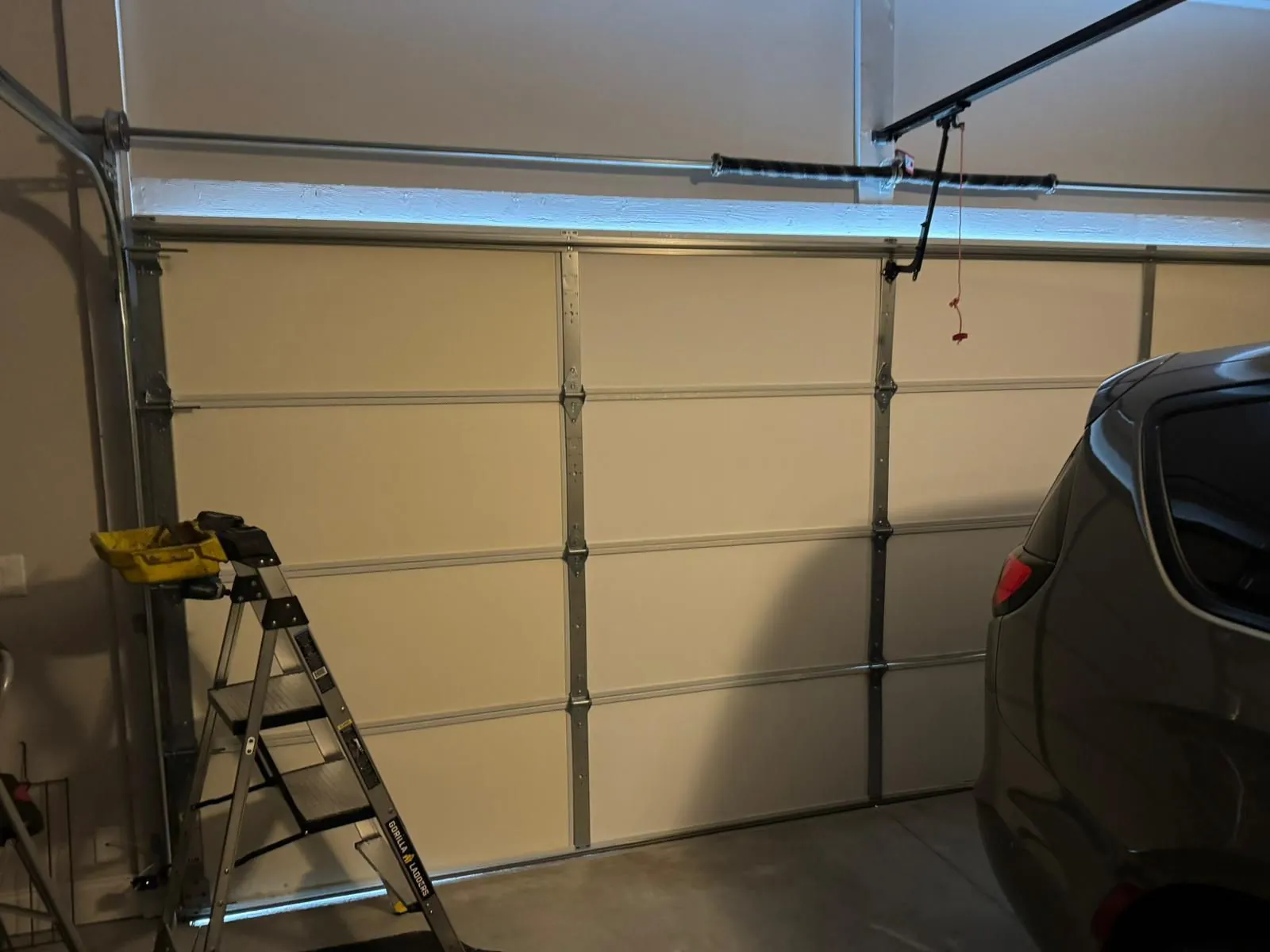
Springs, lift cables and the brackets fixed to the door’s lower corners are under load whenever the door is closed or partly open. Leave them untouched. That includes tightening the set screws on a torsion spring or rehooking an extension spring: both look simple and both can cause serious injury. That dangling red release cord is best ignored while the door hangs half open. With weak springs, the door may fall the moment the opener lets go.
The common causes, and the repair for each
A weak or broken spring. Springs lose some of their pull over the years. When they do, the door feels heavier, and the opener starts stopping short to protect itself. A spring that has broken outright usually leaves the door barely moving at all. Spring repair replaces torsion and extension springs and balances the door so the opener is carrying only what it should.
A fraying or slipped cable. When a cable slips on one drum, that side of the door lifts more slowly and the door jams on the way up. Cable repair replaces snapped and frayed cables and resets them on their drums.
A track or roller problem. Rollers that have worn flat, cracked, or seized with rust drag instead of turning, and a bent track narrows the path. Off-track repair covers bent tracks, broken rollers and realigning the door.
An opener setting or fault. Wrong travel limits, a sensitivity setting that is too tight, or a worn drive can each stop the door early. Opener repair deals with these, including on LiftMaster openers.
The Greater Boston angle
Winter is when this complaint peaks. A door that only reached three quarters of the way up in autumn may stop at half height once the cold sets in, because the spring is giving a little less and the stiff grease is taking a little more.
On the coast, rust speeds things up. Garages in Winthrop, Revere and Marblehead breathe salt air every day, and that air settles on tracks, rollers and cable ends. A roller that seizes in a rusty track is a classic reason a garage door only opens partway, and the same corrosion weakens cables before they show it.
And in the city, a half-open door is more than a nuisance. Where the garage opens straight onto a tight drive or a shared lane, a door stuck at chest height blocks the car in, exposes the garage to anyone passing, and may block the neighbours too. If the door has also dropped out of a track, our off-track door guide explains what to watch for.
When it is time to call
Ring us whenever your garage door only opens partway while labouring, jerking, rising crooked or stopping at different heights, and whenever you can see a spring gap, a loose cable or a bent track. A door stuck open that leaves the garage unsecured is urgent; ring whatever the time, and read the emergency repair page for steps to take before the technician arrives. The broader garage door repair page covers panels, sections and anything else that turns up during the visit.
Questions about a door that stops halfway
My garage door only opens partway, then comes back down. Why?
The opener is detecting more resistance than it expects and reversing for safety. Most often that is a spring that has lost tension, a cable slipping on its drum, or a roller catching in the track.
Can I just lift it the rest of the way by hand?
Not if a spring or cable is the cause. A door with a weak spring can be much heavier than it looks, and it may drop when you let go. Leave it and call.
Is it the opener or the door?
If the door stops smoothly at the same height every time, look at the opener’s travel limit. If it stops at different heights, strains or jerks, the door itself is usually the problem.
Why is it worse in winter?
Cold stiffens grease on rollers and hinges and takes some pull out of an ageing spring, so the door gets heavier just as the opener has to work harder. Many partial-opening doors first show up in cold weather.
Should I turn up the force setting so it goes all the way?
No. Raising the force only hides the problem and makes the door less safe if it meets a person or a car. Fix the reason the door is heavy or binding instead.
Book the repair
If the simple checks have not explained it, or you can see something wrong with a spring, cable or track, call us or book online. Our line is answered overnight and on Sundays, so you need not sit up with an open garage until morning, and you will hear what has failed before any work starts. More door problems are explained on the blog.